

































































The measure garnered 47 votes in the Senate, with GOP Sen. Susan Collins joining with Democrats for the first time

Kevin Carter/Getty Images
The U.S. Capitol Building is seen at sunset on May 31, 2025 in Washington, DC.


 Add JewishInsider on Google
The Senate rejected for the sixth time an effort from Democrats to force the Trump administration to halt the war in Iran — with the vote once again falling largely along party lines.
The vote was the last before the conflict approaches the 60-day mark outlined in the War Powers Resolution of 1973, which requires the executive to seek congressional approval for continuing hostilities or draw down U.S. forces.
“After 60 days of war, it is long past time for Republicans to hold Donald Trump accountable,” Sen. Adam Schiff (D-CA) said in a statement released prior to the vote. “Some of my colleagues have indicated that the War Powers Act’s 60-day mark is the moment they may join our efforts to bring this war to its conclusion. That time has come.”
The latest resolution, sponsored by Schiff and Senate Minority Leader Chuck Schumer (D-NY), failed by a measure of 50-47. Sens. Jerry Moran (R-KS), Patty Murray (D-WA) and Tommy Tuberville (R-AL) did not vote.
Sens. John Fetterman (D-PA), Rand Paul (R-KY) and Susan Collins (R-ME) voted with the opposition party. This was the first time in which Collins sided with the Democrats on the war powers votes.
“As I have said since these hostilities with Iran began, the President’s authority as Commander-in-Chief is not without limits,” Collins said in a statement following the vote. “Further military action against Iran must have a clear mission, achievable goals, and a defined strategy for bringing the conflict to a close. I voted to end the continuation of these military hostilities at this time until such a case is made.”
Collins added that the 60-day war powers deadline is “not a suggestion; it is a requirement.”
Sen. Josh Hawley (R-MO) said he was not surprised by Collins, noting that “she has been saying the 60-day clock is significant for her.”
He added that for him: “We haven’t reached the 60 days. That’s why I voted the way I voted.” However, Hawley said that he wants “to see an end to the war.”
Senate Republicans have told Jewish Insider they expect the White House to abide by the law and provide notification of a 30-day extension to Congress, which is permitted to ensure a safe withdrawal. However, the administration has not yet indicated publicly whether it will seek that extension or continue offensive operations, and Defense Secretary Pete Hegseth claimed at a Senate Armed Services Committee hearing on Thursday that the 60-day clock was “paused” during the ongoing ceasefire.
As the deadline approaches, a growing rift is emerging among Senate Republicans over whether to support an Authorization of Use of Military Force.
“I would hope it wouldn’t come to that,” Hawley said of the White House potentially extending the conflict past the 60-day mark. “I think the administration has tried to remain within the statute.” Hawley has said that should the conflict extend past the deadline with no further action from the White House that he would debate an AUMF, but said he would prefer not to support authorizing a war he wants to see “wind down.”
Hawley said he would “welcome further communication from the White House.”
Sen. Todd Young (R-IN) also said he expects that the White House will “communicate” and “make a very strong legal argument.” He also noted that he believes the administration has “followed the War Powers Act provision so far in a very careful way.”
Young said that should an AUMF be necessary, he could see himself voting for a “properly structured authorization.”
“That’s been my position throughout this exercise,” Young said, referring to the recent slate of war powers votes. “My hope would be that if we went down that road, we’d work with the administration to draft a properly scoped authorization for the use of military force.”
Meanwhile, Sen. Mike Rounds (R-SD) said he is “not ready to commit to anything.”
“I want to make sure that we continue to get classified information on a timely basis from the Pentagon,” Rounds said. “I think today we had a very good classified setting with a lot of good information being provided. I think they [the White House] did a good job of sharing their point of view on it. So we’re moving in a good direction.”
Asked whether he believes anything would change at the 60-day deadline, Rounds replied: “I have no reason to believe that’s the case right now.”
Rounds said he believes a path forward between the U.S. and Iran will be “extremely difficult without regime change.”
“But that doesn’t mean that there isn’t hope for an agreement with this particular regime under very strict observations by outside forces to make sure that they adhere to any agreements we make,” Rounds added.
Sen. Tim Kaine (D-VA) said that while he thinks the current war is “unwise” and “illegal,” he said that if Congress “were to pass an AUMF in both houses it would stop being illegal.”
“I would stop critiquing it as an illegal war if they [Congress] passed an AUMF,” Kaine said.
Kaine said he expects that another war powers vote “will come up right after [Congress adjourns for] recess.”
“I think the testimony this morning shows they [the White House] know they got a 60-day problem,” Kaine said, referring to Hegseth’s remarks at the hearing.
Rounds, who serves on the Senate Armed Services committee, said that he would need to “go back and do a good review of that particular” remark.
“We’re in the middle of it,” Rounds said. “Once I have a chance to actually go through it myself then I’ll have a comfort level. I’m not going to disagree with him [Hegseth] at this stage.”
The two voted for the first time last week in favor of blocking some U.S. arms sales to Israel
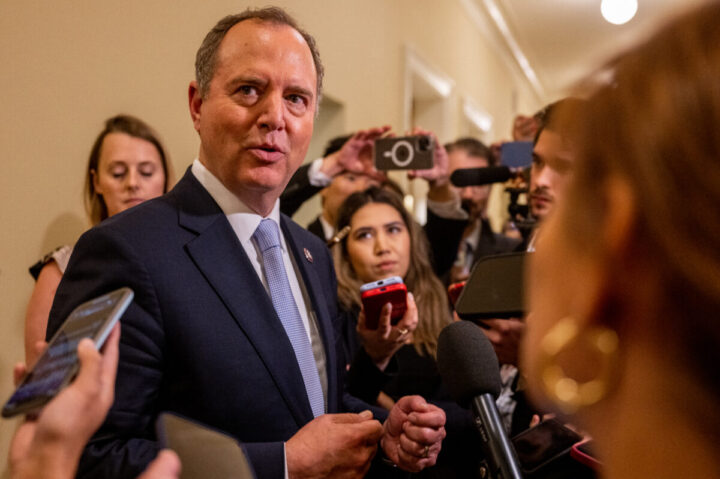
Brandon Bell/Getty Images
Rep. Adam Schiff (D-CA) speaks with reporters after closing remarks during the fifth hearing on the January 6th investigation in the Cannon House Office Building on June 23, 2022, in Washington, D.C.
Sens. Adam Schiff (D-CA) and Mark Kelly (D-AZ), who both voted for the first time last week in favor of blocking some U.S. arms sales to Israel, said that their future positions on such votes would be made on a case-by-case basis, determined by the specific sales in question and the circumstances surrounding the votes.
The two were somewhat surprising votes in favor of Sen. Bernie Sanders’ (I-VT) effort to block U.S. arms sales, having generally maintained pro-Israel records while in Congress.
“I was, and am, strongly opposed to the war in Iran, and I couldn’t justify voting against our own supplemental funding bills, which I plan to, and supporting funding for the same war in a JRD,” Schiff told Jewish Insider, referring to the Joint Resolutions of Disapproval to block specific arms sales to Israel. “I’ll evaluate each circumstance as they come.”
Kelly disputed the notion that his vote had flipped, saying, “I make these decisions based on what is the current situation, and what is the vote on — I don’t make these [decisions] in a vacuum.”
“This isn’t ‘yes’ or ‘no’ in any given moment, I’m always going to be looking out for Israel,” Kelly said. “And I think Israel is weaker, and the Israeli people are at further risk because of the current prime minister of Israel. He’s made a lot of mistakes, and he’s not operating in accordance with our values — but nor is our president. So I’ll look at every one of these [votes] based on what it is and what the current situation is.”
Asked whether his calculus would change if Israeli Prime Minister Benjamin Netanyahu were to lose the next election, he said that the decision is up to the Israeli people, “but I do not think Netanyahu has done Israel as a nation any favors.”
Every member of the caucus except Sen. John Fetterman said they want to ‘preserve the viability of a two-state solution’
Brandon Bell/Getty Images
Rep. Adam Schiff (D-CA) speaks with reporters after closing remarks during the fifth hearing on the January 6th investigation in the Cannon House Office Building on June 23, 2022, in Washington, D.C.
Every Senate Democrat with the exception of Sen. John Fetterman (D-PA) wrote to President Donald Trump on Tuesday urging him to “reinforce” the White House’s pledge to oppose Israeli annexation of the West Bank.
In a letter led by Sen. Adam Schiff (D-CA), the senators offered their “support for your comments opposing any efforts by the Government of Israel to annex territory in the West Bank and to urge your Administration to promote steps to preserve the viability of a two-state solution and the success of the Abraham Accords.”
The missive was sent weeks after Trump vowed publicly to not allow Israel to annex the West Bank, telling reporters in the Oval Office in late September that, “I will not allow Israel to annex the West Bank, nope, I will not allow it. It’s not gonna happen.”
“Since your plan for Gaza does not address the West Bank, it is imperative that your Administration reinforce your comments and emphasize its opposition to annexation. As longstanding supporters of Israel’s security and Palestinian aspirations for statehood, we are unified in our opposition to unilateral measures by either party that undermine the prospect of lasting peace through negotiations to achieve a two-state solution,” the letter stated.
The senators argued that “any steps by Israel to annex territory or expand settlements that prevent the establishment of a Palestinian state” would be harmful to the peace process.
“Such steps have elicited deep concern and opposition from Arab partners and place at risk your past achievements under the Abraham Accords and the possibility of expanding them further,” they wrote. “At the same time, terrorism, including the horrific terrorist attack of Oct. 7, 2023, must be uniformly condemned and will not bring the region closer to peace.”
“It is essential that the United States reject measures that undermine the viability of a negotiated resolution to the Israeli-Palestinian conflict,” the letter continued.
The senators said that aid should be surged to NGOs and multilateral organizations

Kevin Carter/Getty Images
U.S. Capitol Building on January 18, 2025 in Washington, DC.
A group of 40 Senate Democrats, nearly all of the caucus, wrote to administration officials on Tuesday raising concerns about the humanitarian situation in Gaza and calling for a significant expansion of aid, describing the Gaza Humanitarian Foundation as a failure.
The letter to Secretary of State Marco Rubio and Middle East envoy Steve Witkoff, led by Sens. Adam Schiff (D-CA), Brian Schatz (D-HI), Chuck Schumer (D-NY) and Jacky Rosen (D-NV), highlights the extent of the concern even among Democratic leaders and pro-Israel stalwarts.
“The acute humanitarian crisis in Gaza is … unsustainable and worsens by the day,” the lawmakers said. “Hunger and malnutrition are widespread, and, alarmingly, deaths due to starvation, especially among children, are increasing.”
The senators said that the Israeli- and American-backed GHF aid distribution system had “failed to address the deepening humanitarian crisis and contributed to an unacceptable and mounting civilian death toll around the organization’s sites.”
They argued that aid must be significantly expanded, including through “experienced multilateral bodies and NGOs that can get life-saving aid directly to those in need and prevent diversion.” Israel has argued that other aid distribution mechanisms, particularly those affiliated with the United Nations, have failed to effectively distribute aid and prevent Hamas diversion.
The letter further states that efforts to finalize a ceasefire in Gaza “are as critical and urgent as ever and we urge the resumption of good-faith talks as quickly as possible.” The administration walked away from talks with Hamas last week, saying that Hamas was not negotiating in good faith.
“There still remains a viable pathway to end this war, bring home Israeli hostages, and achieve a diplomatic resolution of the Israeli-Palestinian conflict,” the senators asserted.
They emphasized that the living hostages in Gaza “have suffered too long, as have their families” and that “it is imperative that those still living be brought home as soon as possible, before more perish as the war drags on.” They also noted the need to return the bodies of deceased hostages.
The Democrats also voiced “our strong opposition to the permanent forced displacement of the Palestinian people” from Gaza, as has been floated by some Israeli and American leaders, calling such an outcome “antithetical to international humanitarian law,” to the security of Israelis and Palestinians, to lasting peace and to the expansion of the Abraham Accords.
They urged the administration to clearly reject such a plan.
“Beyond a negotiated ceasefire, a permanent end to this war will also require an end to Hamas rule in Gaza and ensuring that Hamas can no longer pose a serious military threat to Israel,” the letter continues. “We reaffirm our strong support for continued U.S.-led diplomacy with Israel, Palestinian leaders, and other partners in the Middle East in pursuit of the long-term goal of a negotiated two-state solution with Israelis and Palestinians living side by side in lasting peace, security, dignity, and mutual recognition.”
The only Senate Democrats who did not sign the letter were Sen. John Fetterman (D-PA) — who has generally abstained from letters by other Democrats critical of Israel — as well as Sens. Andy Kim (D-NJ), Ed Markey (D-MA), Jeff Merkley (D-OR), Tina Smith (D-MN) and Elizabeth Warren (D-MA). Sen. Bernie Sanders (I-VT) also did not sign.
It follows a letter earlier this week from 21 progressive Senate Democrats that more strongly condemned the GHF, describing it as a “private group supported by U.S. security contractors and connected to deadly violence against starving people seeking food in Gaza” that “blur[s] the lines between delivery of aid and security operations.”
That letter called on the administration to “immediately cease all U.S. funding for GHF and resume support for the existing UN-led aid coordination mechanisms with enhanced oversight to ensure that humanitarian aid reaches civilians in need.”
The progressive lawmakers said that the GHF system is insufficient to replace the United Nations aid network and that it is facilitating efforts to displace Palestinians and depopulate Gaza, as well as highlighted incidents in which aid recipients were allegedly attacked at distribution sites.
The lawmakers said the administration had dodged legal and vetting requirements in its provision of aid to the GHF. They also argued that the American military contractors employed to guard the GHF sites are at risk from both Hamas and anti-Hamas militia forces in Gaza.
Sens. Adam Schiff, Andy Kim and Tim Kaine announced plans to introduce an amendment to ensure that the U.S. can continue to share intelligence with Israel and to assist Israel’s defense

Drew Angerer/Getty Images
Sen. Tim Kaine (D-VA) speaks to reporters on his way to a classified all-Senate briefing.
A Senate war powers resolution aiming to block further U.S. military action against Iran appears to be building and solidifying support among Democrats ahead of an anticipated vote later this week.
Sens. Adam Schiff (D-CA), Andy Kim (D-NJ) and Tim Kaine (D-VA) announced on Tuesday they planned to introduce an amendment to Kaine’s resolution to specifically ensure that the U.S. can continue to share intelligence with Israel and to assist Israel’s defense and provide it with defensive equipment to counter attacks by Iran and its proxies.
A House resolution on the issue had prompted private divisions among Democrats earlier this week over a similar issue, with many lawmakers concerned that the resolution would prevent the U.S. from continuing to support Israeli missile defense, a Democratic staffer not authorized to speak publicly told JI.
The senators said in a statement they expect the full Senate will vote on the amendment prior to a final vote on Kaine’s resolution. They argued that the amendment makes clear to Iran that the U.S. will continue to defend Israel.
Kaine said that the ceasefire between the U.S. and Iran announced Monday night doesn’t change the necessity of the vote, and “actually gives you the space to actually have a decision about, prospectively, should we be at war with Iran without a vote of Congress.”
Asked by Jewish Insider whether he still anticipates that most or all other Democrats will still support the resolution, Kaine said, “They believe we should not be at war without a vote of Congress. They may have different points where a war would be the right thing to do, but that should not happen without a vote of Congress.”
He said he still expects to have multiple Republicans supporting the resolution, but the number is unknown. Only Sen. Rand Paul (R-KY) has publicly voiced support.
Sen. Mark Kelly (D-AZ), asked about the resolution, said that there was not a “clear and imminent threat to the United States, to our citizens” and the administration “should have come to us and talked about this,” as it did prior to Operation Desert Storm, in which he served.
“You’ve got a goal, you talk to Congress about it. You get the force ready to do this. You talk to the adversary and you say, ‘Here are our options: Get out of Kuwait or we’re going to kick you out,’” Kelly said. “That occurred with a full, transparent discussion with the United States Congress, per the Constitution.”
Kelly reviewed a classified Defense Intelligence Agency assessment indicating the U.S. strikes had a limited effect on Iran’s nuclear program, and said that the situation shows the “recklessness of just rushing forward when you don’t have the follow-on plan, and you don’t really consider the consequence.”
He said the strikes were risky because Iran may now take its program completely covert and race to a nuclear weapon. “This has been my concern since the second this happened. Does this push them forward?” Kelly said.
Sen. John Hickenlooper (D-CO) said he hadn’t looked at the resolution but said “it seems like we had lots of time to be consulted.”
Sen. Elissa Slotkin (D-MI) said she’s still examining the resolution but emphasized that she led legislation in 2020 to block military action against Iran following the killing of Quds Force head Gen. Qassem Soleimani.
Sen. Ted Cruz (R-TX) on Tuesday proposed another amendment to Kaine’s resolution, commending President Donald Trump for a “successful mission” in damaging the regime’s nuclear program.
The lawmakers said Trump is ‘using what is a real crisis as a pretext to attack people and institutions who do not agree with [him]’

Kevin Dietsch/Getty Images
Senate Minority Leader Charles Schumer (D-NY) leaves a Senate briefing on China on February 15, 2023 in Washington, DC.
A group of Jewish Senate Democrats accused President Donald Trump of weaponizing antisemitism as a pretext to withhold funding from and punish colleges and universities, moves they said in a letter on Thursday “undermine the work of combating antisemitism” and ultimately make Jewish students “less safe.”
“We are extremely troubled and disturbed by your broad and extra-legal attacks against universities and higher education institutions as well as members of their communities, which seem to go far beyond combatting antisemitism, using what is a real crisis as a pretext to attack people and institutions who do not agree with you,” the lawmakers, including Senate Minority Leader Chuck Schumer (D-NY), antisemitism task force co-chair Sen. Jacky Rosen (D-NV) and Sens. Richard Blumenthal (D-CT), Adam Schiff (D-CA) and Brian Schatz (D-HI) wrote to the president.
“It has become abundantly clear that for this administration, the stated goal of fighting antisemitism — which is needed now more than ever, and for which we stand ready to work in a bipartisan way on real solution — is simply a means to an end to attack our nation’s universities and public schools and their ability to function as multifaceted and vital institutions of higher learning and to protect free speech and the civil liberties of their students and employees,” they continued.
The letter points to Trump’s attacks on Harvard University, including the freezing of billions of dollars in funding and threats to revoke its tax-exempt status, as the most prominent examples of the administration’s efforts, which they say “go far beyond constructive and necessary efforts” to support Jewish students.
They said the administration instead appears to be trying to change “the way the university functions” and impose significant penalties “in ways wholly unrelated to combating antisemitism.” The lawmakers instead accused Trump of trying to undermine or destroy these colleges under the “guise” of antisemitism.
“We strongly support efforts to ensure universities uphold their duty to protect students from unlawful discrimination and harassment, but we reject your administration’s policies of defunding and punishing universities out of spite, as they actually undermine the work of combating antisemitism,” the letter continues, “ultimately only making Jews less safe by pitting Jewish safety against other communities and undermining the freedoms and democratic norms that have allowed Jewish communities, and so many others, to thrive in the United States.”
The letter poses a series of questions to the administration, requesting answers by the end of April, including how the administration has chosen the institutions it has targeted, the specific charges made against Harvard, how the “totally disproportionate” penalties are being assessed, how the administration is deciding what funding to cut and what its legal basis is for threatening Harvard’s tax-exempt status.
The lawmakers particularly raised concerns about the impact of cuts to medical research funding, which they say will affect all students, including Jewish students, and why Harvard’s medical school has been targeted.
They also asked why the administration has significantly cut funding and resources for the Department of Education’s Office for Civil rights and how it plans to work with schools to implement reforms and protections for Jewish students going forward, in light of those cuts.
The letter further asks whether the administration has consulted “a broad range” of Jewish students and organizations on remedies for antisemitism and how it will ensure that funding cuts don’t hurt Jewish students or those uninvolved in or victimized by antisemitic activity.
They additionally inquired about the revocation of visas of foreign students and deportation proceedings and whether such actions are being taken based “solely on their expressed views and speech, which the administration has identified as antisemitic.” They asked whether the administration believes that the First Amendment applies to non-citizens and whether any deported or detained students have been charged with any crimes.
Please log in if you already have a subscription, or subscribe to access the latest updates.
 Continue with Google
 Continue with Apple