





















































‘I fear Israel will fall back in love with quiet’: Yaakov Katz warns against complacency after Gaza war
The journalist talked to JI about his new book, While Israel Slept, describing the failures leading up to the Oct. 7 attacks and what Israel can do to ensure they don’t happen again
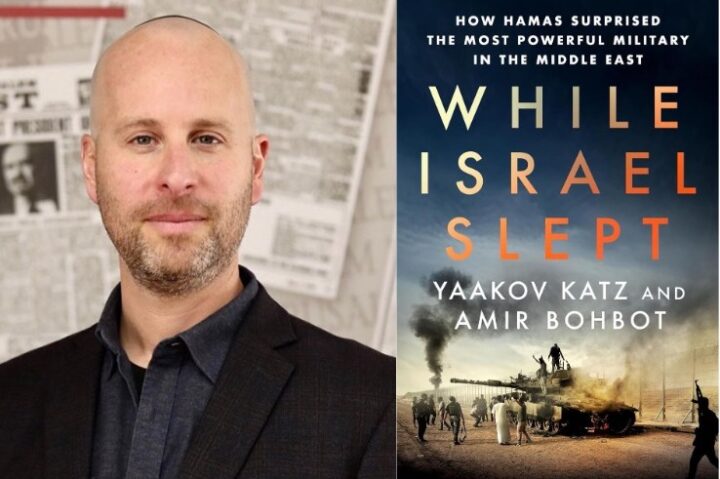
Courtesy
Yaakov Katz/book cover


 Add JewishInsider on Google
In the two years since the Oct. 7, 2023, attacks on Israel, there have been many books in multiple languages published on the topic — personal accounts, tales of heroism, a hostage memoir — but While Israel Slept: How Hamas Surprised the Most Powerful Military in the Middle East by Yaakov Katz and Amir Bohbot may be the most comprehensive.
In the book, Katz, the founder of the MEAD (Middle East-America Dialogue) and former editor-in-chief of The Jerusalem Post, and Bohbot, a veteran Israeli defense reporter, answer the biggest questions about that day, going through the events leading up to the attacks, including the fateful night before.
The book also dedicates chapters to stark warnings that an Oct. 7-style attack could happen again if Israel does not make necessary changes.
In an interview with Jewish Insider’s Lahav Harkov and Asher Fredman, the executive director of the Misgav Institute for National Security and Zionist Strategy, on the “Misgav Mideast Horizons” podcast last week, Katz said that his “deepest fear is that this could happen again.”
“Eventually, quiet will set in,” Katz said. “And I fear that Israel will fall back in love with the quiet and will neglect, to some extent, the vigilance that it will require to prevent Hamas from being able to … reconstitute itself.”
While Katz said he is skeptical Hamas could again launch attacks at the scale of Oct. 7, “to prevent them from rebuilding and reconstituting … will require a major effort that Israel has never really done.”
“Israel fought wars, we walked away and threw away the key, but we’ve never maintained the success … [except] in the West Bank, after Operation Defensive Shield in 2002. … Israel created operational freedom, and then it retained the operational freedom, so in the almost 24 years since, Israel goes in and out of the West Bank as it sees fit,” he said.
Katz noted that Israeli Prime Minister Benjamin Netanyahu has talked about creating a similar situation in Gaza.
“The proof will be in the pudding … If [the IDF] doesn’t do that and just says, ‘We’ll jot down the target, we’ll build up the target bank,’ that’s falling right back into the trap that led to Oct. 7,” he stated.
The IDF has also made structural changes to how it gathers intelligence, Katz said, and there is more coordination between intelligence bodies than before and a better flow of information to the decision-makers.
“I think there’s more vigilance today by the IDF in the way it watches the borders along Israel,” he said. “That preemptive policy, if you see just a rocket being moved or you see a bad guy driving in a car or you see a tunnel being dug — we’re now applying it very much in Lebanon … Israel continues to operate pretty freely in Lebanon. This is part of that new policy. I think that in the aftermath of however this war does end, that will be integral to keep Hamas from reconstituting itself in a way that it could pose another major strategic threat to Israel.”
While Israel Slept is meant to provide “a look at the entirety of what happened,” Katz said.
“What were the different alarm bells that we now know were sounding … in IDF headquarters and Shin Bet headquarters? What were the earlier signs that we know about?” Katz said. “How did Israel fall into a state of complacency? … How was the policy of containment created?”
Katz said both former Israeli Prime Minister Ehud Olmert and Netanyahu should have “refuse[d] to accept a reality that a genocidal terrorist group is living alongside our border.”
“If you look at the way Israel approached Hamas and approached Gaza, it was as if we’re stuck,” he said. “We don’t have an alternative … [to] this game of whack-a-mole every two years or so, where we hit them on the head.”
Israel viewed Hamas as “the bottom of the totem pole” of threats, far below Iran and Hezbollah, Katz said.
Another entrenched — and incorrect — belief in Israel’s political and military establishments was that helping Gaza economically would make Hamas less likely to attack Israel, Katz argued.
“When Naftali Bennett became prime minister in the summer of 2021, he was announcing to the whole world with great pride how he allowed in 10,000 [Gazan] workers” to Israel, said Katz, who was an advisor to Bennett from 2013-2016. “We now know that during his period as prime minister, they were preparing for this invasion and he just got lucky that it didn’t happen on his watch.”
In addition, Katz said that Israel’s general defense doctrine was not to launch preemptive wars in response to conventional military buildups, pointing to Hezbollah’s amassment of 150,000 missiles.
“That has changed,” he said. “The issue of preemption now seems like it’s setting in as the new policy for Israel, which is … the only way forward.”
Katz is also the author of Weapons Wizards, about Israel’s defense industry, and had been working on a follow-up book before Oct. 7. He now views the Israeli military’s reliance on technology as part of what allowed it to remain complacent for so long.
One such kind of technology was defensive. With the Iron Dome, Israel “was able to swat missiles out of the sky like they were mosquitoes. It made it seem like the missile threat is nothing … not a strategic threat.”
When Hamas fighters crossed into Israel via tunnels during 2014’s Operation Protective Edge, Israel sought to address that problem with technology as well, building a border fence with a deep underground element.
“They put these teams of the smartest soldiers and scientists together with sonar experts, seismic experts, geologists … They come up with a system that can detect where a tunnel is being dug, when it’s being dug. They’re so sensitive that they can tell what tool is being used to dig the tunnel: a jackhammer, a shovel, a bulldozer,” Katz said.
“How many people crossed into Israel on Oct. 7 in a tunnel? Zero.” he added. “They blew about 60 different points of entry in the border [fence] and that’s where they came in. … The technology created a false sense of security that we are impenetrable.”
Israel was also overreliant on intelligence technology, Katz said.
“There were hundreds of Hamas [terrorists] in the initial wave [into Israel on Oct. 7] and there wasn’t a single one who could call up his Israeli handler and say, ‘We’re coming,’” Katz said. “We had no agents or informants on the ground in Gaza. We thought we knew everything by listening to them, by watching them. We had neglected the basics of intelligence collection, which is human intelligence.”
Katz said the IDF and Shin Bet have invested in building up greater resources on that front since Oct. 7.
“Contrast Gaza with Lebanon, with the amazing pager attack, with what Israel did in Iran, taking out nuclear scientists and the top military leadership. You see that when Israel allocates the resources, the attention and the focus, it can do incredible things,” he said.
Katz also spoke out against the “huge distraction” of the government’s planned judicial reform that consumed the country in 2023, as well as the outsized public protests against it.
“The right will say that the left and the protesters, and especially those who were the reservists who threatened to not follow orders … weakened the military and the left, or the anti-judicial reform protesters would say the government, in its refusal to stop … and be willing to understand that dividing ourselves made us vulnerable, made us exposed. However you look at it, in the end, the responsibility is upon the government,” he said.
When Israel Slept includes several stories of senior defense officials warning the government that the deep divisions in Israel posed a security threat and Israel’s enemies would take advantage of the discord; though, Katz noted, no one specifically warned that Hamas was planning an invasion.
Katz said the weakening effect on Israel by the extremely tense political atmosphere should have been obvious to the country’s leaders: “We’re at each other’s throats. We’re ripping ourselves apart on the streets. … If we saw this division on the streets of Tehran or Damascus, would we not try to fan the flames just a bit to achieve our objectives in those countries and among our adversaries? Why would we think they would not do the same to us?”
In addition, Katz said, Hamas chose to launch its attack in October 2023 because Israel-Saudi normalization talks seemed to be coming to fruition, and because Hamas leader Yahya Sinwar believed “the alliance between Israel and the U.S. had been weakened and that the Americans under then-President [Joe] Biden would not stand with Israel. … He was wrong.”
In general, though, Katz pointed out, “they’re a genocidal terrorist group. They don’t need an excuse to want to kill us and attack us. It’s something they wake up to every single day. Terrorists like Hamas and Islamic Jihad seek our destruction.”
Hamas’ understanding of the Israeli psyche went beyond taking advantage of the divisions of early 2023, and was a part of its hostage-taking strategy.
“From day one … I could have said, ‘We’re going to win this war, because we’re going to bring down Hamas … but the hostages, we won’t get them back.’ And you would have looked at me and said ‘You’re crazy, that’s not a victory.’ And I could have said the opposite, we’ll win the war because we get the hostages back, but Hamas will remain in power, and you also would have said, legitimately, ‘What are you talking about? That’s not victory,’” Katz said.
“If there weren’t hostages, the war would have ended much earlier,” he said. “Part of this is because we the Israeli people — and I think this is something that the world does not recognize — are still very much hurting, are still very much in our trauma. And as long as the hostages remain in Gaza … the Israeli people will not be able to recover, rehabilitate and heal, and this will make this conflict, unfortunately, continue.”
More Stories
diplomats declared
Israel approves new consuls-general in San Francisco, Houston

LAYING DOWN THE LAW
Trump: ‘Final documents are being drawn’ to designate Muslim Brotherhood as terrorist group
HEZBOLLAH HIT
Israel kills Hezbollah chief of staff in Beirut airstrike

TEXAS TALK
Two Republicans condemned by Jewish groups looking to make comebacks in Texas

MICHIGAN MOVES
Haley Stevens maintains support for Israel as her primary rivals battle over anti-Israel lane