



















































Under pressure at home and abroad, Netanyahu to meet Trump for Gaza talks
If Hamas does not agree to the plan, it would still call for Israel to withdraw from parts of Gaza where Hamas is out of power and for an international stabilization force to take over

SAUL LOEB/AFP via Getty Images
President Donald Trump shakes hands with Israeli Prime Minister Benjamin Netanyahu during a meeting in the Oval Office of the White House in Washington, DC, on April 7, 2025.


 Add JewishInsider on Google
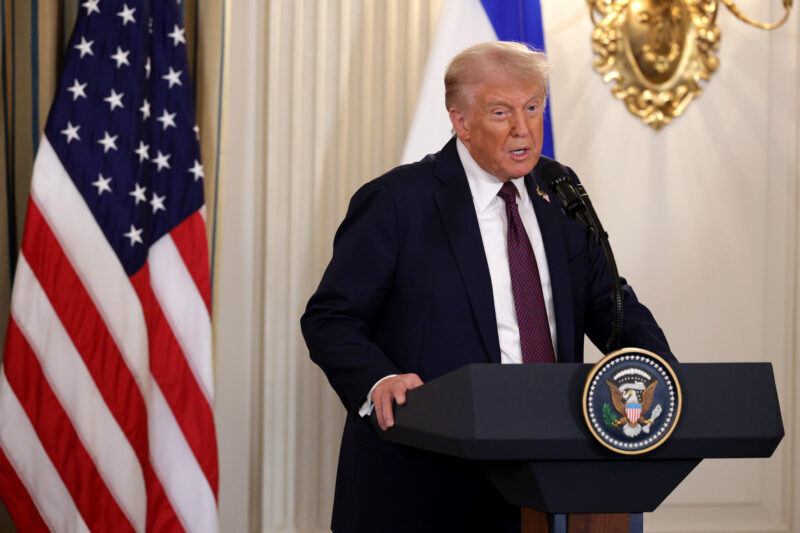
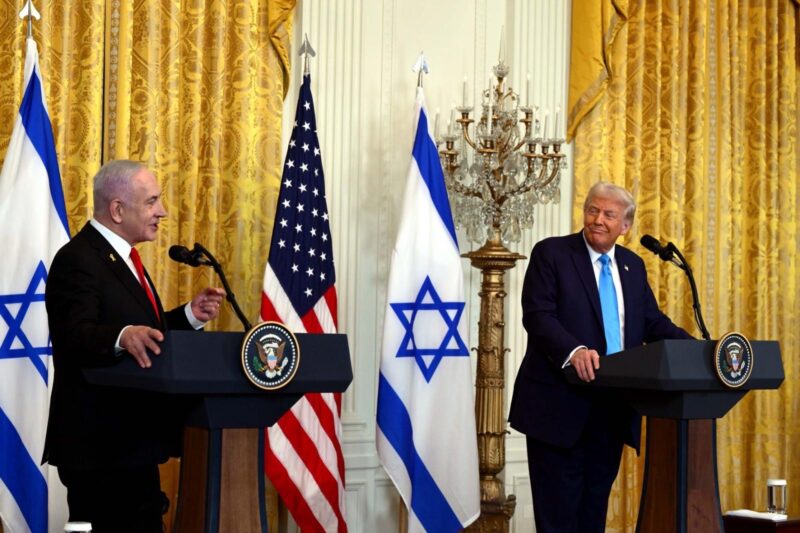
As Israeli Prime Minister Benjamin Netanyahu heads into his meeting with President Donald Trump today, the key question is what kind of Gaza ceasefire plan he will agree to — and how Hamas will respond.
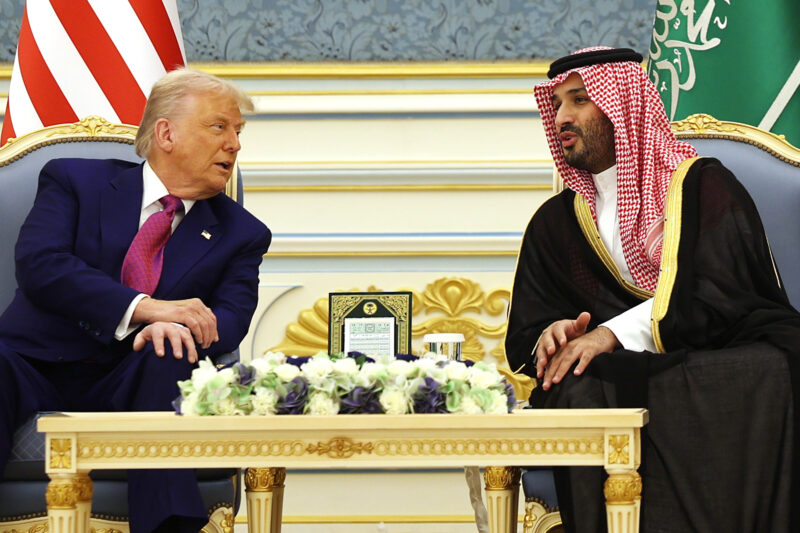
“We have a real chance for GREATNESS IN THE MIDDLE EAST,” Trump posted on Truth Social on Sunday, ahead of his meeting with Netanyahu. “ALL ARE ON BOARD FOR SOMETHING SPECIAL, FIRST TIME EVER. WE WILL GET IT DONE!!! President DJT.”
Netanyahu was more circumspect. “I hope we can make it a go because we want to free our hostages,” he told Fox News on Sunday.
“He won’t say no to Trump,” a source in the prime minister’s delegation said. But what Netanyahu has been saying is something like, “yes, but.”
While Trump clearly would like to make a big announcement at the end of Netanyahu’s White House meeting, having repeatedly said in public that the war will soon end, he has left out the specifics.
A version of the plan that Trump shared with Arab leaders has leaked, but the administration has not made it public or talked much about specific goals beyond ending the war and freeing the hostages. Trump’s Middle East Envoy Steve Witkoff and Jared Kushner, who held Witkoff’s role in the first Trump administration, met with Netanyahu twice in New York and again in Washington, quietly working out the details.
Among the elements of the plan Trump shared with a group of Arab countries at the U.N. General Assembly last week, are that the war would end and Hamas would release the 48 remaining hostages, 20 of whom are thought to be alive, within 48 hours of the ceasefire taking effect. In exchange, Israel would release over 1,000 Palestinian prisoners, including hundreds serving life sentences for serious acts of terror. Israel would not occupy or annex Gaza, and would gradually withdraw from territory.
If Hamas does not agree to the plan, it would still call for Israel to withdraw from parts of Gaza where Hamas is out of power and for an international stabilization force to take over.
Gaza would be deradicalized and demilitarized, and redeveloped, with a surge of aid entering the area. At first, Gaza would be administered by Palestinian technocrats supervised by a U.S.-backed international body with Arab and European countries taking part. This administration is meant to continue until reforms are completed in the Palestinian Authority.
Ultimately, the plan states, it may create the conditions for a pathway to Palestinian statehood, and the U.S. would facilitate a dialogue between Israel and the Palestinians.
The plan also marks a major shift in Trump administration policy. While the president said in February that all residents should leave Gaza, which would then be turned into a “Riviera,” it now says that Gazans would be encouraged to stay and build their future.
The plan contradicts Israel’s conditions to end the war in a number of ways, including that Israel retain a military presence along Gaza’s periphery, security control of Gaza and be allowed to strike anytime it sees terror rearing its head again.
Netanyahu also made clear in his speech to the UNGA on Friday that a Palestinian state is not acceptable to Israel, saying that “giving the Palestinians a state one mile from Jerusalem after Oct. 7 is like giving Al-Qaida a state one mile from New York City after Sept. 11. This is sheer madness. It’s insane, and we won’t do it.” He said in the interview on Fox News on Sunday that he was skeptical the PA could undergo such a “tremendous transformation.”
At home, Netanyahu faces pressure in both directions. Coalition partners like National Security Minister Itamar Ben-Gvir, who said Netanyahu has “no mandate to end the war without defeating Hamas,” and Finance Minister Bezalel Smotrich who publicly stated his red lines on Monday, including full Israeli security control of Gaza, a permanent IDF presence along Gaza’s perimeter and no Qatari or PA involvement. Others on the right say that the plan gives too much to the Palestinians without demanding enough in return. A delegation of West Bank mayors flew to the U.S. over the weekend to try to talk Netanyahu into insisting on annexation.
Yet, at the same time, some in Likud have been quietly urging Netanyahu to accept the broader strokes of the plan — the return of the hostages and demilitarization of Gaza – to bring about the end of the war. Foreign Minister Gideon Sa’ar said he trusts Netanyahu “to represent Israel’s interests as needed in talks with President Trump.”
While Netanyahu may be facing pressure from Trump to return to Israel with a ceasefire plan to enact, the quiet diplomacy — at least by Trump administration standards — indicates that they may give him some time and space to decide.
Yet there is another deadline ahead. Between all of the sports, culture, arms and other boycotts, there is a far more consequential threat emerging: the potential suspension of free trade between Israel and the EU, its largest trading partner, until at least 2027, which could send Israel’s economy into a tailspin.
The European Commission is set to vote on the matter on Oct. 20, and it requires a qualified majority to pass. Germany, Italy, the Czech Republic and Hungary are on Israel’s side, but whether that will be enough remains to be seen. A ceasefire agreement could put a stop to Brussels’ initiative.
And lest we forget, there’s the likelihood that Hamas will reject the plan. While there are elements of it that could go forward without Hamas’ acquiescence, for Israel freeing the hostages is a necessary condition for the reconstruction of Gaza.
More Stories

diplomats declared
Israel approves new consuls-general in San Francisco, Houston

LAYING DOWN THE LAW
Trump: ‘Final documents are being drawn’ to designate Muslim Brotherhood as terrorist group

HEZBOLLAH HIT
Israel kills Hezbollah chief of staff in Beirut airstrike

TEXAS TALK
Two Republicans condemned by Jewish groups looking to make comebacks in Texas

MICHIGAN MOVES
Haley Stevens maintains support for Israel as her primary rivals battle over anti-Israel lane