




























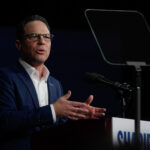

The Jewish civil rights group pointed to $737 million in Qatari funding and communications showing Qatar Foundation officials trying to shape Northwestern's post-Oct. 7 messaging

Bonnie Jo Mount/The Washington Post via Getty Images
Students cross a sky bridge in the temporary campus of Northwestern University in Qater on the Education City campus in Doha, Qatar, on November 2, 2015.


 Add JewishInsider on Google
A leading Jewish civil rights group is urging Attorney General Todd Blanche and the Justice Department’s Foreign Agents Registration Act Unit to investigate whether Northwestern University’s longstanding ties to Qatar violate FARA, Jewish Insider has learned.
In a letter sent to Blanche on Wednesday, the Louis D. Brandeis Center for Human Rights Under Law cited $737 million the government-run Qatar Foundation has sent to Northwestern in connection with the school’s Doha campus, arguing the relationship extends beyond ordinary academic activity.
The Brandeis Center asserts that “officials of Northwestern, acting in their official capacity using university resources, have acted for and on behalf of Qatar.”
The group points to communications uncovered by the House Committee on Education and Workforce showing Qatar Foundation officials pushing to shape Northwestern’s response to Hamas’ Oct. 7, 2023, terror attacks — including talking points sent to the dean of Northwestern Qatar, two weeks after the attack, on Qatar’s “diplomatic role and mediation efforts in Palestine/Gaza.”
Northwestern’s Qatar campus (NU-Q) opened in 2008, and has since faced scrutiny for faculty ties to Hamas. The NU-Q contract states that students, faculty and staff are subject to “applicable laws and regulations of the State of Qatar” including cultural, religious and social customs.
The contract is set to expire at the end of the 2027–2028 academic year. In an interview published in May with The Daily Northwestern, the university’s student newspaper, then-President Henry Bienen said the NU-Q review process to potentially renew the relationship is “ongoing” and would be left up to the university’s new leadership. Mung Chiang, who assumed the role of university president on July 1, has not publicly stated how he plans to address NU-Q and shape the long-term trajectories of both the Doha and Evanston, Ill., campuses.
“When a foreign government funnels hundreds of millions of dollars into one of America’s most prestigious universities and then seeks to shape the school’s actions and messaging, the public has a right to know the full extent of that relationship,” said Kenneth Marcus, chairman and CEO of the Brandeis Center.
“We are urging the Department of Justice to investigate Northwestern’s relationship with Qatar and determine whether the university has been acting on behalf of a foreign government without the transparency federal law requires. Academic freedom and the civil rights of students, faculty members, and their families should never be beholden to the purse strings of a foreign government, especially one that has so openly sought to spread anti-Semitism and embolden extremism in the United States,” he said.
Qatar is the leading foreign funder of American higher education — as well as a major source of funding in K-12 classrooms. As of July, it had provided some $9 billion to elite universities including Northwestern, Cornell and Georgetown.
The move marks a major step in the White House’s efforts to dismantle the Education Department and significantly reduce or distribute its work
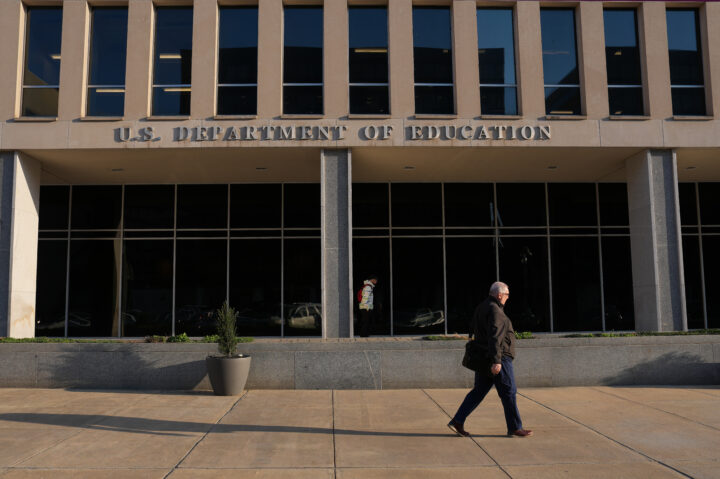
Win McNamee/Getty Images
A person walks past the U.S. Department of Education on March 20, 2025 in Washington, DC.
The Trump administration announced on Tuesday that it will transfer many of the responsibilities of the Education Department’s Office for Civil Rights, the division that investigates civil rights violations at American schools and universities, to the Justice Department.
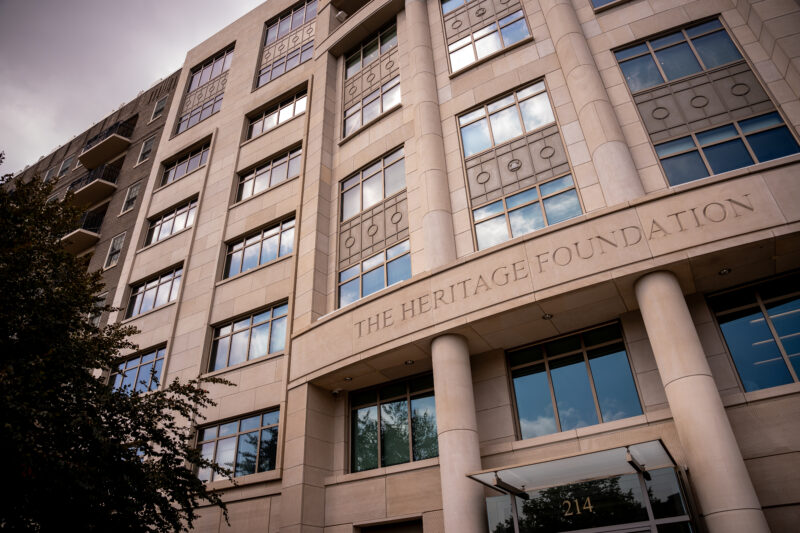
The move marks a major step in the White House’s efforts to dismantle the Education Department and significantly reduce or distribute its work. The policy was first discussed in the Heritage Foundation’s controversial Project 2025 blueprint for the Trump administration, which was released in April 2023 during the run-up to the 2024 presidential election.
“The Department of Education will also team up with the DOJ to ensure stronger, more coordinated civil rights enforcement and robust protections for student privacy,” Education Secretary Linda McMahon said in a statement on Tuesday. An Education Department press release said the new agreement is “designed to reduce federal bureaucracy and improve the efficient delivery of federally funded programs and activities.”
The formal agreement hands to the Justice Department’s Civil Rights Division the core of OCR’s work: investigating and attempting to resolve discrimination complaints against schools and universities. It leaves OCR with the authority to refer cases out and sign off on the results, but has DOJ handling nearly every aspect of the investigation.
OCR has been a crucial tool for Jewish students who experienced antisemitism on their campuses, particularly after the Oct. 7, 2023, attacks in Israel and over the course of the ensuing war. Through Title VI of the Civil Rights Act of 1964, the office’s remit includes complaints of discrimination on the basis of one’s national origin, a broad category that encompasses antisemitism. Jewish organizations have for years encouraged Jewish students and parents to file complaints with the agency.
Now the civil rights office’s mandate and scope — already diminished because of widespread layoffs at the department last year — will for the most part move to the Justice Department. It is not clear whether the OCR staffers will move to DOJ.
The move sparked criticism from the left and praise from more conservative voices.
Kenneth Marcus, the founder of the Louis D. Brandeis Center for Human Rights Under Law who ran OCR during President Donald Trump’s first term, called the move a “promising” step from the White House.
“Much will depend on implementation,” Marcus said in a statement. “But if done right, this could mark a critical step forward for students whose rights have gone unprotected on campuses across the country.”
An Education Department press release said the new agreement between the DOJ and OCR, which accompanied related agreements from DOJ and the Department of Health and Human Services, is “designed to reduce federal bureaucracy and improve the efficient delivery of federally funded programs and activities.”
Jewish Council for Public Affairs CEO Amy Spitalnick said that the push to move OCR to DOJ “is weakening one of the most effective mechanisms for protecting Jewish students and for enforcing civil rights protections on campus.”
Most Jewish organizations have so far not commented on the announcement.
Leo Terrell will chair the new advisory panel while embarking on a 15-city swing to engage Jewish communities and local officials on combating antisemitism

Win McNamee/Getty Images
Leo Terrell at an event in the East Room of the White House on February 20, 2025.
The Justice Department announced on Tuesday that Leo Terrell, senior counsel to the assistant attorney general for civil rights and chair of the Department of Justice’s antisemitism task force, will oversee the creation of the DOJ’s Antisemitism Advisory Committee. As part of the role, Terrell will embark on a 15-city nationwide tour to connect with local faith leaders and law enforcement officials about combating antisemitism.
The department described the panel in a press release on Tuesday as “a new advisory body” that will recommend strategies to the attorney general and other department leadership “on coordinated, timely, and effective responses to antisemitism.”
The committee “will consist of citizen leaders dedicated to combatting antisemitism” and individuals nominated to serve will be “subject to approval by the president,” the release said. (The task force, by contrast, is solely composed of DOJ officials.)
“Members will come from a wide range of backgrounds but share a common goal of developing innovative solutions to address antisemitism across the country,” the department said of the “forthcoming launch” of the panel.
Terrell told Jewish Insider in an interview late Tuesday that he had submitted a list of nominees to President Donald Trump after receiving the green light from acting Attorney General Todd Blanche to launch both initiatives and was awaiting approval from the White House.
The tour, described by the department in a second press release as a “National Awareness & Action Tour to combat antisemitism,” will involve Terrell meeting with “individuals and local communities impacted by antisemitism” and “working to identify practical solutions to combat antisemitism at the local level.”
“This national tour is an important step in ensuring communities across the country know the federal government stands ready to work with them to confront antisemitic threats, protect public safety, and uphold civil rights,” Blanche said in a statement.
Terrell has not determined yet if the tour will include public appearances to engage with Jewish leaders. His schedule is in the process of being finalized, and the senior DOJ official told JI he is open to extending the number of cities beyond the initial 15 stops on the agenda.
As for who he will meet during his travels, Terrell acknowledged that he did not expect to receive much engagement from many leading Democratic officials in major cities, such as New York City Mayor Zohran Mamdani, Chicago Mayor Brandon Johnson or Los Angeles Mayor Karen Bass. Instead, he said he hopes to engage directly with Jewish community stakeholders in these places and urge Jewish Americans to get involved in local elections.
“We’re talking about going to Jewish communities, first of all, to light a fire under them, but also to ask how we resolve these issues when sometimes you’ve got an absentee district attorney, with an absentee mayor, with an absentee school board, with an absentee school superintendent?” Terrell said. “Most importantly, there’s going to be a great emphasis on taking back these school districts and local prosecutor jobs in elections. There’s going to be a focus on putting pressure on some of these politicians in local cities in towns.”
He told JI that his primary objective with both initiatives is to determine what solutions the Trump administration can implement to combat domestic antisemitism on a federal level, as well as ascertain what the federal government should encourage state and local officials to do to address the problem closer to home.
“My position is that antisemitism is a local issue. What I mean by that is, we see the results of failures to address it at the local level — in the cities, in the school districts and areas like that,” Terrell said. “Not all of the solutions are in Washington. The solutions are in Los Angeles, Detroit, Chicago, San Francisco, in big cities, small cities, mid-sized cities in the South.”
“How do we get prosecutors in local cities to address antisemitic content that is being ignored and protected under the umbrella of free speech? How do we stop the curriculum problems that are developing in K-12 schools by teachers’ unions that support antisemitic misconduct?” he added. “How do we stop the issues caused by what I call the ‘Jewish tax,’ where Jewish citizens have to pay exorbitant security fees in order to worship or to have events? These are things that are happening at the local level.”
Terrell said he is “wide open” to considering ideas from Jewish leaders across the country about solutions to the domestic antisemitism scourge, arguing that he believed “out-of-the-box thinking” was required at this moment.
Terrell said that he viewed the success of the federal programs he hopes to enact over the remainder of the second Trump administration as a necessity, arguing that those initiatives yielding tangible results would make it difficult for a future president to shut down.
“With this advisory committee, we’re going to work on the problem of antisemitism. We’re not going to be just talking, having hearings and things of that sort. This is not an advisory council that’s going to write a report that collects dust. I’m not in for that, I’m in for finding working solutions,” Terrell told JI. “Recognizing the problem is one thing. What to do is another.”
“I think that’s going to be the task of the commission, because I believe guardrails need to be put up before this president’s term in office is over,” he continued. “The president, in my opinion, has been the best friend that the Jewish American community has had in the White House. He’s committed. My biggest concern from here at DOJ is getting some guardrails up so the next president or the next White House will continue these programs.”
The DOJ’s Board of Immigration Appeals rejected the Columbia University anti-Israel protest leader’s attempt to dismiss his deportation case

Andrew Lichtenstein/Corbis via Getty Images
Demonstrators hold a rally and march to the national ICE headquarters to protest the arrest of Mahmoud Khalil, April 5, 2025 in Washington, D.C.
The Justice Department’s Board of Immigration Appeals rejected Columbia University anti-Israel protest leader Mahmoud Khalil’s attempt to dismiss his deportation case on Thursday, his lawyers said.
Khalil called the ruling, which was widely expected and brings him closer to re-arrest and possible deportation, “biased and politically motivated.”
“The only thing I am guilty of is speaking out against the genocide in Palestine — and this administration has weaponized the immigration system to punish me for it,” Khalil said in a statement. The ruling has not yet been publicized by the DOJ.
Khalil was a key organizer of Columbia University’s anti-Israel encampment in April 2024, a two-week demonstration in the center of campus during Israel’s war in Gaza. The demonstration included several incidents of assault on Jewish students. Protesters used threatening and antisemitic slogans, including, “Go back to Poland”; signs with the Hamas symbol and the words “I’m with them”; and chants calling for Hamas attacks on Tel Aviv.
Khalil later described the Oct. 7 attacks as “a desperate attempt to tell the world that Palestinians are here. That was my interpretation of why Hamas did the Oct. 7 attacks on Israel,” he said in a New York Times interview.
Last month, while speaking at the annual South by Southwest festival in Austin, Texas, Khalil argued that “claims of antisemitism are being weaponized to silence any critique of the U.S. support to Israel.”
A former Columbia graduate student who grew up in Syria but is of Palestinian descent, Khalil was released in June from the Immigration and Customs Enforcement detention center in Louisiana, where he had been held for three months pending deportation proceedings. Judge Michael Farbiarz ruled that his prolonged detention likely violated his constitutional rights.
A federal appeals court then ruled in January that Khalil could be rearrested. In a 2-1 ruling, a panel from the U.S. Court of Appeals for the Third Circuit decided that the federal district court in New Jersey that issued Khalil’s release did not have jurisdiction over the matter and that it should have been handled in immigration court, which is part of the executive branch overseen by the Justice Department, meaning Khalil is now liable to be rearrested.
Eighteen-year legal fight over the Iran-tied Alavi Foundation ends with a new group with similar leadership taking over its assets — and NYC skyscraper
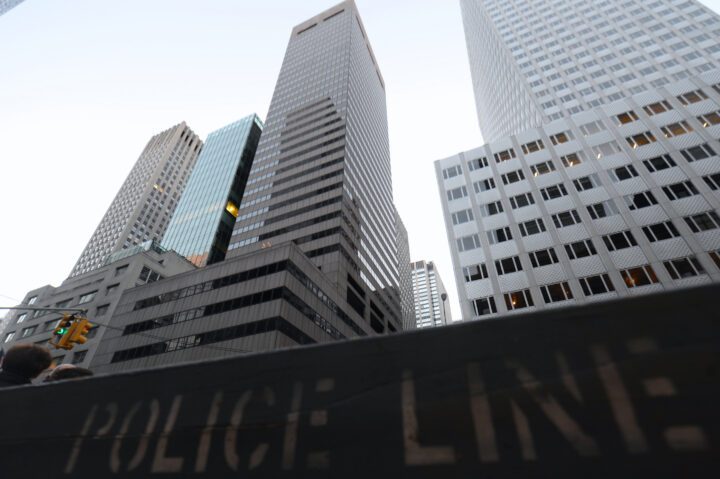
Cem Ozdel/Anadolu Agency/Getty Images
The 650 Fifth Avenue building, a 36-story office tower, located on 52nd Street near Rockefeller Center is seen on April 20, 2014 in New York City.
As tensions intensified between the U.S. and Iran amid the regime’s violent repression of protesters in January, and as Tehran vowed itself “prepared for war,” a long-running battle with the Islamic Republic’s forces in Manhattan came to an end.
The final stages of the conflict between the Justice Department and the New York-based Alavi Foundation, which since 2008 has faced allegations of acting under Iranian direction, took place in secrecy — with scores of legal documents sealed and even vaulted away.
But materials filed on Jan. 12 with the New York State Charities Bureau revealed its ultimate outcome: a settlement that will provide compensation for numerous American and Israeli victims of Tehran-backed terror, but also enable a successor organization to recoup control of the foundation’s vast assets, including its 36-story crown jewel skyscraper on Fifth Avenue.
The final deal — which a filing this month shows came together confidentially in the last days of the Biden administration, and has just begun to go into effect — will officially dismantle the Alavi Foundation and strip it of hundreds of millions of dollars. Formed as the Pahlavi Foundation in 1973 during its namesake shah’s reign, Alavi was later commandeered and rechristened by figures tied to the regime of the mullahs, and the federal government accused it of conspiring with an Iranian state-owned bank to evade taxes and sanctions.
The settlement of the suit brought by the federal government compels payouts totaling $318 million to the U.S. government and a wide array of people Iran and its proxies have harmed: in the 1983 bombing of the U.S. Marine barracks in Beirut, in the 1996 Khobar Towers attack in Saudi Arabia, in multiple 1990s and 2000s suicide attacks against Israel, in the torture and murder of an Iranian dissident, and in the 1990 assassination of Rabbi Meir Kahane.
In exchange, a new non-governmental organization, the Amir Kabir Foundation, will rise in Alavi’s place. Named for a historic Persian imperial administrator, the new group will take full possession of 650 Fifth Ave., appraised at $435 million, plus bank and investment accounts holding more than $87.6 million, and properties from Queens to California worth tens of millions more and home to various Shia religious and educational facilities.
Records show that the Amir Kabir Foundation shares Alavi’s old address and even its phone number, and that three of the five members of the Alavi Foundation’s board of directors are part of the new group’s six-person leadership team. This includes Dr. Hamid Yazdi, who has served as Alavi’s president since 2013, and whose name appears on registration paperwork for the Amir Kabir Foundation. Yazdi did not respond to requests for comment.
And although by-laws for the new group require it to remain “independent from any national or international agencies,” it will continue to provide funding and support for at least one longtime Alavi affiliate: the Qoba Foundation of Carmichael, Calif., which occupies an Alavi-owned property that the feds sought to seize in the early days of the case and which bears the name of a politically significant Iranian mosque.
The news that the Amir Kabir Foundation shared much of Alavi’s leadership team and would regain access to the huge rental revenues from 650 Fifth Avenue and the network of religious facilities lodged at the old organization’s properties alarmed longtime Iran-watchers.
“This is the Iranians playing anti-sanctions, anti-accountability three-card monte. They are treating the U.S. Department of Justice and the courts as if they are fools,” asserted Dr. Michael Rubin of the American Enterprise Institute. “Iran’s only concern is maintaining the property. It’s lucrative and, in theory, can help undermine U.S. security from within. If the CIA owned a skyscraper in Tehran, would they be so willing to give it up, or would they just shuffle the acronyms around and hope no one notices?”
The news also worried Lara Burns, head of terrorism research at George Washington University’s Program on Extremism. Burns highlighted her own contributions to a report that found Alavi-backed groups had promoted anti-American, pro-ayatollah extremist rhetoric, and noted the group’s history of violating sanctions, as documented in the federal case. She suggested “government fatigue” with the lengthy and expensive litigation process may have contributed to the federal decision to settle.
A former FBI agent, Burns further argued financial penalties like those in the settlement can at times serve effective “punitive and deterrent functions” — but not in this case.
“I do not believe restitution and fines serve either purpose in the case of Alavi Foundation, who has shown a willingness to continue its behavior at all costs and the fiscal ability to maintain that agenda,” she argued to Jewish Insider. “Allowing Alavi to obfuscate their identity and basically start with a clean slate creates risks related to a continued foreign influence campaign on behalf of a regime that has called for the death of U.S. leaders and who has blatantly stated its intent to cause America harm through a variety of nefarious activities.”
But Alavi’s longtime attorney, Daniel Ruzumna, maintained that the new foundation would in no way serve as an alter ego to the old. He noted that the Alavi Foundation’s board had completely turned over during the yearslong legal fight, and stated that all members of the Amir Kabir Foundation’s leadership had submitted to interviews with the federal government and received no objection.
Further, he pointed to language in the document filed in New York subjecting the Amir Kabir Foundation to a five-year term of oversight from the state Attorney General’s office, and said that it would operate under the “close supervision” of the Justice Department.
“AKF and its board members have no relationship to the Government of Iran, no connection to the Government of Iran, and have never been accused of having a relationship with Iran — zero, nothing,” Ruzumna said. “Any suggestion otherwise is categorically false.”
The office of the U.S. Attorney for the Southern District of New York, which handled the case, declined to comment for this story.
Follow the language to its most extreme end, and what emerges is undiluted antisemitism
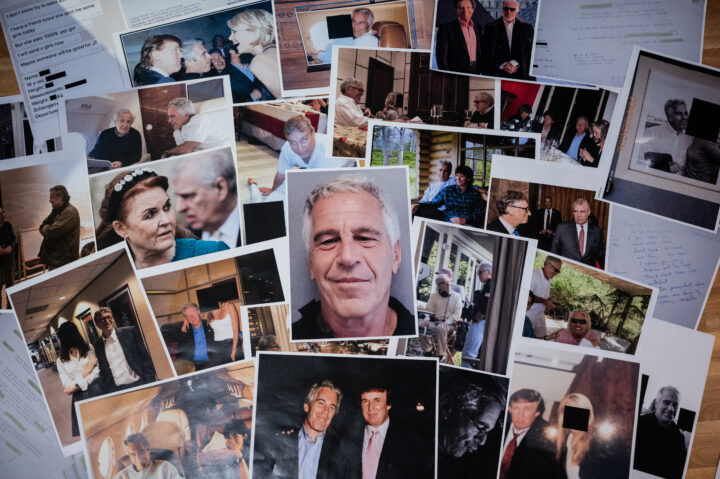
Martin BUREAU / AFP via Getty Images
This photograph taken in Le-Perreux-sur-Marne, outside Paris on February 9, 2026 shows undated pictures provided by the US Department of Justice on January 30, 2026 as part of the Jeffrey Epstein files.
Since late last year, when the Justice Department began releasing millions of documents from its investigation into Jeffrey Epstein, the well-connected financier and sex trafficker, each day seems to bring news of yet another luminary who had a relationship with Epstein. The fallout — high-profile resignations at prestigious employers including Goldman Sachs, the law firm Paul Weiss and Hyatt Hotels — is only just beginning.
The revelations of Epstein’s ties to elite power brokers on both the political left and right has contributed to a deepening conspiratorial mindset among the public, as people understandably question why influencers and titans of finance stayed in close touch with a man who had been convicted of sex crimes.
But the legitimate outrage at the powerful people who ignored and at times enabled Epstein’s crimes has spread beyond just those who appear in the chummy emails he exchanged with longtime Trump advisor Steve Bannon, former Harvard President Larry Summers, far-left linguist Noam Chomsky and many others. It has now, in some corners, bled into conspiratorial finger-pointing on issues that have nothing to do with the ethical concerns raised in the document dump.
Rep. Ro Khanna (D-CA), a Silicon Valley progressive, has begun referring to this hodgepodge of people as the “Epstein class.” But usage of the term is not precise. It’s an anti-elite message, and Khanna is applying it more widely than just the people with whom Epstein had a relationship.
“These people were at the Davos conferences together, they were financing the same politicians together,” Khanna said in a recent interview. “It’s all the same club. It’s a club. And they don’t want that club to be broken.”
Sen. Jon Ossoff (D-GA), who faces a competitive reelection campaign this year, invoked the phrase during a recent campaign rally, using “Epstein class” to refer to what he described as President Donald Trump’s wealthy, out-of-touch administration.
“We were told that MAGA was for working-class Americans. Remember that? But this is a government of, by and for the ultra-rich. It is the wealthiest Cabinet ever. This is the Epstein class, ruling our country,” Ossoff said.
“Epstein class” is a moniker that confers guilt by association: Lots of wealthy people were connected to Epstein, and perhaps those individuals’ associates are at fault for Epstein’s sins, even if they were not themselves in the files.
“This is about the Epstein class,” Rep. Thomas Massie (R-KY), an anti-Trump Republican who worked with Khanna on the legislation that forced the release of the files, said last week when asked about Trump’s efforts to unseat him in this year’s midterm election. “The people who are funding the attacks, they may or may not be implicated in these files. But they were certainly rubbing shoulders with the people who are in these files. They’re billionaires who are friends with these people.”
Others are taking the term outside of even any nominal connection to Epstein, using it instead as a catch-all to refer to global policymakers deemed out of touch with the masses. Matt Duss, who has served as a foreign policy advisor to far-left lawmakers Sen. Bernie Sanders (I-VT) and Rep. Alexandria Ocasio-Cortez (D-NY), accused the “Epstein class” of being warmongers seeking a confrontation between the U.S. and Iran.
“There is no popular support for war with Iran. It’s being entirely driven by the Epstein class. And once again, American workers will be stuck with the bill,” Duss said on X last week, in response to a Fox News clip of former U.N. Ambassador Nikki Haley calling for Trump to take a more hawkish approach to the Islamic Republic.
Never mind the fact that Haley does not appear in the Epstein files at all, except for in a couple news articles sent to Epstein by others. There is no evidence Haley ever met Epstein.
So what could “Epstein class” mean, then, but another euphemism for the shadowy group purportedly pulling the strings of foreign policy behind the scenes?
More radical voices have explicitly blamed the “Epstein class” for Israel’s actions in Gaza. Carrie Prejean Boller, a conservative activist and former member of the White House Religious Liberty Commission — who was removed from the body last week after her hostile questioning of Jewish witnesses at a hearing on antisemitism — had authored an Instagram post advancing this view.
“The politicians who refuse to condemn the Israeli government’s starvation and genocide on the Palestinians are the same ones unmoved by the Epstein crime files,” Prejean Boller wrote in a post that was also shared by Sameerah Munshi, a member of the commission’s advisory board. “Gaza was a precursor to the release of the Epstein files. Their goal: normalize and justify the torture and killing of innocent children … Arrest these monsters. Drain the evil swamp. End Palestinian genocide. Defund Israel.”
Follow the language to its most extreme end and what emerges is straightforward antisemitism.
“Yes, we are ruled by satanic pedophiles who work for Israel,” the far-right podcaster Candace Owens posted on X in reference to the Epstein files. “This is the synagogue of Satan we are up against.”
The assistant attorney general for civil rights said the DOJ will pursue those funding, training and supporting groups such as American Muslims for Palestine
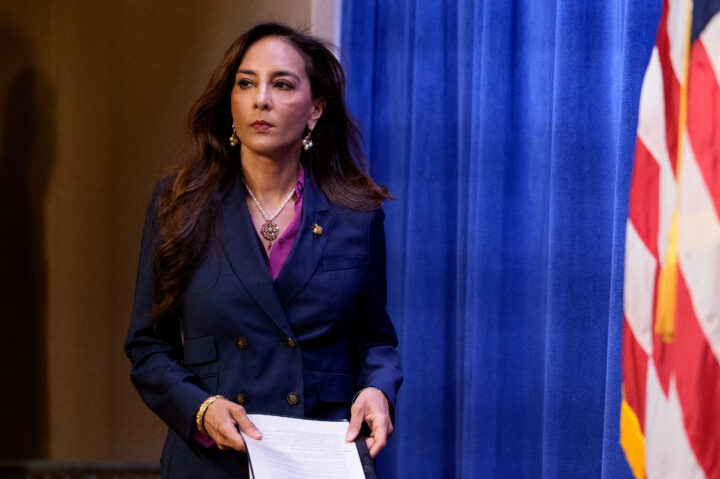
Andrew Harnik/Getty Images
Assistant Attorney General for Civil Rights Harmeet Dhillon arrives for a news conference at the Justice Department on September 29, 2025 in Washington, DC.
Harmeet Dhillon, the assistant attorney general for civil rights, said the Justice Department intends to pursue and ultimately shut down groups that have engaged in disruptive protests at synagogues and other antisemitic activities, as well as those supporting those groups.
“We are investigating, prosecuting, and we will bring these groups and these individuals to justice,” Dhillon said. “We intend to bring strong cases that dismantle these groups at their very root so that these unlawful attacks can be stopped once and for all.”
She said her division’s work includes pursuing those funding, training and supporting groups such as American Muslims for Palestine and the Party for Socialism and Liberation, which she said are engaging in “acts of domestic terrorism.”
Dhillon said that many of the groups behind antisemitic attacks are also involved in other activities, including “unlawful obstruction” of Immigration and Customs Enforcement officers.
The assistant attorney general said that Jewish communities around the country that she’s engaged with “feel like they’re under a coordinated attack and that authorities aren’t doing enough to help them,” adding that she is “ashamed as an American, to hear that groups have acted with impunity.”
She alluded to numerous pending investigations of disruptions at synagogues, of civil rights violations on campuses and of discrimination in zoning and land use approvals, vowing that the DOJ “will not let this stand.” She emphasized that the DOJ has been acting “swiftly and decisively” in response to acts of antisemitism and attempted attacks.
Dhillon said that the DOJ’s invocation of the Freedom of Access to Clinic Entrances (FACE) Act in prosecuting individuals for their involvement in a demonstration outside New Jersey’s Congregation Ohr Torah has become a model that has “paved the way” for its use in other cases to defend other synagogues and houses of worship for other groups. She said that there are more FACE Act investigations underway, related to both Jewish and Christian organizations.
The FACE Act bars the use of force, threats or obstruction to block access to reproductive health services or to obstruct the right to worship. It has previously been applied in cases of demonstrators blocking abortion clinics, but the DOJ under the Trump administration has applied it in cases of protesters blocking of houses of worship.
“For too long, groups and individuals acted as if they were above the law when attacking people of faith,” Dhillon said. “They engaged in a coordinated campaign designed to intimidate Jewish communities from even holding events at synagogues. Their methods are unlawful.”
Speaking at a conference on antisemitism organized by The George Washington University Program on Extremism, Dhillon also praised GW President Ellen Granberg “for standing up to these attacks and being a leader in this area,” pushing back on antisemitism on campus.
Dhillon, the assistant attorney general for civil rights, spoke at the Israel Hayom conference in New York City on Tuesday
Andrew Harnik/Getty Images
Assistant Attorney General for Civil Rights Harmeet Dhillon arrives for a news conference at the Justice Department on September 29, 2025 in Washington, DC.
Harmeet Dhillon, the assistant attorney general for civil rights at the Justice Department, defended Tucker Carlson’s hosting of neo-Nazi Nick Fuentes at the Israel Hayom summit on Tuesday.
Dhillon took part in a conversation at the gathering, which took place in Manhattan, with the outlet’s senior diplomatic correspondent, Ariel Kahana, about the Trump administration’s efforts to combat domestic antisemitism.
Asked about Carlson’s interview with Fuentes and what tools the U.S. had to prevent the spread of the antisemitic ideas from the far right, Dhillon distanced herself from Fuentes while calling Carlson a “friend.” She noted the importance of protecting free speech, though she did not condemn Carlson for his recent history of inviting antisemites and Holocaust deniers on his podcast.
“What we say in First Amendment world is: The antidote to speech that you don’t like is more speech. It isn’t shutting down speech,” Dhillon said. “So, I don’t agree with a single word that Nick Fuentes says or has to say, and the decision of whether or not to platform that person is one for my friend and former client, Tucker Carlson.”
“But we have a free country, still,” she continued. “Nothing is guaranteed, it is always one generation away from being lost. Thanks to Elon Musk acquiring Twitter, we have a free platform in America on X.” A study by the Jewish Council for Public Affairs earlier this year found that antisemitic content is rampant on X, more so than other social media sites.
Despite not pushing back on Carlson’s antisemitic embrace, Dhillon said Americans have an obligation to counter antisemitic and other hateful ideas through dialogue.
“The beauty of our country is that you can drown out negative views and viewpoints by simply speaking more,” she said, later adding: “It devolves on each of us as citizens to drown out those voices of hatred with our own voices, and have courage and stand up. The government can only do so much, and we are doing that.”
Earlier in the conversation, Dhillon lambasted New York City Mayor-elect Zohran Mamdani as an “antisemitic demagogue” who is incapable of changing his views.
“Look, the future mayor of New York is an antisemitic demagogue. That’s a fact,” Dhillon said. “There’s no persuading that kind of person, in a way. We will be responding with law enforcement to the extent that the city of New York fails to protect Jews in this city, and we see hate crimes, we see attacks or blockages surrounding houses of worship in this city.”
“The federal authorities, including the Department of Justice, FBI and others, are already actively investigating attacks in New York, New Jersey and elsewhere,” she continued. “Everywhere we find it in this country, we will step up and protect Jews.”
In an interview with JI, the senior DOJ official said that while combating antisemitism is a priority, the Justice Department is focused on the Trump administration’s battle with DEI

Chip Somodevilla/Getty Images
Assistant Attorney General for Civil Rights Harmeet Dhillon prepares for her confirmation hearing before the Senate Judiciary Committee in the Dirksen Senate Office Building on Capitol Hill on February 26, 2025 in Washington, DC.
When Harmeet Dhillon started her role as assistant attorney general for civil rights at the Justice Department in April, she refocused the division’s priorities to explicitly follow the aims of President Donald Trump: rooting out antisemitism, eradicating diversity, equity and inclusion programs and ending the participation of transgender athletes in women’s sports.
The move was met with controversy among the civil rights division’s staff, many of whom are civil servants, not political appointees. About half of the division’s lawyers have quit since she was sworn in.
But while Dhillon, a Republican operative and civil rights attorney from San Francisco, is committed to rigorously carrying out Trump’s agenda, she is attempting to do so while also remaining committed to protecting free speech. In an interview at the Justice Department on Thursday, Dhillon told Jewish Insider that she does not intend to crack down on free speech despite the prevalence of antisemitism at American universities — a position that she said diverged from what some members of Congress and Jewish activists have asked of her.
“People in the Jewish community have pressured me to issue guidance to outlaw certain kinds of speech on the campus, and I haven’t gone that far. I don’t think that’s appropriate,” Dhillon said on Thursday in her office. “I think that you can criticize Israel. Many Jews criticize Israel. You can criticize the United States’ role. You can support the aspirations of the Palestinian people. You can even support Hamas, to a degree.”
Unless, she noted, the person who is espousing support for Hamas is an international student. “If you’re here as a foreign student and you’re supporting terrorism or what happened on Oct. 7, you may not be entitled to stay in this country. So those are all personal choices people are making, and those personal choices have consequences,” said Dhillon.
As a partner at her own law firm, Dhillon took on several notable cases representing conservative clients who felt their rights had been trampled in liberal jurisdictions. In 2017, she sued the University of California, Berkeley, on First Amendment grounds, on behalf of the Berkeley College Republicans after a speaker the group brought to campus was canceled by the university. She filed numerous lawsuits in 2020 challenging California’s COVID-19 policies. In 2023, her firm filed a case on behalf of a person who sought to reverse their gender transition.
A former board member of the northern California chapter of the American Civil Liberties Union, Dhillon outlined her approach to determining when free speech crosses the line into unlawful behavior.
“I am a firm believer in free speech, and I think the way I see it on a campus setting is that a campus is not just an ‘open free speech’ zone,” Dhillon explained. “Where someone’s so-called free speech is obstructing the main purpose of the facility or the area, and obstructing the right of students and employees of the university to be able to get to their classes, teach their classes, enjoy their classes, or there’s a level of othering and obstruction and picketing and misery that makes it impossible for people to enjoy a peaceful educational setting — that’s where it becomes problematic.”
It’s the onus of the universities to “police this,” she said, because they receive federal funding.
“It’s complicated, and so each case is different,” said Dhillon. “You have to do the analysis of where this is and where it’s happening. Blocking access to a dormitory — that’s not a limited purpose public forum. It’s a private space, actually, so you don’t have the same free speech rights there as you do on the college green.”
While antisemitism has factored heavily in the Justice Department’s work in recent months, Dhillon said it is secondary to DEI in terms of the extent of each problem.
“Antisemitism is just one of the many issues. DEI is a bigger issue. There’s sports issues, Title IX issues, women’s privacy issues,” said Dhillon. “You don’t see antisemitism at every school. You see DEI at every school.”
Trump administration officials and other opponents of DEI argue that diversity, equity and inclusion programs promote discrimination by prioritizing identity over merit, while critics of that view say eliminating them will roll back decades of progress on equal opportunity. DEI initiatives, which expanded rapidly in universities and corporations after the George Floyd protests and the rise of the Black Lives Matter movement, have recently faced pushback and retrenchment — as institutions from the federal government to major companies and universities scale back their programs.
Much of the department’s work under Dhillon has centered on conservative priorities and targeted left-wing causes. That doesn’t mean the DOJ is ignoring antisemitism from the right, said Dhillon, noting she does “not apply a political lens to our work.” But she is not worried about harmful speech alone.
“Where protesters have blocked access to Hillel or Chabad on campuses, those are FACE Act cases. People need to bring me the facts, and we will work them up and see if we can bring a prosecution on those cases, civil or criminal,” Dhillon said.
“I see a lot of noise online. I see some conservative commentators, including some people who’ve been friends of mine or I agreed with in the past, taking some radical views on some of these issues. And I mean, okay, the marketplace of free ideas in America means I don’t have to follow them or listen to them,” she said. “It’s disturbing, but that’s free speech. So the antidote to speech we don’t like in America is more speech. [But] where you’re talking about somebody attacking a house of worship, attacking people of the Jewish faith because of their faith or because of their support of the victims of Oct. 7, those are hate crimes, and that’s what we deal with.”
The Justice Department filed a lawsuit in September against anti-Israel protesters who demonstrated outside a New Jersey synagogue, alleging their actions were meant to keep congregants from exercising their religion. The suit relied on the FACE Act, a Clinton-era statute that has typically been applied to violent protesters outside abortion clinics, but which also has a provision about houses of worship. Dhillon intends to file more cases in that vein.
“Where protesters have blocked access to Hillel or Chabad on campuses, those are FACE Act cases. People need to bring me the facts, and we will work them up and see if we can bring a prosecution on those cases, civil or criminal,” she said.
While the department does research into which cases to bring, Dhillon said her team acts “as almost a customer-service bureau, if you will, to complaints from the public.” Some of it comes across her desk online. She is active on X, where she regularly responds to news stories and commentary. “Not good,” she wrote on Tuesday in response to a post from a Seattle talk radio host who was calling attention to DEI programs at the University of Washington.
At the heart of the Trump administration’s aggressive approach is a willingness to demand that all entities that receive federal funding — nearly every university in America, as well as many municipalities, school districts and more — are committed to upholding civil rights in the way the administration has interpreted that pillar of American democracy.
“We’re not in the business of micromanaging universities. We’re in the business of ensuring that our federal civil rights laws are being followed,” Dhillon said. “We have the right, as the DOJ, under this agreement [with UVA], to go back in immediately and open up new investigations if the facts merit that.”
The result has been the withholding of billions of dollars of funds from several prominent universities and, more recently, settlements with a number of those schools, including Columbia, Brown and, this week, the University of Virginia.
That’s a function that in the past may have been reserved for the Education Department. But with Trump’s desire to eliminate the Education Department entirely, more of those responsibilities now fall under Dhillon’s purview. Despite the heavy-handed approach, Dhillon said the government mostly intends to leave implementation of the agreements up to the schools, so long as they know they are not off the hook for future violations.
“We’re not in the business of micromanaging universities. We’re in the business of ensuring that our federal civil rights laws are being followed,” Dhillon said. “We have the right, as the DOJ, under this agreement [with UVA], to go back in immediately and open up new investigations if the facts merit that.”
That threat of legal action has led to change on college campuses, Dhillon said.
“That’s the effect of a watchdog, aggressive DOJ, and it has been very effective so far,” said Dhillon. “I don’t think any school in America thinks they can get away with discriminating against Jews and not letting them get to class without seeing a tweet from me followed by a lawsuit from me.”
The lawsuit invokes a rarely used provision prohibiting individuals from using force or threats to prevent another person’s exercise of the right to worship

Valerie Plesch/picture alliance via Getty Images
Department of Justice - Federal Bureau of Investigation
The Department of Justice filed a civil suit on Monday against several protesters and anti-Israel groups for their involvement in a demonstration at a New Jersey synagogue, Congregation Ohr Torah, last November.
The DOJ complaint alleges that the Party for Socialism and Liberation-New Jersey, American Muslims for Palestine-New Jersey and six individuals engaged in physical assaults and antisemitic and threatening chants, as well as defying police orders.
The complaint alleges that the defendants broke through a police line, marched onto synagogue property and attempted to physically block Jewish worshippers from entering the synagogue.
Two are accused of using vuvuzelas — large plastic horns typically used at sporting events — as a “weapon reasonably known to lead to permanent noise-induced hearing loss,” blowing them inches from one attendee’s ear with the intention of causing “serious bodily harm.” One of the same defendants allegedly physically tackled another attendee, grabbed his throat and put him in a chokehold. Another also reportedly “deployed a stink bomb” to obstruct access to the synagogue.
According to the complaint, the event was originally set to take place in a private home, but was relocated to the synagogue “due to credible threats of violence from certain Defendants.” One of the defendants was recorded on camera delivering a threatening letter to that private home, and the home address was posted online.
The complaint alleges that these actions were intended to intimidate Jewish worshipers and prevent their participation in religious observance, in violation of federal law, and that comments captured on video indicate they were motivated by antisemitic animus.
The complaint states that the vuvuzela sounds overpowered the memorial service and Torah sermon.
The suit was brought under the Freedom of Access to Clinic Entrances (FACE) Act, traditionally used against those who block access to abortion clinics, but which also includes provisions barring the use of force, threats, intimidation or physical obstruction to interfere with the right to worship.
The event in question was an Israel real estate fair and spiritual event, which the complaint describes as “a religious event centered on the Jewish obligation to live in the Land of Israel, a tenet of Jewish faith.”
According to the complaint, it “was to include prayer, a religious memorial service for the late Rabbi Avi Goldberg, a Torah sermon, religious songs with biblical verses, prayerful dancing, educational activities about the religious obligation to live in Israel, a real estate fair, and a festive barbecue in the synagogue’s parking lot — all part of the religious observance.”
“This Justice Department will vigorously enforce the right of every American to worship in peace and without fear,” Assistant Attorney General Harmeet K. Dhillon, who leads the DOJ’s Civil Rights Division, said in a statement. “Those who target houses of worship and violate our federal laws protecting people of faith are on notice that they will face the consequences.”
Nathan Diament, the executive director of public policy for the Orthodox Union, praised the DOJ for filing the lawsuit, and said that he had pressed the Biden administration to file similar cases, but was rebuffed.
“We applaud Attorney General Bondi and Assistant Attorney General Dhillon for bringing this suit to protect the Jewish community and all people of faith who have the constitutional right to worship without fear of harassment,” Diament told Jewish Insider. “OU Advocacy urged the Biden administration to bring FACE Act lawsuits to no avail. Hopefully, violent protestors will now be held accountable, and this lawsuit will send a strong message to anyone who targets houses of worship.”
The complaint further notes that PSL and AMP have histories of organizing violent protests and other incidents targeting Jewish institutions and pro-Israel events, and that “unless restrained, Defendants are likely to continue violating the FACE Act, given their history of targeting Jewish religious events with violence and intimidation.”
The lawsuit requests a permanent injunction against such activity by the defendants, an order that they be banned from coming within 50 feet of the private home or synagogue and that they pay compensatory damages to victims and a fine to the government.
The lawsuit alleges the university knowing allowed anti-Israel protesters to harass Jewish students and prevent them from going to class

Getty Images
Department of Justice, Washington, D.C.
The Justice Department’s newly formed Federal Task Force to Combat Antisemitism filed a statement of interest in court on Monday night supporting Jewish students and a professor in their case alleging that the University of California Los Angeles permitted antisemitism on campus.
According to the suit, in the spring of 2024 UCLA violated Title VI of the 1964 Civil Rights Act by knowingly allowed members of an anti-Israel protest encampment to physically prevent students and faculty from accessing portions of the campus if they were wearing items that identified them as Jewish if they refused to denounce Israel. The filing comes as the task force is separately investigating the University of California system for Title VI violations.
The brief filed on Monday marks the first time the federal government has filed a statement of interest in court to argue that a university should be held accountable for the campus antisemitism that has skyrocketed across the country since the Oct. 7 terrorist attacks in Israel.
Leo Terrell, head of the antisemitism task force, said in a statement that “the President, Attorney General Pam Bondi, and the Task Force know that every student must be free to attend school without being discriminated against on the basis of their race, religion or national origin.”
The Trump administration’s new multi-agency task force to combat antisemitism announced earlier this month that it would visit 10 university campuses that have experienced an increase of antisemitic incidents.
The task force already announced it will cut $400 million from Columbia University’s federal funding due to antisemitic demonstrations unless the university agrees to a number of conditions by Thursday. At the time, Terrell said that was “only the beginning” of university funding cuts.
More than 30 House Republicans signed on to a letter requesting a specific provision to block any relocation of the U.S. Embassy in Israel

Michael Brochstein/Sipa via AP
Rep. Andy Barr (R-KY) speaks at a press conference in D.C.
A group of more than 30 House Republicans is requesting that the bill funding the State Department and other foreign affairs activities for 2021 expressly prohibit the relocation of the U.S. Embassy in Israel out of Jerusalem.
“We respectfully request that language be included that prohibits any [Fiscal Year 2021] funding… being used to move the United States’ embassy out of Jerusalem,” the legislators, led by Rep. Andy Barr (R-KY), wrote in a letter addressed to House Speaker Nancy Pelosi (D-CA), Senate Majority Leader Mitch McConnell (R-KY), Senate Minority Leader Chuck Schumer (D-NY) and House Minority Leader Kevin McCarthy (R-CA).
“In a time when we are seeing the increasing normalization of relations between Israel and its Arab neighbors, we must ensure that the United States does not take a step backward by moving the U.S. embassy out of Jerusalem,” the letter continues.
There is not currently a significant push in Congress to relocate the embassy back to Tel Aviv, and President-elect Joe Biden has pledged not to do so. Israeli media reported last month that Palestinian Authority President Mahmoud Abbas had pressured Biden to change his stance on keeping the embassy in Jerusalem — and a number of President Donald Trump’s other Mideast policy moves — in exchange for the PA’s return to the negotiating table.
“Congress must ensure that America’s embassy to Israel remains in Jerusalem — the rightful capital of Israel,” Barr told JI. “This was a diplomatic victory two decades in the making when it was finally achieved in 2018. America must stand behind its most sacred ally in the region against radical assertions that Israel’s capital city is in dispute.”
Rep. Jim Banks (R-IN), who also signed the letter, was more explicit about his concerns.
“Moving the U.S. embassy to Jerusalem was one of this administrations’ many important foreign policy victories in the Middle East,” Banks said in a statement to JI. “Unfortunately, it’s one of many I’m worried Joe Biden will undo by returning to Obama-era policies of appeasement.”
Please log in if you already have a subscription, or subscribe to access the latest updates.
 Continue with Google
 Continue with Apple