


Courtesy Ricky Mason
Scouting America offers ‘safe space’ for Jewish campers to hold Shabbat services
The group’s new national chair, Ricky Mason, is believed to be the first national chair to receive an aliyah at the Scouts’ Torah service


 Add JewishInsider on Google
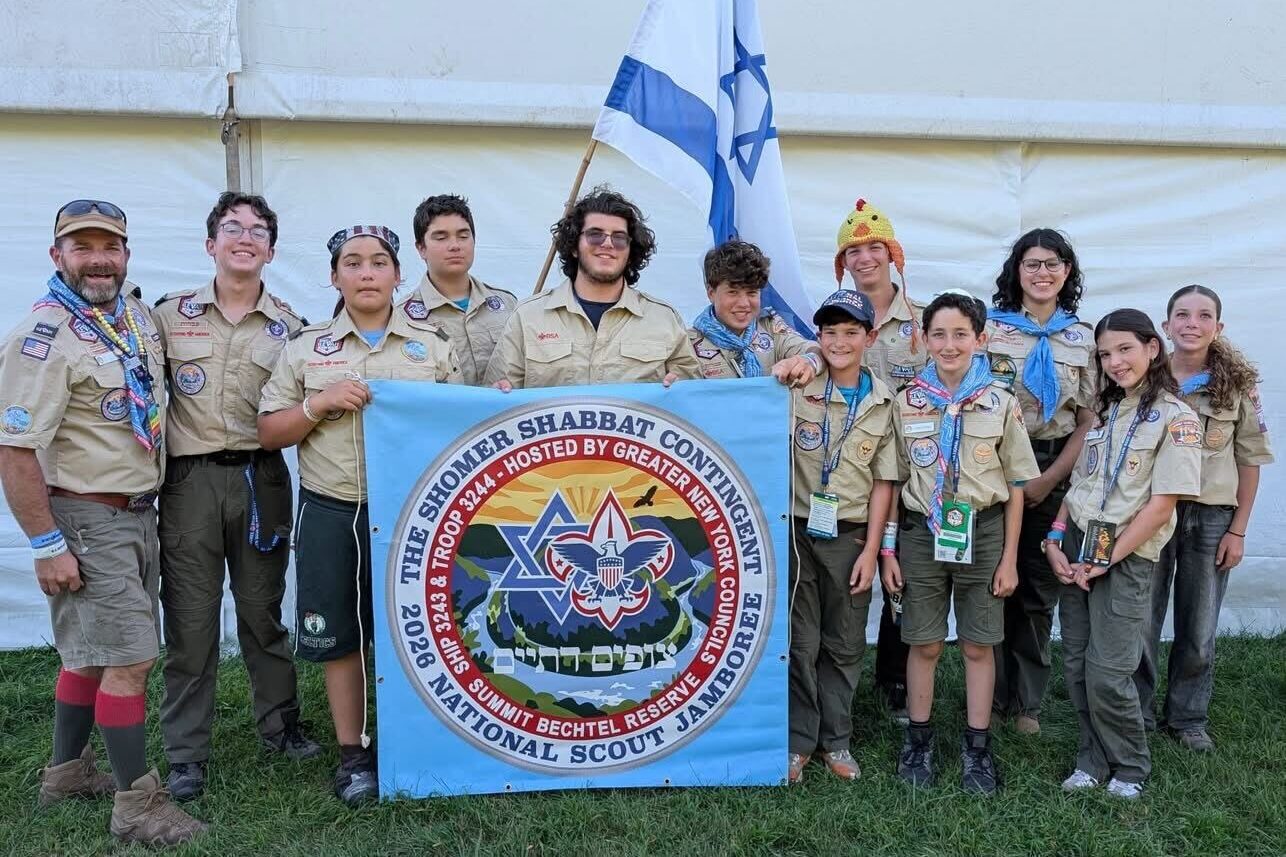
Clad in khaki uniforms and merit badges, hundreds of scouts gathered on a Saturday morning for a sight that has become increasingly rare in America: a Jewish prayer service without security and where nobody felt the need to look over their shoulder.
At a moment when Jewish students contemplating the upcoming school year are weighing whether to wear or hide their Star of David necklaces as they return to the classroom, this summer’s Scouting America national jamboree in West Virginia offered a different message — holding a full, public Shabbat service for its Jewish scouts as part of an event organizers describe as one of the last unapologetically inclusive spaces for religious minorities in youth culture.
“I’ve had the privilege of going to synagogue services around the world for the past 20 years. [The jamboree] was the only one I’ve been to, other than in Israel, where there was no need for security around the service,” Ricky Mason, chair of Scouting America’s national executive board, told Jewish Insider.
Mason was elected chair in May, the first Jewish leader to hold the volunteer post in about 50 years. His election followed the decision in February 2025 by the Boy Scouts of America to change its corporate name to Scouting America, coinciding with the organization’s 115th anniversary, in an effort to be more inclusive.
At last month’s jamboree — a signature scouting event held every four years — Mason is believed to be the first Jewish national chair to receive an aliyah at the gathering, he told JI. Although he grew up as a Boy Scout, this was his first time attending the jamboree, where tens of thousands of scouts and volunteers engage in 10 days of activities such as rock climbing, ziplining and camping.
Mason is the third Jewish chair of the Boy Scouts since the 1930s. Mortimer Schiff, a prominent banker in New York City, was named the first Jewish leader in May 1931, during a period of rising antisemitism. “They had no issue with him being Jewish and it’s the same today,” said Mason, who added that before being elected, he “made it very clear I’m Jewish and received positive reactions.”
Mason credited scouting’s faith-based roots for its inclusivity, noting that troops are often sponsored by churches, synagogues and mosques, and that the 115-year-old Scout Oath explicitly binds members to a “duty to God and my country.”
“So we have a duty to God here,” he said, describing the setting at jamboree as “the Jewish tent beside the Islamic tent beside the Latter Day Saints.” But the different religions also interact with each other, he said, noting he recently received Scouting’s National Islamic Committee’s highest award. “We also have an inter-religious committee, representatives of all of the faiths in scouting. We have a very close cooperative relationship,” said Mason.
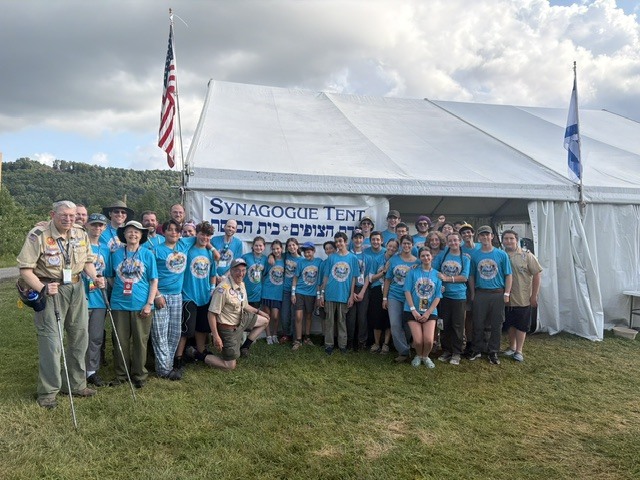
According to Mason, the experience also let participants learn about Jewish customs they might not otherwise know. This group included a shomer shabbat contingent of about 20 youth from the Northeast.“ The volunteer staff, which is mostly non-Jewish, had erected an eruv around their campsite for Shabbat. “That cooperation is emblematic of scouting,” said Mason.
Among those who connected with their Jewish identity at the jamboree was a 14-year-old girl from West Virginia. Although her mother had mentioned their Jewish roots, the family had never been affiliated with a community. The girl was drawn to a delegation from Israel made up of children of American and Canadian immigrants, according to Erik Claster, the founder of BSI, an independent boy and girl scouting organization in Israel modeled after Scouting America. After spending time at their campsite, the girl asked a volunteer how she could become a bat mitzvah, Claster recalled.
Together with the shomer shabbat contingent, “We had a little ceremony for her, we gave her gifts,” he said. “It was the only Jewish experience she’s had in her 14 years and it could also be the last, who knows. But she was attracted to our contingent.”
Claster, who grew up in rural Kansas where he was a boy scout before making aliyah 30 years ago, brought a group of 11 boys and girls to the jamboree, his second time doing so. For many, it was their first time coming to the U.S. since the start of the Israel-Hamas war and ensuing antisemitism. “A lot of our scouts came unsure of what it would hold for them,” said Claster. They’ve been hearing a lot about what goes on with their family and friends in the last few years since the war, about blatant anti-Israel [rhetoric] and antisemitism. They didn’t know what to expect and we had to prepare them.”
“We weren’t just Jewish, we’re also from Israel. We have Israeli patches to go along with our American patches, we have an Israeli flag that we had at all the ceremonies and at our campsite. It could have theoretically gone in a very different direction but thankfully it didn’t. It was happy and welcoming,” he said.
“We do have a track record — scouts in general are pro-Israel in the sense there is no negative sentiment. The ethos of scouts is to be friendly, courteous and kind,” Claster continued.
Still, he noted that for many at the jamboree, this was their first time meeting someone Jewish, let alone from Israel.
“But kids are kids,” he said. “When you’re doing a zip line, when you’re white-water rafting, it’s not an issue. It’s the best environment for kids who come from different backgrounds to share a core baseline value system.”
Ahead of the jamboree, Mason and other scouts designed a custom patch that was copied into about 3,000 patches that he signed and traded. Divided into triangles, he included three personal symbols on his patch: the New York City skyline, a mountain he has climbed and a Torah scroll.
“I used it as an opportunity to teach,” he recalled. “A 14-year-old asked me, ‘What’s this at the top?’ I said, ‘Well, I’m Jewish and that’s a Torah scroll.’ I got a huge positive reaction.”
“It’s a very safe space for Jewish kids,” continued Mason. “And the Jewish kids who saw that there was a Jewish chair for scouting, their smiles were as wide as the Mississippi River.”
Featured Stories
Please log in if you already have a subscription, or subscribe to access the latest updates.
 Continue with Google
 Continue with Apple