

The suit claims that Northwestern University violated students’ rights by requiring them to agree to the school’s code of conduct
Vincent Alban for The Washington Post via Getty Images
Northwestern University in Evanston, Ill. on Saturday, October 5, 2024.
A new lawsuit filed by the Council on American-Islamic Relations’ Chicago branch last week alleges that Northwestern University violated Title VI of the Civil Rights Act of 1964 by adopting time, place and manner restrictions on student protest and requiring students to watch an antisemitism training video.
The plaintiffs include Northwestern Graduate Workers for Palestine, a doctoral student who “is not Arab, Jewish, or Muslim, but publicly associates with these students” and a doctoral candidate of Syrian and Palestinian descent.
Title VI prohibits institutions that receive federal funding from discriminating based on a person’s race, color and national origin — understood to include both Arabs and Jews — though the lawsuit claims that “Antizionist Jews are also a cognizable ethnic group” under the statute. The suit also accuses the Chicago-area school of violating Title VI by discriminating against those who “associate with” Jewish and Arab students “who oppose or criticize Zionism.”
The suit, filed in federal court in Illinois, claims Northwestern violated students’ rights by requiring them to agree to the school’s code of conduct, which now incorporates the International Holocaust Remembrance Alliance’s working definition of antisemitism, as well as mandatory bias training that includes a video on antisemitism created in collaboration with the Jewish United Fund, the city’s Jewish federation.
The training is required to be completed by Monday, or students will be prohibited from registering for classes for the winter term.
The plaintiffs claim that the mandate to watch the JUF video, which includes information on the ties between antisemitism and anti-Zionism, has “caused Arab individuals and those who support them injury in the form of emotional distress.” The two doctoral students, who are considered student employees of the university, also claim the training, which is required for their employment, violates the Illinois Worker Freedom of Speech Act.
A spokesperson for Northwestern declined to comment on the ongoing litigation. The university responded to the allegation in court filings that students must attest that they “have reviewed and agreed to abide by” the student code of conduct but “notably, the attestation does not require students to agree or enforce the substance or viewpoints expressed in the training. It merely confirms that they will comply with the university’s uniformly applicable policies — just as all students must typically do to maintain good standing.”
The suit further alleges that Northwestern implemented an “Intimidation Policy” in response to the disruptive anti-Israel encampment that overtook the university’s campus in May 2024 by now requiring “a reservation, advance notice, and a permit from the University’s administration” in order to table on university property and a permit to use devices that amplify sound, as well as limiting flyers posted outdoors to university bulletin boards.
Students participating in the encampment engaged in several instances of harassment and intimidation of Jewish students, which were detailed by the House Committee on Education and Workforce when it called then-President Michael Schill to appear before the committee. Schill negotiated with the encampment and acceded to several of the student leaders’ demands, including allowing students to weigh in on university investments, which earned the praise of the international Boycott, Divestment and Sanctions (BDS) movement and drew condemnation from Jewish leaders.
The requested remedies of the suit include finding Northwestern’s use of the IHRA definition, which labels some criticism of Israel as antisemitic, to be illegal and prohibiting the school from using it and for emotional distress damages for the plaintiffs.
AJC CEO Ted Deutch: ‘This law is a meaningful tool to make our campuses places where students can learn without fear of discrimination’
Susan Watts/Office of Governor Kathy Hochul
Gov. Kathy Hochul tours Anne Frank exhibit and delivers remarks at the Anti-Hate Center in Education at the Center for Jewish History.
Responding to heightened campus antisemitism, New York Gov. Kathy Hochul will sign legislation on Tuesday afternoon that requires all colleges in the state to designate anti-discrimination coordinators to enforce Title VI of the Civil Rights Act of 1964, her office confirmed to Jewish Insider.
The new bill, which passed the New York State Legislature unanimously in June, was introduced by Assemblywoman Nily Rozic and state Sen. Toby Ann Stavisky, both Democrats from Queens, amid an uptick in antisemitism on college campuses in the aftermath of Hamas’ Oct. 7, 2023, attacks.
“By placing Title VI coordinators on all college campuses, New York is combating antisemitism and all forms of discrimination head-on,” Hochul, a Democrat, told JI. “No one should fear for their safety while trying to get an education. It’s my top priority to ensure every New York student feels safe at school, and I will continue to take action against campus discrimination and use every tool at my disposal to eliminate hate and bias from our school communities.”
The legislation centralizes colleges’ enforcement of Title VI, which prohibits discrimination in federally funded programs based on race, color and national origin, by mandating a designated Title VI coordinator to address student complaints and directing the New York State Division of Human Rights to develop training to support such efforts.
It was backed by several Jewish groups including the Anti-Defamation League, UJA-Federation of New York and the American Jewish Committee.
Ted Deutch, chief executive of the AJC, called the legislation “a significant step in protecting Jewish students across the state.”
“This bipartisan legislation signed by Gov. Hochul will combat the alarming rise of antisemitism and ensure Jewish students’ concerns are heard and taken seriously,” he said in a statement. “By requiring every college and university in the state to have a properly trained Title VI Coordinator, this law is a meaningful tool to make our campuses places where students can learn without fear of discrimination.”
The bill comes as Democrats have faced criticism nationally from Republicans over their approach to countering antisemitism and supporting Israel amid its war in Gaza. It also comes as President Donald Trump has moved to dismantle the Department of Education — an effort that has raised questions among Jewish leaders over the government’s ability to investigate Title VI complaints and to hold schools accountable for incidents of antisemitism.
In anticipation of the bill and amid the Trump administration’s ongoing crackdown on campus antisemitism, some schools in the state, including Columbia University, New York University and the State University of New York system, have already announced commitments to hire designated Title VI coordinators.
Hochul, who is facing a potentially competitive reelection campaign as she seeks a second full term, has tackled the issue of rising campus antisemitism during her time in office, meeting with hundreds of college officials last year to address the matter, among other efforts.
Rep. Elise Stefanik (R-NY), a Republican whose viral questioning of university leaders over their handling of campus antisemitism seized the national spotlight, is mulling a challenge to Hochul in next year’s election.
Among other actions, Barnard College agreed to hire a coordinator to review allegations of Title VI violations and refuse to meet with anti-Israel campus groups
Lishi Baker
Milbank Hall on Barnard College campus on February 26, 2025 as the building was occupied by anti-Israel protesters for six hours.
Barnard College reached a settlement on Monday in a lawsuit brought by Jewish students which claimed that the school violated Title VI of the Civil Rights Act of 1964 by failing to address antisemitism.
Under the agreement reached, Barnard will adopt an anti-masking policy at demonstrations; refuse to meet with anti-Israel campus groups, including Columbia University Apartheid Divest; “consider” adoption of the International Holocaust Remembrance Alliance’s working definition of antisemitism; require students, faculty and staff to complete antisemitism training; and expand its discipline policy to include harassment that occurs off campus or online.
Barnard will also hire a coordinator to review new allegations of Title VI violations and agreed not to divest from companies that have ties to Israel.
The complaint, Students Against Antisemitism, Inc. et al v. The Trustees of Columbia University in the City of New York, filed in district court in New York in February 2024 against Columbia University and Barnard, detailed several instances of antisemitism, including physical assaults of Jewish students. The complaint alleges that faculty members and students routinely referred to Hamas’ Oct.7, 2023 attacks as “awesome” and a “great feat.”
Barnard also recently expanded its partnership with the Jewish Theological Seminary. Jewish studies courses at JTS — located near Barnard’s Morningside Heights campus — will now count toward Barnard degree requirements, with students able to participate with no additional tuition costs.
Laura Ann Rosenbury, president of Barnard, said in a statement that the settlement “reflects our ongoing commitment to maintaining a campus that is safe, welcoming, and inclusive for all members of our community.”
Monday’s settlement comes as Barnard — which is closely affiliated with Columbia but has independent administration and affiliation — remains under investigation by the Trump administration for violating Title VI.
Barnard faced several major incidents of antisemitism on its campus during the last academic year. A staff member was assaulted and sent to the hospital in February by anti-Israel demonstrators who stormed the college’s main administrative building and remained there for several hours, chanting “resistance is justified when people are occupied” and “intifada revolution.”
The demonstration was a response to the school’s decision just days earlier — in its most forceful response to anti-Israel activity on campus to date — to expel two second-semester seniors who disrupted a “History of Modern Israel” class on Columbia’s campus by storming in, banging on drums and distributing posters to students that read “CRUSH ZIONISM.”
Marc Kasowitz of Kasowitz LLP, counsel for the plaintiffs, praised Barnard’s “commitment to take meaningful actions to combat antisemitism demonstrates its leadership in the fight against antisemitism and upholding the rights of Jewish and Israeli students.”
Kasowitz continued, “These commitments are not only the right thing to do, but are essential to creating a welcome and inclusive campus for all members of the Barnard community. I encourage other colleges and universities to do the right thing and follow Barnard’s lead.”
The Virginia university contended with several high-profile incidents of antisemitism last year
Robert Knopes/UCG/Universal Images Group via Getty Images
Graduates pass a statue of George Mason on the campus of George Mason University, Fairfax, Virginia.
George Mason University is the latest target of the Trump administration’s investigations into universities for allegedly violating Title VI of the Civil Rights Act of 1964 by not cracking down on harassment of Jewish students.
The Department of Education’s Office for Civil Rights launched the investigation on Tuesday, according to a letter first obtained by the Free Beacon. The school has until July 21 to provide detailed information requested by the administration, including all complaints surrounding antisemitism.
“George Mason University has received notice of an impending investigation and a request for data,” a university spokesman told the Free Beacon. “The university believes the allegations to be false, and is working on a timely and comprehensive response.”
The public university in Northern Virginia contended with several major incidents of antisemitism on its campus during the last academic year. The administration faced scrutiny from several pro-Israel individuals affiliated with the school about its response, perceived to be lackluster, after pro-terrorism materials were found in the home of two of its students and a third student was charged with plotting a mass causality attack in November.
George Mason’s administration suspended its Students for Justice in Palestine chapter after two of the group’s student leaders vandalized a campus building with anti-Israel graffiti — and barred the two women from campus for four years. The university also expelled a freshman student who was charged with plotting a terror attack against the Israeli consulate in New York. Administrators later conducted a meeting with Jewish groups to discuss safety and security on campus.
But the university’s response to the incidents avoided any mention of the suspects’ antisemitic motivations or their Islamist sympathies. The police search of the home of the George Mason SJP leaders, sisters Jena and Noor Chanaa, found firearms, scores of ammunition and pro-terror materials, including Hamas and Hezbollah flags and signs that read “death to America” and “death to Jews.”
The OCR investigation into the university comes as the federal government has frozen billions of dollars in federal funding following similar investigations at several elite colleges including Columbia, Harvard and Northwestern.
The texts from Claire Shipman, published in a letter by the House Education Committee, call a Jewish board member a ‘mole’ and ‘extremely unhelpful’
Alex Wong/Getty Images
Acting Columbia University President Claire Shipman testifies before the House Committee on Education & the Workforce at Rayburn House Office Building on April 17, 2024 in Washington, DC.
Text messages obtained by the House Committee on Education and Workforce published in a letter on Tuesday revealed that Claire Shipman, acting president of Columbia University, suggested that a Jewish trustee should be removed over her pro-Israel advocacy and called for an “Arab on our board,” amid antisemitic unrest that roiled the university’s campus last year.
“We need to get somebody from the middle east [sic] or who is Arab on our board,” Shipman, then the co-chair of Columbia’s Board of Trustees, wrote in a message to the board’s vice chair on Jan. 17, 2024. “Quickly I think. Somehow.”
Shipman said in a follow-up message days later that Shoshana Shendelman, a Jewish board member who frequently condemned campus antisemitism, had been “extraordinarily unhelpful” and said, “I just don’t think she should be on the board.”
In another communication on April 22, 2024, according to the texts obtained by the committee, Wanda Greene, vice chair of the board of trustees, asked Shipman — referring to Shendelman — “do you believe that she is a mole? A fox in the henhouse?” Shipman agreed, stating, “I do.” Greene added, “I am tired of her.” Shipman agreed, “so, so tired.”
The messages were referenced in the letter, first obtained by Free Beacon, sent to Columbia on Tuesday by the committee’s chairman, Tim Walberg (R-MI), and Rep. Elise Stefanik (R-NY) as part of the committee’s ongoing investigation into whether the school is violating Title VI of the Civil Rights Act of 1964 by allowing harassment of Jewish students.
The lawmakers wrote in the letter, which was addressed to Shipman, “These exchanges raise the question of why you appeared to be in favor of removing one of the board’s most outspoken Jewish advocates at a time when Columbia students were facing a shocking level of fear and hostility.”
Columbia responded to the letter, in a statement to Free Beacon, claiming that the text messages were taken out of context.
“These communications were provided to the Committee in the fall of 2024 and reflect communications from more than a year ago,” the university said. “They are now being published out of context and reflect a particularly difficult moment in time for the University when leaders across Columbia were intensely focused on addressing significant challenges.”
Shipman, a former ABC News reporter, stepped into the role in March after interim President Katrina Armstrong’s abrupt resignation. At the time, Stefanik called the choice of Shipman “untenable.” On campus, the news of Shipman’s hiring was met with cautious optimism from pro-Israel student leaders.
Last April, Shipman testified at a congressional hearing regarding antisemitism at Columbia alongside then-Columbia President Minouche Shafik, who resigned from her post in August, and board co-chair David Greenwald. Shipman told members of the House Committee at the time that she knew Columbia had “significant and important work to do to address antisemitism and to ensure that our Jewish community is safe and welcome.”
The federal government said Columbia ‘acted with deliberate indifference towards the harassment of Jewish students’
CHARLY TRIBALLEAU/AFP via Getty Images
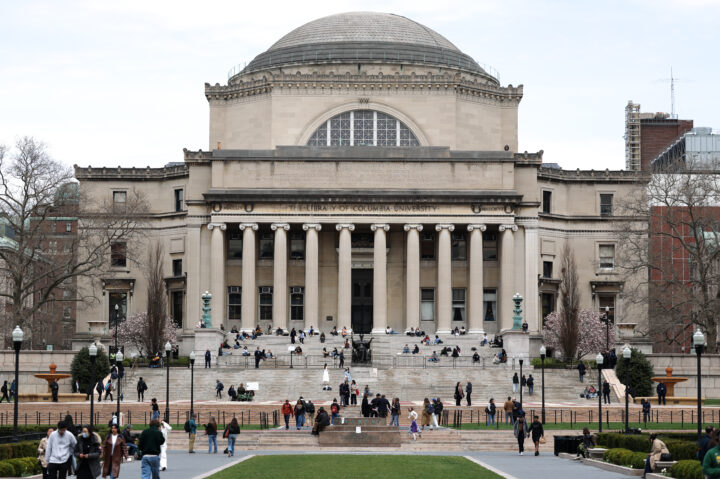
Students are seen on the campus of Columbia University on April 14, 2025, in New York City.
The Trump administration’s battle with higher education escalated on Wednesday with the announcement that Columbia University is at risk of losing accreditation for violation of the Title VI of the Civil Rights Act of 1964.
The U.S. Department of Education’s Office for Civil Rights and the Department of Health and Human Services’ Office for Civil Rights “determined that Columbia University acted with deliberate indifference towards the harassment of Jewish students, thereby violating Title VI,” the Education Department said in a statement, noting that the Ivy League institution “no longer appears to meet the Commission’s [sic] accreditation standards.”
Columbia is accredited by the Middle States Commission on Higher Education, a voluntary membership organization recognized by the Department of Education. Accreditation is required for a university to receive federal funding, for its students to receive public student loans and to be recognized by employers.
In a statement to Jewish Insider, a spokesperson for Columbia said that the university is “aware of the concerns raised by the U.S. Department of Education’s Office for Civil Rights today to our accreditor… and we have addressed those concerns directly with Middle States.”
“Columbia is deeply committed to combating antisemitism on our campus. We take this issue seriously and are continuing to work with the federal government to address it,” the spokesperson said.
The Education Department did not immediately respond to a request for comment from JI inquiring whether any specific recent incidents led to the determination.
Education Secretary Linda McMahon said in the department’s announcement that Columbia’s actions on antisemitism since the Oct. 7, 2023, terrorist attacks have been “immoral” and “unlawful.”
McMahon said the department will work with the accreditor “to ensure Columbia’s compliance with accreditation standards including compliance with federal civil rights laws.”
Columbia University has faced intense scrutiny from the federal government since President Donald Trump returned to the White House earlier this year.
In February, the Trump administration directed that an investigation into violations of Title VI be opened. A month later, it pulled $400 million from Columbia’s federal funding over its failure to crack down on antisemitism, marking the first time a university has faced a cutoff of federal funds since Title VI was implemented six decades ago.
Columbia responded by entering ongoing negotiations with the government. The agreement included putting the school’s Middle Eastern studies department under a “receivership,” which involves closer oversight from an external body.
Several other elite institutions faced similar funding freezes in the weeks that followed, including Harvard University, which responded by suing the Trump administration.
The shift has been attributed to a mix of factors: stricter consequences from university leaders, fear of running afoul of Trump’s pledge to deport pro-Hamas foreign students and the issue generally losing steam among easily distracted students
Grace Yoon/Anadolu via Getty Images
Pro-Palestinian students at UCLA campus set up encampment in support of Gaza and protest the Israeli attacks in Los Angeles, California, United States on May 01, 2024.
For a brief moment, it looked like 2024 all over again: Tents were erected at Yale University’s central plaza on Tuesday night, with anti-Israel activists hoping to loudly protest the visit of far-right Israeli National Security Minister Itamar Ben-Gvir to campus. Videos of students in keffiyehs, shouting protest slogans, started to spread online on Tuesday night.
But then something unexpected happened. University administrators showed up, threatening disciplinary action, and the protesters were told to leave — or face consequences. So they left. The new encampment didn’t last a couple hours, let alone overnight. The next day, Yale announced that it had revoked its recognition of Yalies4Palestine, the student group that organized the protest. (On Wednesday night, a large protest occurred outside the off-campus building where Ben-Gvir was speaking.)
Meanwhile, at Cornell University, President Michael Kotlikoff announced on Wednesday that he had canceled an upcoming campus performance by R&B singer Kehlani because of her history of anti-Israel social media posts. He wrote in an email to Cornell affiliates that he had heard from many people who were “angry, hurt and confused” that the school’s annual spring music festival “would feature a performer who has espoused antisemitic, anti-Israel sentiments in performances, videos and on social media.”
The quick decisions from administrators at Yale and Cornell to shut down anti-Israel activity reflect something of a vibe shift on American campuses. One year ago, anti-Israel encampments were, for a few weeks, de rigueur on campus quads across the nation. University leaders seemed paralyzed, unsure of how to handle protests that in many cases explicitly excluded Jewish or Zionist students and at times became violent. That’s a markedly different environment from what’s happening at those same schools so far this spring.
“In general, protest activity is way down this year as compared to last year,” Hillel International CEO Adam Lehman told Jewish Insider.
There is no single reason that protests have subsided. Jewish students, campus Jewish leaders and professionals at Jewish advocacy organizations attribute the change to a mix of factors: stricter consequences from university leaders, fear of running afoul of President Donald Trump’s pledge to deport pro-Hamas foreign students and the issue generally losing steam and cachet among easily distracted students.
Last spring, an encampment at The George Washington University was only dismantled after the university faced threats from Congress. Now, no such protest is taking place — which Daniel Schwartz, a Jewish history professor, said was likely due in part to the “sense that the university was going to be responding much more fiercely to anything resembling what happened last year.”
“For the most part, the enforcement of rules, the understanding of what the rules are, what you can do, what you can’t do, requiring people to get permits for protests, has really calmed things down [from] the sort of violence that we saw last year,” said Jordan Acker, a member of the Board of Regents of the University of Michigan, who has faced antisemitic vandalism and targeted, personal protests from Michigan students.
Michael Simon, the executive director at Northwestern Hillel, came into the school year with a “big question mark” of how the school’s new policies, which provide strict guidance for student protests and the type of behavior allowed at them, would be applied. “I’m going to say it with a real hedging: at least up until now, I would say we’ve seen the lower end of what I would have expected,” he said of campus anti-Israel protests.
Many major universities like Northwestern spent last summer honing their campus codes of conduct and their regulations for student protests, making clear at the start of the school year that similar actions would not be tolerated again. In February, for instance, Barnard College expelled two students who loudly disrupted an Israeli history class at Columbia,.
“For the most part, the enforcement of rules, the understanding of what the rules are, what you can do, what you can’t do, requiring people to get permits for protests, has really calmed things down [from] the sort of violence that we saw last year,” said Jordan Acker, a member of the Board of Regents of the University of Michigan, who has faced antisemitic vandalism and targeted, personal protests from Michigan students.
In recent weeks, the Trump administration has pressured top universities to crack down on antisemitic activity. The president’s threats to revoke federal funding if universities don’t get antisemitism under control has drawn pushback — Harvard is suing the Trump administration over its decision to withhold $2.2 billion in federal funds from the school — but it has also led universities to take action to address the problem.
Sharon Nazarian, an adjunct professor at UCLA and the vice chair of the Anti-Defamation League’s board of directors, said there is “no question” that “the national atmosphere of fear among university administrators for castigation and targeting by the [Trump] administration is also present” at UCLA and other University of California campuses.
“My sense is that being anti-Israel is not as much of the popular thing anymore,” Evan Cohen, a senior at the University of Michigan, said at a Wednesday webinar hosted by Hillel International for Jewish high school seniors. “On my campus, there are other hot topic issues. There might be more focus on what’s happening with U.S. domestic politics.”
Rule-breaking student activists also face a heightened risk of law enforcement action. A dozen anti-Israel student protesters were charged with felonies this month for vandalizing the Stanford University president’s office last June. On Wednesday, local, state and federal law enforcement officials in Michigan raided the homes of three people connected to anti-Israel protests at the University of Michigan. Protesters’ extreme tactics have scared off some would-be allies.
“I think some of the most activist students went too far at the end of last year with the takeover of the president’s office and a lot of pretty intense graffiti in important places on campus,” said Rabbi Jessica Kirschner, the executive director of Hillel at Stanford. “I think a lot of other students looked at that and said, ‘Oh, this is perhaps not where we want to be.’”
Students’ priorities shift each year, and other issues beyond Israel are also vying for their attention. Trump’s policies targeting foreign students are drawing ire from students at liberal universities, many of which have large populations of international students.
“My sense is that being anti-Israel is not as much of the popular thing anymore,” Evan Cohen, a senior at the University of Michigan, said at a Wednesday webinar hosted by Hillel International for Jewish high school seniors. “On my campus, there are other hot topic issues. There might be more focus on what’s happening with U.S. domestic politics.”
But the lack of protests does not mean that campus life has returned to normal for Jewish students, many of whom still fear — and face — opprobrium for their pro-Israel views.
“It’s easy to avoid the protests but if you are an Israeli student or a Jewish student perceived to be a Zionist, you should expect to be discriminated against in social spaces at the university,” Rabbi Jason Rubenstein, executive director of Harvard Hillel, told JI. “That is the most powerful way students are impacted by all of this.”
Ken Marcus, founder and chairman of the Louis D. Brandeis Center for Human Rights Under Law, which since Oct. 7 has represented dozens of Jewish students in Title VI civil rights cases against their universities, said that campus-related lawsuits are only faintly slowing down this semester.
“A lot of the staff and the administration think that, ‘OK, since there’s no protest outside, all the Jewish students must feel OK, and let’s put all this stuff that happened in the spring behind us.’ It’s really not the case,” said Or Yahalom, a senior at Northwestern University who was born in Israel. “That doesn’t mean that it’s all better for students. Jewish students are increasingly afraid to speak openly about their identity or connection to Israel, except in private, safe Jewish spaces.”
“Some campuses have been less intense than during last year’s historically awful period, but others have been bad enough,” Marcus told JI. “I believe that the federal crackdown, coupled with the impact of lawsuits and Title VI cases, has had a favorable impact at many campuses, but the problems have hardly gone away.”
Or Yahalom, a senior at Northwestern University who was born in Israel, recently attended a dinner with Northwestern President Michael Schill, who has faced criticism from Jewish Northwestern affiliates — including several members of its antisemitism advisory committee — for what they saw as the administration’s failure to adequately address antisemitism.
“A lot of the staff and the administration think that, ‘OK, since there’s no protest outside, all the Jewish students must feel OK, and let’s put all this stuff that happened in the spring behind us.’ It’s really not the case,” said Yahalom. “That doesn’t mean that it’s all better for students. Jewish students are increasingly afraid to speak openly about their identity or connection to Israel, except in private, safe Jewish spaces.”
Even without massive encampments, disruptive anti-Israel protests and campus actions have not gone away entirely, though they have been more infrequent this academic year. A Northwestern academic building housing the school’s Holocaust center was vandalized with “DEATH TO ISRAEL” graffiti last week. The office of Joseph Pelzman, an economist at The George Washington University who authored a plan calling for the U.S. to relocate Palestinians in the Gaza Strip and redevelop the enclave, was vandalized in February. The Georgetown University Student Government Association is slated to hold a campus-wide referendum on university divestment from companies and academic institutions with ties to Israel at the end of the month. Smaller-scale protests continue at Columbia, with students chaining themselves to the Manhattan university’s main gate this week to protest the ICE detention of Mohsen Mahdawi and Mahmoud Khalil, two foreign students who had led protests last year.
Leaders of the University of Michigan’s anti-Israel coalition held a sham trial for the university president and Board of Regents members in the middle of the Diag, the main campus quad, this week. The event took place without issue, and the activists left when it ended.
“I wouldn’t want to say that it’s perfect,” said Acker, the Board of Regents member. “But it’s certainly much better than a year ago.”
The school year isn’t over. Some students at Columbia are planning to erect another encampment this month, NBC News reported on Wednesday.
But they’ll be doing so at an institution with new leadership, weeks after Columbia reached an agreement with the Trump administration, where the Ivy League university pledged to take stronger action against antisemitism to avoid a massive funding cut. The pressure on Columbia to crack down on any encampment will be massive.
Harvard is the latest university to have its contracts and grants put under review for failing to adequately address antisemitism on campus
Getty Images
Gate at Harvard University, Cambridge, Massachusetts, USA
Ramping up its pressure campaign against Ivy League schools, the Trump administration notified Harvard University on Monday in a letter that it is reviewing the school’s billions of dollars in federal funding.
The newly formed Federal Task Force to Combat Antisemitism will review $255.6 million in contracts and $8.7 billion in multiyear grant commitments between the government and Harvard, first reported by The Free Press and later announced by the Department of Education.
“Harvard’s failure to protect students on campus from anti-semitic discrimination — all while promoting divisive ideologies over free inquiry — has put its reputation in serious jeopardy,” Secretary of Education Linda McMahon said in a statement. “Harvard can right these wrongs and restore itself to a campus dedicated to academic excellence and truth-seeking, where all students feel safe on its campus.”
Harvard President Alan Garber argued in a statement on Monday that the university has “devoted considerable effort to addressing antisemitism” for the past 15 months.
Those efforts, Garber said, have included “strengthen[ing] our rules and our approach to disciplining those who violate them, training and education on antisemitism across our campus and [the introduction of] measures to support our Jewish community and ensure student safety and security.”
Garber said that the university will “engage with members of the federal government’s task force to combat antisemitism to ensure that they have a full account of the work we have done and the actions we will take going forward to combat antisemitism.”
The crackdown comes days after Columbia University agreed to enter into ongoing negotiations with the Trump administration, which cut $400 million from the university on March 7, citing the academic institution’s “ongoing inaction in the face of relentless harassment of Jewish students.” The set of demands that Columbia agreed to include putting the school’s Middle Eastern studies department under a “receivership,” which would involve closer oversight from an external body.
As an apparent preemptive measure to avoid a fate similar to Columbia’s, two heads of Harvard University’s Center for Middle Eastern Studies were let go from their roles last Wednesday.
Task force member Sean Keveney, acting general counsel at the Department of Health and Human Services, said in a statement that the task force is “pleased that Harvard is willing to engage with us.”
Harvard University did not immediately respond to a request for comment from Jewish Insider about the investigation.
On March 10, the Department of Education sent letters to 60 universities, including Harvard, warning them of “potential enforcement actions” if they do not fulfill their obligations under Title VI of the Civil Rights Act to protect Jewish students.
The lawsuit alleges the university knowing allowed anti-Israel protesters to harass Jewish students and prevent them from going to class
Getty Images
Department of Justice, Washington, D.C.
The Justice Department’s newly formed Federal Task Force to Combat Antisemitism filed a statement of interest in court on Monday night supporting Jewish students and a professor in their case alleging that the University of California Los Angeles permitted antisemitism on campus.
According to the suit, in the spring of 2024 UCLA violated Title VI of the 1964 Civil Rights Act by knowingly allowed members of an anti-Israel protest encampment to physically prevent students and faculty from accessing portions of the campus if they were wearing items that identified them as Jewish if they refused to denounce Israel. The filing comes as the task force is separately investigating the University of California system for Title VI violations.
The brief filed on Monday marks the first time the federal government has filed a statement of interest in court to argue that a university should be held accountable for the campus antisemitism that has skyrocketed across the country since the Oct. 7 terrorist attacks in Israel.
Leo Terrell, head of the antisemitism task force, said in a statement that “the President, Attorney General Pam Bondi, and the Task Force know that every student must be free to attend school without being discriminated against on the basis of their race, religion or national origin.”
The Trump administration’s new multi-agency task force to combat antisemitism announced earlier this month that it would visit 10 university campuses that have experienced an increase of antisemitic incidents.
The task force already announced it will cut $400 million from Columbia University’s federal funding due to antisemitic demonstrations unless the university agrees to a number of conditions by Thursday. At the time, Terrell said that was “only the beginning” of university funding cuts.
The Preventing Antisemitic Harassment on Campus Act also directs the Department of Education to oversee private lawsuits against colleges for antisemitism
Kevin Dietsch/Getty Images
Sen. Rick Scott (R-FL) speaks on government funding during a press conference at the U.S. Capitol on March 06, 2024 in Washington, DC.
Sen. Rick Scott (R-FL) reintroduced legislation last week targeting universities that have failed to stem the surge of antisemitism taking place on college campuses.
Scott originally introduced the Preventing Antisemitic Harassment on Campus Act last October with then-Sen. Marco Rubio (R-FL), now the secretary of state, as anti-Israel encampments had begun reemerging on some campuses ahead of the presidential election.
The legislation would expand Title VI of the Civil Rights Act of 1964 — which currently bans discrimination on the basis of race, color or national origin — to include religious discrimination and implement “clear and escalating penalties for institutions of higher education (IHEs) that are repeat violators.” It would also direct the Department of Education to “oversee private lawsuits against colleges receiving federal financial aid related to antisemitism.”
“Following Iran-backed Hamas’s attack on Israel, we saw a drastic rise in antisemitic attacks in the United States with anti-Israel mobs taking over campuses, and we’ve seen an unacceptable failure from leadership at higher education institutions to take action to condemn these mobs and protect Jewish students. Jewish students were afraid to go to class, fearful of the violence these pro-terrorist mobs threatened. That can’t happen,” Scott said in a statement.
The legislation was reintroduced on Friday, the same day that the Trump administration announced it would cut $400 million from Columbia University’s federal funding due to the school’s handling of antisemitic demonstrations that have roiled the campus since the Oct. 7, 2023, Hamas terror attacks.
Earlier last week, Trump posted on social media that “all Federal Funding will STOP for any College, School, or University that allows illegal protests.”
“President Trump is completely right to withhold federal funding from higher education institutions that refuse to enforce the law on their campuses and enable antisemitic hate to flourish, and I’m proud to lead this bill to build on his efforts,” Scott said.


