



Courtesy
A Lebanese Zionist’s longshot bid to reshape the Middle East
Hagar Hajjar Chemali, who is half Jewish and half Christian, thinks she has a shot at helping break through the deep sectarianism that has led to distrust both within Lebanon and towards Israel


 Add JewishInsider on Google
Hagar Hajjar Chemali is an American by accident — quite literally — of birth.
Her parents left their native Lebanon in 1981 as a civil war raged in the country. Chemali’s father, Hadi, had been kidnapped by a political group, and the young couple quickly left the country once he was released, with plans to move to Milan. While visiting friends in Greenwich, Conn., Chemali’s mother, Mirella, began experiencing pregnancy complications and chose to wait out the final months of her pregnancy there. Soon after, Chemali was born, followed quickly by a son. The family never left.
So began Chemali’s American story, the result of a potent combination of determination and coincidence. That’s the story of Chemali’s professional journey, too: a mix of persistence and being in the right place at the right time. She spent the first decade of her career helping steer U.S. foreign policy on the Middle East in the Bush and Obama administrations, ultimately becoming the spokesperson for former U.S. Ambassador to the United Nations Samantha Power. She spent the next decade as a consultant and communications expert, appearing regularly on cable news and a YouTube channel where she produces an occasionally satirical show explaining American foreign policy.
Now Chemali, 44, faces her biggest and most personal assignment yet: creating an unofficial backchannel to boost the ongoing peace talks between Lebanon and Israel, the first time that officials from the two countries have sat for direct talks since 1983. And Chemali, who is half Jewish and half Christian, thinks she has a shot at helping break through the deep sectarianism that has led to distrust both within Lebanon and towards Israel.
The deal between the U.S. and Iran that was announced on Sunday may complicate Chemali’s efforts. Iran’s attempt to link its own negotiations with the U.S. to developments in Lebanon could potentially complicate efforts to advance Israeli-Lebanese peace, and Iranian state media said on Sunday that Lebanon would be part of the new deal. Details remain scarce.
“It’s about the art of the possible. Lebanese-Israeli peace is not particularly easy to achieve,” said Daniel Glaser, a former assistant Treasury secretary for terrorist financing and financial crimes. He hired Chemali for her first job at the Treasury Department. “What’s going to get it done is the ability to understand what’s possible, and how to get to that possible within the U.S. system, within Israel and the Israeli system, within Lebanon and the infinitely complicated Lebanese system. There’s not a lot of people that have the ability to do that more than Hagar.”
In April, she announced the creation of an organization called LIPA, the Lebanon-Israel Peace Alliance. It’s a vessel for advocacy by Chemali and a cadre of Israeli, Lebanese and American foreign policy experts she colloquially describes as the “peace crew” — many do not yet want to publicize their involvement with the effort — who are working to keep the pressure on the U.S. government to help broker a deal between Lebanon and Israel.
The group has been collaborating since early last year, soon after Israel and Lebanon reached a ceasefire in late 2024 that ended the fighting between Israel and Hezbollah that began when the Iranian-backed group launched missiles at Israel on Oct. 8, 2023. The effort gained traction amid a broader shift in Lebanon: Hezbollah was weakened by the death of its longtime leader, Secretary-General Hassan Nasrallah, and newly elected Lebanese President Joseph Aoun moved to reassert state authority over Hezbollah’s power and influence.
“She was one of the very first people that said to me that I should go for peace,” said Morgan Ortagus, who served as deputy Middle East special envoy at the beginning of the Trump administration. Ortagus and Chemali have been friends since they worked in the Treasury Department together nearly 20 years ago. “I said, ‘Really, do you think they’re ready?’ And she was emphatic that she thought that it was the time to go for peace.”
The work of Chemali’s burgeoning “peace crew” solidified in March, at a dinner soon after the Iran war started. The geopolitical time crunch of a fast-moving war spurred the group to come up with a name to formalize the informal diplomacy they had been pursuing for more than a year.
“All this work actually helped bring the Israelis and the Lebanese governments to hold direct talks in Washington,” said Hanin Ghaddar, a senior fellow studying Lebanon at The Washington Institute for Near East Policy. “I don’t think this would have been possible without the whole year of work on the narrative and the policy and the recommendations and the shift on the ground, that this is where Lebanon and Israel finally decided, ‘Let’s do this.’”
After the U.S. and Iran agreed to a ceasefire in early April, Israeli Prime Minister Benjamin Netanyahu announced that Israel would open direct negotiations with Lebanon. It was the moment for which Chemali had yearned for over 18 months — or, perhaps, a whole lifetime. In the aftermath of the first round of talks, LIPA was launched in the way so many projects are: via a somewhat haphazard post on X. Chemali did not want to lose her chance at creating momentum for a window for peace that might soon close. She has not returned to Lebanon in 15 years due to security risks.
“As a comms person, I would never advise a rollout this way. This is like the opposite of what you do before a rollout. You have all your ducks in a row when you roll anything out,” Chemali told Jewish Insider in a recent interview at a Washington cafe. “We wanted to come out there and be like, we have an organization that exists that is there to support this process.”
For Chemali, the effort is a culmination of her own professional arc, as well as the choices her parents made in building a life here. Her family might be Lebanese, but this effort is all-American — something she can do because of where she was born and the circumstances that allowed her to rise to a public, senior government role without having to worry about the strict sectarian divisions that govern Lebanese society and the country’s government.
But there was a piece of Chemali’s story that was missing, something that now makes her uniquely positioned to serve as a convener of Lebanese and Israelis here in the U.S.
“She’s half-Jewish and half-Christian,” said Hussain Abdul-Hussain, a Lebanese-Iraqi researcher at the Foundation for Defense of Democracies. “She has the highest pedigree for someone to be working on this issue.”
Chemali did not know about her Jewish roots when she was growing up. Her father is a Maronite Christian, a Catholic sect with deep roots in the Levant. The family attended a nondenominational church in Connecticut. When Chemali was 11 or 12, her mother revealed a secret she had kept since her children were born: She was Jewish.
“I think she just couldn’t take it anymore. She was just like, ‘Actually, I’m Jewish,’” Chemali recalled. “My brother and me, being raised in the United States, we were like, ‘That is so cool. Does that mean we get Hanukkah gifts?’”
Her mother, Mirella, grew up in Wadi Abu Jamil, Beirut’s Jewish neighborhood. She attended a Catholic school at the urging of the family of her late father. The nuns at her school would tell Mirella that “she had evil in her blood because she was Jewish,” according to Chemali. “So [her family] practiced Judaism in secret at home.”
The revelation from her mother intrigued Chemali. Why didn’t she tell them sooner? Mostly Chemali ignored it, until she came to Washington during the George W. Bush administration. She joined the Treasury Department in 2006, in the newly created Office of Terrorist Financing and Financial Crimes, where many of her colleagues were Jewish. They started inviting her to Shabbat dinners and Jewish holidays. Chemali learned more about Judaism, and began to feel proud of that part of her identity. When she moved back to Greenwich, she asked her mom to teach her more about her family’s traditions.
“I told my mom, ‘These traditions die with you. You didn’t raise me with these traditions. I only know what I know from books and from going with friends to their houses for events,’” Chemali said. So her mom bought a menorah, and they lit candles together for Hanukkah.
“She starts singing in Hebrew, and I was like, ‘Who is this woman who sings in Hebrew?’ As far as I knew, she speaks a lot of languages — actually, she speaks five languages — but Hebrew was not one of them,” said Chemali.
Chemali has not abandoned the Christian faith she was raised with, even as she grapples with her identity.
“What I tell people of where I am at the moment, but it is always an evolution, is that I am of Christian faith and feel very much a Jew,” said Chemali. “I always tell people I’m a member of every tribe.”
Lebanon is so beset by tribal division that different government positions are reserved for people from different religious sects: the president is required to be a Maronite Christian, the prime minister is a Sunni Muslim and the speaker of parliament is a Shia Muslim. Chemali has refused to diminish any part of her identity, even as her home country all but demands she pick a side.
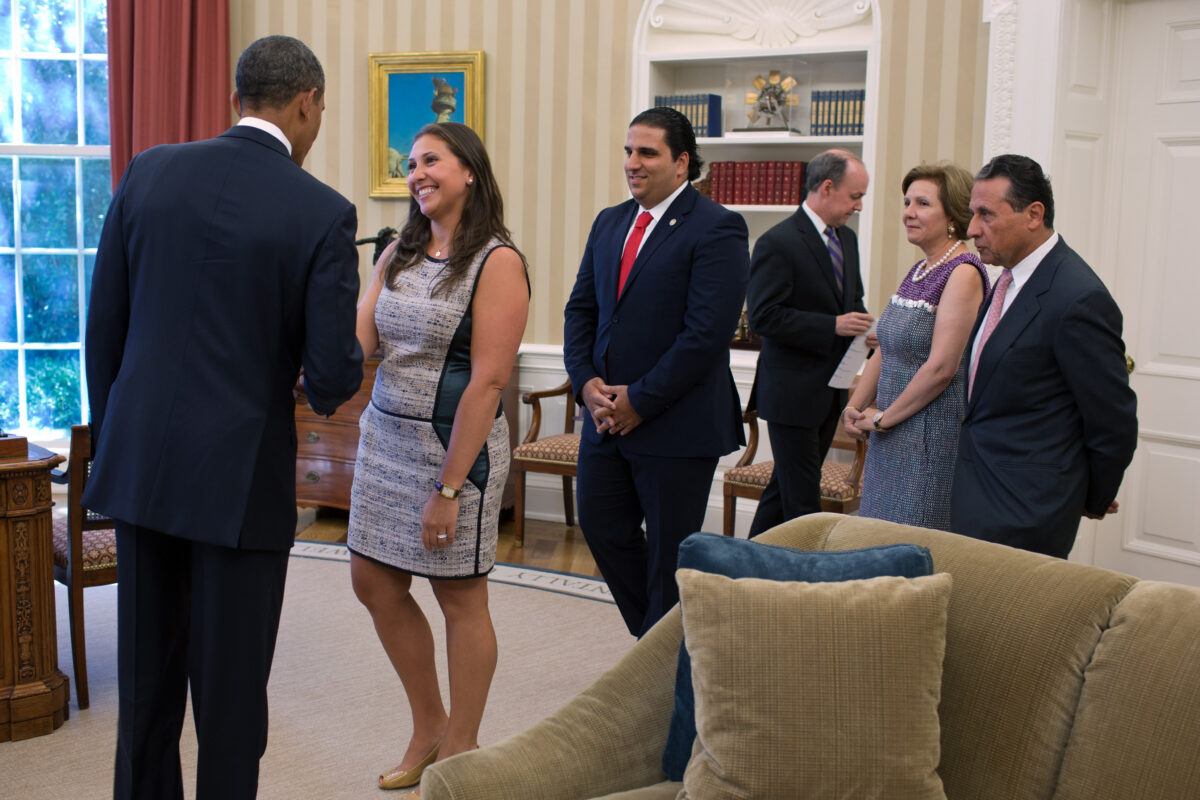
“She’s someone who can actually speak to everyone. She’s not there to take sides,” said Ghaddar. “She really sees the whole picture, and I think that’s what this kind of initiative really needs. It’s someone who has a stake in everyone and everything.”
Chemali retains the idealism that so many lose after decades in Washington. She described herself as a “Lebanese Zionist,” a position she said she has stuck by even amid the polarization that crept into her family after Oct. 7.
“This is the thing that sets me apart from the rest of my family. There’s a chunk of my family that unfriended me on social media after Oct. 7 because of my statements — and by the way, my statements are not like, ‘Yeah, go into Gaza and get ‘em.’ That’s not what I’m saying. My statements were more posting about the hostages,” said Chemali. “There’s one chunk of my family from Syria on my dad’s side that, straight up, they will lecture me at any opportunity they have. I view them as brainwashed, to be perfectly honest, and they probably view me as brainwashed.”
Chemali recalled a trip to Lebanon during her time as the National Security Council’s director for Lebanon and Syria in the Obama administration. A Lebanese friend advised her not to share that she’s Jewish.
“I was like, ‘Look, that’s not how I operate,’” said Chemali. “First, I really make sure religion doesn’t come up in my government work, because I don’t want anyone ever accusing me of seeing something through a religious lens. But secondly, if it comes up, I don’t hide. That’s not how I roll, ever.”
Still, she understands that not everyone can be as visible as she is. Chemali gave up her Lebanese citizenship before entering the U.S. government, but ordinary Lebanese people face steep prison sentences simply for talking to Israelis because of the country’s anti-normalization laws. Free from these restrictions, Chemali has recently taken to setting up discreet dinners between Lebanese and Israelis in Washington.
“We are trying to come up with creative ways to work around these laws,” she said. “We have to pick locations where nobody will see them or recognize them, so it makes it much more difficult.”
One of LIPA’s priorities is urging the U.S. to pressure Lebanon to repeal those laws. Chemali holds meetings with members of Congress on both the left and right. She talks to contacts at the State and Treasury Departments regularly, advocating for new sanctions on Hezbollah. She’s a fixture in Foggy Bottom and at wonky Middle East conferences, on cable news and in cafes, all from her home base in Connecticut.
“The ideal is a warm peace where you have thriving business relations, and that’s how our efforts are geared, toward that vision,” said Chemali. “That will hopefully undermine Hezbollah’s presence.”
After a new round of talks early this month, the governments of Lebanon, Israel and the U.S. released a joint statement in which Lebanon’s army agreed to create “pilot zones” where it will exert control and ban Hezbollah, the Iran-backed militia that uses southern Lebanon as a base to attack Israel. The diplomats will meet again later this month, and military representatives from each country will hold their own parallel track. The talks are testing the Lebanese government’s appetite for taking a stand against the militia. Meanwhile, Israel and Hezbollah continue to trade blows even as the talks proceed.
That negotiations are happening at all reflects unprecedented discontent within Lebanon toward Hezbollah. Until now, Lebanon’s leaders have been unable or unwilling to exert the strength needed to push back on Hezbollah’s grip over the country’s politics. Earlier this month, Aoun, the country’s president, took the unusual step of criticizing Iran, Hezbollah’s primary backer: “It’s not your country, it’s our country,” he told CNN.
Former U.S. Ambassador to Israel Dan Shapiro called the peace talks a “tremendous opportunity” for both countries.
“Maybe more for Lebanon than for Israel, because it really would mean breaking free from the handcuffs of Hezbollah and Iran,” said Shapiro. He hired Chemali for her job at the Obama White House and said he is encouraged by her efforts with LIPA.
“Having a strong advocacy body in the United States perhaps buttressed by those in Europe and elsewhere in the region is important fuel to that process,” said Shapiro. “She’s got just endless energy and creativity and a real commitment.”
The biggest challenge is that Lebanon’s leadership does not control Hezbollah. Peace between Israel and Lebanon would still be momentous even without dealing with Hezbollah, but it would leave the most intractable issue unresolved.
“It’s not the elephant in the room, because they all talk about it. But the crux of this is Hezbollah and Hezbollah’s weapons, and it’s not just the disarmament of them, it’s ensuring that they’re never able to rearm again,” said Chemali.
Washington is easily distracted; Trump is no exception. For Chemali, who is not directly involved in the talks, perhaps the most urgent task is to make sure the people in the room do not move on. She needs to remind them that the Lebanon-Israel file remains important, and worth pursuing — and that it should not be subsumed up by negotiations between the U.S. and Iran.
“We keep our fingers crossed, we advocate, we speak up, publish op-eds, you name it. Go on interviews, whatever it takes, just to make sure that things keep on going in the peace direction,” said FDD’s Abdul-Hussain, who is friends with Chemali but is not formally collaborating with her. “People like us, who are not governments, who are just regular people, we have a bigger margin. We have a lot of freedom to move. We have a lot of freedom to explain things, or to oppose things.”
But even in the perpetually explosive Middle East, where the talks could easily fall apart, Chemali believes something fundamental has changed.
“No matter what happens with the talks, there’s a reason I have hope,” she said. “Because you see this taboo in Lebanon has broken.”
Please log in if you already have a subscription, or subscribe to access the latest updates.
 Continue with Google
 Continue with Apple