


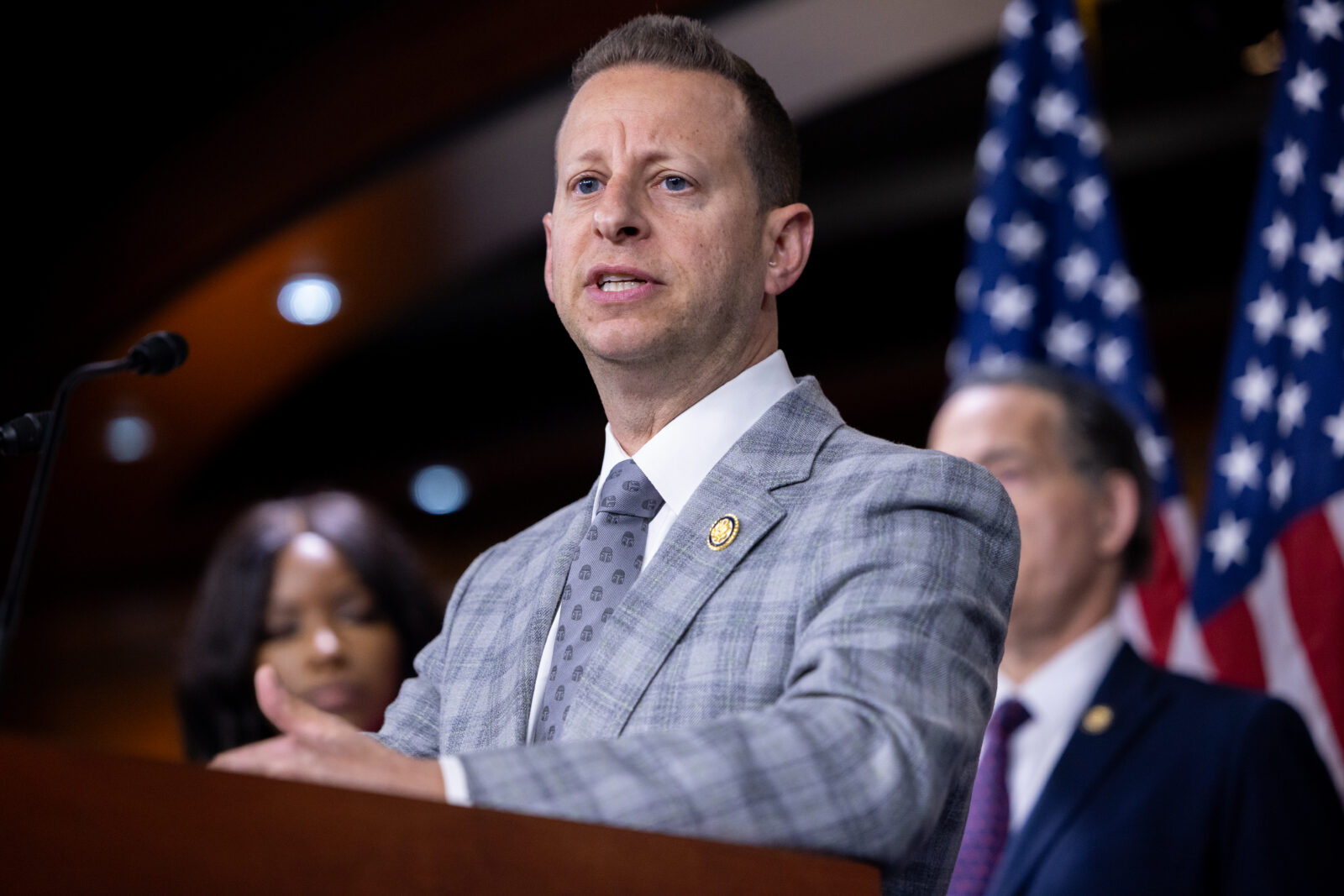
Nathan Posner/Anadolu via Getty Images
Rep. Jared Moskowitz: Pro-Israel Democrats are being ‘ostracized’ in the Democratic Party
He attributed much of the shift on Israel policy among his Democratic colleagues to bullying, harassment and threats from the anti-Israel camp


 Add JewishInsider on Google
For Rep. Jared Moskowitz (D-FL), the Democratic caucus has become an increasingly lonely place for those who remain staunchly pro-Israel, with what he described as bullying, harassment and threats from the anti-Israel camp contributing to the shift away from Israel in among Democratic lawmakers.
“What is it like to be in the caucus? It’s become lonely,” Moskowitz said during a wide-ranging interview with Jewish Insider in his Capitol Hill office last week. “None of my colleagues are mean to me, but it is an ostracizing feeling. There’s no doubt that the Democrats that are super pro-Israel, in general, feel somewhat ostracized, and how could you not?”
He said that the “mushy middle” of the party is being pushed left, explaining that he has had colleagues tell him that consultants have told them that, in order to win reelection, they’ll need to reject AIPAC or vote against pro-Israel legislation or express opposition to Israeli missile-defense systems.
“No one really loves family infighting,” he said. “For me, I’m fighting for what I believe in. For me, it’s not about the polling. I’ll go down on this issue. Ultimately, I’m not interested in moderating to try to win my election.”
He also attributed some of the shift to harassment and threats of violence targeting members, including Moskowitz being the target of an assassination attempt in 2024. Standing up for Israel, at this point, puts members’ families at risk, he said, and with that pressure coming exclusively from the anti-Israel side, it’s no surprise that some members are caving.
“I talk to members. They’re scared from all of this stuff. Not only are they scared, their spouses are scared, and do not underestimate the spouse in this congressional relationship,” he said. “The bullying is only happening one way. Members are getting bullied online. They’re getting bullied in the hallways. They come down the steps [from the House chamber], cameras get put in their face on this issue.”
Moskowitz said that, because he has refused to cave on this issue, he now needs armed security and police protecting him in his district — as do other outspoken members. He said that it’s important for members who have been outspoken, on both sides of the aisle, to be reelected.
“If you look at what’s happened to the Jewish community in two years, where are we in five? Where are we in five years? Are we going to lose an entire political party?” he asked.
And Moskowitz warned that he sees similar issues on the horizon in the Republican Party. “The Tucker [Carlson] wing of the [Republican] Party is ready to pounce. The only thing that’s keeping them at bay is Trump. … The fight you’re seeing that we’re having now, they are going to have on the right.”
The Florida congressman, asked about the upcoming Israeli elections, said that he believes that some of his Democratic colleagues have “backed themselves into a corner” by focusing their criticism on Israeli Prime Minister Benjamin Netanyahu.
“A lot of my colleagues, when they voted to cut off aid to Israel, both in the Senate and in the House, said, ‘Well, it was all about Netanyahu,’” he recounted. “My argument to them was, ‘At some point, he won’t be there. How are you going to go back to those voters who you’ve now courted because you cut off aid and go back to them saying, ‘Well I’m going to let the aid flow now because Netanyahu is gone?’”
As a result, he predicted that a loss for Netanyahu would do little to change Democratic discourse on Israel, noting that anti-Israel voices online have already begun to target other Israeli leaders as polling has suggested that Netanyahu may lose.
Moskowitz said that the recent outrage, from both progressive commentators and some of his colleagues, over his appointment as ranking member of the House Foreign Affairs Committee’s Middle East and North Africa subcommittee has been disproportionate to the position itself, and tinged with “veiled antisemitism.”
At the same time, Moskowitz argued that the appointment shows that pro-Israel Jews remain part of the Democratic “big tent” — at least for Democratic House leaders. He also noted that anyone on the committee — which includes several vocal critics of Israel — could have objected to the appointment, but chose not to.
“For me, this isn’t game theory. This is real,” Moskowitz said, emphasizing that his relatives fled the Holocaust in Europe. “Tough economic times in a country, wealth inequality — the Jews. It’s not a new playbook that’s being run on the community.”
“Not only does the big tent include pro-Israel Jews but we’re going to give them leadership spots on that issue,” he said.
He said that he sees criticisms of “Zionists” and of Israel as barely disguised attacks on the Jewish people as a whole — with the vast majority of American Jews being Zionists — drawing on historic tropes and patterns.
“For me, this isn’t game theory. This is real,” Moskowitz said, emphasizing that his relatives fled the Holocaust in Europe. “Tough economic times in a country, wealth inequality — the Jews. It’s not a new playbook that’s being run on the community.”
“If we don’t fix the affordability issue, antisemitism is going to continue to get worse,” he added. “For me, it’s intricately linked. It’s not our fault, but we are being made the scapegoat for all of these things. Flock cameras? Jews. AI? Jews. Can’t afford your groceries? Jews. If we don’t start fixing problems here, we’re going to be on the short side of that stick.”
His children, he said, will grow up in a different and more hostile America than he did, after the Jewish community had believed it was assimilated and safe.
“We assimilated in Spain. We assimilated in Germany. Never thought what could happen could happen, and we were expelled and exterminated in both of those countries,” he said.
He credited much of the rise in antisemitism and anti-Israel sentiment to malign foreign influence, particularly through coordinated bot campaigns on social media. He said that, if the Nazis had a tool like social media on their side during World War II, they likely would have won.
“Congrats to China and our foreign adversaries, who took an 80-20 issue and turned it into a 20-80 issue as an experiment in a petri dish that they can apply to Taiwan in the future,” Moskowitz said. “We’re just letting foreign adversaries decide how the American people are going to think on everything.”
He described social media platforms as deliberately blind to the problem — until similar tactics were applied to the issue of data centers, which could impact their bottom lines.
“When it comes to Israel, I want to see them treated like any other ally,” he continued. “If the idea is that the majority of our members want to cut off aid to Israel, then we’re going to have to look at all our other allies’ humanitarian records, and we’re going to have to treat them all the same. I look at that as calling balls and strikes, and getting into reality off of the internet.”
Moskowitz is favored to be chairman of the Middle East subcommittee next year if Democrats take the House, but he said he would still need to rally support on the committee to secure the seat. He said that ultimately House Minority Leader Hakeem Jeffries (D-NY) and Foreign Affairs Committee Ranking Member Greg Meeks (D-NY) would set the agenda for Democrats, but that he sees opportunities to use the post to strengthen U.S. ties with the Gulf and Mideast allies.
He called the decision to allow a Saudi nuclear energy deal to proceed without Saudi Arabia joining the Abraham Accords a “missed opportunity” and said it’s important to ensure that Gulf allies don’t try to appease Iran “because the Iran war now has gone south.”
“When it comes to Israel, I want to see them treated like any other ally,” he continued. “If the idea is that the majority of our members want to cut off aid to Israel, then we’re going to have to look at all our other allies’ humanitarian records, and we’re going to have to treat them all the same. I look at that as calling balls and strikes, and getting into reality off of the internet.”
The congressman also blasted those who blame Israel alone for the war in Iran, explaining that in conversations with ambassadors from the Gulf countries, “they were all supportive of this — all of them,” but are now “upset about the marketing and the branding of the war” and hiding from responsibility.
Moskowitz supported the administration’s 2025 strikes on Iran’s nuclear program, and opposed war powers efforts to block a U.S. attack on Iran before the war began earlier this year. But he has supported war powers resolutions since the war started, arguing that Congress must preserve its constitutional role in making war.
“I think the president made a mistake in hindsight. Think about it this way: In an alternative reality, had he come to Congress in the very beginning, it probably would have passed,” he said, “and then we would have owned it with him. He owns it all on his own.”
He said the administration underestimated Iran’s willingness to take the Strait of Hormuz hostage and to expand the war to attack Gulf allies, and overestimated the fragility of the Iranian regime.
Moskowitz also said that the administration has shifted and scaled back its goals, noting that Trump no longer emphasizes the need to remove enriched nuclear material from Iran, now focusing primarily on the Strait of Hormuz.
“We didn’t succeed on the terms he told people of why we were going. And so I think it was a completely failed strategy on prosecuting the war,” Moskowitz said, even as he said he’s glad that former Iranian Supreme Leader Ayatollah Ali Khamenei is dead, Iran’s navy has been destroyed and the Iranian nuclear program has been set back.
He said he does not want the war to become a long-term problem, but also said that he still does not want to see a deal that would provide Iran with substantial financial relief. “That has to be still the North Star. They cannot have a nuclear weapon. But mistakes that we have made to try to achieve that now could have long-term repercussions.”
Since beating Democratic Socialists of America member Oliver Larkin by nearly 30 points in his primary race, Moskowitz has gone on the offensive against the DSA and the surging socialist wing of the Democratic Party.
He said that he thinks mainstream Democrats need to recognize income inequality and other economic struggles that are driving young people toward the DSA, but also need to realize that the DSA is “awash in antisemitism” and a range of other unpopular and fringe ideas.
“There will be members here from the DSA, but they’ll be 5% of the caucus,” Moskowitz said. “What we can’t do is what the Republicans did with [former House Speaker] Kevin McCarthy. We can’t go make a deal with the DSA because then that deal will be held over the entire caucus for the next two years while we’re in power.”
He said that, despite being targeted with what he described as the “whole DSA apparatus” in his primary, he decided not to engage directly with his opponent, to not run negative ads and to try to keep the race local.
“I was going to deny these viral moments for them,” he said, arguing that other Democrats had erred by getting in direct fights with DSA opponents. “It was my belief that the voters would reject it without me having to spend a ton of money explaining to them why it was bad, and that’s what happened.”
He said his polling showed that Larkin’s stances were turning off voters and argued that his strategies “blew up in their face,” alienating older voters, Jewish voters and Hispanic voters.
“This is not a place that the DSA can win in, and they shouldn’t have done it because it made them look stupid,” Moskowitz said.
Moskowitz noted that he now enters the general election with $2 million, a substantial cash advantage over his Republican opponent, former Boca Raton Mayor Scott Singer, who is also Jewish.
He argued that his brand of politics and his past ties to former Gov. Ron DeSantis will help him win over independent voters in the general election, and highlighted his appeal with Jewish voters, among whom he vastly outperformed former Vice President Kamala Harris in the 2024 election. He noted that he doesn’t have to calibrate stances on the U.S.-Israel relationship in his district, but can instead express his honest views in a way that other Democrats can’t.
“This election between me and [Singer], on [Israel and antisemitism] in particular, is the difference between a vote versus a voice,” Moskowitz continued. “He’ll be a vote on pro-Israel. I’m not going to deny that. He will be a vote, but he won’t be a voice.”
Featured Stories

Please log in if you already have a subscription, or subscribe to access the latest updates.
 Continue with Google
 Continue with Apple