


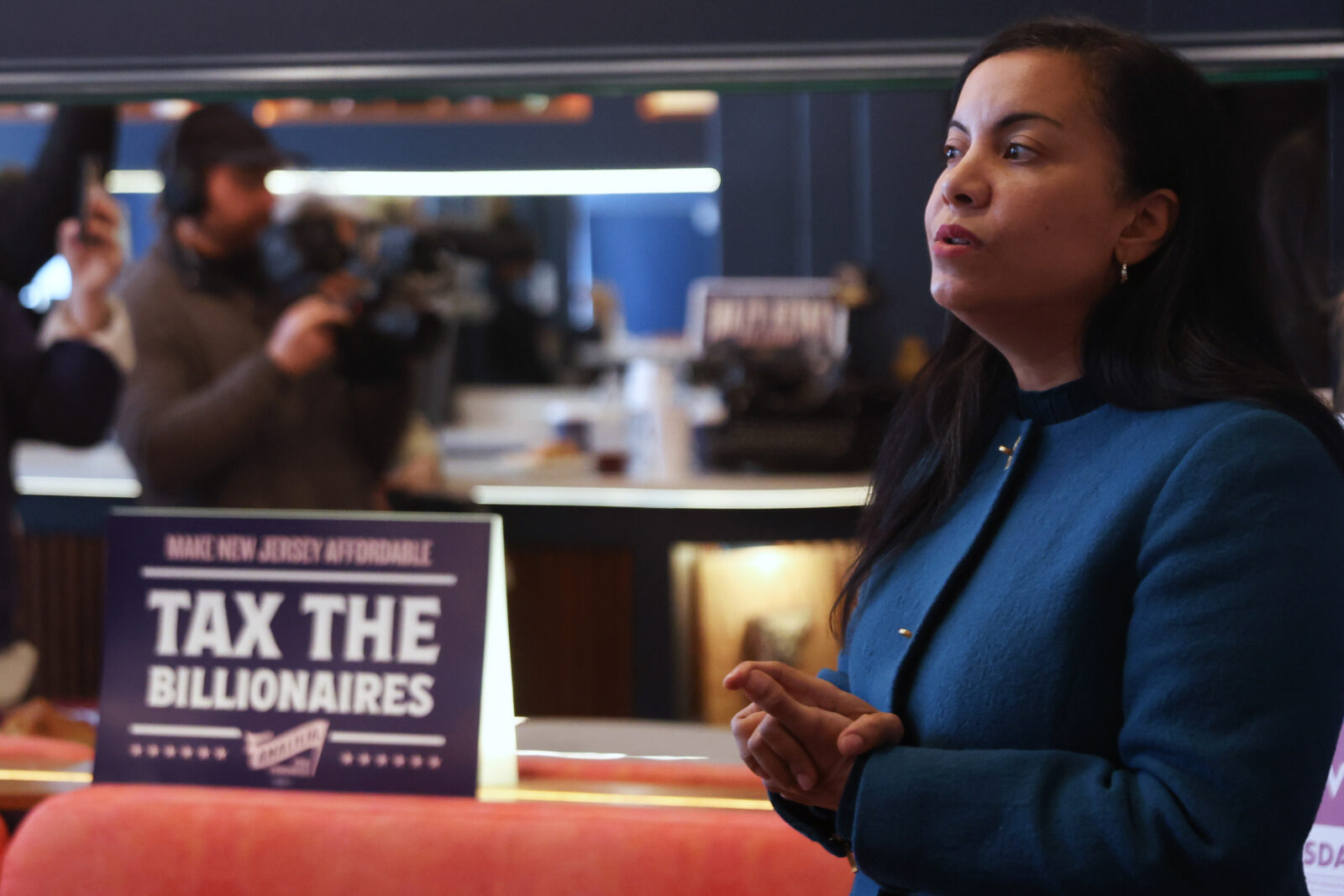
Heather Khalifa/Bloomberg via Getty Images
Will Democrats rally behind progressive activist Mejia as she vies to represent wealthy N.J. district?
Already several members of the state’s congressional delegation have begun to coalesce around Mejia’s campaign


 Add JewishInsider on Google
With progressive activist Analilia Mejia’s expected victory in the special election Democratic primary in New Jersey’s 11th Congressional District, attention is now turning to the upcoming April special general election and the June regular election primary as the last chances for moderates and pro-Israel groups to defeat her.
AIPAC’s super PAC, the United Democracy Project, which spent $2.3 million attacking former Rep. Tom Malinowski (D-NJ), said in a statement that its “focus remains on who will serve the next full term in Congress” and that it will be “closely monitoring … the June NJ-11 primary, to help ensure pro-Israel candidates are elected to Congress.”
Mejia is on track to receive less than 30% of the primary vote in a relatively moderate suburban district, creating an opportunity for a moderate candidate to challenge her. But several Jewish leaders, as well as a local analyst, said that that will be difficult to achieve.
“June is potentially irresistible for the other candidates who ran … if any of these candidates could get a one-on-one shot at making it in June,” Micah Rasmussen, the director of the Rebovich Institute for New Jersey Politics at Rider University, said. But unless the field can consolidate, Rasmussen said, it’s hard to see how the result would be any different in June.
Rasmussen said he doesn’t share the view of some Democrats that voters would be frustrated with a Democratic candidate who decides to challenge Mejia.
Though they haven’t formally endorsed her yet, other members of New Jersey’s congressional delegation appear to be coalescing around Mejia — Reps. LaMonica McIver (D-NJ), Bonnie Watson Coleman (D-NJ) and Rob Menendez (D-NJ) participated in a town hall focused on Immigration and Customs Enforcement organized by Mejia on Saturday, and Menendez — a relative moderate aligned with the state’s party machine — posted a photo with her on Sunday.
Malinowski has not yet conceded the race, but said during the primary that he would not run again in June if he lost. Essex County Commissioner Brendan Gill also does not plan to run again. That leaves the most likely moderate challenger as former Lt. Gov. Tahesha Way, who was endorsed by Democratic Majority for Israel and is believed to be AIPAC’s choice in the race.
Way is holding in third with 17% of the vote. Her campaign did not respond to a request for comment on whether she plans to run again.
Local Jewish leaders on Friday were generally pessimistic about the chances of taking Mejia down in the June primary — for the full term in Congress — but there could be a path to defeating the ascendant progressive.
“I sat on a debate stage with Analilia Mejia when she said that Israel has a right to exist, but not as a Jewish state,” Jeff Grayzel, a local Jewish leader who ran for the seat with ambitions of uniting the Jewish community behind his campaign, said. “It is said that Jews will be blessed when they stand together and will experience misfortune when they are divided. My pleas for Jewish unity in this race went unheeded. In my messaging to the Jewish community, I warned of a repeat of New York City in NJ-11, and this result is a consequence of a house divided. I pray our people can unify to find a path forward.”
Rasmussen said that Malinowski, who came closest to beating Mejia, would be the strongest candidate in a head-to-head race against Mejia in June, and Rasmussen said he could envision a scenario in which Malinowski ultimately took another shot at the seat despite his previous pledge not to.
“I think it’s a little bit tougher for Tahesha Way to do that,” Rasmussen said. “She would very clearly have outside spending with her. She’d very clearly have fundraising with her. But it’s a little tough to go from a 17% result to a majority result. We’ll see what happens. It doesn’t mean she shouldn’t think about it, she shouldn’t consider it, but it’s probably a stretch.”
Jeff Grayzel, a local Jewish leader who ran for the seat with ambitions of uniting the Jewish community behind his campaign, lamented Mejia’s victory as a disappointing development for supporters of Israel, and said the Jewish community needs to come together.
“I sat on a debate stage with Analilia Mejia when she said that Israel has a right to exist, but not as a Jewish state,” Grayzel said. “It is said that Jews will be blessed when they stand together and will experience misfortune when they are divided. My pleas for Jewish unity in this race went unheeded. In my messaging to the Jewish community, I warned of a repeat of New York City in NJ-11, and this result is a consequence of a house divided. I pray our people can unify to find a path forward.”
Though Mejia is well to the left of candidates that the district typically picks, Rasumussen said that it’s “hard to come up with a situation” where the district — drawn to favor Democrats with a highly motivated Democratic voter base in a midterm year — would become competitive for Republicans in the April 16 special general election to fill out the remainder of Gov. Mikie Sherrill’s House term.
“However, that’s not to say that Republicans won’t try,” Rasmussen said. “If I were a Republican who had the ability to invest resources, I would certainly be taking a very close look at this race on these next three elections that are going to be happening this year in this district, and trying to see if I can take advantage of the very particular circumstances.”
“I think it’s pretty clear why voters went to Mejia, and it’s not because she is a socialist or because she is the most left of any candidate in the race,” Micah Rasmussen, the director of the Rebovich Institute for New Jersey Politics at Rider University, said. “Voters were driven away from Malinowski because of that advertising. They did not view a machine candidate as a viable alternative. They saw Mejia as the candidate in the race who could most stand up to Trump … the candidate who had the clearest position on ICE.”
Rasmussen said that UDP’s advertising against Malinowski “very clearly … worked,” citing the significant drop in Malinowski’s share of the vote from the first early votes to be submitted — where he was receiving 60-70% of the vote — and votes submitted later in the cycle, as well as votes on election day.
“It’s pretty clear that the reason they went in [Mejia’s] direction is because she carved out a different position on ICE, which is very clearly on voters minds, and just convinced voters that she was the person who could best stand up to Trump, and that, it seems is what Democratic voters are looking for,” Rasmussen said.
He was skeptical of the narrative that the result was a sign of a broader voter appetite for socialist or socialist-adjacent policies in moderate suburban districts.
“I think it’s pretty clear why voters went to Mejia, and it’s not because she is a socialist or because she is the most left of any candidate in the race,” Rasmussen said. “Voters were driven away from Malinowski because of that advertising. They did not view a machine candidate as a viable alternative. They saw Mejia as the candidate in the race who could most stand up to Trump … the candidate who had the clearest position on ICE.”
The race also saw substantially higher turnout than most anticipated — surpassing 2024 primary turnout levels in not just the 11th District but every congressional district in New Jersey, according to Rasmussen — a sign of strong Democratic motivation to vote, likely spurred by President Donald Trump.
Gill’s fourth-place finish — despite entering the race as the favorite given the backing he received from New Jersey Democratic institutions — is a clear signal that the state’s Democratic machine has largely lost its ability to shape elections to its will, Rasmussen added.

Please log in if you already have a subscription, or subscribe to access the latest updates.
 Continue with Google
 Continue with Apple