Joe Raedle/Getty Images
‘Confused young groypers’: Jewish Republicans reckon with resurgent antisemitism on the right
President Donald Trump, called by his Jewish supporters ‘the most pro-Israel president in history,’ won’t lead the party forever. So what will come next?


 Add JewishInsider on Google
During a talk at a Turning Point USA event at the University of Mississippi last month, Vice President JD Vance listened carefully as a student took the microphone and asked him a question grounded in antisemitic tropes. Vance took the question at face value, declining to push back.
“I’m a Christian man, and I’m just confused why there’s this notion that we might have owed Israel something, or that they’re our greatest ally,” the questioner began. “I’m just confused why this idea has come around, considering the fact that not only does their religion not agree with ours, but also openly supports the prosecution [sic] of ours.”
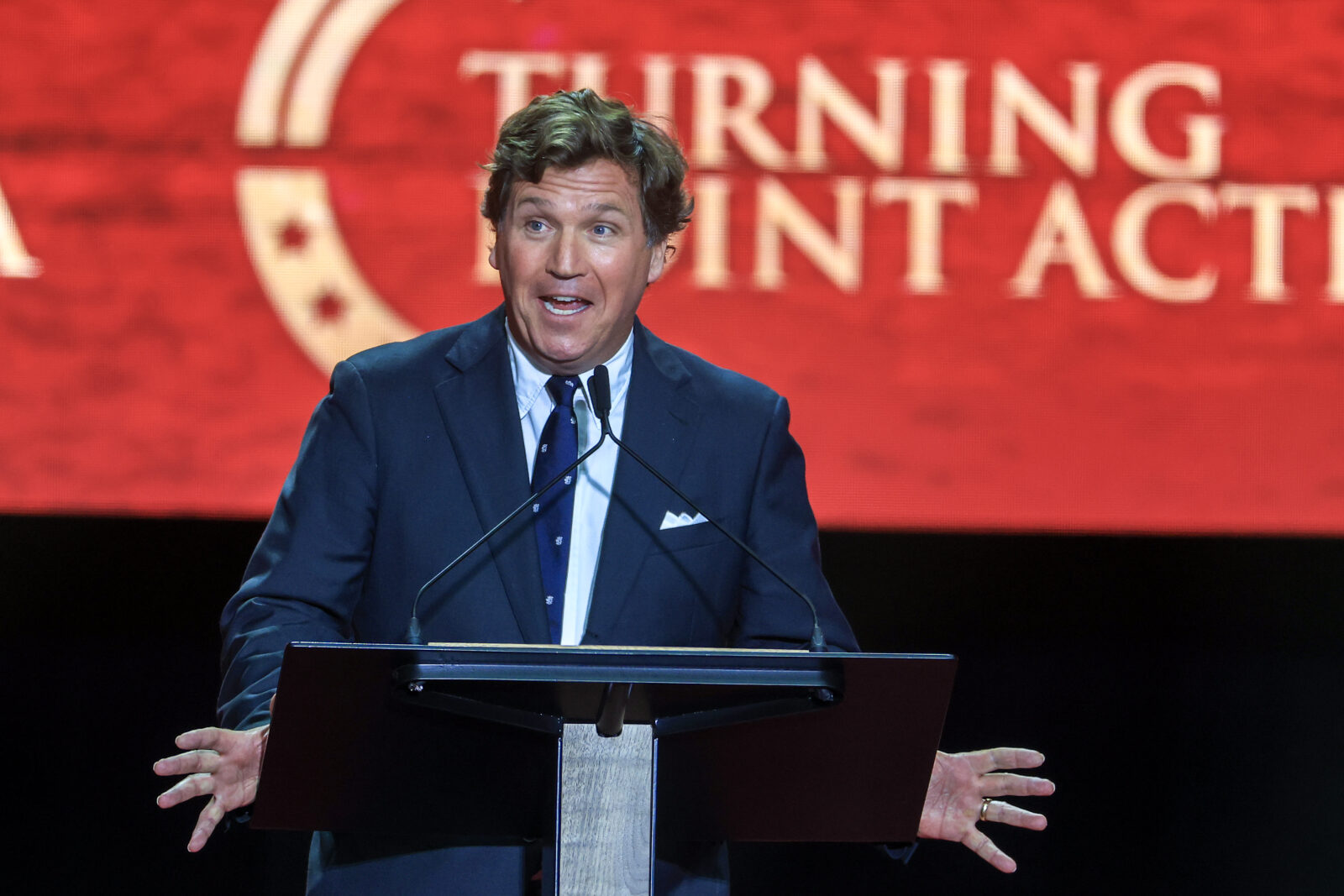
The exchange came soon after right-wing podcaster Tucker Carlson hosted neo-Nazi provocateur Nick Fuentes for a decidedly friendly interview, a shocking but not altogether surprising cultural moment that catapulted an intra-party rift into the open: a shift among a small but growing contingent of young conservatives away from Israel and, increasingly, into a conspiratorial worldview that holds the Jewish state — and Jews — responsible for the world’s ills.
The question facing party leaders is just how deeply this perspective has rooted itself among the right and how to deal with it: whether to fight it, accept it or stay quiet and hope it disappears.
Vance’s response at the Turning Point event sparked concern among Jewish conservatives about how a potential future GOP presidential nominee plans to deal with a growing segment of the political right that is not just critical of Israel but of Jews — and why he has been willing to make excuses for the bigotry of some of his supporters. Last month, Vance called criticism of scores of racist and antisemitic messages in Young Republicans group chat “pearl clutching.” And earlier this month, after many conservatives spoke out against Carlson’s interview with Fuentes, Vance decried what he deemed “infighting” calling it “stupid.”
Until Sunday, President Donald Trump had avoided the maelstrom of the last several weeks, which saw the venerable Heritage Foundation devolve into chaos after its president, Kevin Roberts, defended Carlson following the Fuentes interview. But Trump entered the fray for the first time on Sunday when he was asked by a reporter what role Carlson should play in the conservative movement after hosting “antisemite Nick Fuentes” — and responded with praise for Carlson.
“I found him to be good. I mean, he said good things about me over the years. I think he’s good,” Trump said. “You can’t tell him who to interview. I mean, if he wants to interview Nick Fuentes, I don’t know much about him, but if he wants to do it, get the word out. People have to decide.” Trump dined with Fuentes and Kanye West, also an avowed antisemite, at his Mar-a-Lago resort in 2022, though Trump has insisted that he didn’t invite Fuentes, but rather that Fuentes tagged along with West.
Pro-Israel Republicans have generally been willing to dismiss Trump’s connection to Carlson — Trump appeared on Carlson’s podcast during the campaign last year soon after the former Fox News host platformed a well-known Holocaust denier — because of what they describe as Trump’s pro-Israel bona fides.
“It’s a ridiculous conversation to be having, because nobody should doubt where the president stands on this,” Republican Jewish Coalition CEO Matt Brooks told Jewish Insider on Monday. “Donald Trump has zero tolerance when it comes to antisemitism.” Brooks, who is highly critical of Carlson, categorized Trump’s comments as “an omission in his remarks on an airport tarmac.”
Earlier this month, at the RJC conference in Las Vegas, Republican fundraiser Eric Levine told JI that he has concerns about Vance, though he added that those concerns are balanced out by the fact that Trump remains “the most pro-Israel president in the history of the country.”
“I was disappointed in JD Vance’s response, particularly as part of the Trump administration, which is so pro-Israel, so pro-Jewish,” Levine said. “This notion of this outsized influence that Jews have is disturbing, and I would have thought that the vice president could have done a better job, could have been clearer on that point.”
Yet Vance’s rhetoric, coupled with his ties to the more isolationist wing of the Republican Party, has frustrated even some of his Jewish backers, who want to see him do more to disavow the fringe, conspiracist right.
“This [anti-Israel] sensibility has been gaining ground on the right for several years now, and I count myself as one of those who has been warning about it and is worried. But the antisemitic part of it is relatively new,” Peter Berkowitz, who served as a senior State Department official in Trump’s first term, told JI. “It’s high time for those great adepts of social media, President Trump and Vice President Vance, to take to social media and weigh in.”
“I admire and support JD Vance, but his response to that question was disappointing,” said David Brog, a conservative activist who leads the Maccabee Task Force, an organization focused on fighting the Boycott, Divestment and Sanctions movement targeting Israel. “He knows better. He is the vice president of the United States now. He doesn’t need to please the confused young groypers” — a term used by Fuentes’ acolytes to describe themselves. “He needs to step up, lead and teach them the right path forward.”
Andrew Day, an editor at The American Conservative, a magazine identified with more isolationist strains of the right, called Vance “the clear favorite of a growing faction on the right that favors realism and restraint in foreign policy, a faction generally hostile toward Israel,” while noting that his “pro-restraint views have long accommodated sympathy for the Jewish state,” so he won’t entirely alienate pro-Israel Republicans. Vance has written for the magazine, and Carlson sits on its advisory board.
“This [anti-Israel] sensibility has been gaining ground on the right for several years now, and I count myself as one of those who has been warning about it and is worried. But the antisemitic part of it is relatively new,” Peter Berkowitz, who served as a senior State Department official in Trump’s first term, told JI. “It’s high time for those great adepts of social media, President Trump and Vice President Vance, to take to social media and weigh in.”
The White House did not respond to a request for comment, and a spokesperson for Vance declined to comment for this article.
Vance’s sympathy toward a more transgressive younger generation of conservatives is an outgrowth of that contingent’s expansion in the party. How widely that worldview has percolated is not fully known: conservative writer Rod Dreher recently estimated that 30 to 40% of young Republican staffers in Washington “are fans of Nick Fuentes,” while journalist Emily Jashinsky wrote at the conservative website UnHerd that the “number is high, but not nearly as high as 30-40%.”
What is not disputed is that among Gen Z conservatives, old dogmas, like support for Israel, are no longer accepted at face value. In the weeks after TPUSA founder Charlie Kirk’s murder, several well-known figures on the right, particularly in the podcasting sphere where Carlson operates, have attempted to recast Kirk as critical of Israel. In a letter sent to Israeli Prime Minister Benjamin Netanyahu earlier this year, Kirk was clear about the trend lines: “Israel is losing support even in conservative circles. This should be a 5 alarm fire,” he wrote.
But Jewish Republicans see an issue bigger than just a shift away from Israel among some Republicans who are skeptical of American involvement overseas, particularly in the aftermath of the invasion of Iraq two decades ago. They also see an antisemitism problem, in addition to an apathy problem — or, perhaps more accurately, a fear factor — among leaders who are wary of taking on an increasingly radicalized young generation.
“It wouldn’t be accurate to say the right is inherently antisemitic, or that being anti-Israel is endemic on the right,” said Tamara Berens, a conservative writer in Washington who wrote an article in early 2023 outlining the growth of antisemitism on America’s far right. “I think what’s endemic is the platforming and the excusing of antisemitic figures.”
“You’re going to get debates about where America’s long-term interests truly lie and where they don’t, and that’s where I think you get a very hot debate,” said Rusty Reno, editor of First Things, a prominent Christian magazine. “Certainly because of the Gaza war, it became a very heated debate about whether or not the U.S. has an interest in a strong alliance with Israel.”
A June Quinnipiac poll found that 64% of Republicans sympathized more with Israelis than Palestinians — a far higher number than Democrats, but a decrease from November 2023, when 80% of Republicans were more sympathetic to Israel. And that drop in support has come alongside “flirt[ing] with antisemitism,” said Maccabee Task Force’s Brog.
“It’s a new era, certainly when it comes to the conversation about where the guardrails are, if there are any remaining on the broader right,” said Josh Hammer, a conservative activist and lawyer. “There are a lot of young folks on the right who have been infected with varying degrees of this mind virus.”
As the editor of First Things, a prominent Christian magazine, Rusty Reno is aware of the anti-establishment sentiment growing among young conservatives. He attributes much of that to an emerging “consensus that we need to revise and fundamentally rethink our global commitments,” Reno told JI.
“You’re going to get debates about where America’s long-term interests truly lie and where they don’t, and that’s where I think you get a very hot debate,” Reno explained. “Certainly because of the Gaza war, it became a very heated debate about whether or not the U.S. has an interest in a strong alliance with Israel.”
Reno said he believes some of the concern about rising antisemitism has brought about a “hysterical response,” although he acknowledged that it is not “just this internet nonsense.”
“It does exist, and I’ve heard people say things that shocked me in some circles on the right,” Reno said. “It’s difficult for me to interpret in young people the extent to which they say things performatively, to demonstrate to each other their bona fides as not captive to the baby boomer mentality, and how much of it is real, or something I should worry about.”
Even staunch backers of Trump’s agenda now acknowledge that they can no longer ignore the fact that something has begun to shift among some hardcore conservatives.
“I don’t think Republicans should make the same mistake that Democrats made and allow themselves to be eaten by a radical fringe, which inevitably means you start losing elections,” said the Foundation for Defense of Democracies’ Rich Goldberg, who until recently served as a senior advisor at the Department of Interior.
“I do not think that is reflective of the party as a whole, by any stretch of the imagination. I think that it is, with respect to the adults in the room, still fringe,” Sandra Hagee Parker, the chair of Christians United for Israel Action Fund, told JI. “But I think that the issue is that we have to be aware of what’s happening in this young generation and be prepared to respond to that.”
The party now finds itself at a crossroads as Republican leaders consider how to deal with a small but vocal antisemitic fringe.
“I don’t think Republicans should make the same mistake that Democrats made and allow themselves to be eaten by a radical fringe, which inevitably means you start losing elections,” said the Foundation for Defense of Democracies’ Rich Goldberg, who until recently served as a senior advisor at the Department of Interior.
It is certainly not a foregone conclusion that the party will fully cede to that perspective. Sen. Ted Cruz (R-TX) has spoken out sharply against Carlson recently, including in a recent speech calling on his Republican colleagues to criticize the popular podcaster. By going after Carlson, Cruz may be positioning himself for a 2028 presidential run, Axios reported this week.
Trump is in his second term, and the Republican Party — which has been shaped almost exclusively by Trump for the last decade — will eventually have a new figurehead. Whether that is Vance or someone else remains to be seen, with two years before presidential primary season begins. But the fight that is playing out now is not one that Trump will be able to contain forever.
“What these guys are fighting for is not MAGA. It’s fighting for the next thing,” said David Reaboi, who operates a national security communications firm. “They don’t care if he’s MAGA or not. They’re very happy to hand over MAGA at this point.”
Featured Stories
Cognetti’s campaign
Paige Cognetti running in Josh Shapiro’s footsteps in key Pa. swing district

campus beat
University of Washington to host radical anti-Israel activists at Palestinian advocacy conference