


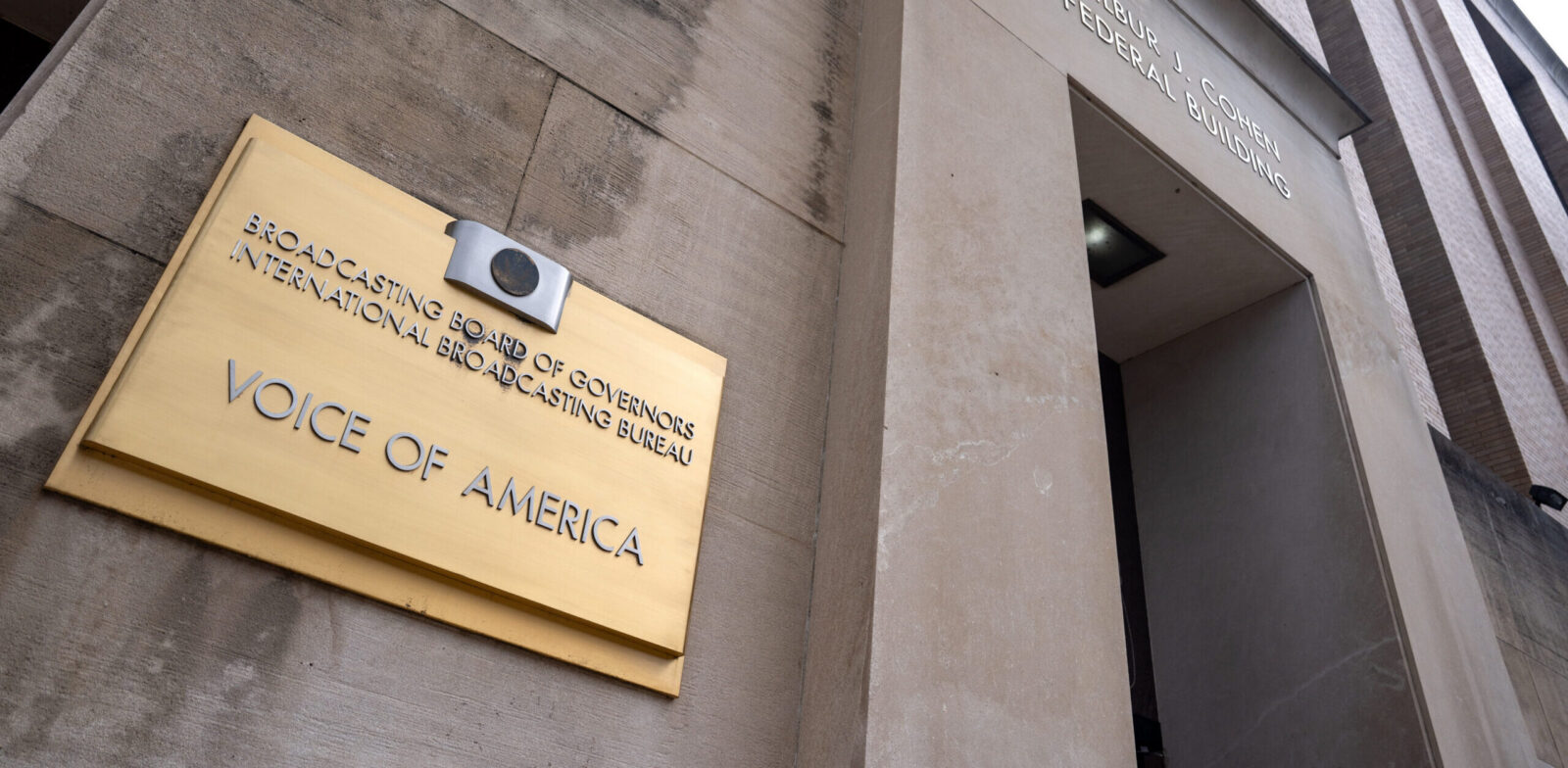
Kent Nishimura/Bloomberg via Getty Images
Court ruling reviving VOA sparks cautious hope for expanded Iran coverage
The international broadcaster, along with Radio Free Europe, has struggled to deploy its Persian-language services to provide coverage amid an internet blackout in Iran


 Add JewishInsider on Google
A federal judge’s ruling this week that voided the Trump administration’s efforts to shutter Voice of America, restoring more than 1,000 journalists and other employees by Monday, is raising some hopes that the embattled international broadcaster funded by the federal government may now be able to ramp up its Persian-language coverage to reach Iranians at a crucial moment amid war with the U.S. and Israel.
While VOA had resumed some of its Persian news broadcasting in recent months, it has been hobbled by a yearlong near shutdown ordered by the Trump administration that had reduced the organization to a skeletal staff — further battered by the tumultuous tenure of Kari Lake, who until recently served as the de facto leader of the U.S. Agency for Global Media, which oversees the network.
In a separate ruling earlier this month, the judge ordered that Lake’s appointment as acting chief had been unlawful and nullified her aggressive moves to gut VOA. President Donald Trump last week nominated Sarah Rogers, a senior State Department official, to take over USAGM — a position that requires Senate confirmation which Lake never received. The Department of Justice has not confirmed if it will seek to appeal the latest ruling.
One USAGM source expressed optimism that the judge’s decisions would result in “more resources,” but cautioned that “there are still leadership issues” in the Persian service — once one of VOA’s largest divisions — stifling its ability to report exhaustively on news developments and offer coverage without the appearance of bias.
The Persian division — whose content had seen a growing audience among Iranian news consumers before the shutdown, according to a VOA fact sheet — is now led by Ali Javanmardi, an Iranian Kurdish journalist who has drawn scrutiny for censoring the outlet’s reporting on Iranian opposition figures such as Reza Pahlavi, the exiled crown prince who gained renewed prominence amid mass protests that swept the country prior to the war. One journalist with the Persian service said this month he was fired because of disagreements with leadership over the network’s direction.
The editorial constraints and massive cuts to VOA’s stable of full-time reporters not only “decimated the Iran division” but also “politicized it at a time when it is more important than ever for the United States to be speaking directly to the Iranians,” the USAGM source told Jewish Insider before the recent rulings, speaking on the condition of anonymity to discuss a sensitive issue. “It’s a shame what has happened.”
Now, as the joint U.S.-Israeli military campaign in Iran continues amid a near-total internet blackout imposed by the country’s regime, the need to reach information-starved Iranians has only grown more urgent, several experts familiar with the matter told JI.
But there are ongoing concerns that VOA as well as a federally funded but independent network, Radio Free Europe/Free Liberty, which operates a Persian service called Radio Farda, will continue to struggle due to government roadblocks that have obstructed their ability to produce meaningful stories and even to transmit broadcasts that Iranians have viewed as trusted sources during previous domestic conflicts.
“By adhering to the truth, U.S. international broadcasting can be a powerful tool in America’s arsenal, particularly in Iran where RFE/RL and VOA have strong brands and audiences,” Jamie Fly, who led RFE/RL from 2019-2020 and now serves as chief executive of Freedom House, a think tank promoting global democracy, told JI on Thursday.
Under current management, however, USAGM “seems to be doing everything possible to ensure that President Trump’s messages to the Iranian people are not heard, and in some cases, directly contradicted,” Fly added.
RFE/RL, which Lake tried but failed to shut down, has faced a litany of obstacles that have particularly diminished Radio Farda’s broadcasting presence in Iran. In addition to withholding funding that forced its Persian service to furlough half of its staff, Lake’s efforts to target the network included cutting access to a key U.S. transmitter in Kuwait that allowed it to disseminate its broadcasts in Iran and inhibiting the use of virtual private networks that help circumvent internet shutdowns, among other hostile moves.
According to an RFE/RL source, USAGM “is still asking that” the network “use its own grant” resources to broadcast via short and medium wave radio from the Kuwait transmitter — which is federally funded. USAGM “resumed transmissions of Radio Farda” on shortwave in early February and medium wave in early March, the source told JI. The network has additionally paid for satellite as well as short and medium wave transmissions using its “own grant funds already through private vendors.”
“As the internet remains unstable” in Iran, the source said, “our journalists have been able to conduct interviews with and receive updates from Iranians on the ground only periodically.”
Despite such issues, Farda “continues to garner a significant audience online,” the source told JI. From Feb. 28 to March 17, for instance, “Farda published 738 posts on Instagram, recording 105.5 million impressions and 28.6 million video views.”
Even as the organization has managed to bypass some impediments to its operations, another RFE/RL source described intense frustration with USAGM, calling its oversight “dysfunctional” as the agency has sought to exert its control over a network that — unlike VOA — is not a government entity.
“They have no plan,” the source said on condition of anonymity to avoid reprisals. “There’s no strategy.”
USAGM “could and should be more cooperative when Iran blocks” internet access, the source told JI this week. “We should all be surging into Iran now,” where RFE/RL has learned that university students in the country have been “sharing shortwave radios to hear” its broadcasts amid the war.
USAGM did not respond to a request for comment. On social media, Lake has otherwise touted VOA’s efforts to reach Iranians, despite criticism that she has hampered its resources and diluted its Persian coverage — which she wrote in one recent post that she had tried to “realign” with “U.S. foreign policy.”
Experts raised doubts about the possibility of an imminent news surge into Iran even if the judge’s recent ruling is expected to soon restore VOA to its pre-shutdown capacity. As USAGM maintained an adversarial posture toward VOA, RFE/FL and other federally funded nonprofit groups, it still remains to be seen if Rogers, the nominee to succeed Lake, will change direction. Lake, meanwhile, has pledged she will appeal the ruling invalidating her role and said that she will continue at USAGM as its deputy CEO.
Amid the changes, Ilan Berman, an Iran expert at the American Foreign Policy Council who serves on the board of RFE/FL, told JI in an interview that he was “cautiously optimistic there is going to be more coherence to administration” inside USAGM, after a year in which he questioned its “strategic mission.”
During Lake’s tenure, “there was no coherence to the informational enterprise” except for a “focus on disruption,” Berman noted. “The people who suffer are the people of Iran.”
Featured Stories
Please log in if you already have a subscription, or subscribe to access the latest updates.
 Continue with Google
 Continue with Apple