


Alexander KAZAKOV / POOL / AFP via Getty Images
Josh Gruenbaum’s rapid rise from overseeing federal contracting to dealmaking on the world stage
Gruenbaum started working with Steve Witkoff and Jared Kushner on Middle East diplomacy after the ceasefire between Israel and Hamas took effect in October


 Add JewishInsider on Google
Josh Gruenbaum’s Thursday started in Davos, Switzerland, at the signing ceremony to inaugurate President Donald Trump’s Board of Peace. Gruenbaum walked onto the World Economic Forum stage where Trump sat, surrounded by world leaders, to hand the president the board’s first resolution — focused on the demilitarization and reconstruction of Gaza — for him to sign.
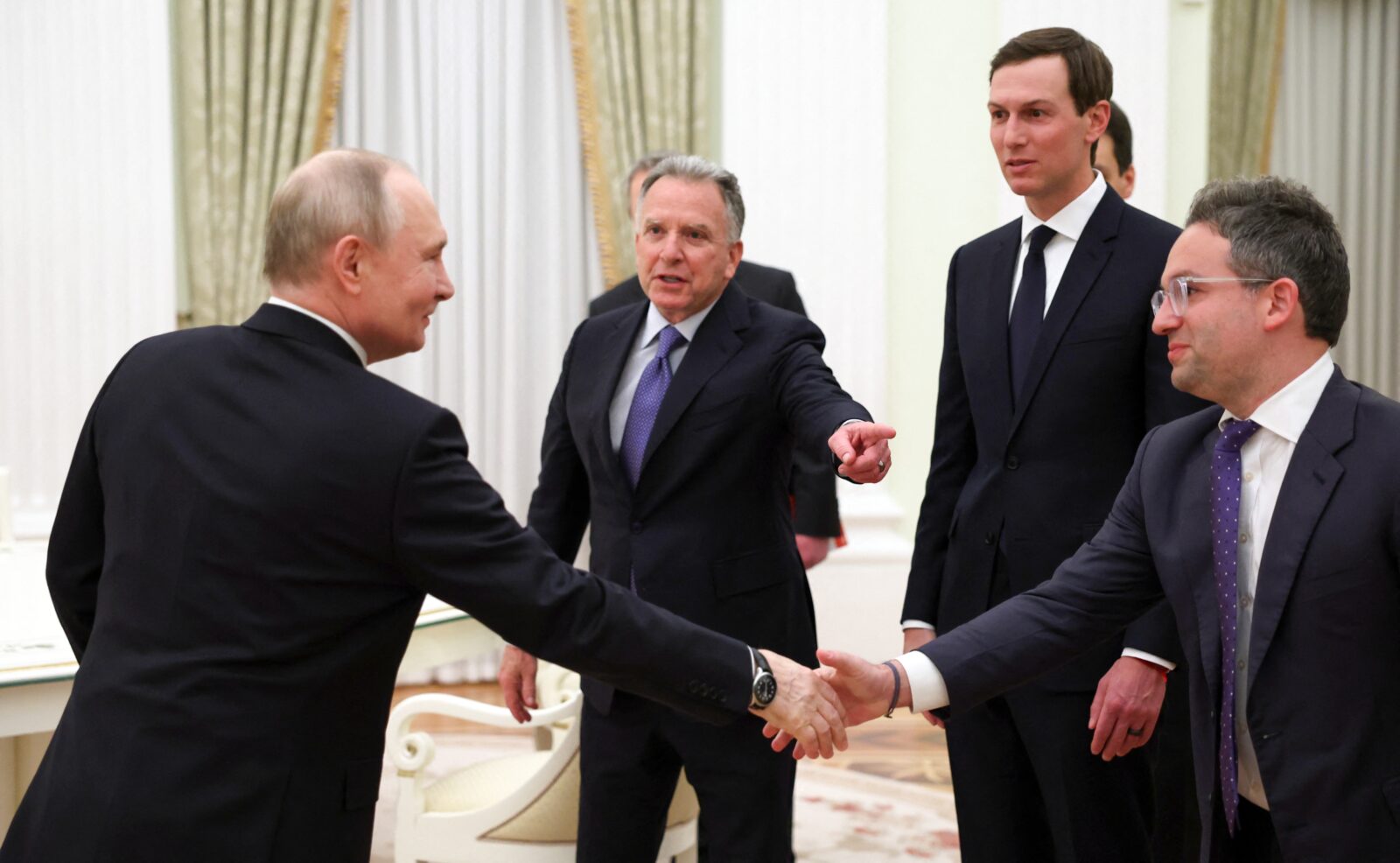
Hours later, Gruenbaum’s day ended at the Kremlin in Moscow, alongside the two men most closely associated with Trump’s unorthodox brand of foreign policy dealmaking: White House Special Envoy Steve Witkoff and advisor Jared Kushner.
“This is Josh,” Witkoff told Russian President Vladimir Putin as he shook Gruenbaum’s hand at the start of their meeting, a video feed from the Kremlin showed. The men sat down just before midnight. The overnight meeting lasted four hours, ahead of planned security talks between Russia, the U.S. and Ukraine in Abu Dhabi today.
Gruenbaum is a relatively new figure on the diplomatic scene. He started working with Witkoff and Kushner soon after the ceasefire between Israel and Hamas took effect in October. Since then, he’s been spotted in meetings with Israeli Prime Minister Benjamin Netanyahu and Ukrainian President Volodymyr Zelensky. Earlier this month, Gruenbaum was named a diplomatic advisor to the new Board of Peace, which the Trump administration is reportedly envisioning as a replacement to the United Nations.
It’s a somewhat surprising turn for Gruenbaum, whose expertise is not diplomacy or foreign policy but investment banking. But with his business background, Gruenbaum fits in with Witkoff and Kushner, both of whom come from the real estate world. His rise underscores how the Trump administration is reshaping the machinery of government by elevating loyalists with private-sector backgrounds and expanding their portfolios far beyond traditional lanes.
Gruenbaum first joined the Trump administration last year as commissioner of the Federal Acquisition Service, a little-known agency within the General Services Administration that oversees federal contracting. He told Jewish Insider last March that the role allowed him to take a DOGE-like approach to cost-cutting. It was also a perch that allowed him to be involved with federal antisemitism policy, and he quickly joined the federal antisemitism task force.
Gruenbaum’s hypothesis was that government contracts are an effective venue for the Trump administration to exert its influence. So if the government has contracts with, say, a university, then the government can apply pressure to ensure that university complies with federal civil rights laws — a strategy that was used frequently last year to target billions of dollars in federal research funding going to universities that the White House alleged were not appropriately committed to fighting antisemitism.
“I come from a community where Jewish values and the Jewish religion were very important. That is part and parcel to how I was raised and how I think about the world and where I get my moral compass from,” Gruenbaum told JI last year.
He grew up in an Orthodox Jewish community and studied at a yeshiva, before working in his father’s food importing business and then earning a law degree and MBA from New York University. He most recently worked at the private equity firm KKR before moving to Washington last year.
In his role at FAS — a position he still holds, while also flitting between world capitals — Gruenbaum practiced the Washington maxim of making yourself useful, and making your presence known. He undertook a multibillion dollar review of federal contracts. Last fall, he worked on the Trump administration’s higher education compact, an attempt to get universities to sign onto a White House pact in order to get preferential access to federal funds. (No universities have yet agreed to it.)
Now he is also a senior advisor to the president.
Please log in if you already have a subscription, or subscribe to access the latest updates.