


Daniel Boczarski/Getty Images for People's Action
Illinois Democrat Robert Peters pivots from AIPAC outreach to anti-Israel crusade
The far-left state senator is now making his attacks against the pro-Israel group a central message of his campaign


 Add JewishInsider on Google
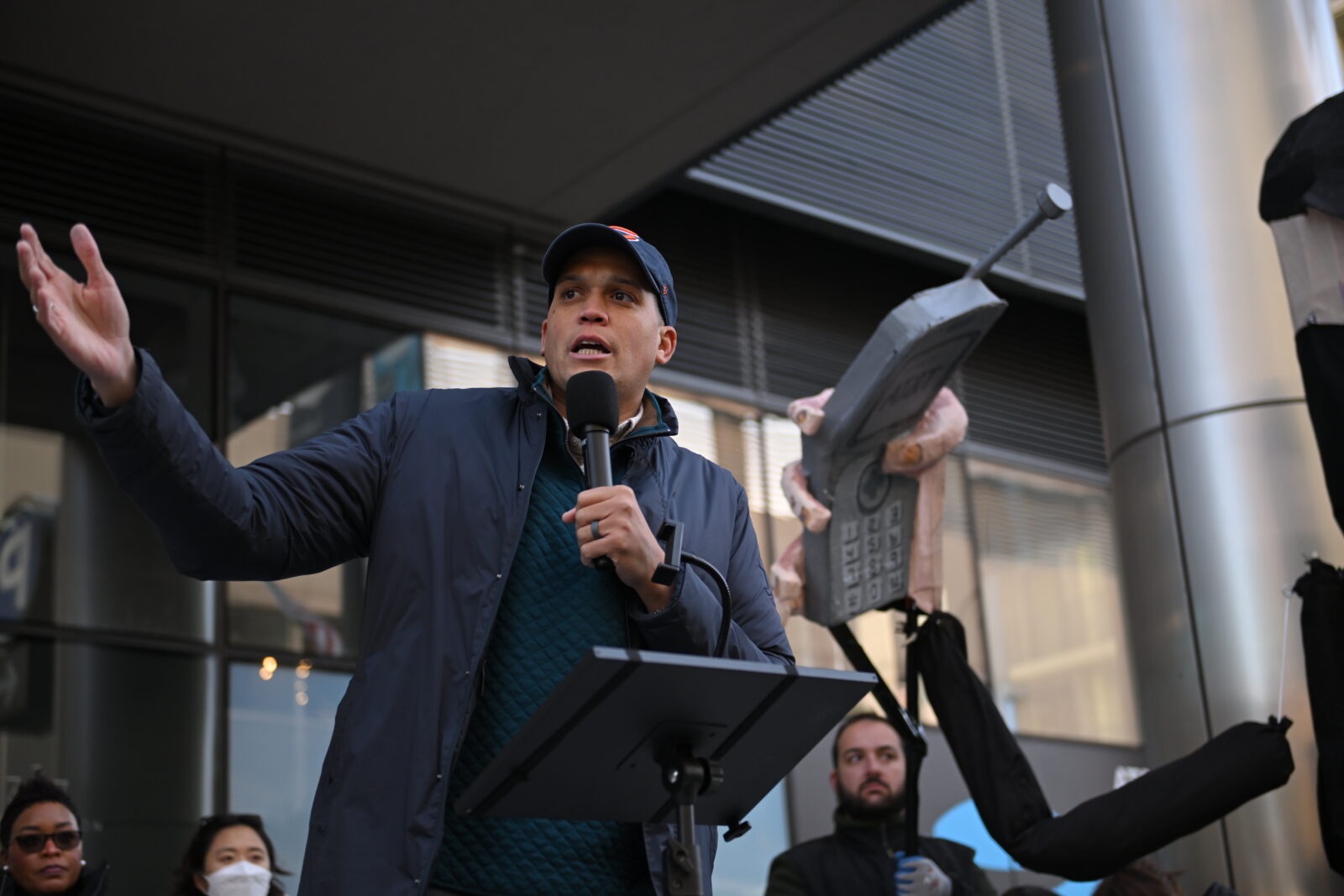
Robert Peters, a far-left state senator from Illinois who is now competing in a crowded Democratic primary for a safely blue Chicago-area House seat, has made anti-AIPAC messaging a central focus of his campaign, castigating the pro-Israel group as a corrupting force in congressional elections funded by Trump-aligned interests scheming to promote a “right-wing agenda.”
Just last week, for instance, Peters joined forces with a coalition of progressive House candidates in Illinois to decry AIPAC’s recently reported political engagement in key congressional races in the state, claiming that anyone who accepts support from the group will become “a ‘yes man’ to Trump donors to commit unspeakable horrors in another part of the world.”
Not long after he had launched his campaign last year, however, Peters met privately with an AIPAC official in Chicago and then filed an Israel position paper at the group’s request, according to a person with close ties to the organization who reviewed the document at the time it was submitted.
The behind-the-scenes engagement — rumors about which have circulated among Peters’ opponents — raises questions about the sincerity of his hostile rhetoric toward AIPAC as he now is building support from prominent Israel critics.
Most likely, the source familiar with the matter suggested to Jewish Insider this week, Peters was “seeking AIPAC’s good grace” in a strategic effort to preempt attacks from its super PAC, United Democracy Project, which often targets candidates who stray from pro-Israel messaging.
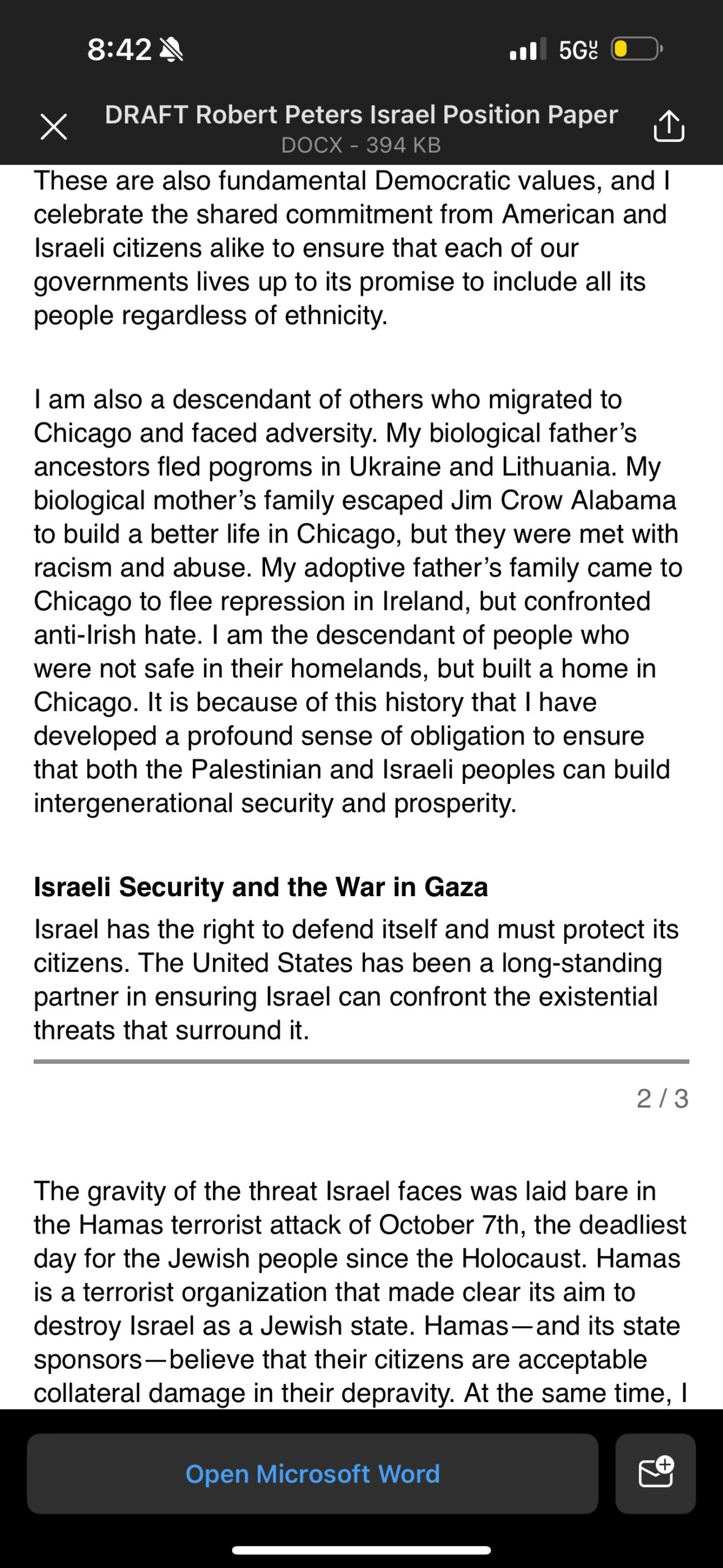
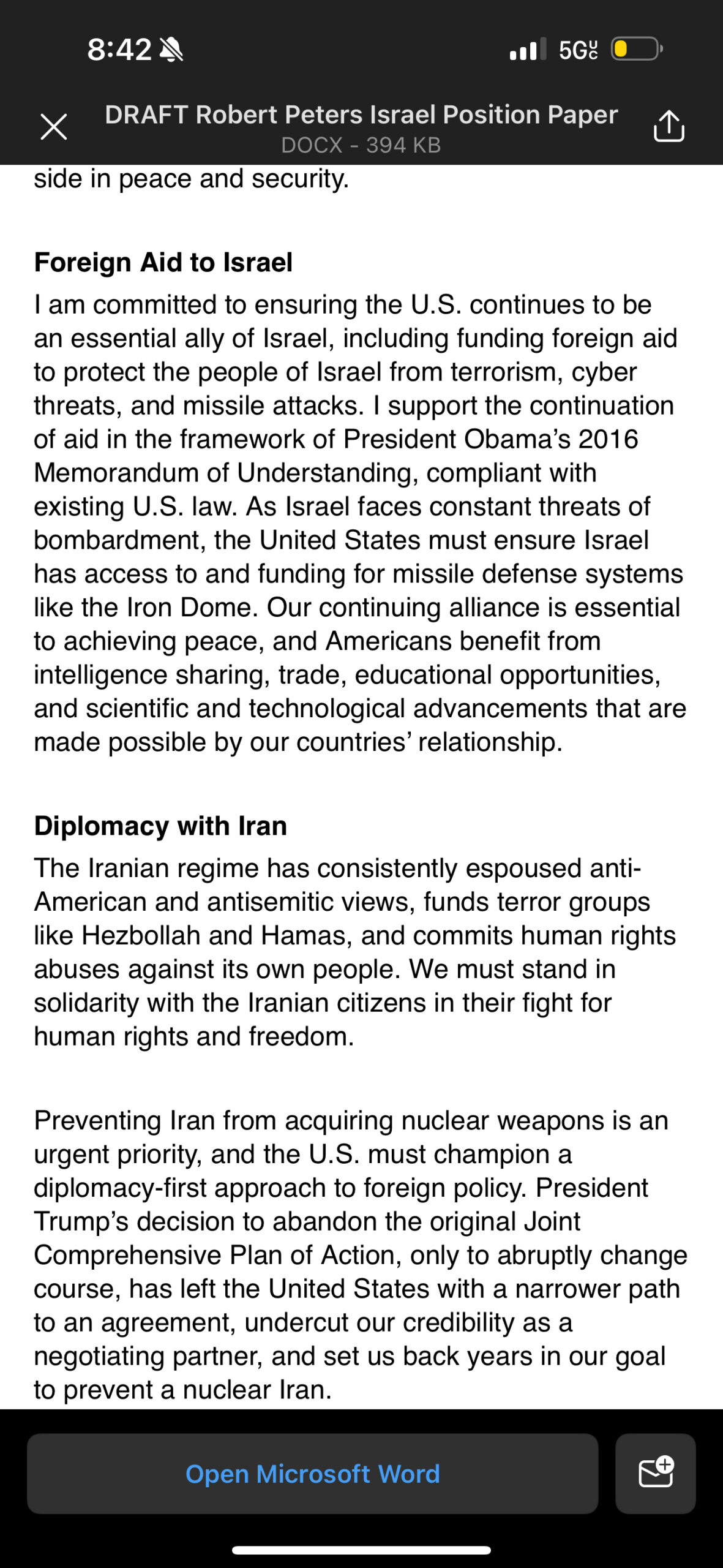
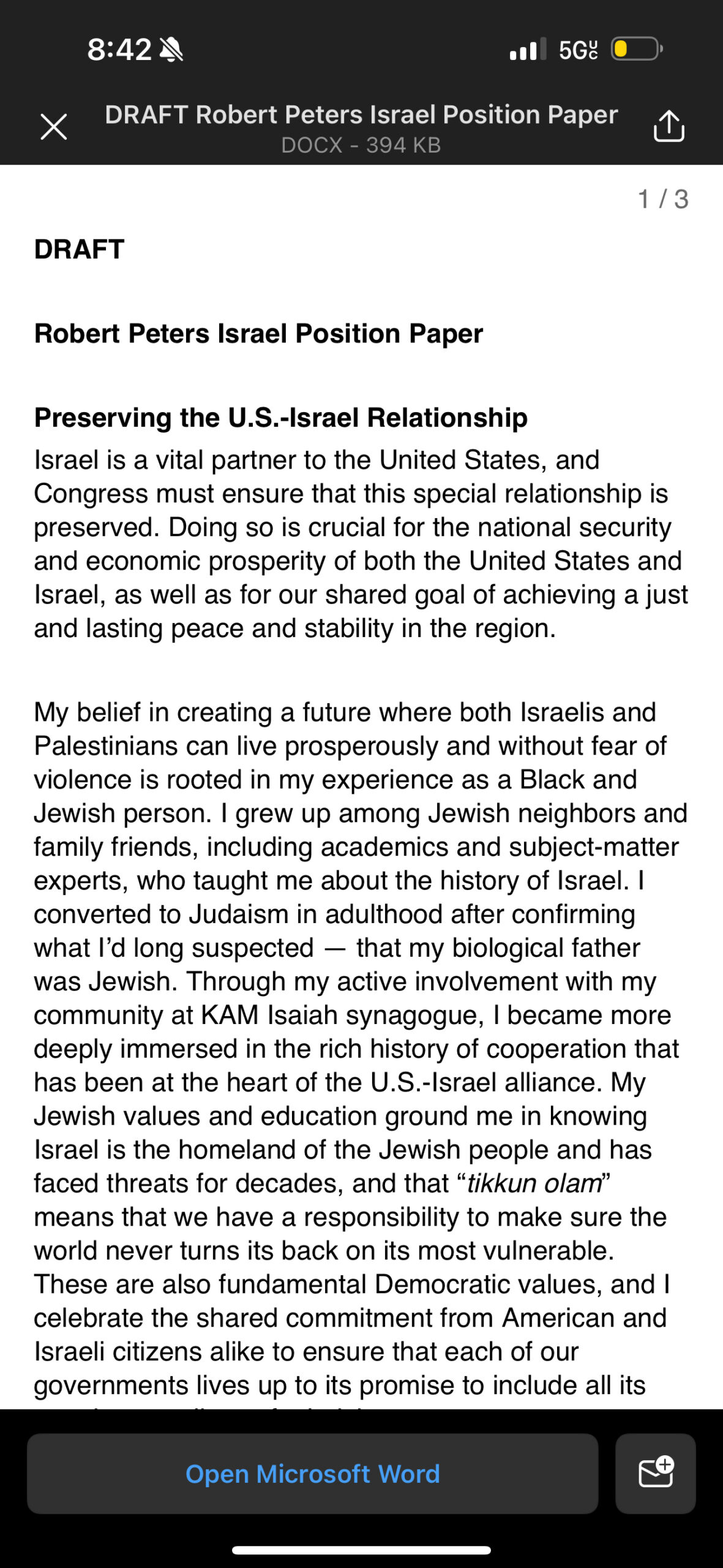
“Israel is a vital partner to the United States, and Congress must ensure that this special relationship is preserved,” Peters wrote in his paper, confirming in a separate section he is “committed to ensuring the U.S. continues to be an essential ally of Israel, including funding foreign aid to protect the people of Israel from terrorism, cyber threats and missile attacks.”
The group is now facing scrutiny over its alleged covert funding of a newly formed super PAC, called Affordable Chicago Now!, which is investing heavily in Peters’ race to help boost a top rival, Cook County Commissioner Donna Miller, a pro-Israel Democratic candidate. Peters, for his part, has accused “AIPAC and Trump donors” of “pouring cash” into Miller’s primary bid, warning “AIPAC and Trump allies” are now “trying to buy this seat,” though AIPAC has not endorsed her and UDP is not publicly involved in the race in Illinois’ 2nd Congressional District. (UDP did not respond to a request for comment.)
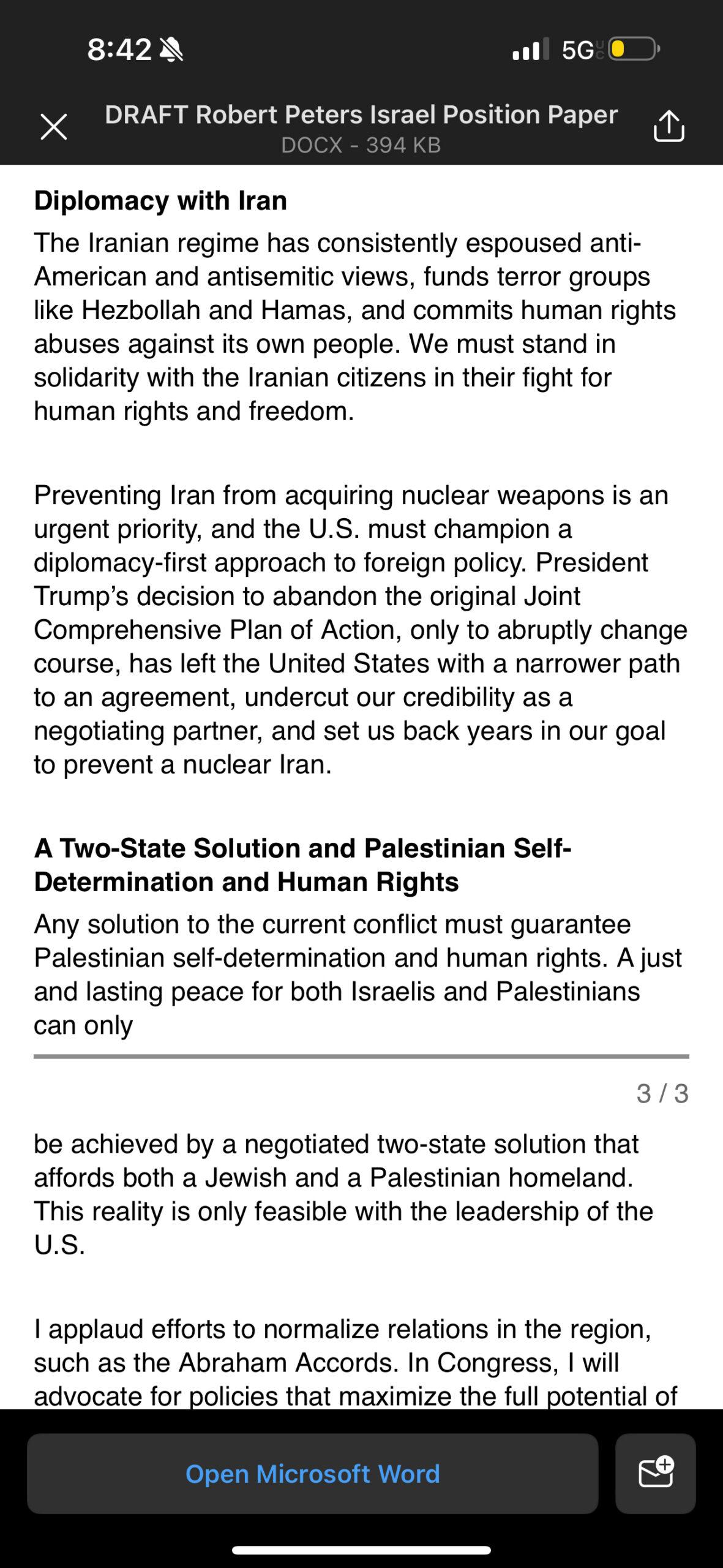
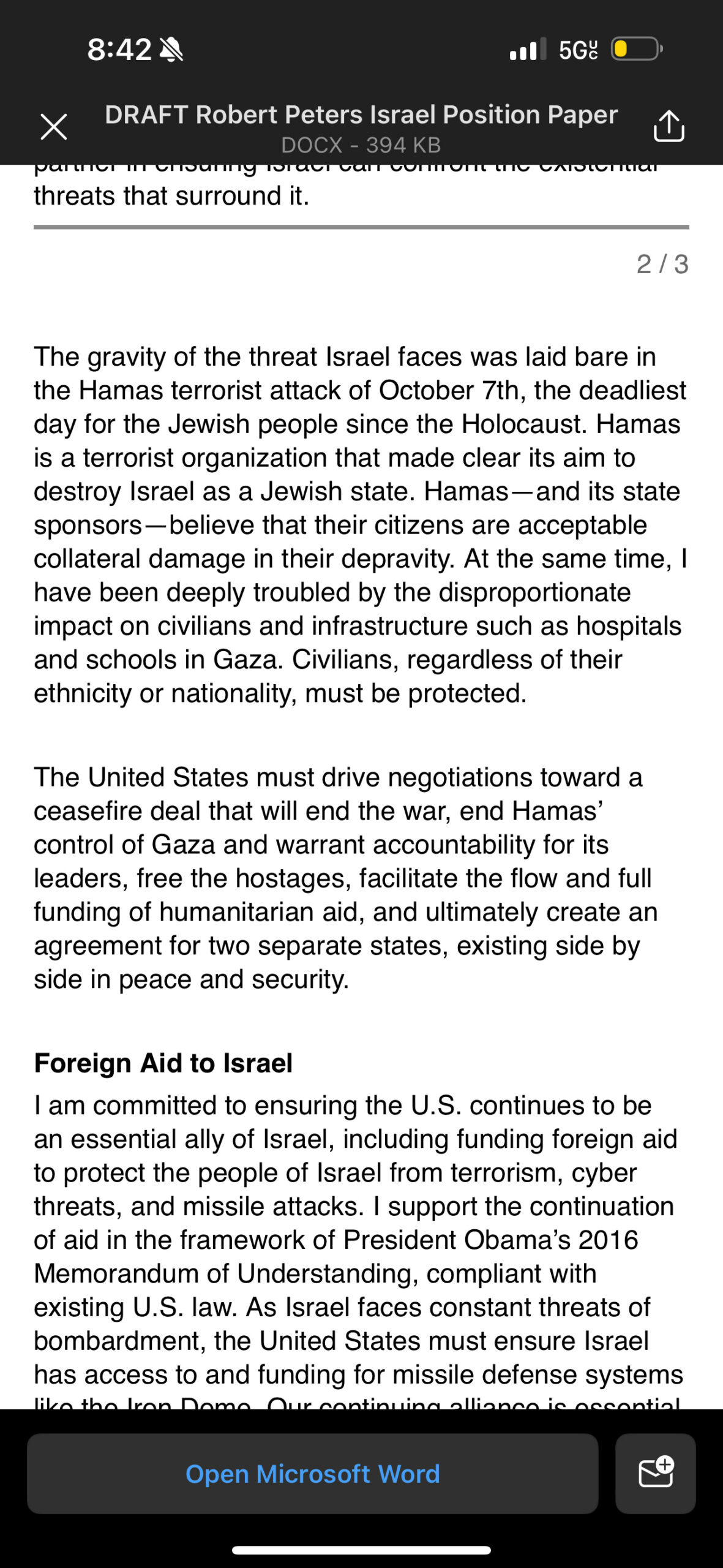
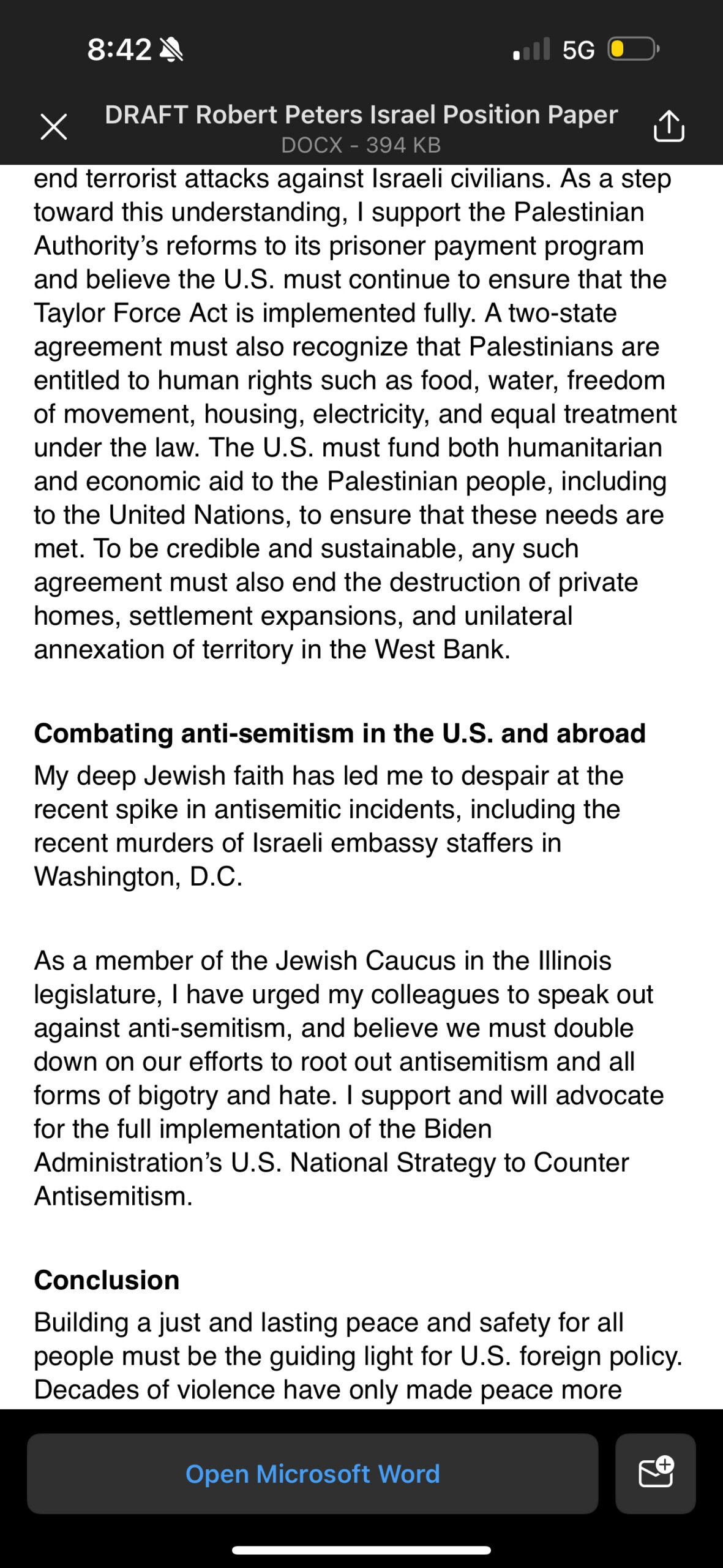
The policy paper that Peters allegedly submitted to AIPAC — screenshots of which were obtained by JI — is far more measured than the anti-Israel stances he now espouses. Most strikingly, he voiced support for upholding continued U.S. military aid to Israel, which the group views as one of its top litmus tests. Earlier this month, for example, UDP invested millions on attack ads in a special House primary in a wealthy suburb of northern New Jersey, hitting an erstwhile ally, former Rep. Tom Malinowski (D-NJ), who had entertained policies to condition assistance to Israel.
“Israel is a vital partner to the United States, and Congress must ensure that this special relationship is preserved,” Peters wrote in his paper, confirming in a separate section he is “committed to ensuring the U.S. continues to be an essential ally of Israel, including funding foreign aid to protect the people of Israel from terrorism, cyber threats and missile attacks.”
By contrast, Peters has more recently condemned AIPAC-backed candidates as pro-Israel pawns “OK with unconditional military aid” to support what he calls Israeli Prime Minister Benjamin Netanyahu’s “war machine,” which he says committed genocide in Gaza. If elected, Peters has pledged to sign on to the Block the Bombs Act, a bill that seeks to impose sweeping new conditions on U.S. weapons transfers to Israel.
Matthew Fisch, a spokesperson for Peters, said in a statement to JI on Wednesday that the state senator has shared his Israel position paper “with a range of stakeholders and individuals upon request, some of whom responded with feedback for our campaign.”
“Among those stakeholders was AIPAC staffer Martin Ritter, who has a longstanding relationship with Robert going back to his days as an organizer with the Chicago Teachers Union,” Fisch said. He claimed that Ritter, who directs AIPAC’s Midwest outreach in Chicago, “requested the document and provided feedback, which our campaign promptly rejected.”
Peters “is not and has never been open to receiving support from AIPAC for his campaign,” Fisch said, noting the candidate’s “positions on this issue are well documented and have been widely discussed.”
When JI first reached out to Peters’ campaign last October to inquire about the paper, Fisch said the document had been “drafted in the early months of the campaign to share with any and all stakeholders from across the spectrum of viewpoints,” and that it had “reflected Robert’s nuanced position on a range of subjects in the context of that moment.”
He did not respond to follow-up questions from JI at the time asking if the paper had been submitted to AIPAC.
Peters, a Jewish convert, had long been prominently opposed to Israel’s war in Gaza, joining at least one anti-Israel protest affiliated with the far-left Jewish Voice for Peace and IfNotNow, the latter of which is now backing his campaign. He called for a ceasefire in mid-November 2023, just over a month after the Hamas attacks of Oct. 7, writing in an opinion piece that he had “watched the unprecedented bombing campaign rain down on” Gaza and “saw that it was being done in our name, as Jews and as Americans.”
But even as Peters’ outspoken views on Israel would seem to preclude any outreach to AIPAC, the source familiar with his engagement, granted anonymity to discuss a sensitive topic, said he had regularly been in touch with the group at least until January, when he spoke with Ritter to express his concerns that the paper had been leaked.
Fisch confirmed that a call took place last month but said Ritter initiated it. “At the time, he falsely insisted to Robert that AIPAC was not supporting Commissioner Miller,” he told JI, “something that proved demonstrably false just a few days later.”
“Robert has always supported conditioning aid and ensuring it is in full compliance with the Leahy Law and international law,” Matthew Fisch, a spokesperson for Peters, told JI, adding the paper “does not mention the Block the Bombs Act because it was drafted prior to the bill’s introduction.”
Ritter, for his part, referred questions to an AIPAC spokesperson. “Like many advocacy organizations,” the spokesperson said in a statement to JI, “AIPAC routinely meets with candidates across the country to understand their views on issues important to its members.”
In some ways, the paper seems written specifically to meet AIPAC’s approval — including in its support for “fully” implementing the Taylor Force Act, a key legislative tool favored by the lobbying group, the Taylor Force Act that withholds direct aid to the Palestinian Authority until it ceases payments to convicted terrorists or members of their families.
But Fisch insisted that the paper is consistent with Peters’ long-standing Middle East policy positions. “Robert has always supported conditioning aid and ensuring it is in full compliance with the Leahy Law and international law,” he told JI, adding the paper “does not mention the Block the Bombs Act because it was drafted prior to the bill’s introduction.”
In a section of the paper on foreign aid to Israel reviewed by JI, Peters made no explicit argument for conditions, saying only that he supports “the continuation of aid in the framework of President Obama’s 2016 Memorandum of Understanding, compliant with existing U.S. law.” The 10-year agreement, set to expire in 2028, provides $3.8 billion in military aid and missile-defense funding to Israel annually — assistance the Block the Bombs Act is designed to challenge. Critics have argued the proposed legislation would effectively amount to an arms embargo on Israel for many key weapons systems.
Peters, 40, has largely positioned himself as a progressive front-runner in the March 17 primary, where 10 candidates are competing to fill the seat being vacated by Rep. Robin Kelly (D-IL), who is running for Senate. In addition to Peters and Miller, the primary field includes former Rep. Jesse Jackson Jr. (D-IL), who is drawing support from an AI-backed super PAC, and state Sen. Willie Preston, among others candidates.
During a recent candidate forum, Preston accused Peters of being dishonest in his AIPAC messaging. “Robert Peters tells you AIPAC hates him,” Preston said, according to video of the event reviewed by JI. “He sought their support — they just didn’t give it to him.”
Peters, in his own remarks at the forum, said that he shared a “position paper” with “Palestinian-led organizations,” among other organizations he claimed “groups like AIPAC fundamentally hate,” according to the video. He denounced AIPAC as a “right-wing, Trump-allied” organization, and said that “anybody taking” its support “is disqualified to represent” the district in Congress.
Peters has claimed major endorsements from leading Israel critics, including Sens. Bernie Sanders (I-VT) and Elizabeth Warren (D-MA) and Reps. Ro Khanna (D-CA) and Delia Ramirez (D-IL) — who introduced the Block the Bombs Act last May. He has also won support from anti-Israel groups such as the Working Families Party, which endorsed his campaign on Tuesday, and the anti-Israel AIPAC Tracker, which has argued that candidates “only submit a policy paper to AIPAC if” they are “angling for” support from the organization.
Peters is not the only Israel critic now seeking the Democratic nomination in an Illinois primary race to have allegedly engaged in discussion with AIPAC. Daniel Biss, the mayor of Evanston who is hoping to succeed retiring Rep. Jan Schakowsky (D-IL) in the suburbs of Chicago, sought backing from the group before he announced his run for Congress last year, JI has reported, though he denies having done so.
Biss has claimed publicly he met with AIPAC in an effort to stave off potential spending by the group in his race.
In recent weeks, AIPAC has become a particularly divisive subject of debate in Illinois as the group has ramped up its spending while facing accusations it is attempting to hide its involvement in some districts by operating under the cover of newly created super PACs not required to disclose their funding sources until after the primaries.
“He is practiced in the ways of politics,” Tom Bowen, a Democratic strategist in Chicago who is not involved in Peters’ primary, told JI on Wednesday. “That he submitted a paper in order to demonstrate he would be a collaborative elected official, I’m not surprised at all. Robert understands politics, and you have to build coalitions in order to legislate.”
Last week, for example, Schakowsky said she was rescinding her endorsement of Miller because of support the county commissioner has reportedly received from AIPAC-aligned forces in her primary. “Illinois deserves leaders who put voters first,” the congresswoman said in a statement, “not AIPAC or out-of-state Trump donors.”
In a separate Democratic House primary in the state, meanwhile, Anthony Driver Jr., a progressive candidate critical of Israel, said recently that he was rejecting a campaign contribution from a prominent Jewish party donor in Chicago, Michael Sacks, over his ties to AIPAC — a move Sacks lamented as a sign of growing “anti-Israel sentiment and outright Jew hate.”
Tom Bowen, a Democratic strategist in Chicago who is not involved in Peters’ primary, said he would not be surprised if the candidate had privately engaged with AIPAC, calling him a savvy political operator.
“He is practiced in the ways of politics,” he told JI on Wednesday. “That he submitted a paper in order to demonstrate he would be a collaborative elected official, I’m not surprised at all. Robert understands politics, and you have to build coalitions in order to legislate.”
As for why he is “saying what he’s saying today,” Bowen suggested that there is “obviously political opportunity in corralling support from the folks in Congress who make” Israel “a top issue for national fundraising.”
“In many races in Illinois now, it is very difficult to forge broad coalitions,” Bowen added. “Ultimately,” the candidates are working to build coalitions “they think they need to win.”
Featured Stories



Please log in if you already have a subscription, or subscribe to access the latest updates.