ASIF HASSAN/AFP via Getty Images
Saudi Arabia’s talks to acquire Chinese-Pakistani JF-17 jets could complicate its pursuit of U.S. F-35s
Analysts tell JI that the move ‘is not the behavior Washington can reasonably expect from a partner who would like to be trusted with the F-35’


 Add JewishInsider on Google
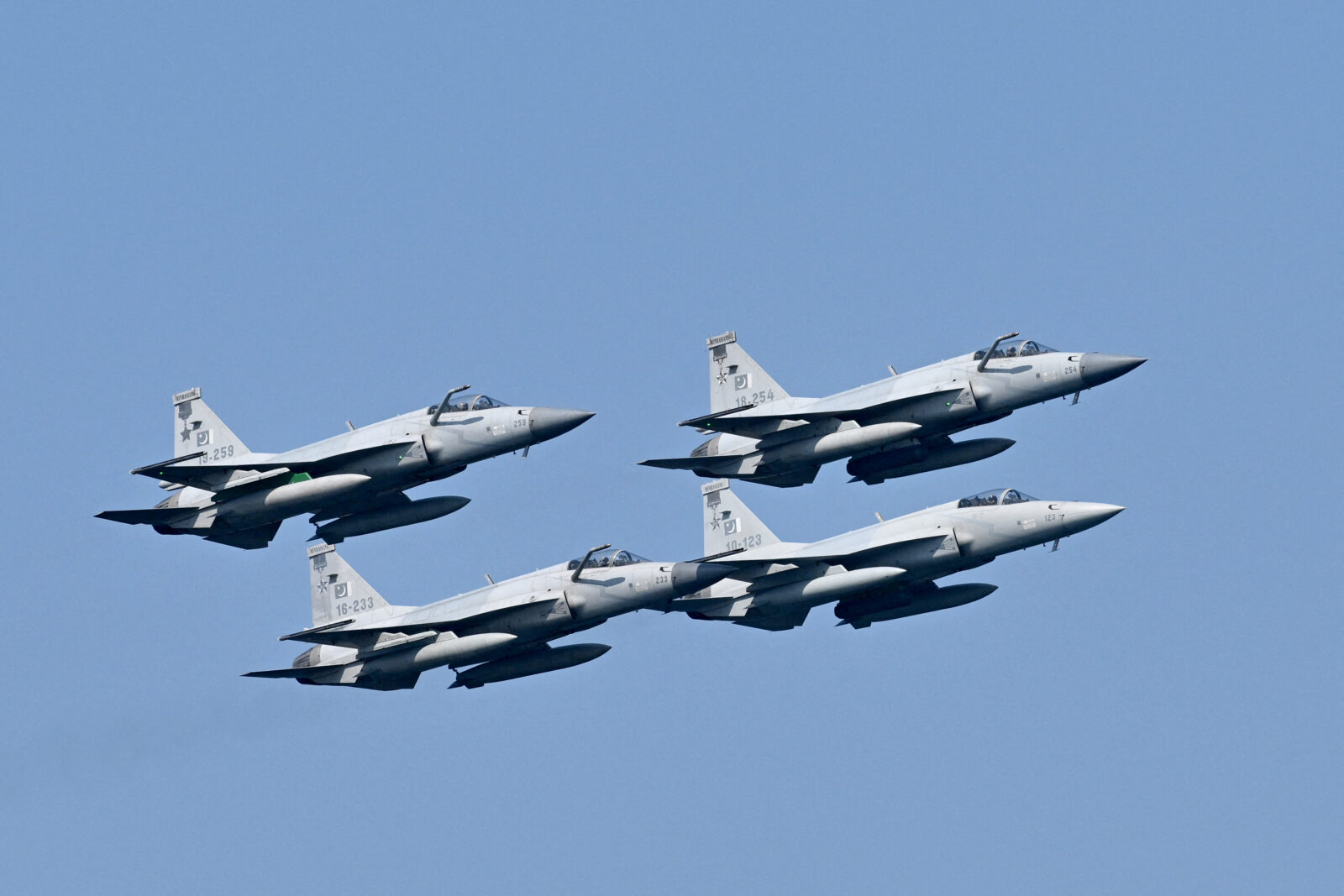
Reports that Saudi Arabia may strike a deal with Pakistan to acquire Chinese-Pakistani JF-17 Thunder fighter jets are raising concerns in Washington, as Riyadh’s potential acquisition of the aircraft signals a continuation of its recent shift in alliances and could complicate its efforts to secure the U.S.’ F-35 jet.
The discussions between Saudi Arabia and Pakistan, first reported by regional outlets, would deepen defense ties between the two longtime partners while easing Karachi’s financial strain by wiping out its $2 billion in loans from the kingdom.
The JF-17, which is widely used by the Pakistani Air Force, was jointly developed by Pakistan and China, and incorporates Chinese electronic systems and a Russian engine.
Grant Rumley, a senior fellow at The Washington Institute for Near East Policy, said the aircraft would offer little operational benefit to Saudi Arabia, which already fields a fleet of U.S.- and European-made fighter jets, and could instead be a sign that Riyadh is aiming to strengthen ties with multiple defense partners.
“I don’t think there’s any military justification for Saudi Arabia purchasing this plane,” Rumley said, noting that the kingdom’s existing F-15s and Eurofighter Typhoons — along with its planned acquisition of the F-35 — would significantly outperform the JF-17. “Saudi understands Pakistan is in a tough economic situation and converting it into JF-17s is a way to alleviate some economic pressure and further intensify or accelerate defense cooperation.”
Rumley added that despite the lack of military advantage from the JF-17, Saudi Arabia’s desire to acquire the fighter jet linked to U.S. adversaries raises concerns about U.S. national security and Riyadh’s political alignment, potentially prompting backlash that could complicate or even derail Riyadh’s procurement of F-35s from the U.S.
“The fact that [the JF-17] has a Russian engine and Chinese avionics means it will very likely be viewed as a security risk if it’s co-located near U.S. forces,” said Rumley, who warned this arrangement could pose a danger to the protection of U.S. intel. “The F-35 is one of the crown jewels of American military equipment. Protecting that proprietary information and capabilities is a top priority across party lines in the U.S. national security apparatus.”
Such a deal could create “undue turbulence” for Saudi Arabia’s acquisition of the F-35, potentially “complicating the discussion” around the deal and even putting it “into jeopardy,” Rumley said.
While experts said it is unlikely Congress would be able to stop an F-35 sale to Riyadh if the White House gives it the green light, they warned the JF-17 talks could provoke internal pushback within the administration, particularly among officials focused on competition with China.
“The Saudis are publicly entertaining this deal because of their dissatisfaction with U.S. policy, their desire to build leverage that brings America around to the Saudi position and, if that fails, to enable Riyadh to develop alternative security ties,” said Jonathan Ruhe, a fellow at the Jewish Institute for National Security of America. “The fact that the Saudis are considering such inferior aircraft, from a less established partner, emphasizes their dislike of how the broader U.S. defense relationship is trending.”
“The China hawks within the U.S. will not look favorably on this type of arrangement in general,” said Rumley. “Buying a fighter jet that’s co-produced with China and has Chinese technologies, as well as Russian technologies, is going to burn through a lot of goodwill with the folks in Washington.”
Jonathan Ruhe, a fellow at the Jewish Institute for National Security of America, said a Saudi deal for the JF-17s could also “throw a major wrench in existing defense cooperation with Riyadh,” framing the reported talks as part of a potential reassessment of the kingdom’s security partnerships.
“The Saudis are publicly entertaining this deal because of their dissatisfaction with U.S. policy, their desire to build leverage that brings America around to the Saudi position and, if that fails, to enable Riyadh to develop alternative security ties,” said Ruhe. “The fact that the Saudis are considering such inferior aircraft, from a less established partner, emphasizes their dislike of how the broader U.S. defense relationship is trending.”
He added that Saudi Arabia has historically used major arms purchases to build political leverage rather than to fill operational gaps, noting that Saudi officials have closely watched Qatar’s use of “checkbook diplomacy” to secure a unilateral U.S. security guarantee last year, even as Riyadh’s own mutual defense treaty discussions stalled.
In recent weeks, observers have noted that Saudi Arabia has increasingly pivoted away from moderation and toward Turkey, Qatar, Iran, and Pakistan, as seen in their actions in Yemen, Sudan, and the horn of Africa, along with attacking the UAE over its relationship with Israel.
“Riyadh’s current security cooperation with China is not the behavior Washington can reasonably expect from a partner who would like to be trusted with the F-35,” said Justin Leopold-Cohen, a senior research analyst at the Foundation for Defense of Democracies, who noted that any deal should be viewed “in the context of Riyadh’s recent naval exercises with China.”
“Saudi Arabia looks at Turkey and Pakistan and sees sort of a middleweight power that is able to exert a ton of influence in the profession of arms and is able to put platforms on the market that drive, not only revenues at home, but is also a pretty effective instrument of national power,” said Rumley. “And they [Saudi Arabia] want that.”
Justin Leopold-Cohen, a senior research analyst at the Foundation for Defense of Democracies, said the reported talks likely reflect Saudi Arabia’s desire to “avoid overreliance” on any single defense partner, though he echoed concerns from the U.S. perspective.
“Riyadh’s current security cooperation with China is not the behavior Washington can reasonably expect from a partner who would like to be trusted with the F-35,” said Leopold-Cohen, who noted that any deal should be viewed “in the context of Riyadh’s recent naval exercises with China.”
However, Rumley argued that such a deal may not necessarily reflect “realignment from a security standpoint,” but could be “more about gaining access to some other technologies.”
“It may be that this is simply a way for Saudi Arabia to get access to these jets, rip them up, or reverse engineer them and take those technologies and use them for their own defense, industrial base development,” said Rumley.