Tony Dejak/AP
Amy Acton became a household name in Ohio — now, she wants to be governor
Acton, the expected Democratic nominee, was the state’s public health director during COVID, a legacy she hopes won’t get in the way of her affordability message


 Add JewishInsider on Google
Amy Acton is running for governor of Ohio this November as an outsider: a Democrat challenging 15 years of Republican gubernatorial rule, a medical doctor with no political experience, a “scrappy kid” from Youngstown who experienced homelessness as a child.
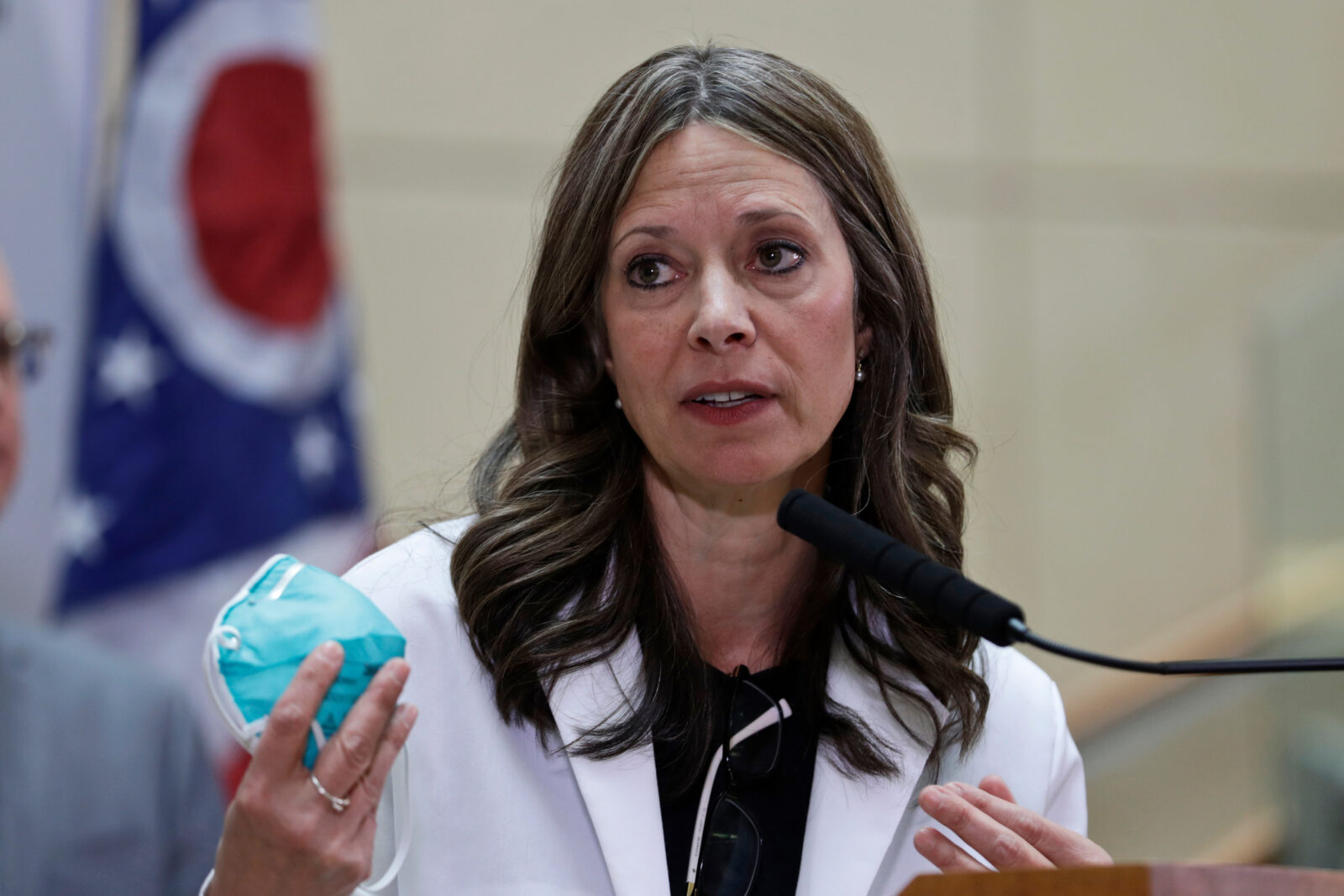
But over a three-month period in the spring of 2020, she became a household name across the state. Every night, Ohioans watched Acton, then the statewide health director, in a white lab coat, describing the state’s COVID-19 precautions and trying to calm the anxiety people felt at the start of a new pandemic. The New York Times called her “the leader we wish we all had.” CNN called her “the Buckeye state’s version of the straight-talking Dr. Anthony Fauci” — before Fauci became a polarizing figure.
Now Acton is mounting her first political campaign — a bid for governor in a former swing state that has trended redder and redder in recent elections. Acton, perhaps cognizant of the angst that followed pandemic shutdowns and mask mandates, is not making her COVID-era fame the focal point of her campaign.
In a statement to Jewish Insider, Acton said her campaign will focus on one of the most animating issues for voters and politicians alike right now: affordability.
“I’m running for governor because people in my state are struggling with rising costs. There’s no breathing room,” Acton, who would be Ohio’s first Jewish governor if elected, said. “I refuse to look the other way while special interests and bad actors try to take our state backwards on nearly every measure. Everywhere I go, Ohioans are ready for change.”
But before she can get to that, Acton has to thread a difficult needle in reminding voters who she is. In the spring of 2020, during the peak of the pandemic, it felt like she was in everyone’s living rooms. Acton told the state about her family’s virtual Seder that year as she urged religious communities to celebrate the holiday without congregating. (“My matzah ball soup is the best, just saying,” Acton said, noting she didn’t have time to make it that year.)
“The magic of Amy Acton on those press conferences was her authenticity and her compassion,” said Richard Stoff, the founder of Ohio Business Roundtable.
Acton worked with DeWine to make Ohio one of the first states to shut down mid-March 2020. The move earned widespread praise at the time but now puts her in a precarious position politically, as the public health measures that were implemented early in the pandemic have turned into partisan cudgels in the ensuing years.
“Right now, that’s not the lead thing in her bio,” said Stephen Mockabee, director of the School of Public and International Affairs at the University of Cincinnati. “I think that the message that Acton will present is, ‘I’m a native Ohioan, and I love the state, that’s why I’m running, because I care about the state, and, you know, I have these experiences coming up from humble beginnings, through medical school in Ohio, working on behalf of the public in the public health capacity.’ I think that’s the story, not just referring specifically to COVID.”
“We saw the backlash to COVID, and how that could be a vulnerability for her. But what I’ve seen is it’s a strength. It is a foundation of trust that people have in her,” Ohio state Sen. Casey Weinstein told JI. “And if the worst attack against her from the other side is going to be that she fought for our health and fought to keep people out of the hospital and fought to keep us safe and was working hard to bring science and the absolute best she could to keep us and our families healthy, then okay, like, let’s have it.”
Indeed, Acton doesn’t lean into her turn as a pandemic celebrity in her messaging. Her campaign website describes her tough childhood in Youngstown, where she survived an abusive parent and homelessness, even living in a tent for a period. Her official biography tells of how she worked her way through college and medical school, kicking off a career in public health and advocacy. The only reference to COVID is carefully weighed: “When the pandemic hit, her steady leadership and voice for common sense not only saved countless lives but also helped Ohio’s economy and schools open earlier than other states,” Acton’s website declares.
Acton’s experience as Ohio health director showed her the personal cost of public life. Protesters regularly picketed her home in the Columbus suburb of Bexley. It was mostly people unhappy with pandemic-related restrictions, although the demonstrations also included a Proud Boys activist and a handful of antisemitic signs.
Ohio state Sen. Casey Weinstein, a Democrat whose district includes Akron, was also facing protesters in front of his family’s home as he spoke out against book bans. Acton reached out, and the two developed a friendship. A couple years ago, they reconnected at a Passover Seder hosted at the Ohio statehouse, and Weinstein has helped her campaign in the Cleveland area. (The two were also “celebrity bartenders” at a fundraiser for the Akron JCC last year.)
“We saw the backlash to COVID, and how that could be a vulnerability for her. But what I’ve seen is it’s a strength. It is a foundation of trust that people have in her,” Weinstein told JI. “And if the worst attack against her from the other side is going to be that she fought for our health and fought to keep people out of the hospital and fought to keep us safe and was working hard to bring science and the absolute best she could to keep us and our families healthy, then okay, like, let’s have it.”
Acton stepped down from the role in June 2020, three months into the pandemic. But it wasn’t due to the protests, she asserts. It was, as she told an interviewer last month, because she refused to go along with Republican lawmakers who wanted her to give permission to reopen some venues that had been shuttered due to pandemic restrictions.
“That she’s running I think takes a lot of guts on her part, because she was a face during COVID that people knew and recognized, and got a lot of negativity, I think unwarranted negativity, but about her role in trying to manage that crisis,” said Dan Birdsong, a political scientist at the University of Dayton.
“I could not put my name on orders that, frankly, would have killed people. I have a Hippocratic Oath as a doctor to do no harm,” she said. The campaign pitch is in the pivot that comes next — that she is still proud of leading the shutdown charge because it allowed the state to reopen schools and other spaces sooner.
“In Ohio, we flattened the curve. We saved a lot of lives, and we actually got back to work and life sooner because we took swift, decisive action,” she said. The key question — aside from whether any Democrat can, in 2026, be a viable statewide candidate in Ohio — is how the public will respond to the pandemic flashbacks that her campaign will inevitably spark.
“That she’s running I think takes a lot of guts on her part, because she was a face during COVID that people knew and recognized, and got a lot of negativity, I think unwarranted negativity, but about her role in trying to manage that crisis,” said Dan Birdsong, a political scientist at the University of Dayton.
The primary hasn’t taken place yet, but Acton and her general election opponent — Republican entrepreneur Vivek Ramaswamy, who ran for president in 2024 — have each cleared the field in their respective parties. A December poll showed Acton leading Ramaswamy by one point, but experts cautioned that it is too soon to draw any conclusions.
Acton has not made her Jewish faith central to her campaign in the same way that Pennsylvania Gov. Josh Shapiro did during his 2022 campaign. But she has long been steeped in the Jewish community, serving on boards like the Columbus JCC, Columbus Jewish Day School and Congregation Beth Tikvah outside Columbus. “My Jewish roots in tikkun olam have been a guiding force throughout my career as a public servant and instilled in me the belief that everyone deserves the same chance to get ahead that I had,” Acton told JI.
Antisemitism has taken an unusual place in the race, aside from the anti-Jewish hate that Acton faced as health director six years ago. Ramaswamy, the son of Indian immigrants, published an op-ed in The New York Times last month calling out the racist, antisemitic “Groyper” movement — conservatives who consider themselves followers of the neo-Nazi influencer Nick Fuentes.
“Conservative leaders should condemn — without hedging — Groyper transgressions,” Ramaswamy wrote. “We must practice what we preach: My current Democrat opponent in Ohio is a Jewish woman, and while I criticize her policy record unsparingly, I will be her most vocal defender against antisemitic attacks from left or right.”
Ramaswamy struck up a dialogue with Jewish communal leaders in Ohio after the Republican presidential primary ended.
“He’s staked out a really powerful position opposing some of the antisemitism and the bigotry on the right wing of the Republican Party. He’s gotten hate because of that,” said Howie Beigelman, president and CEO of Ohio Jewish Communities, a statewide advocacy group. “I think that both of them have a personal connection to our community, in that sense, understanding what we’re going through and the fears we have.”
Acton is not running as an uber-progressive Democrat; she did, after all, get her start in politics working for a Republican governor. That moderate sensibility is likely to help her in Ohio.
She is also hoping to ride the coattails of former Sen. Sherrod Brown, the last Democrat to win statewide in Ohio, as he challenges Sen. John Husted (R-OH), who was appointed to the Senate last year. Senate Minority Leader Chuck Schumer (D-NY) said this week that if Democrats hope to regain the Senate majority, they’ll need to win in Ohio — and Democrats will spend heavily to boost Brown.
“There are coattails there, and so making sure that she’s as strong as can be is really important,” said Jeff Rusnak, a Democratic strategist in Cleveland.
And whether COVID ultimately proves to be positive or negative for Acton, there’s no question her actions during that pandemic earned her some hardcore fans who will be trying to get her across the finish line. Acton’s neighbors in Bexley put signs in their yards that read, “DR. AMY ACTON FAN CLUB,” some of which remained well after the pandemic emergency ended. A local apparel company designed shirts in support of Acton that said “Not all heroes wear capes.”
“She had this following, and she still has this. I’ve been with her in public and witnessed this firsthand,” Rusnak said. “You could just be sitting at a coffee shop with her, having coffee, and people who she does not know will just walk up to her in tears and thank her, and want to hug her. It’s this very strange phenomenon.”