


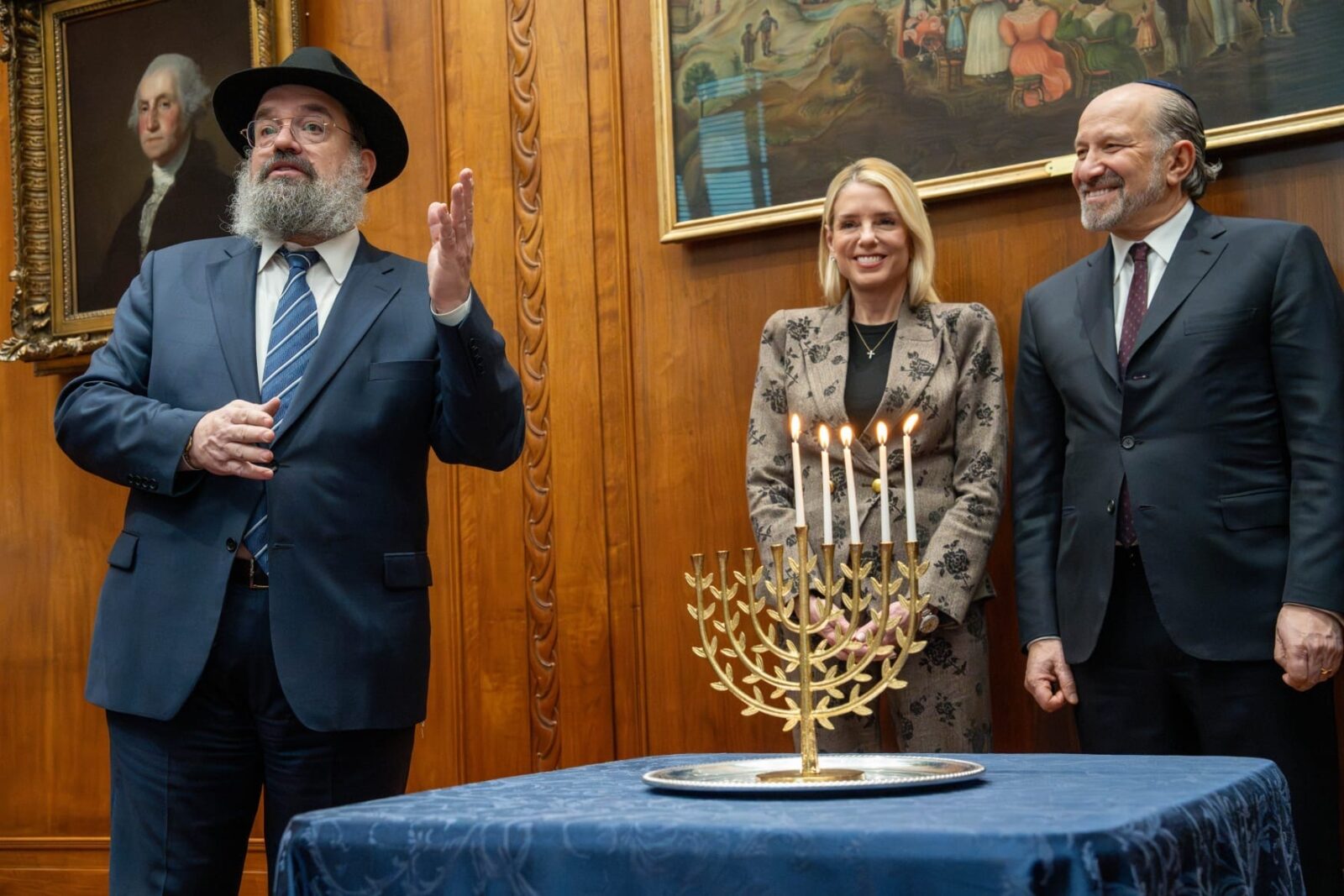
Lighting up Washington: Rabbi Levi Shemtov brings Hanukkah to the halls of power
The EVP of American Friends of Lubavitch is a staple around town during the holiday, regardless of the party in power


 Add JewishInsider on Google
One of Washington’s few remaining bipartisan traditions is the annual clamoring for a ticket to the White House Hanukkah party — an affair that was smaller than usual this year after the Trump administration tore down the East Wing, prompting disappointment even from some Republican allies who did not score an invite. If you’re a member of the opposing political party, forget about it.
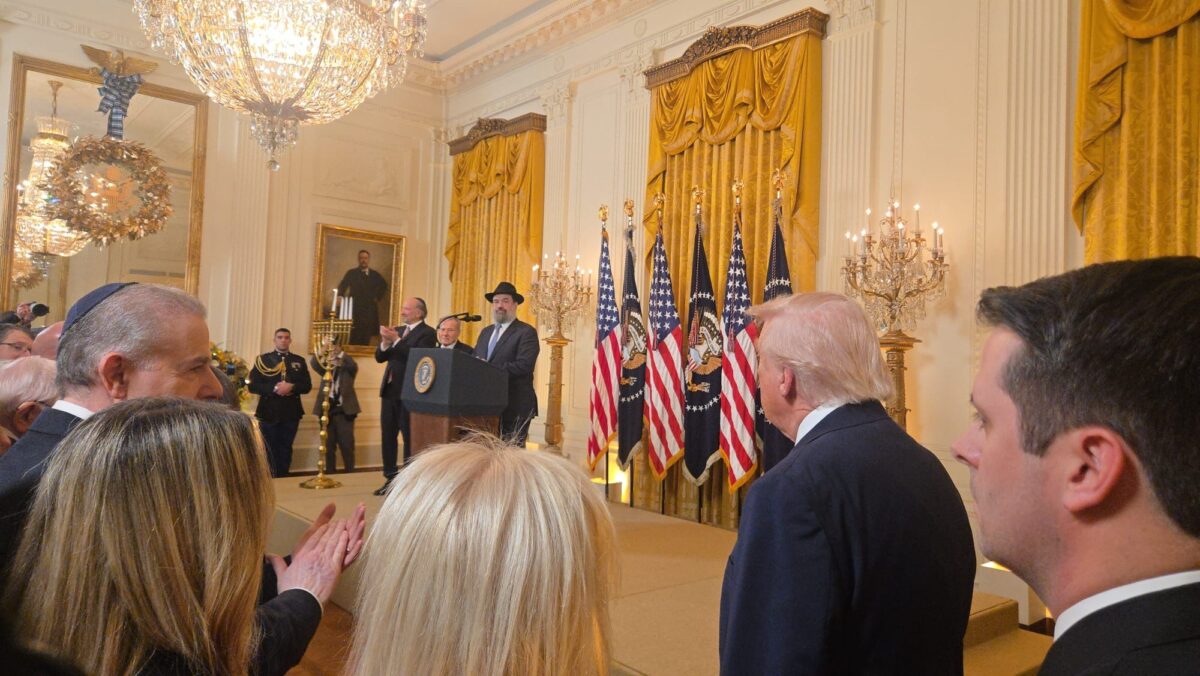
But even as power changes hands in Washington, one person is a fixture at Republican and Democratic White House Hanukkah parties, as well as Hanukkah gatherings all across the Beltway, from the Pentagon to the Justice Department to the Capitol. That’s Rabbi Levi Shemtov, the executive vice president of American Friends of Lubavitch (Chabad), the Washington arm of the global Chabad movement, and Washington’s unofficial menorah-lighter-in-chief.
“I was raised during the Bicentennial, and I got a very patriotic education in our day school. I felt very American, and I thought this was a strong public expression of a deep Jewish pride that I was able to enjoy,” Shemtov said during Hanukkah last week. “I come from grandfathers on both sides of my family who were arrested and imprisoned, tortured and exiled for being Jews and for practicing Judaism and for leading Jewish communities. So I wasn’t going to let the freedom we are so fortunate to have here just pass without my active participation in it.”
In an interview with Jewish Insider, Shemtov reflected on the importance of spreading a Hanukkah message of light in a region where that’s often missing: the halls of power in Washington.
During Hanukkah this year Shemtov attended as many as four events in a day, shuttling between government institutions and reciting the blessings in front of dignitaries including President Donald Trump, Vice President JD Vance and Attorney General Pam Bondi. He led a bipartisan menorah lighting on Capitol Hill with House Speaker Mike Johnson (R-LA), House Minority Leader Hakeem Jeffries (D-NY) and Senate Minority Leader Chuck Schumer (D-NY).
“The menorah itself is a symbol of bipartisanship, in my opinion, because you almost always have four branches on one side, four branches on the other, and a shamash in the middle,” Shemtov reflected. “In the time of the Temple, we are told that the flames used to point towards the center from either side, and the center flame used to point towards heaven. And that was the connection of divinity with this world.”
“When we point towards the center,” Shemtov continued, “we bring more sensibility and, therefore, divinity to our existence across the board. That’s why, especially when we do this with the two leaders, the speaker and the minority leader together, I think it sends a very powerful message to whoever sees it that there’s hope for togetherness, even in a time of divisiveness.”
It was Shemtov’s father, Rabbi Abraham Shemtov, who is most responsible for bringing public observances of Hanukkah to Washington. In 1979, Abraham Shemtov participated in the first National Menorah Lighting with President Jimmy Carter, a tradition that his son now leads on the Ellipse, outside the White House, each year.
But this year’s National Menorah Lighting would be different than the usual large, boisterous affair. Shemtov knew that as soon as he woke up.
“I was able to tell that it was going to be a very cold day, but that was a small problem compared to what I saw was an unprecedented vicious terrorist attack on a Hanukkah celebration in Sydney, Australia. Sydney is very close to me,” Shemtov said. His wife Nechama is from Sydney and lived down the street from Bondi Beach, where 15 people were killed on the first day of the holiday by terrorists who reportedly pledged allegiance to the Islamic State.
But the brutality of that day, which sent his wife’s family huddling together for safety, did not keep Shemtov from spreading the message of Hanukkah around Washington. “I think that it’s an important opportunity to bring a message of life, unity, warmth and positivity in a way which might otherwise not even be possible,” Shemtov said.
It’s no longer a surprise to arrive at the White House or the Naval Observatory and find kosher brisket, freshly made latkes and sufganiyot in a variety of flavors. But the White House Hanukkah party is a relatively recent invention. The first one took place in 2001, hosted by President George W. Bush. It would be a few more years before the event was certified kosher — by Rabbi Shemtov, of course. It’s a responsibility he oversees regardless of who is president.
“They say about the White House, etc., that the moment you don’t feel it’s special to walk into these places — the White House, the Capitol, VPR [the vice president’s residence] — you should stop working there,” said Shemtov. “Access, acceptance and prominence within these hallowed and rarefied quarters of society is something our forebears can only have dreamed of in an ambitious fantasy, and here we are, able to live it. We just have to want to be proud enough to do so, and that’s why, of course, it’s always an honor to be invited, involved, participating and particularly in helping organize such respectable recognitions of our faith.”
Shemtov’s job is to drive for hours around the Beltway, helping Jews in positions of power practice their faith proudly and publicly. This year, he made it a priority to also be home in time to light his own menorah.
“I have to have a Jewish home as well, not just a Jewish expression to the outside world. And to do that takes effort because scheduling is so crazy,” said Shemtov. “We have to remember it’s like an airplane. You have to put your own oxygen mask on, or else you won’t be able to help anyone at all.”
Featured Stories
RECAP
In State of the Union, Trump underscores willingness to use force against Iran if diplomacy fails
Cappello’s campaign
Democrat John Cappello brings military experience in Israel to race against Mike Lawler
DOHA DIPLOMACY
Jacob Helberg: Economic diplomacy could lead to Qatar-Israel normalization
Please log in if you already have a subscription, or subscribe to access the latest updates.