Carlos Jasso - WPA Pool/Getty Images
Britain’s Jewish community wants actions, not words, after Manchester synagogue attack
While added financial resources for more guards and extra security has been welcomed by the U.K.’s Jewish community, there remains considerable unease and hostility toward the government


 Add JewishInsider on Google
LONDON — Since the terrorist attack on a Manchester, England, synagogue on Yom Kippur that left two congregants dead, British politicians have redoubled their efforts to reassure the country’s Jewish community, which has been increasingly concerned about security issues amid widespread anti-Israel sentiment that has grown in the wake of the Oct. 7, 2023, Hamas terror attacks and ensuing war in Gaza.
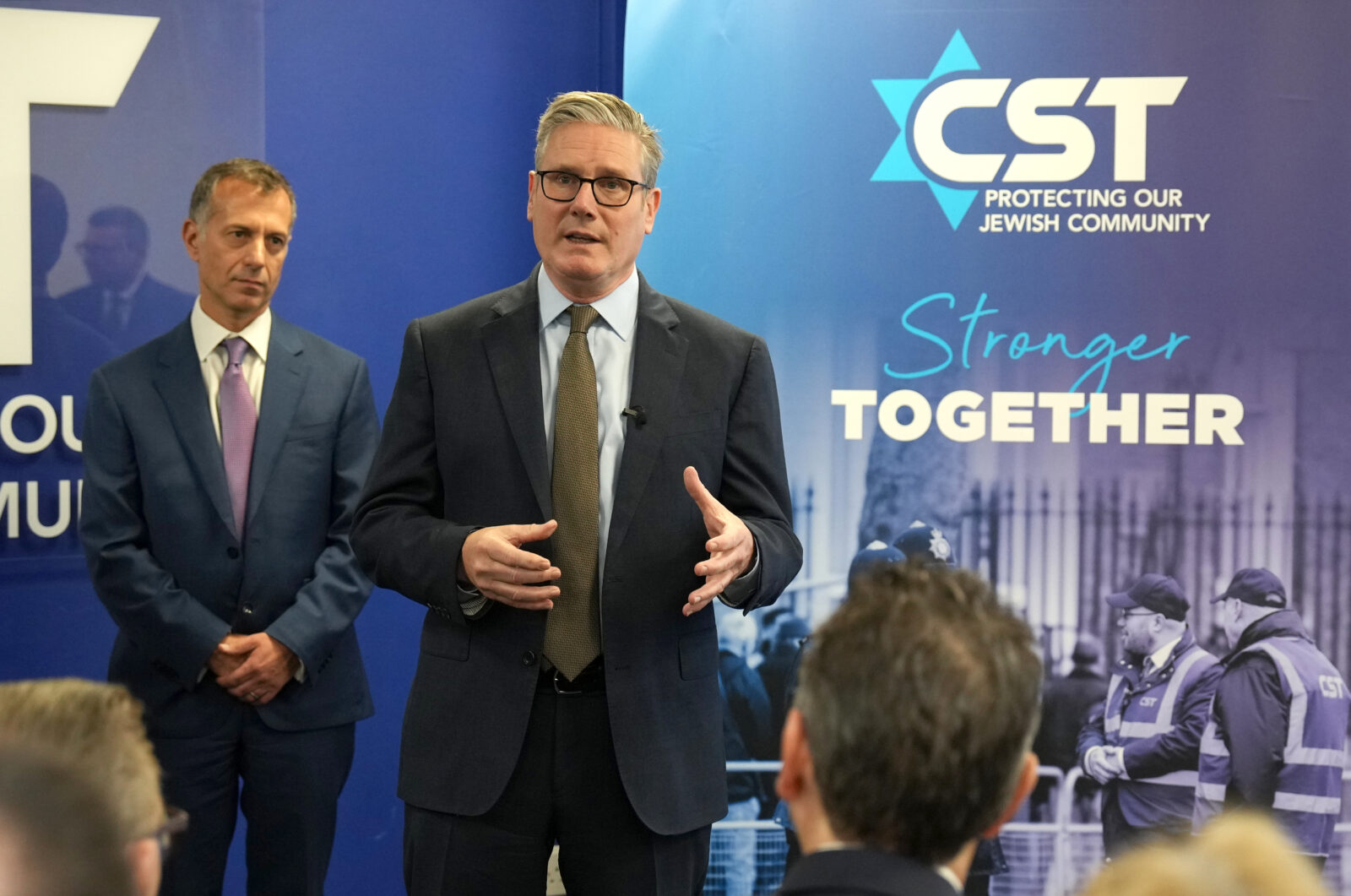
British Prime Minister Keir Starmer promised to do “everything” in his power to protect the Jewish community, including the recent approval of £10 million ($13 million) in emergency funds to provide greater security.
But while the added financial resources for more guards and extra security has been welcomed by the U.K.’s Jewish community, there remains considerable unease and hostility toward the government, something that became starkly apparent the day after Yom Kippur.
When David Lammy, the country’s deputy prime minister, attended a vigil close to Heaton Park synagogue the day after the attack, he was booed and heckled with cries of “Shame on you” and “Blood on your hands.”
Lammy was foreign secretary when Britain said it intended to recognize a Palestinian state earlier this year. The move was formally announced by Starmer last month, alongside similar action taken by countries including France, Australia and Canada.
In his previous role, Lammy imposed restrictions on British arms sales to Israel and twice summoned Israel’s ambassador to the U.K. to criticize him over Israel’s handling of the Gaza war. Lammy and his parliamentary colleagues have also been criticized by the Jewish community for not doing enough to protect them by allowing hostile anti-Israel marches to proceed week after week in British cities.
“What David Lammy and his government have done has allowed this to happen,” Melanie, who asked only to be identified by her first name, told Jewish Insider. The 42-year-old nurse, who was among those who booed Lammy, attended the vigil with her husband and three children, all of whom attend a Jewish school close to the targeted synagogue.
The angry outburst included cries of “Go to Palestine, leave us alone,” and “You have allowed Jew hatred in Manchester.”
“What right did that man have to be there? That was probably the worst person they [the government] could have sent,” said Melanie. “I don’t know who made that decision but it was the wrong decision.”
As in many Western European countries, incidents of antisemitism in the U.K. have skyrocketed over the last two years. In its latest report, the Community Security Trust (CST), a charity that works towards Britain’s Jewish communal safety and monitors antisemitism, revealed that 1,521 antisemitic incidents were reported in the first half of 2025. This was the second highest level ever recorded for that period, just behind the same timeframe in 2024.
Among the incidents in recent months have been synagogues desecrated with excrement, the vandalism of a rabbi’s home with a swastika and an incident in which visibly Jewish teenagers were shot at with an air rifle.
Meanwhile last week, soccer club Aston Villa announced that it was banning fans of Maccabi Tel Aviv from attending a match at their stadium next month. The decision came after police in Birmingham, Britain’s second-largest city and home to a substantial Muslim population, warned it could not guarantee fans’ safety, leading the Israeli football club to announce on Monday that it would decline any tickets offered to its fans out of concern for their wellbeing and safety. The U.K. government said it was “deeply saddened” by Maccabi Tel Aviv’s decision.
Writing in The Guardian in the wake of the Manchester attack, Dave Rich, director of policy at CST, said, “Antisemitism has been allowed to rise in an unacceptable way for far too long. Last year’s official hate-crime statistics showed that a Jewish person in Britain was 12 times more likely to be the victim of a religious hate crime than someone from any other faith background. Calls for violence against Jews, or Israelis, or Zionists, online and on our streets, have become normalised in parts of our politics.”
The U.K.’s recognition of a Palestinian state was also met with concern over the message the move conveyed about the country’s priorities around the war in Gaza.
A survey of over 4,800 British Jews conducted prior to the Manchester attack by the Institute for Jewish Policy Research, a U.K.-based Jewish research organization, found that Jews’ sense of “ambient antisemitism” in society, including hostile media coverage, online commentary and microaggressions, had increased substantially — 45% of respondents said they experienced it “frequently” or “regularly” in 2025, as opposed to only 8% of British Jews before the Oct. 7 attacks.
In a statement released after the Manchester, attack CST described what happened on Yom Kippur as “the kind of terrorist attack that we have prepared for over many years.”
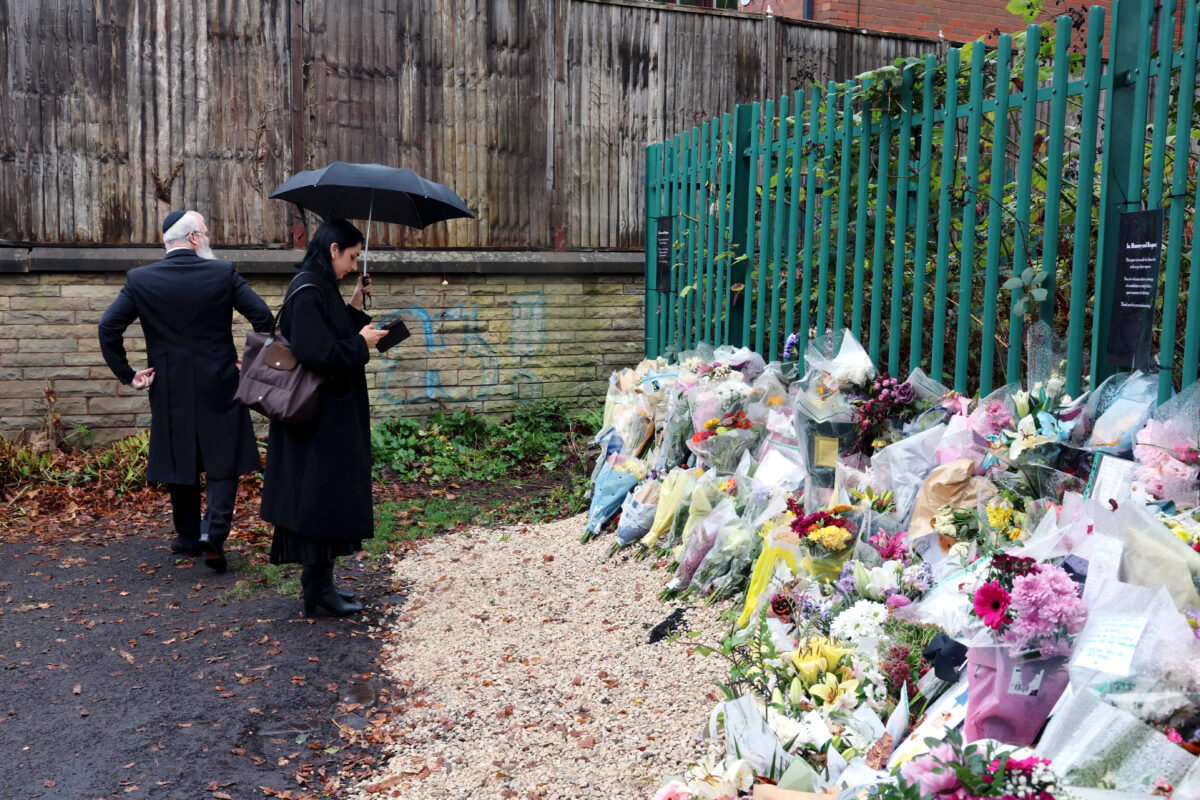
That is cold comfort for many in the community. “If somebody decided to ram a car along the pavement as the kids were heading into school, they would be hitting lots of kids and lots of parents,” Melanie, the nurse who attended the vigil, said.
“We don’t have any thoughts that the government is going to protect us because they haven’t done so far,” she said. “It’s terrifying for the kids to know this is the world they’re growing up in.
Is there any place for Jews in this country anymore? If things carry on the way they’re going, I don’t think so because we’re just targeted all the time.”
Lord Katz, a government frontbencher in the House of Lords, told JI that the government has been “acutely aware of the increasing fear and anxiety of the community over the past two years.”
“Whatever your views on the Israeli government, it’s always been clear that that shouldn’t impact on the way that British Jews live their lives and the government’s commitment to working with the CST and other communal bodies to ensure they have enough funding and the right legal measures in place to tackle antisemitism is very very clear and is underlined by lots of recent activity,” he said.
“In the long term, though, it has to be about tackling the cause and not just the symptoms. It has to be done through education and building community cohesion and there’s no easy route to that.”
Katz added: “This isn’t a party political issue — whether it’s attending football matches, wearing Jewish insignia, using the NHS [National Health Service] or feeling safe on our streets and campuses, the Government knows British Jews are fearful and will protect our rights, liberties and way of life.”
Journalist Nicole Lampert, who has been outspoken about antisemitism in the U.K., said that antisemitism began to flourish under the previous Conservative government. The marches have been taking place since the start of the war when Rishi Sunak and his Conservative government was still in power.
She said: “There are many people to blame, but of course, the people that are in control of things are the government,” she said, adding that Labour “came with a history of antisemitism,” referring to the party’s previous leadership under Jeremy Corbyn, who had a long record of anti-Israel and antisemitic rhetoric.
In 2020, an investigation by the Equality and Human Rights Commission (EHRC) found that under Corbyn the party had a culture “which, at best, did not do enough to prevent antisemitism and, at worst, could be seen to accept it”.
Lampert said, “Many of the people that were in the cabinet, including Keir Starmer, had been in the cabinet with Jeremy Corbyn and had told us to vote for Jeremy Corbyn and had refused to really speak out against antisemitism.”
“Although Keir Starmer said ‘I’m going to clear this party of antisemitism’ [in his leadership campaign], in some ways he used antisemitism as a blunt tool to just get rid of the far left in his party,” she added.
“They didn’t use it as an opportunity for a teachable moment as to what antisemitism actually is and what they’d done wrong,” Lampert said. “That was really frustrating because antisemitism is complex. If you had explained ‘this is why you’re antisemitic’ or ‘this was what was wrong,’ that would’ve been better.”
Alex Hearn, co-director of the campaign group Labour Against Antisemitism, agreed.
“Time after time we’ve seen that it’s easier to remove Jews rather than to challenge racism,” he said. “It’s easier to erase the people who cooperate rather than challenge the vocal and unlawful minority.
“The places we’re allowed to go safely are getting narrower and narrower. Don’t go to central London during marches, don’t walk down the streets looking visibly Jewish, don’t go on social media. And it’s just growing and growing, whether it be comedy clubs or now football matches — our world is getting smaller,” Hearn said. “Then what we’re hearing from our government is that they say the right things when they have to and we find ourselves applauding the sentiments, but wondering where the meaningful action is.”
Hearn added: “Keir Starmer has announced increased security funding to the Jewish community, but other things show why that’s necessary: because the authorities consistently allow racists to run riot on our streets. So we’re building higher and higher fences but we’re not addressing the issue. The most high fences can’t keep everyone out, as we’ve learned from Manchester.”
Dovid Lewis, the rabbi of Bowdon synagogue in south Manchester, said that, like many others, he had been “shaken and shocked” but “not surprised” by the Yom Kippur attack. “Antisemitism is insidious throughout society at the moment,” he said.
“There’s a reason why we have guards outside shul,” he said. “It’s not because we’re paranoid. It’s because there’s a credible threat.”
One of the worshippers at Lewis’ synagogue told him that following the attack she felt most insulted by an interview in which Starmer said that Jews “should feel comfortable in my country.”
The rabbi responded, “We don’t need to feel comfortable in the prime minister’s country — this is our country. I was born here, my parents were born here, my grandparents were born here.”
“You can’t declare [support for] a Palestinian state on Erev Rosh Hashanah and declare at the Labour Party conference, between Rosh Hashanah and Yom Kippur, that Israel is committing genocide, then scratch your head and wonder why somebody named Jihad Al-Shamie did what he did several days later,” he said. “There is a cause and an effect.”
Featured Stories
heated exchange
Sen. Van Hollen attacks Maryland Jewish community liaison Ron Halber as Netanyahu ‘apologist’
hand in hand
Gov. Wes Moore: ‘Maryland stands with the Israeli people’ and the Jewish community