






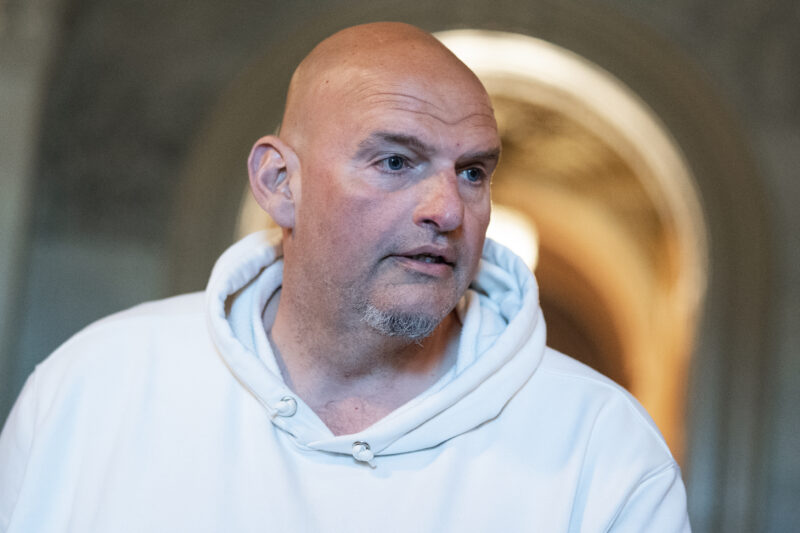
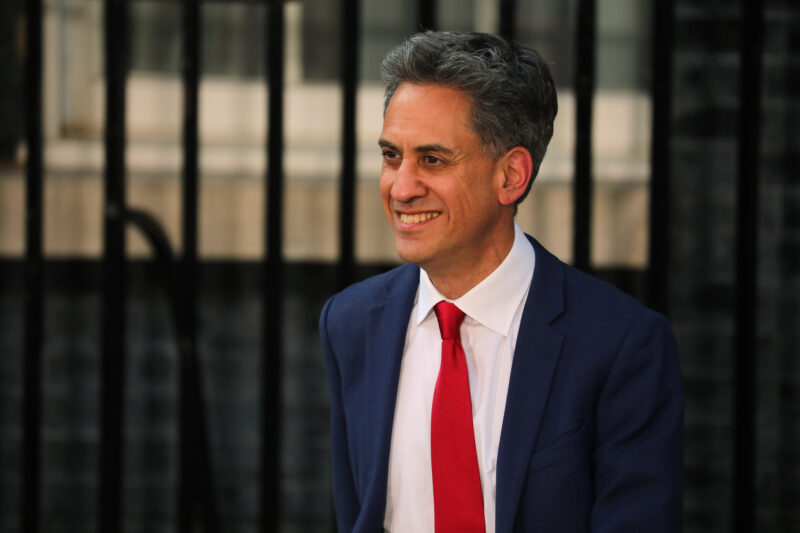
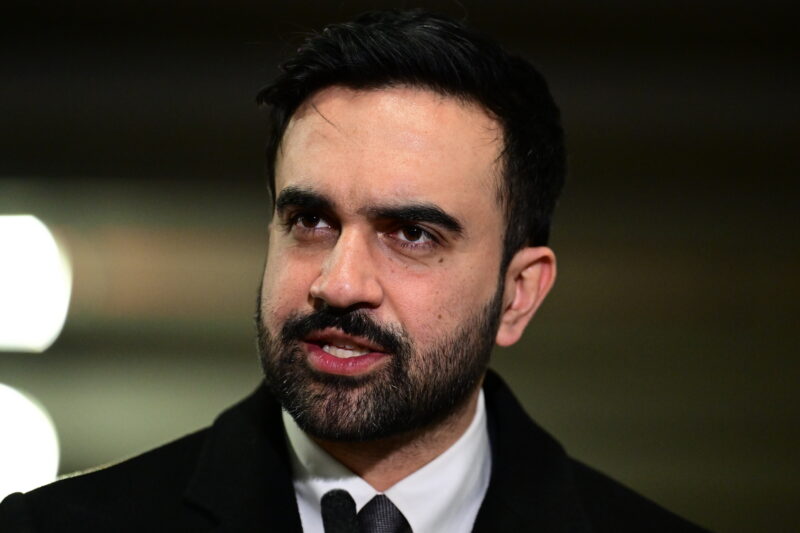
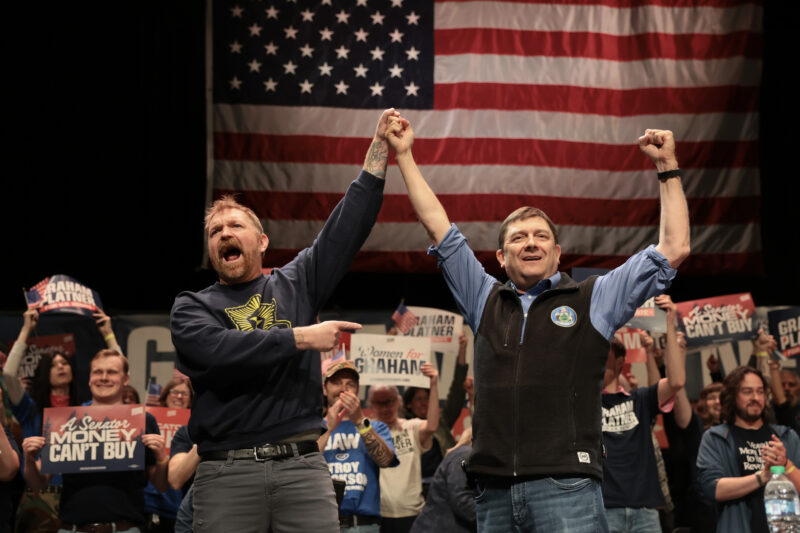








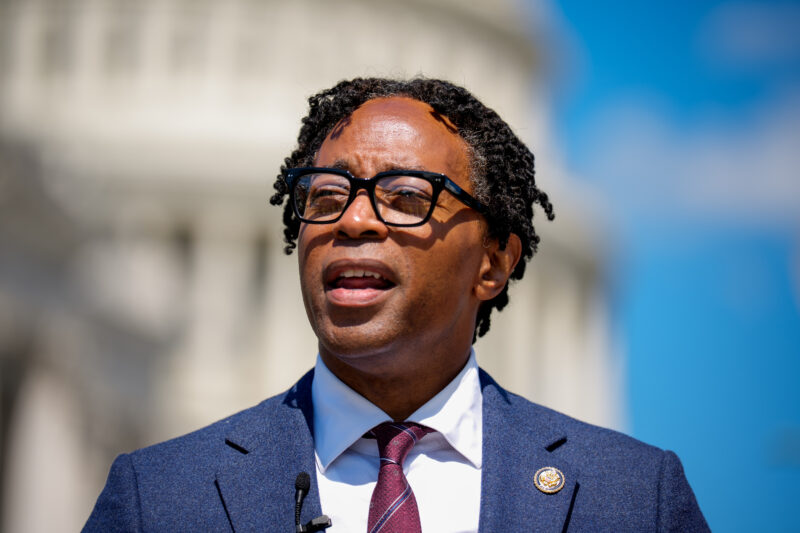










If elected mayor of Washington, D.C, Janeese Lewis George’s victory would hand a major win to Washington’s Democratic Socialists of America chapter
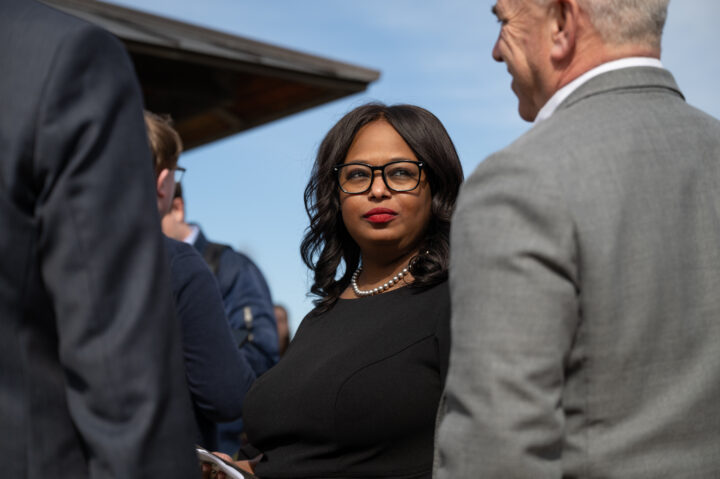
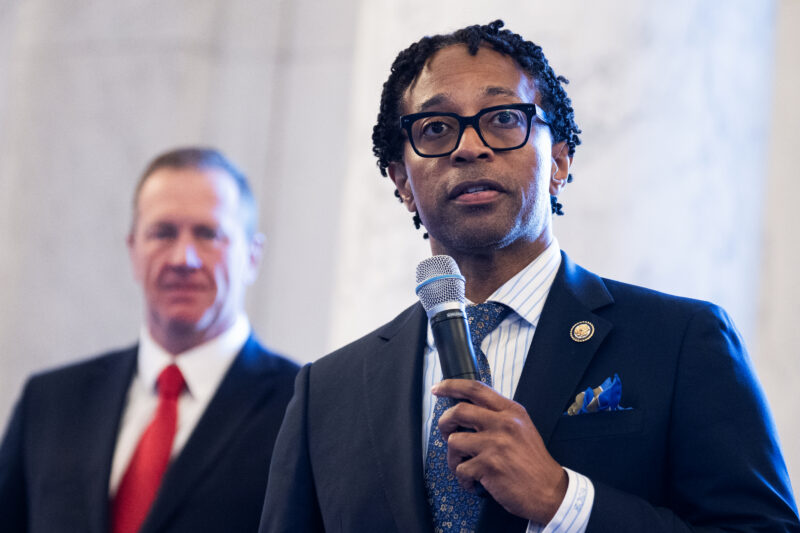
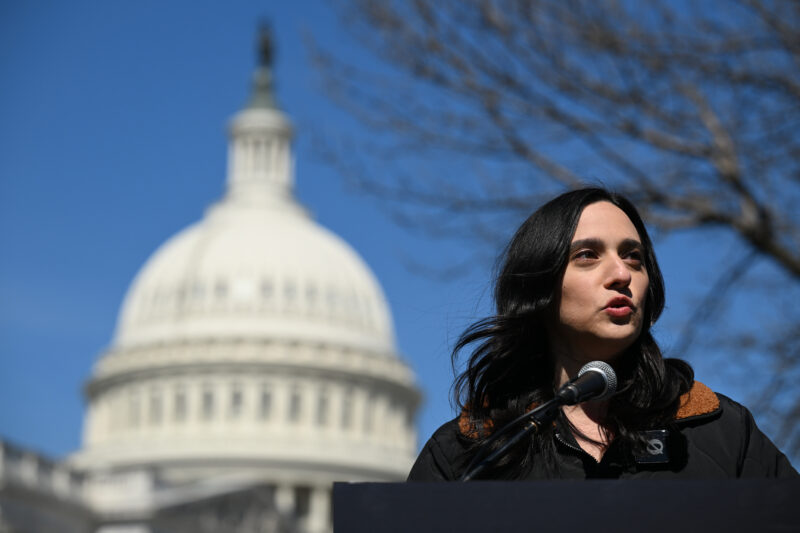
Craig Hudson for The Washington Post via Getty Images
D.C. councilmember and mayoral candidate Janeese Lewis George is seen on Capitol Hill for a press conference in Washington, DC on March 10, 2025.


 Add JewishInsider on Google
The open race for mayor of Washington, D.C., has been largely uneventful ahead of next month’s primary — so much so that the first TV ads run by the leading candidates, Kenyan McDuffie and Janeese Lewis George, sound nearly identical. Both candidates tout affordability and safety on the campaign trail, with promises to build more housing and stand up against President Donald Trump.
But if elected, Lewis George’s victory would mark a significant shift away from the centrist brand of politics espoused by outgoing Mayor Muriel Bowser over the last 12 years, and would instead hand a major win to Washington’s Democratic Socialists of America chapter, of which Lewis George has been a member for years.
Lewis George has faced criticism throughout the campaign from some in the Jewish community for comments she made on a DSA endorsement questionnaire pledging to boycott events that “promote Zionism” and criticizing Jewish activists’ approach to combating antisemitism. Ron Halber, CEO of the Jewish Community Relations Council of Greater Washington, on Tuesday called DSA an “evil” organization that seeks “to make being Jewish unacceptable in polite society.”
DSA has activated its small but growing membership to knock on doors for Lewis George, a member of the D.C. Council, tapping into a grassroots energy that they hope translates into success at the ballot box. Rep. Rashida Tlaib (D-MI), one of two DSA members currently serving in Congress, attended a recent DC DSA rally alongside Lewis George.
DSA’s Metro DC chapter is relatively small. Yet its current roster of roughly 3,400 members represents a massive increase from its pre-2016 nadir of just 200 members — and mirrors DSA’s growing clout nationally.
“For most of the ‘80s and ‘90s and 2000s, DSA was a small organization with maybe 5,000 or 8,000 people at the most. I would say the average age was probably over 60, maybe higher than that,” said Peter Dreier, an emeritus professor of politics at Occidental College in Los Angeles. “Then Bernie [Sanders] ran for president in 2016 and started talking about democratic socialism in a way that made sense to, particularly, a lot of young people, and he kind of opened the door to people to be in DSA.”
Overall, DSA is still a small organization on the fringes of Democratic politics. Even the highest membership counts — adding up DSA’s local chapters — don’t top 100,000. But the unexpected popularity of Sanders’ 2016 presidential run sparked a resurgence of interest in democratic socialism not seen in generations, and that has continued well past his two campaigns. A 2025 Gallup poll found that 42% of Democrats have a positive image of capitalism, down from 54% a decade ago, while 66% have a positive view of socialism.
“If [young people] don’t remember the Cold War, then what do they think when they hear the word socialism? There’s still a battle over that, but they’re more likely to think, ‘Oh, countries that have more equality, or students that get free or almost free higher education, everybody has access to healthcare,’” said Dreier.
“We are going to raise money and develop a plan over the course of the next few months to try to make them toxic, to make it unacceptable for major figures in the party or anybody actually running for office to be affiliated with the DSA, the way it should be unacceptable to be affiliated with [neo-Nazi influencer] Nick Fuentes if you’re running as Republican,” Third Way’s senior vice president for public affairs, Matt Bennett, said.
The key question now facing capital-D Democrats — one they sound unsure of how to answer, or perhaps unwilling — is how to handle an insurgent faction that has galvanized people over its straightforward messaging on corporations (bad), taxing the rich (good) and Medicare for All (necessary), while at the same time promoting far-left positions like prison and police abolition that are nowhere near the Democratic mainstream. The group has long promoted the Boycott, Divestment and Sanctions movement, as well as calling for an arms embargo on Israel, and its members passed a resolution last year affirming their commitment to anti-Zionism. On Oct. 7, 2023, DSA released a statement holding Israel accountable for the Hamas attacks and calling on members to take to the streets to protest U.S. support for Israel.
The centrist Democratic group Third Way plans to launch a major PR campaign against DSA in the coming months, one of the group’s executives told JI, arguing that its far-left positions and incendiary brand of politics will be harmful for the party’s electoral prospects.
“We are going to raise money and develop a plan over the course of the next few months to try to make them toxic, to make it unacceptable for major figures in the party or anybody actually running for office to be affiliated with the DSA, the way it should be unacceptable to be affiliated with [neo-Nazi influencer] Nick Fuentes if you’re running as Republican,” Third Way’s senior vice president for public affairs, Matt Bennett, said.
In the decade since Sanders’ 2016 campaign, DSA has had an outsized impact on national politics. The 2018 congressional victory of Rep. Alexandria Ocasio-Cortez (D-NY), a DSA member, raised the group’s profile. A steady stream of more than 200 DSA-aligned candidates have been elected to state and local offices since, culminating with the election of DSA member Zohran Mamdani as mayor of New York City last year.
“To the degree that people need to pay attention to DSA, it’s because they built this kind of political machine,” said Micah Sifry, a journalist focused on left-wing political organizing. “In a time when people are, for the most part, not very organized, the ability of any small group, relatively speaking, to punch above its weight grows.”
Perhaps unsurprisingly, New York has the largest bench of DSA-affiliated state lawmakers. The group has slowly but steadily been gaining electoral power in state and local offices in some unexpected places, too, like Minnesota, Colorado, Delaware and Wisconsin. The group’s largest foothold is in city council races, where a small but committed cadre of volunteers can swing elections in low-turnout races.
National Democratic leaders are divided about how to treat the small but vocal socialist minority in the party.
House Minority Leader Hakeem Jeffries (D-NY) declined to support Mamdani in the primary election but ultimately endorsed him ahead of the general election last year. Weeks later, Jeffries voted in favor of a Republican-led resolution condemning socialism. He has been skeptical of the left-wing ideology throughout his political career: “There will never be a moment where I bend the knee to hard-left democratic socialism,” he said in 2021. A spokesperson for Jeffries declined to comment this week when asked if he believes Democrats should be welcoming socialists into the party.
Democratic National Committee Chair Ken Martin has been more open-minded about socialists. Asked by Fox News last year whether progressives like Mamdani and Ocasio-Cortez make his job harder, he said no.
“The party is a big tent. But just like we have to believe it’s a big tent, the DSA also has to believe it’s a big tent, and I’m not sure they do,” Brian Romick, CEO of Democratic Majority for Israel, said. “Democratic leaders want to win elections, and that means a big tent, and that means that Democratic base voters and pro-Israel voters and moderate people who maybe voted for [Donald] Trump sometimes because they’re concerned about prices have to be in the tent.”
“I don’t think they make it difficult at all,” Martin said in August 2025. “The difference between the Democratic Party and the Republican Party is that we’re a big tent. We have lots of people in that tent from all of the different ideological wings, from conservative Democrats, to centrists, to progressives, to these new leftists.” A DNC spokesperson did not respond to multiple requests for comment this week.
Brian Romick, CEO of Democratic Majority for Israel, told Jewish Insider this week that he is concerned about the inroads DSA is making in the party. He agreed with Martin that the Democratic Party should be a big tent, but noted that DSA members — who are at times intent on putting litmus tests even on would-be allies — don’t extend the same understanding to more moderate members of the party.
“The party is a big tent. But just like we have to believe it’s a big tent, the DSA also has to believe it’s a big tent, and I’m not sure they do,” Romick said. “Democratic leaders want to win elections, and that means a big tent, and that means that Democratic base voters and pro-Israel voters and moderate people who maybe voted for [Donald] Trump sometimes because they’re concerned about prices have to be in the tent.”
The questionnaire Lewis George filled out in Washington to earn DSA’s endorsement reveals how important hard-line opposition to Israel is to the organization, which requires even candidates for local offices with no connection to foreign policy to all but disavow the Jewish state. Most voters who support DSA-aligned candidates likely are not drawn to them because of their views on the Middle East; Mamdani’s message was first and foremost about affordability. But DSA’s growing reach among Democrats gave a foothold to anti-Israel views that may have once been rare, though global attention on the war in Gaza also contributed to shifting Democratic orthodoxy on the conflict. (Other far-left groups like Justice Democrats have played a role, too.)
Zach Shartiag, a Jewish Democratic campaign operative from Chicago, told JI that Democrats he has talked to who support DSA candidates generally do not do so because of DSA’s stance on Israel, even if the activists are themselves critical of Israel.
“People might be very anti-Israel now, but at the same time, it’s like, what does that have to do with local politics?” said Shartiag, who is currently working on a congressional campaign in Hawaii. “I’ve talked to a lot of people, just in general, normal humans, and it’s like, ‘Yeah, I might be against what Israel’s doing, but what does that have to do with the local and the city and the state?’”
The full picture of DSA’s influence in the party will not be known until all the votes are tallied at the end of this year’s midterm elections. A number of DSA-affiliated candidates are gaining ground in congressional primaries, such as Pennsylvania state Rep. Chris Rabb, who has garnered progressive endorsements in a Philadelphia-area open seat, and New York state Assemblymember Claire Valdez, who has Mamdani’s backing for her congressional campaign.
Still, the election outcomes in states across the country this year will present only a partial picture of where the Democratic Party is moving. In the same year that Mamdani won in New York City, for instance, Democratic moderates Abigail Spanberger and Mikie Sherrill won gubernatorial races in Virginia and New Jersey, respectively.
The only certainty, then, is that the battle between centrists and socialists will continue into 2028.
“I think you’re going to have a real mixed verdict, with us yelling about our side and the left yelling about their side,” Third Way’s Bennett acknowledged. “So what that means is, unsurprisingly, we’re going to go into the presidential primary season with the two camps demanding that they are right.”
Among the most controversial picks was Mamdani’s appointment of Tamika Mallory, a former Women’s March leader who stepped down from its board amid allegations of antisemitism, to a newly established community safety committee
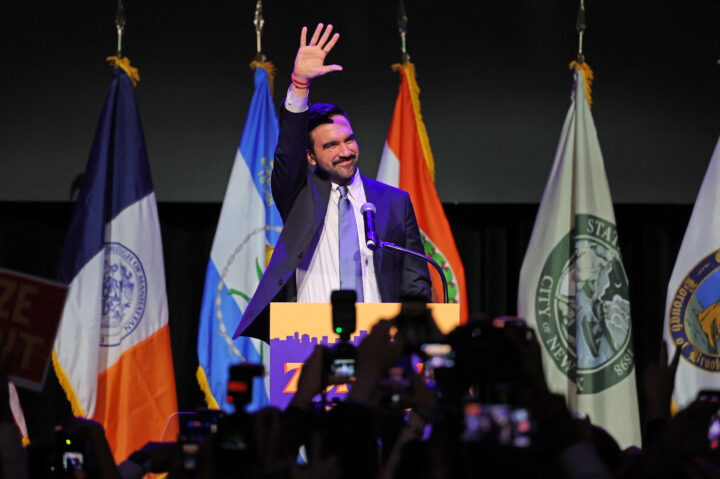
ANGELA WEISS/AFP via Getty Images
New York City Mayoral candidate Zohran Mamdani celebrates during an election night event at the Brooklyn Paramount Theater in Brooklyn, New York on November 4, 2025.
Zohran Mamdani, the mayor-elect of New York City, rolled out an extensive list of more than 400 new transition team appointees on Monday, saying the picks would help “recruit top talent and develop smart policy” on such issues as housing, community safety and economic development.
Despite the wide diversity of his choices, some of the appointees have raised concerns among Jewish leaders who remain skeptical of the mayor-elect and his commitment to fighting antisemitism, especially in moments where anti-Israel sentiment can cross a line into overt bigotry against Jews.
Among the most controversial sources of criticism was Mamdani’s appointment of Tamika Mallory, a former Women’s March leader who stepped down from its board amid allegations of antisemitism, to a newly established community safety committee.
Mallory, who rose to prominence as a leading organizer of the Women’s March after President Donald Trump was first elected, resigned from her role as a co-chair of the organization after facing accusations of having made virulently antisemitic remarks, including a widely discredited claim that Jewish people had played a major part in the slave trade.
The assertion echoed an infamous tract published by the Nation of Islam, whose antisemitic leader, Louis Farrakhan, Mallory had also praised as “the GOAT,” or “greatest of all time,” on social media.
In a statement to Jewish Insider on Tuesday, the Anti-Defamation League, which launched an online tool to monitor policies and personnel choices of the incoming administration, called Mallory “simply the wrong choice for a committee on community safety” and said that she has “made some highly insensitive remarks about Jews and money, which play directly into antisemitic tropes,” while aligning “herself with people like notorious antisemite Louis Farrakhan.”
“Given the fact that New York’s Jewish community is facing antisemitism and security threats at unprecedented levels, the mayor-elect needs to appoint someone who will unite, rather than divide, communities.” the ADL spokesperson said.
In 2020, Mamdani called on social media for Mallory to be released from custody after she and others were arrested during a social justice demonstration in Kentucky. Linda Sarsour, a Palestinian American activist and former Women’s March leader who also has espoused antisemitic rhetoric, has long been an ally of Mamdani, but was not appointed to a role on any of his transition committees.
Monica Klein, the communications director for Mamdani’s transition, said in a statement shared with JI on Tuesday that the newly announced “subcommittees are preparing to implement Mayor-elect Mamdani’s agenda of safety and security for Jewish New Yorkers and everyone else who calls this city home, including his pledge for an 800% increase in anti-hate crime prevention.”
Mallory did not respond to a request for comment.
After the appointees were publicized Monday, Jewish leaders were scouring the lists in group chats and private texts for signs of how the newly elected mayor, a democratic socialist and staunch critic of Israel, would approach issues of concern to the community.
“There are a lot of bad names,” one Jewish leader told JI, sharing screenshots of exchanges flagging some transition picks seen as problematic, such as an anti-Zionist rabbi and activists affiliated with the Democratic Socialists of America, which is pushing Mamdani to divest from Israel when he takes office.
Other appointees who drew scrutiny were Alex Vitale, a professor of sociology at Brooklyn College who has called for an end to policing and will advise on community safety.
The list included a number of outspoken detractors of Israel. Tahanie Aboushi, a civil rights lawyer and a former candidate for Manhattan district attorney who, like Mamdani, has endorsed boycotts against the Jewish state, will provide input on legal affairs. Lumumba Bandele, a member and organizer of the Malcolm X Grassroots Movement who is joining the community organizing team, has frequently accused Israel of genocide as well as apartheid, while calling Zionism “a crime against humanity,” among several other incendiary social media comments.
The tolerance of such heated rhetoric underscores how Mamdani’s election upended the conventional thinking that a winning candidate in New York — a place with the largest Jewish community of any city in the world — must show strong support for Israel, emboldening like-minded allies who are now poised to shape the administration.
Still, some Jewish leaders were encouraged that Mamdani had chosen Rabbi Joseph Potasnik, the executive vice president of the New York Board of Rabbis, to join an emergency response committee, despite his past criticism of the mayor-elect’s views on Israel.
Potasnik, who was recently named the first chief chaplain of the New York City Police Department, said he had “no specifics” to share about his role at the moment, noting that Mamdani’s representatives advised new appointees to direct any press requests to the transition team.
“There are going to be meetings discussing what we’re expected to do,” Potasnik told JI broadly. “I just think that it’s important to have constructive engagement discussing important issues impacting our lives in New York.”
Potasnik was a member of outgoing Mayor Eric Adams’ transition team, which featured more than 700 members and leaned heavily on the Orthodox community.
Mamdani, for his part, named a handful of rabbis to join his transition team, including Abby Stein, a top Jewish ally who identifies as an anti-Zionist and will advise on health issues, and Rachel Timoner, who is the leader of Congregation Beth Elohim, a Brooklyn Reform synagogue that hosted a discussion with the mayor-elect during the campaign. She is serving on the immigrant justice committee.
In addition to clergy members, Mamdani tapped a pair of former Jewish lawmakers, Helen Rosenthal and Ruth Messinger, and community activists such as Masha Pearl of the Blue Card Fund, a nonprofit providing financial support for Holocaust survivors.
Rabbi Marc Schneier, a critic of Mamdani, spoke with the mayor-elect late last week after protesters had demonstrated outside Park East Synagogue, a Modern Orthodox congregation in Manhattan led by his father.
He said that Mamdani — who had drawn backlash over his initial statement on the protest, which he revised this week — voiced interest in learning more about legislation to bar demonstrations from taking place outside houses of worship.
But while Schneier was encouraged that Mamdani had been receptive to his recommendation, he told JI that he did “not see things changing” with respect to other key issues, such as the mayor-elect’s refusal to recognize Israel’s right to exist as a Jewish state.
“If he continues to encircle himself with people who are going to support his limited understanding of Israel,” he said, “then we’re going to have a problem here.”
Despite past clashes and concerns from Jewish groups, the two New Yorkers emphasized cooperation and characterized the Oval Office meeting as ‘productive’
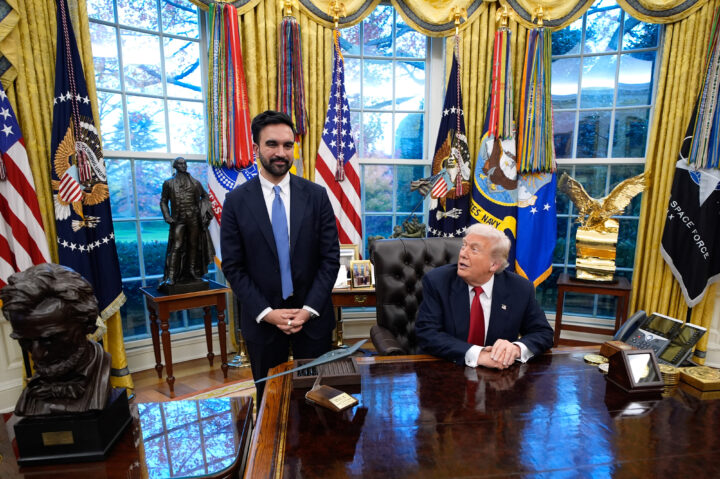
Yuri Gripas/Abaca/Bloomberg via Getty Images
Zohran Mamdani, mayor-elect of New York, left, and US President Donald Trump during a meeting in the Oval Office of the White House in Washington, DC, US, on Friday, Nov. 21, 2025. Trump said he talked about the need for New York utility Consolidated Edison Inc. to lower rates during a meeting with Mamdani at the White House.
In a surprisingly chummy press conference, President Donald Trump and New York City Mayor-elect Zohran Mamdani spoke about their “productive” Oval Office meeting on Friday, yet mostly dodged questions on Israel and antisemitism.
“We had a great meeting. One thing in common, we want this city of ours that we love to do very well, and I wanted to congratulate the mayor. He really ran an incredible race against a lot of smart people,” said Trump. “We talked about getting housing built and food prices. The better he does, the happier I am.”
Mamdani said he “appreciated” the opportunity to meet with Trump and that he looks forward to working “together to deliver that affordability.”
Mamdani’s rise to mayor has drawn concern from pro-Israel and Jewish groups over his past rhetoric regarding Israel, including his inability to condemn the phrase “globalize the intifada,” which calls for violence against Jews. Mamdani has also threatened to arrest Prime Minister Benjamin Netanyahu if he visits New York
On Thursday Mamdani distanced himself from protestors who gathered outside Park East Synagogue in Manhattan, however he suggested that the event, which provided information on immigrating to Israel, violated international law.
In response to a question directed at Mamdani regarding Thursday’s incident, Trump allowed the mayor-elect to evade the question, ultimately taking the conversation in a different direction. It was only at the conclusion of the press conference that Mamdani returned to the subject, reiterating similar comments he has made in the past, saying that he will “protect Jewish New Yorkers.”
During the campaign, Trump said that any Jewish person who votes for Mamdani is a “self-professed Jew hater” and a “stupid person.” However, the president let much of his apparent differences with the mayor-elect on Israel slide.
When asked whether he would stop Mamdani from arresting Netanyahu, Trump simply replied that the two “didn’t discuss” it, refraining from any confrontation on the issue.
Mamdani said he “desperately” wants peace in the Middle East, however, he also noted that he wanted an end to taxpayer’ dollars “funding violations of human rights,” seeming at times to gesture toward Israel without calling out the Jewish state by name.
“I’ve spoken about the Israeli government committing genocide, and I’ve spoken about our government funding it,” said Mamdani. “We have to follow through on international human rights, and still today those are being violated.”
Trump did not interject, instead remaining cordial with Mamdani and proceeding to call him “a rational person” that “wants to see New York be great again.”
In the run-up to the meeting, the president and Mamdani had traded barbs with each other. Mamdani has vowed to “Trump-proof” New York City, sharply criticizing the president’s immigration and economic policies. Meanwhile, Trump has called Mamdani “my little communist mayor” and has threatened to withhold federal funds.
When asked about whether he will provide Mamdani with federal funding, Trump said he plans to “help him,” adding that he believes the mayor-elect “has a chance to do a great job.”
“Some of his ideas, really, are the same ideas that I have,” said Trump. “We agree on a lot more than I would have thought. I want him to do a great job.”
His real estate company, Repvblik, buys hotels and retail properties and converts them into housing units

Courtesy
Richard Rubin and a room in "Plato's Cave," the converted housing unit in Branson, MO.
The COVID-19 pandemic has ravaged U.S. businesses — particularly the retail and hospitality sectors — and placed thousands of Americans at risk of being evicted. But Richard Rubin, CEO of real estate company Repvblik, sees an opportunity amid the economic uncertainty.
Rubin believes his company’s business model of “adaptive reuse” — buying up old hotels and retail and commercial spaces and converting them into affordable workforce housing — is well suited to the changing economic environment.
“There’s just so much that goes into a building that was previously vacant and turning it around that is just hugely beneficial if one does a good job,” Rubin told Jewish Insider, “within not only the town or city or village or enclave in which one’s operating, but also, creating communities and homes for folks is really a special thing to do.”
Repvblik has so far opened just one converted building — a former Days Inn in Branson, Missouri, now known as Plato’s Cave — but has about 10 projects in the works across the country, with a goal of expanding further and constructing 20,000 total apartments within the next five years.
“Things are definitely changing as far as people’s perception of the profitability of doing naturally occurring affordable housing within the U.S.,” he said. “We have the expertise and fortunately now the capital resources to make a reasonable impression in the market and hopefully deliver on a national basis many thousands of affordable housing units.”
Rubin added that he believes the carnage COVID will inflict on the real estate market has thus far been vastly understated.
“I think there’s gonna be a lot of adaptive reuse coming down the pike. I think it’s going to become the flavor of the day,” he said. “I think it’s going to become one of the most common forms… it’s going to become its own asset class, just based on what’s occurring.”

A room in “Plato’s Cave” in Branson, MO. (Courtesy)
Repvblik’s apartments target a niche group that Rubin said is vastly underserved: the workers who make up between 60% and 120% of the area median income — too much to qualify for subsidized housing, but not enough to afford the high-end housing on which many developers focus.
Rubin’s company also has its eye on potentially expanding into transitional housing for homeless people who are able to afford to pay some rent.
The entrepreneur got his start in the adaptive reuse market in his home country of South Africa. His company pioneered the field in Johannesburg’s Central Business District, he said, buying up high-rise commercial office spaces and converting them into multi-family apartments.
Rubin was not initially successful. His real estate business grew out of what he joked was the “most unsuccessful advertising agency in the world.” He originally looked at vacant buildings as potential advertising opportunities, but began to realize the real estate potential.
“I started to look at the fact that there were a million people coming into the city and a million people leaving,” he said. “And I thought, well, there’s got to be an opportunity for housing here.”
Rubin emphasized that in addition to the potential financial opportunities, a spirit of philanthropy and sustainability runs through his work.
“I come from very humble financial beginnings,” he said. “I know what it’s like to have a situation where one’s home is not as secure as one would want from a financial perspective.”
“Everything I’ve ever done has always been some confluence of capitalism and… philanthropy,” Rubin continued. “I feel pretty good about reusing assets.”
While still in South Africa, Rubin expanded into a pan-African student housing business and worked on a slum relocation project. He ultimately moved to the U.S. in 2015 after traveling there a year earlier for a student housing conference.
“I just set up shop here and just thought, there’s a huge opportunity to do this. And you know it’s been a very long road,” he said. “It was a difficult start. But I think we’re building quite a lot of momentum now… I think there’s a huge contribution we could make here.”
Please log in if you already have a subscription, or subscribe to access the latest updates.
 Continue with Google
 Continue with Apple