The group of over 200 participants traveled to Asia last month to promote ties between Israel and the U.S. allied countries
President Lai Ching-te/X
Taiwanese President Lai Ching-te meets with AIPAC leadership, including CEO Elliot Brandt and Board Chair Michael Tuchin, in Taipei on Oct. 28, 2025.
A delegation organized by AIPAC recently completed a nine-day visit to Taiwan, Japan and South Korea, Jewish Insider has learned, as the pro-Israel lobbying group seeks to promote ties with Israel among key U.S. allies.
Over 200 of AIPAC’s largest donors as well as its CEO, Elliot Brandt; board chair, Michael Tuchin; board president, Bernie Kaminetsky; and top professional staff traveled to the region from Oct. 22-30, according to a participant with knowledge of the trip’s background.
Though Israel already has warm relations with all three countries, as both Israel and the U.S. look to increase ties in the Indo-Pacific region, the trip was meant to highlight the Jewish state’s relevance in its defense prowess, relationship to the U.S., shared democratic values, growing relations to the Gulf states — which have historically provided the Asian nations with much of their oil and gas — and acumen in the technology and business sectors, the participant said.
The large group met with high-level leadership in each country, including the Taiwanese president, vice president and secretary-general of its National Security Council, Korean ministers and a Japanese senior diplomat.
Taiwanese President Lai Ching-te told the group that “the Taiwanese people often look to the example of the Jewish people when facing challenges to our international standing and threats to our sovereignty from China,” and that the T-Dome, a missile interceptor project announced by Lai earlier this month, was inspired by Israel’s Iron Dome and President Donald Trump’s “Golden Dome” project.
The Taipei Economic and Cultural Office in Tel Aviv said in a statement to JI, “We welcome AIPAC’s recent visit in Taiwan, underscoring the positive synergies and mutual benefits of partnerships among Taiwan-U.S.-Israel. We continue to work with all stakeholders to deepen cooperation in trade and advanced technologies, to safeguard our shared interests of peace and prosperity.”
The Japanese leg of the trip coincided with Trump’s visit to Tokyo, and the Japanese government had just been sworn in — with its first female prime minister, Sanae Takaichi.
Takaichi, known as a national security hawk, was elected within the ruling Liberal Democratic Party on a platform of boosting defense capabilities and reinforcing Japan’s role in the region, largely through prioritizing the country’s alliance with the U.S., which the AIPAC delegation highlighted as areas of success for Israel.
In South Korea, the delegation visited the Korean Demilitarized Zone, its border with North Korea, where participants heard from Mike Chinoy, a veteran CNN correspondent for the region. The conversations with government officials focused on shared concern between Israel and Korea about North Korea’s nuclear capabilities and cooperation with Iran.
The group also met with business leaders throughout the region who, the participant said, see Israel’s “start-up nation” as a compliment to their own “scale-up nations,” not well-known for innovation but able to rapidly scale technological advancements. The delegation emphasized the multilateral possibilities in the “new Middle East” as a result of Israel’s ties with its Abraham Accords partners, something the participant said is not yet well understood in the region.
AIPAC has taken similar delegations to the Gulf, India and Europe. The Asia visit had been planned for 2020 but was postponed due to the outbreak of COVID-19.
In a recent conversation at a fundraising event, the Maine Senate candidate claimed the Israeli government funded Hamas and also revealed he is related to Israeli author and analyst Seth Frantzman
Sophie Park/Getty Images
U.S. senatorial candidate from Maine Graham Platner speaks at a town hall at the Leavitt Theater on October 22, 2025 in Ogunquit, Maine.
Like many progressives now running for Congress, Graham Platner, a Democratic Senate candidate in Maine, has made opposition to Israel a central part of his messaging.
He frequently accuses Israel of genocide in Gaza, advocates for blocking U.S. aid to Israel and is an outspoken critic of AIPAC. During a campaign event last month, Platner, a 41-year-old former Marine who runs an oyster farm, also said he believes that Israel is a terrorist state.
But more so than many candidates, the political newcomer seems particularly invested in engaging on Middle East policy, even if his views have drawn scrutiny, according to audio of a recent private discussion in which he debated about Israel with some attendees at a fundraising event in Maine for nearly 20 minutes.
Speaking at the August fundraiser, Platner defended his stances on Israel and shared previously undisclosed details about his personal ties to the region, according to the audio, recently shared with Jewish Insider.
Despite his hostile criticism of Israel, Platner said he believed that the country “has the same right to exist that every nation has to exist,” though he did not confirm whether he recognizes Israel’s right to exist as a Jewish state.
While he said he agreed that Hamas is a terrorist organization, Platner claimed that Netanyahu had “publicly stated that” Israel was “funding Hamas to make sure that there was going to be no non-radical leadership within Gaza in order to keep a Palestinian state from happening.”
While members of Netanyahu’s coalition have made this argument — Finance Minister Bezalel Smotrich referred to the terrorist organization as “an asset” as it serves as an obstacle to Palestinian statehood — the prime minister has never personally made such a claim. New York Times reporting from shortly after the Oct. 7 attacks alleged that the Israeli prime minister had allowed the Qatari government to send money into the Gaza Strip for several years in order to “maintain peace in Gaza.” Netanyahu called allegations that he was empowering Hamas “ridiculous.”
“It is difficult for me to lay the onus of everything only at the feet of the Palestinians,” he explained, “and not include the Netanyahu government.”
Platner also quibbled with an attendee who said that 1,200 Israeli civilians had been killed during the attacks, noting that a percentage of those who had died on Oct. 7 were soldiers in the Israeli military.
“It wasn’t 1,200 civilians. It was 600 military members,” Platner countered, using a number that far exceeded the approximately 300 soldiers who were killed in the attacks.
“Who were taken sleeping, unarmed, out of their beds, I’ve met families,” the attendee responded, likely referring to the tatzpitaniot, unarmed female observer soldiers, and others, who were famously killed and kidnapped in their pajamas.
“When you are wearing a uniform and carrying a gun in the service of a cause, it is difficult for me to feel that you can be called a civilian,” said Platner, who fought in Iraq and Afghanistan. “There is a one-way street on this,” he continued, “that I find to be disingenuous.”
The private comments suggest that Platner is not merely paying lip service to such issues on the trail, as he runs in a competitive primary against Maine Gov. Janet Mills for the Democratic nomination to unseat Sen. Susan Collins (R-ME).
Platner’s campaign did not respond to a request for comment.
Platner’s views on Israel and Gaza have received limited attention in recent weeks as his campaign has weathered controversy over his past incendiary Reddit posts and faced questions over when he first became aware that a skull tattoo on his chest he had for nearly 20 years resembled a Nazi symbol known as a Totenkopf.
Platner, who covered the tattoo this month, has insisted he did not know what the skull signified until recently, though reporting from JI and CNN has contradicted that claim.
He has also argued that members of his family are Jewish and never objected to the skull tattoo when he took his shirt off around them. “Eighteen years,” he told The Atlantic recently. “It’s never come up.”
In the conversation about Israel at the fundraiser, which took place before controversy ensnared his campaign, Platner noted his stepbrother is Seth Frantzman, an Israeli author, journalist and security analyst who has long worked for The Jerusalem Post and lives in Jerusalem, saying they are “very close,” according to the audio.
Frantzman, who has previously written admiringly about Platner without mention of their familial ties, did not respond to an email seeking comment.
Platner also said that he had “multiple friends in B’Tselem,” the left-wing Israeli human rights group that has described Israel as an apartheid regime and accused Israel of committing genocide in Gaza — as he argued that Israel is not fully a democracy.
He cited his friends from B’Tselem “who have showed me videos, who have introduced me to former soldiers, who have introduced me to Palestinians, who have laid out a very clear and, frankly, well-sourced case that Palestinians living within the borders of the occupied territories do not live in a democracy, that they do not have equal rights, that they do not have equal access to areas.”
He said that, “as an American taxpayer,” he was uncomfortable with sending continued U.S. aid to support Israel’s military.
But even as he has been deployed to the Middle East, Platner confirmed that he had never visited Israel.
The documentary highlights anti-Israel conspiracy theories and is filled with antisemitic tropes
Anna Moneymaker/Getty Images
Rep. Ro Khanna (D-CA) speaks at a rally near the U.S. Capitol on June 29, 2021, in Washington, D.C.
Rep. Ro Khanna (D-CA) distanced himself from antisemitic influencer Ian Carroll after the congressman posted to social media an excerpt from a YouTube documentary that featured separate clips of himself and Carroll.
Carroll, described in the documentary as a researcher, is an antisemitic conspiracy theorist who has engaged in Holocaust distortion. He has claimed that Israel and Jewish people are involved in a malign global conspiracy, control the U.S. government and were responsible for the 9/11 attacks. He has also asserted that pedophile and financier Jeffrey Epstein was a “clearly a Jewish organization working on behalf of Israel and other groups.”
In the excerpt shared by Khanna alongside his own comments, Carroll stated that recipients of pro-Israel support are “operat[ing] our government on behalf of someone else,” referring to AIPAC and Israel. Khanna himself discussed his concerns about interest group spending in U.S. elections.
“This was a documentary made by Tommy G who interviewed me. I did not speak to or meet Ian Carroll. I stand by my words and should be judged by them,” Khanna said in a statement to Jewish Insider. “I vehemently disagree and reject any views blaming Israel for 9/11, denying the Holocaust, or conspiracies about a Jewish syndicate exerting control.”
In the documentary, Khanna described the U.S. as “complicit” in the destruction in Gaza and stated that Israel has committed war crimes in the enclave and that the International Court of Justice should examine and adjudicate the issue.
“The Hamas terrorist attack was awful, and I said that people who committed those crimes had to be brought to justice and the hostages had to be released,” Khanna said. “But that happened months in. Netanyahu has been bombing for 2 years.”
“Who says, ‘We’re going to starve the people so much that they suffer that we’re going to force the surrender?’ It’s sick, and your tax dollars, my tax dollars, are funding them,” Khanna added.
The documentary itself, posted by a YouTube videomaker with the handle Tommy G, is filled with antisemitic tropes. The thumbnail for the video frames Israeli Prime Minister Benjamin Netanyahu as a puppetmaster with strings controlling several men in suits, posed in front of the White House, flanked by Israeli and AIPAC flags. There are also several dollar bills superimposed over the image.
The documentary highlights anti-Israel arguments — including some conspiracy theories — and repeatedly brushes off or attempts to rebut arguments from pro-Israel voices featured in it. Anti-Israel voices receive the majority of the screen time in the video.
The narrator, Tommy G, opens the documentary by highlighting claims of a coverup or Israeli foreknowledge of the Oct. 7 attack, and plays up alleged Israeli abuses in Gaza.
While condemning Hamas’ actions, he suggests that the terrorist group’s actions could be seen as reasonable or provoked by Israel’s own actions, framing the group — as well as the Taliban in Afghanistan — as “freedom fighters” and “resistance movements.”
Tommy G also makes passing mention of — and does not interrogate — baseless claims that Israel may have been involved in the assassination of Charlie Kirk.
The documentarian describes Carroll as “one of the internet’s top conspiracy analysts,” who critics “label an antisemite … but to others he is a fearless journalist that speaks on what some perceive as an extremely strong Zionist pressure on our government.”
He also suggests that it is inherently suspicious that many lawmakers have traveled to Israel.
And he concludes the documentary by stating, “A lot of us feel deep in our gut something is off here, something is wrong here and I will not be intimidated into not asking questions.”
Carroll himself suggests in the documentary a connection between the pro-Israel cause and the John F. Kennedy assassination, that Israel had foreknowledge of the 9/11 attack and that Israel dispatched Jeffrey Epstein to cultivate relationships with U.S. leaders and blackmail them.
Another anti-Israel voice in the documentary is Anthony Aguilar, a former Gaza Humanitarian Foundation contractor whose key claim of Israeli and GHF abuses has been disproven.
Aguilar states in the documentary that American politicians aren’t allowed to talk about Israel and that shows “who controls you.”
Other featured guests include Sens. Rand Paul (R-KY) and Ron Johnson (R-WI) and Reps. Nancy Mace (R-SC) and Hank Johnson (R-GA), as well as Code Pink leader Medea Benjamin, an IDF reservist and a U.S. doctor who volunteered in Gaza.
Mace, Johnson and the IDF reservist all spoke in defense of Israel.
The video includes a clip of Norman Finkelstein, an antisemitic scholar who has voiced support for Hezbollah and accused Jews of exploiting the Holocaust.
In the documentary, Paul suggests, falsely, that the U.S. has created “easier” rules around lobbying disclosures for countries the U.S. considers to be allies and that many pro-Israel activists are dual-citizens, part of a segment of the documentary that attempts to interrogate why AIPAC is not registered as a foreign lobbying group.
The group’s members and leaders are American citizens who act on their own recognizance, rather than at the instruction of the Israeli government.
Khanna, pushing back on the narrative framing AIPAC supporters as foreign agents, states in the documentary, “They’re American citizens. If you’re an American citizen and you’re articulating a point of view, that’s your right. … They’re American citizens. They’re lobbying for their interests. They’re lobbying for the Netanyahu government’s interests because they think that’s what benefits America. And they’re paying millions of dollars, which under Citizens United is legal.”
Khanna argues in the documentary that spending from outside super PACs on behalf of favored candidates should be outlawed.
The California congressman, rumored as a potential 2028 presidential candidate, has also recently faced scrutiny for his appearance at ArabCon, where other speakers defended Hamas and laughed off the idea of condemning its Oct. 7 attacks.
Facing antisemitism in the workplace, these staffers have turned to each other in group chats and at the Shabbat dinner table for comfort
Kevin Carter/Getty Images
The U.S. Capitol Building is seen at sunset on May 31, 2025 in Washington, DC.
On the night of May 21, several dozen young diplomats and political aides gathered at the Capital Jewish Museum in Washington for a reception focused on humanitarian aid efforts in Gaza.
The event was one of dozens of similar programs that happen around Washington, offering networking opportunities and social connection (alongside tasty hors d’oeuvres) to the overworked, largely underpaid employees that power Congress and the federal bureaucracy. But this event imprinted on the minds of young Jewish politicos because of what happened as it was ending, when Sarah Lynn Milgrim and Yaron Lischinsky, two Israeli Embassy staffers, were shot and killed just after leaving the American Jewish Committee event by an assailant who said that he carried out the attack “for Gaza.”
“I saw the news and I said, ‘Could’ve been any of us,’” a legislative aide for a Democratic member of Congress, who had a ticket to that night’s event, told Jewish Insider last week.
For that staffer, the event brought back to the fore the kind of visceral pain and discomfort that Jewish congressional aides — especially those in Democratic offices and social circles — have gotten used to dealing with since the Oct. 7, 2023, Hamas terror attacks in Israel.
Confronting the aftermath of that day and the ongoing war in Gaza has been a challenge for American Jews in all fields, many of whom have had to face growing antisemitism and antipathy to Israel in their professional lives. But in the Democratic spaces of Capitol Hill — one of the most consequential and most scrutinized workplaces in the country, which is in large part managed by young staffers in their 20s and 30s — the issue is inescapable.
Many of the liberal-minded Jewish staffers on the Hill came to Washington to work on issues such as reproductive rights, access to health care and environmental policy. Now, for nearly two years, they have had to navigate a professional environment that demands an air of detached professionalism while their fellow staffers and Democrats writ large adopt a more critical approach to Israel and antisemitism.
A June poll showed Democratic sympathy toward Israel at an all-time low, with 12% saying they sympathize more with Israelis, and 60% saying they sympathize more with Palestinians. That was a major drop from November 2023, when 34% of Democrats said they were more sympathetic to Israelis and 41% said they were more sympathetic to Palestinians.
Several Democratic Jewish staffers, ranging from junior aides to chiefs of staff — most of whom requested anonymity, wary of being made a target of antisemitism and concerned about putting themselves at risk professionally at a time when Democratic jobs are hard to come by — told JI that, in the face of growing antipathy to Israel and continued antisemitic terror and threats, they have turned to each other to build a tight-knit community among Jews working on Capitol Hill.
“It has led to increased camaraderie and dialogue and kind of just a common understanding and bond … We work for a lot of different members: members who are Jewish, members who are not Jewish, members who one of their main issues is the U.S.-Israel relationship, members who are not mainly concerned with it,” said the legislative staffer. “But nonetheless, I think a lot of us are united and brought together by the aftermath of Oct. 7.”
“If you’re just going to pick up lunch, and you just hear something about ‘apartheid Israel’ in the cafeteria, that hurts. You feel something on that,” said one former senior Jewish staffer who no longer works on Capitol Hill.
Laurie Saroff spent more than 20 years on Capitol Hill, most recently as chief of staff to Rep. Lou Correa (D-CA). When she left Congress in 2022, she started a bipartisan networking organization called the Capitol Jewish Women’s Network.
“So many of us, which is something people don’t understand, are grieving. We’ve been grieving for 650-plus days. Everyone is touched at a different level, but it’s very personal, and sometimes I’m with people who are not Jewish and don’t understand how this impacts us so much,” Saroff told JI. “I think there’s a need for people to come together that I hadn’t seen in the past.”
Part of that desire to connect came from a feeling of alienation from other colleagues on Capitol Hill. Encountering charged anti-Israel rhetoric in the hallways of the Capitol and its fortress of office buildings has become commonplace.
“If you’re just going to pick up lunch, and you just hear something about ‘apartheid Israel’ in the cafeteria, that hurts. You feel something on that,” said one former senior Jewish staffer who no longer works on Capitol Hill. Whenever the war in Gaza intensifies, congressional offices face a barrage of angry, often confrontational phone calls seeking to pressure the members not to support Israel, which the Jewish staffer called “absolutely brutal” for the interns tasked with picking up the phone.
“The things that we hear in our day-to-day about the way that people talk about Jewish communities or Israel groups is so outside the boundaries of what could be considered polite or not antisemitic statements – ‘AIPAC controlling the government,’ AIPAC’s money in races where they don’t even spend it, and yet it’s blamed on AIPAC,” a Jewish foreign policy staffer told JI. “We hear from callers all day long about AIPAC money. Clearly at this point, it’s just a stand-in for saying Jewish money. That’s how I hear it.”
Soon after the Oct. 7 attacks, some Democratic congressional staffers began to pressure their bosses to call for a ceasefire between Israel and Hamas. “Dear White Staffers,” an Instagram account that first went viral several years ago for revealing allegations of lawmaker misconduct, has taken a sharply anti-Israel turn, frustrating many Jewish aides who see their colleagues continuing to follow and engage with the account.
In 2024, some staffers who wanted the U.S. to take a tougher line against Israel created a website that they dubbed the Congressional Dissent Channel. “We are congressional aides dedicated to changing the paradigm of U.S. support for the genocide against Palestinians in Gaza being carried out by the state of Israel,” the organizers wrote on the website, which has since been taken offline.
“I also have had a lot of Dem staff who are not Jewish — who kind of privately don’t agree with this sort of orthodoxy on the topic that is emerging — reach out to me and be like, ‘This is kind of crazy,’” a Jewish Democratic staffer said. “And it’s really nice to hear that. And I’ve definitely gotten closer to some people for that reason,” she told JI, though she added that the anti-Israel contingent in the Democratic Party and on the Hill “feel like there’s a lot of permissiveness for them to say things that are really not acceptable.”
“It’s the small things, like Dear White Staffers. You can’t even explain to your colleagues how repugnant some of these posts are. For any other group, it feels like they would be disciplined. The post would be removed. There would have to be apologies,” the foreign policy staffer told JI. “It’s no secret that — how do I say this? — that diversity is something that seems to be really valued, except for when it comes to Jewish voices.”
Another Jewish Democratic staffer wanted to make clear that many of her non-Jewish colleagues were similarly alarmed by the language that other Hill staffers had adopted after Oct. 7.
“I also have had a lot of Dem staff who are not Jewish — who kind of privately don’t agree with this sort of orthodoxy on the topic that is emerging — reach out to me and be like, ‘This is kind of crazy.’ And it’s really nice to hear that. And I’ve definitely gotten closer to some people for that reason,” she told JI, though she added that the anti-Israel contingent in the Democratic Party and on the Hill “feel like there’s a lot of permissiveness for them to say things that are really not acceptable.”
A senior staffer for a pro-Israel member of Congress said that when their office interviewed potential new hires after Oct. 7, the interviewers began asking job candidates — mostly younger people seeking early career roles — if they were comfortable with the member’s views on Israel and other topics, and what they would do if they disagreed.
“You had to walk on eggshells with your staff, because staff are way more progressive than the offices we were representing. It was a very, very challenging thing, while you’re also dealing with the personal ramifications and trauma of the actual events that happened,” said the former senior staffer who no longer works on the Hill. “I remember there was this one junior staff walkout, and it was the craziest thing to me, because if you’re not from the community, if you’re not a constituent, what are you trying to do? Members are trying to represent the interests of their district, not what their staff or interns want them to do.”
With these experiences casting a shadow over Jewish staffers’ time on the Hill and their understanding of politics and identity, they’ve found comfort in each other and in Jewish tradition.
“There’s a deep desire amongst people to lean on the most beautiful parts of the [Jewish] identity,” a Jewish policy staffer told JI. “I think that gives people a lot of strength because it’s really hard to hear all these things about your community all the time, and then you go to something like a Shabbat dinner … and you’re really reminded that this negative barrage is something that you have to endure for the sake of something that is really meaningful and powerful.”
The legislative aide who had purchased a ticket to the Capital Jewish Museum event said that the aftermath of Oct. 7 and rising antisemitism are “not theoretical and are extraordinarily personal,” which “is a theme that I have found has united and brought together a lot of Jewish staffers on the Hill.” The past two years have also led to “increased camaraderie and dialogue and a common understanding and bond,” bringing these staffers together both inside and outside the workplace.
The staffer who found solidarity with some non-Jewish colleagues said Jewish staff “have formed group chats to support each other and check in and … vent about frustrating experiences that they’re having, stuff like that. So I definitely think professionally and personally the community has deepened a lot and people are really leaning on each other.”
“Shabbat has really been an anchor, I think,” the aide told JI. Congressional staffers endure “lots of busy weeks, lots of long weeknights.” Joining together for a Shabbat meal, as groups of staffers do frequently, becomes “an intentional place to kind of withdraw from that and exist in our Jewish selves.”
The staffer said that, in attending Shabbat dinners, “there’s a deep desire amongst people to lean on the most beautiful parts of the [Jewish] identity. I think that gives people a lot of strength because it’s really hard to hear all these things about your community all the time, and then you go to something like a Shabbat dinner … and you’re really reminded that this negative barrage is something that you have to endure for the sake of something that is really meaningful and powerful.”
Shabbat, she added, is “a good antidote for the constant gaslighting.”
The White House denied Trump’s comments signaled any policy change or the lifting of U.S. sanctions
ATTA KENARE/AFP/GettyImages
Oil tanker SC Hong Kong is seen off the port of Bandar Abbas, southern Iran, on July 2, 2012.
President Donald Trump announced Tuesday that he would allow China to continue to purchase oil from Iran, though a senior White House official denied there had been any change in policy or that sanctions would be lifted.
Trump’s comments appeared to many observers to be a reversal of his own administration’s actions just months ago and in contravention of congressionally approved sanctions designed to cut off the Iran-China oil trade, one of Iran’s most critical sources of funding.
Trump’s comments drove concern among supporters of the sanctions and Iran analysts, who believe that loosening sanctions on Iran now will help it gather funding to rebuild its nuclear program.
“China can now continue to purchase Oil from Iran,” Trump posted on Truth Social on Tuesday morning, following the implementation of a ceasefire between Iran and Israel. “Hopefully they will be purchasing plenty from the U.S., also. It was my Great Honor to make this happen!”
Congress last year passed two separate bills with broad bipartisan support, the SHIP (Stop Harboring Iranian Petroleum) Act and the Iran China Energy Sanctions Act, which were specifically designed to choke off the oil trade between Iran and China. A third bill, the Enhanced Iran Sanctions Act, to place additional sanctions on the trade, has been advancing in the House with strong bipartisan support.
Trump’s announcement appears to mark a striking turnaround from his commitment to “maximum pressure” on Iran. Just months ago, the administration imposed sanctions on Chinese “teapot” refineries for importing Iranian oil for the first time, with the goal of pressuring Iran.
“The President is committed to drive Iran’s illicit oil exports, including to China, to zero,” State Department spokesperson Tammy Bruce said in April. “All sanctions will be fully enforced under the Trump Administration’s maximum pressure campaign on Iran.”
A senior White House official told JI on Tuesday that “The President was simply calling attention to the fact that, because of his decisive actions to obliterate Iran’s nuclear facilities and broker a ceasefire between Israel and Iran, the Strait of Hormuz will not be impacted, which would have been devastating for China.”
The official continued, “The President continues to call on China and all countries to import our state-of-the-art oil rather than import Iranian oil in violation of U.S. sanctions.”
“China is the main consumer of Iranian oil. Enabling China to continue purchasing Iranian oil violates existing sanctions and will allow Iran to rebuild its capabilities, including its nuclear program,” Rep. Josh Gottheimer (D-NJ), the lead Democratic sponsor of the Iran China Energy Sanctions Act, told Jewish Insider.
“With the regime now significantly weakened, we must continue applying maximum pressure and cut off its sources of funding. Doing so will help protect America, our military and diplomatic assets, and our allies around the world.”
Rep. Mike Lawler (R-NY), the lead sponsor of both bills, did not respond to a request for comment.
Trump’s announcement is also driving concern from Iran analysts.
“China purchasing oil from Iran allows it to rearm, refinance and rebuild making future conflict with Israel more likely. It also gives Tehran resources to rebuild its nuclear program,” Jason Brodsky, the policy director for United Against Nuclear Iran, warned. “Also if your goal is zero enrichment in Iran, allowing China to flood Iran with resources makes that goal harder to achieve.”
Brodsky added: “The calculus behind getting China to curtail its purchases of Iranian oil is to achieve zero enrichment in Iran, which has been the president’s longstanding and rightful position.”
“If ever there was a time for more maximum pressure, it would be in a post-strike scenario to contain or roll back the Islamic Republic and prevent China and Russia from helping it ‘build back better,’” Behnam Ben Taleblu, the senior director of the Iran program at the Foundation for Defense of Democracies, said.
Ben Taleblu also noted the sanctions “[undermine] the spirit and letter” of the administration’s executive order and national security memorandum on oil sanctions, while FDD’s CEO Mark Dubowitz highlighted that the trade “violate[s] U.S. sanctions — passed by Congress on a bipartisan basis.”
AIPAC, which urged lawmakers to support the SHIP Act, said in a statement, “We must continue to apply maximum pressure on Iran to ensure that it cannot rebuild its nuclear and ballistic missile capabilities.”
This story was updated at 5:50 p.m. on Tuesday to include comments from a White House spokesperson.
The group’s national leadership refused to support a draft statement in response to anti-Israel protests that included a standalone condemnation of antisemitism
Grace Yoon/Anadolu via Getty Images
Pro-Palestinian students at UCLA campus set up encampment in support of Gaza and protest the Israeli attacks in Los Angeles, California, United States on May 01, 2024.
As anti-Israel encampments on college campuses sprung up at dozens of universities last week, the national leadership of the College Democrats of America (CDA) asked the group’s Jewish and Muslim caucuses to draft a statement condemning the antisemitism that was quickly appearing among some protesters.
The byzantine process that followed would lead the College Democrats’ top Jewish leader to accuse the influential organization of ignoring antisemitism at campus protests to further a one-sided, anti-Israel agenda, after the organization’s leadership nixed the inclusive statement that had been created by the top Jewish and Muslim activists in the group.
Allyson Bell, chair of the CDA’s national Jewish caucus and an MBA student at Meredith College in Raleigh, N.C., got to work writing a statement about antisemitism with Hasan Pyarali, the Muslim caucus chair and a senior at Wake Forest University. The two of them turned in a draft of a statement detailing antisemitism at Columbia University and stating that the College Democrats “absolutely and irrevocably denounce the antisemitism that has taken place at Columbia University and other college campuses over the past week,” according to a document shared with Jewish Insider.
But College Democrats’ national leaders weren’t pleased with this draft, Bell stated. “They wanted us to write a 50/50 approach, to both protect the peaceful side of the protesters and stand against antisemitism,” Bell told JI on Wednesday night. So she and Pyarali gave it another stab. (“It’s been really tough for people to work together on this issue, so I’m so glad that we’ve been able to work together,” Pyarali told JI.)
This time, the draft statement began with a denunciation of antisemitism and a statement of support for the “broad and interfaith coalitions of students who call for a ceasefire, release of the hostages, and a two-state solution where both Israelis and Palestinians can live side by side in peace.” This too, was voted down.
The statement that was ultimately released by the College Democrats on Tuesday ignored the middle path proposed by Bell and Pyarali. Instead, the statement described “heroic actions on the part of students around the country to protest and sit in for an end to the war in Palestine and the release of the hostages.” It called Israel’s war against Hamas “destructive, genocidal, and unjust” — language that Bell had never seen. An Instagram post with the statement touted the endorsement of Pyarali and the Muslim caucus, with no mention of the Jewish caucus — except a comment on the post from the Jewish caucus’ own Instagram account.
“This should not have ever been released without Jewish students’ support. Protect Jewish students, do better,” the College Democrats’ Jewish caucus commented.
“It’s a hurtful thing, not only to not feel heard, but also to know that the organization you’re in doesn’t believe that the antisemitism is happening and doesn’t care enough about it to even include the factual things that we’ve seen on video,” explained Bell.
For months, the Democratic Party has faced criticism from young activists for President Joe Biden’s support for Israel in its war against Hamas. In March, a cadre of influential progressive activist groups, including the Sunrise Movement and March for Our Lives, signed onto a “youth agenda” that focused on climate change, gun violence prevention, immigration reform and reaching a “permanent ceasefire” in Gaza. Debates over Israel and antisemitism have roiled progressive organizations since Oct. 7.
College Democrats touts itself as the official collegiate arm of the Democratic National Committee, the party’s campaign apparatus. The group endorsed Biden’s reelection campaign, and in the past it has served as a crucial tool for reaching young people in an election year, even as the organization has drifted far to the left of the national party in recent years. Spokespeople for the DNC and the Biden campaign declined to comment when asked if they support the message adopted by College Democrats.
The statement sharply diverged from the path charted by Biden, who has supported Israel in its war against Hamas after the Oct. 7 terror attacks that killed more than 1,200 people in Israel, while also seeking humanitarian protections for Palestinian civilians. College Democrats’ national communications chair, Sohali Vaddula, a New York University undergraduate, told JI on Wednesday that the group “has opposed President Biden’s support for Israel in terms of providing military aid, which would further the genocide that’s ongoing.”
On Tuesday morning, hours before CDA came out in favor of campus protests, a White House spokesperson slammed the violent tactics and antisemitism exhibited by some anti-Israel protesters at U.S. college campuses after activists at Columbia violently stormed a campus administrative building. Biden offered a similar message in a Thursday morning speech, the president’s first major remarks on the campus protests.
The College Democrats statement recognizes antisemitism halfway through, with a line that university administrations “need to protect students from all forms of hatred — antisemitism and Islamophobia — without impeding on the rights of students.” It refers to antisemitism having increased “in the weeks following October 7th” with no mention of what occurred that day. College Democrats did not issue a statement on the violence in the Middle East until December, two months after the Hamas attack, when they issued a call for a cease-fire and hostage deal. They refrained from doing so sooner because the issue was “controversial,” said Vaddula.
“This issue has always been controversial, even before Oct. 7, and especially after Oct. 7,” Vaddula said. (She was not an executive board member at the time and wasn’t involved in that decision.)
The College Democrats’ Tuesday statement says the group stands alongside protesters who are calling for an “immediate permanent ceasefire, releases of hostages, and a two-state solution where both Palestinians and Israelis can live side by side in peace.” But this is not what most of the protesters are demanding. Chants of “from the river to the sea, Palestine will be free” — widely seen as a call for the extermination of the Jewish state — are heard frequently from protesters, who also often chant about “intifada.” More than 1,000 Israelis were killed in the Second Intifada two decades ago. Other language and signage exhibited at encampments across the country state that Zionists are not welcome among the protesters.
“It’s hurtful to see so many progressive allies look at the situation as a black-and-white issue, where they can’t hold in themselves, in their hearts, empathy for the Israeli people, for hostages, for Jewish people who are victims of antisemitism,” said Stephanie Hausner, now the chief operating officer at the Conference of Presidents of Major American Jewish Organizations and a former senior leader with both CDA and the Young Democrats of America. “As someone who was deeply involved in the organization, both College Democrats and Young Democrats and the Democratic Party, it’s really hard to see what’s going on in those spaces.”
“I have not seen one student encampment talking about a two-state solution with both sides living side by side,” one former longtime Democratic Party staffer and White House aide observed.
Pyarali, the Muslim caucus chair, disagreed: “I think the majority of people are standing for a two-state solution, and at least we want them to know that at least the majority of College Democrats are,” he told JI on Thursday. “We do think it is possible to be supportive of Israel without being supportive of this genocidal campaign.”
Stephanie Hausner, now the chief operating officer at the Conference of Presidents of Major American Jewish Organizations and a former senior leader with both CDA and the Young Democrats of America, which serves young professionals, lamented the group’s approach to the protests and the war.
“It’s hurtful to see so many progressive allies look at the situation as a black-and-white issue, where they can’t hold in themselves, in their hearts, empathy for the Israeli people, for hostages, for Jewish people who are victims of antisemitism,” Hausner told JI. “As someone who was deeply involved in the organization, both College Democrats and Young Democrats and the Democratic Party, it’s really hard to see what’s going on in those spaces.”
Young Democrats’ Jewish caucus chair, Zach Shartiag, echoed that assessment. “Our organization has turned a blind eye, even in my mind pre-10/7, to issues of antisemitism,” he told JI.
“The Jewish caucus had not signed off on this particular statement because we felt like this one was more representative of what our organization wanted to support,” College Democrats’ national communications chair, Sohali Vaddula, a New York University undergraduate, told JI . “We just don’t want statements to focus entirely on antisemitism because that is a double standard. We should also be focusing on the rising Islamophobia on campuses. There are other students that feel unwelcome on these campuses, not just Jewish students. We wanted to highlight that and not make it one-sided. We felt that the Jewish caucus was making it one-sided.”
“Jewish Dems and the Democratic Party firmly stand with Israel and support its right to self-defense, especially in the aftermath of the horrific attacks perpetrated by Hamas,” Jewish Democratic Council of America CEO Halie Soifer told JI on Thursday. “President Biden, the head of the Democratic Party, has never wavered from his staunch commitment to Israel’s safety and security, while Republicans in Congress blocked emergency aid to Israel for more than six months. We stand with Israel and any statement to the contrary isn’t representative of the vast majority of Democrats and President Biden.”
Vaddula, the College Democrats board member, acknowledged that the Jewish caucus did not approve of the group’s final statement. But, she added, condemning only antisemitism would present a “double standard.” The statement was adopted by a vote of 8-2 among executive board members. She said the group didn’t need to specifically mention instances of antisemitism “because we didn’t feel that the existence of antisemitism at the protests was in question.”
“The Jewish caucus had not signed off on this particular statement because we felt like this one was more representative of what our organization wanted to support,” she said. “We just don’t want statements to focus entirely on antisemitism because that is a double standard. We should also be focusing on the rising Islamophobia on campuses. There are other students that feel unwelcome on these campuses, not just Jewish students. We wanted to highlight that and not make it one-sided. We felt that the Jewish caucus was making it one-sided.”
By ignoring Islamophobia, as the first drafts did, “certain students and identity groups [would] feel excluded from organization,” said Vaddula. When asked about Jewish Democrats who feel excluded, Vaddula said “there’s a seat at the table and the Democratic Party for everybody.”
Ultimately, she said the reason for not aligning with the Jewish caucus came down to the Jewish caucus’ difference of opinion on the war on Gaza. Vaddula said the Jewish caucus might not be “representative” of the Jewish community and cited groups like Jewish Voice for Peace, an anti-Zionist organization whose positions opposing the Jewish state represent a far-left fringe of the U.S. Jewish community.
“Unfortunately, the Jewish caucus just wasn’t willing to denounce genocide,” said Vaddula. “We felt like maybe that wasn’t the best representative sample of Jewish College Democrats or just Jewish young Democrats in general.” (In a follow-up conversation on Thursday, Vaddula clarified that “well-informed people of goodwill will continue to disagree when we use the word ‘genocide’ to describe the situation in Gaza, and of course, there is room for them in College Democrats.”)
“It does feel like the administration, or at least members of the executive board, believe that Jewish students are pro-genocide or anti-Palestine simply for being Jewish,” Allyson Bell, chair of the CDA’s national Jewish caucus and an MBA student at Meredith College in Raleigh, N.C., said. “That conversation hasn’t even been had, but it’s assumed. And like I said before, it’s isolating. It’s alienating. It’s disheartening, and it’s hurtful. I feel for my caucus members. I hate that we’re in this position where we’re trying to figure out like, How do we get heard? How do we share how we’re feeling without getting in trouble for it?”
“When I look at organizations like Jewish Voice for Peace and all these other organizations, some of whom actually are Jewish and are also calling out a genocide, I think it’s important to think about the larger messaging that we’re sending out,” Vaddula added. “I think that is in line with what most of the Jewish groups are saying.” (A March Pew poll found that 62% of U.S. Jews say the way Israel is carrying out its war in Gaza is acceptable, and 89% see Israel’s reasons for fighting Hamas as valid.)
Bell, the Jewish caucus leader, said that in conversations with other top College Democrats, someone implied that she supported genocide, even though no one had discussed the matter with her.
“The irony of saying that to a Jewish student — I honestly just can’t wrap my head around it at this point,” said Bell, who signed onto the December statement supporting a cease-fire. “It does feel like the administration, or at least members of the executive board, believe that Jewish students are pro-genocide or anti-Palestine simply for being Jewish. That conversation hasn’t even been had, but it’s assumed. And like I said before, it’s isolating. It’s alienating. It’s disheartening, and it’s hurtful. I feel for my caucus members. I hate that we’re in this position where we’re trying to figure out like, How do we get heard? How do we share how we’re feeling without getting in trouble for it?”
College Democrats’ turn away from Israel is striking against the backdrop of the organization’s long history of alignment with Israel and pro-Israel organizations such as AIPAC, which is now viewed as a target by many progressive activists. AIPAC used to bring the leaders of both College Democrats and College Republicans on bipartisan missions to Israel, a tradition it continued as recently as 2017. The leaders of both groups also used to travel to Washington each year for AIPAC’s annual policy conference.
“College Democrats owe it to their president and national party, not to mention the Israelis and Palestinians still committed to peace and coexistence, to avoid incendiary statements that will only exacerbate the already explosive situation on campus,” Jonathan Kessler, former leadership development director at AIPAC and founder of the peacebuilding NGO Heart of a Nation.
Despite the Gaza war and campus unrest, in an April Harvard Kennedy School poll, 18- to 29-year-olds ranked the Israeli-Palestinian conflict near the bottom of a list of most important topics; it ranked 15th out of 16 topics mentioned. But Vaddula and Pyarali both told JI they are struggling with College Democrats’ endorsement of Biden in light of his support for Israel.
“I’ve spoken to so many people who have seen his unfettered support as so soul-crushing, because we voted for Joe Biden with the thought that this is someone who’s gonna bring dignity back, someone who’s gonna bring compassion back to the White House,” said Pyarali, who called Biden “complicit in genocide.” Pyarali said Israel was “justified in their targeting of Hamas” after the “horrific” events of Oct. 7, but “it’s never been about targeting just Hamas.” He called the war genocidal from the beginning.
The College Democrats’ Jewish caucus chair said the experience over the past week has made her question her future with the organization.
“At this point, I’ve kind of just decided that it’s worth speaking out about, even if it means that I need to move away from College Democrats of America,” Bell said. “This is important enough that I think more people need to be speaking out in support of Jewish students and the rising antisemitism that is happening across college campuses, even though currently it’s not a popular stance.”
Marvel Joseph is 'bridging the gap between the black community and Israel'
Courtesy
Marvel Joseph speaks at the AIPAC 12th annual real estate division luncheon in New York.
As a new employee of the Maccabee Task Force, an organization that fights BDS on college campuses, Marvel Joseph is responsible for connecting with students at historically black colleges and universities. Joseph’s goal, he told Jewish Insider, is “bridging the gap between the black community and Israel.” The recent college graduate is up for the task — he was an outspoken AIPAC activist at Florida Atlantic University (FAU), and a prominent black voice in the college’s pro-Israel scene.
But following George Floyd’s death at the hands of Minneapolis police officers last month, Joseph, the son of Haitian immigrants, has found himself in an unfamiliar role: teaching Jewish communities about racism. He has participated in recent Zoom webinars with different Jewish communities — including an Orthodox synagogue and his alma mater’s Hillel — about the ongoing protests. In recent weeks he has discussed fighting police brutality with rabbis, Jewish nonprofit professionals and other Israel advocates he has gotten to know since he first got involved in the pro-Israel space in 2018.
“This is the first time that I’ve really been able to say, ‘This is what it’s like being black,’” Joseph explained. “Never before in my entire time as a pro-Israel advocate or pro-Israel leader… have I ever had the opportunity, necessarily, to really stand up and say, ‘This is what my community is going through.’”
Since he attended a 2018 retreat hosted by AIPAC for African-American students, Joseph has placed Israel advocacy at the forefront of his personal and professional endeavors. He has interned at AIPAC, traveled to Israel four times and developed relationships in the Jewish community. Now, for the first time, he is asking the friends he made there to show up for him — and he has found a largely receptive audience.
“What I’m hoping comes out of all of this, when it’s all said and done, is that in the same way that we have black activists in the pro-Israel movement, I hope we also get strong Jewish activists in the pro-black community and the black lives matter movement,” Joseph said.
Joseph, who is Christian, is used to being in Jewish spaces, having grown up and attended school in Boca Raton, Florida. In 2010, when a major earthquake rocked his parents’ native Haiti, many of his Jewish friends joined together to raise relief funds for Haitians. That memory of “Jewish kids helping me” has stayed with Joseph.
As a child, he identified more with the Haitian community than with the broader African-American community in south Florida. “Growing up from immigrant parents as opposed to growing up from a family of descendants of African-American slaves… there’s a different starting point,” Joseph said. Unlike some of his friends whose families were affected by violent, racially tinged events, his parents started fresh in America in the 1980s.
Even in the mostly white spaces he was accustomed to, Joseph didn’t think much about racism. “The schools that [my parents] put me in, even though I was the only black person there, I didn’t feel any different than anyone else, because my background, my culture, always revolved around being Haitian, not around being black in America,” Joseph said.
That changed when he started college. At a fraternity party freshman year with a white friend from home, the friend turned to him, saying, “‘Dude, I’m so glad that you’re not like these other n*****s,’” Joseph recalled. “I was like, ‘What?’ And he’s like, ‘Yeah, you’re one of the good ones,’” Joseph said. “It didn’t matter anything else that happened years before… to him I was just a good n****r,” Joseph added.
The encounter at the party set him on a quest to “find out what my real identity was,” he said. Joseph began reading black authors like James Baldwin, whose quote “to be black and conscious in America is to be in a constant state of rage,” inspired his journey toward better understanding systemic racism in the United States.

Marvel Joseph leads a Maccabee Task Force trip to Israel for black student leaders in December. (Courtesy)
Still, Joseph’s Haitian background is a key part of his identity, and it’s what inspired his connection to Israel. He has only been to Haiti once, on a three-day visit in 2019, which he described as the most meaningful trip of his life. “It was the first time when I walked into a place I didn’t feel out of place. I got to actually be part of my people,” Joseph explained. “Probably how a lot of Jewish people feel when they get to go to Israel.” That shared feeling of being part of a diaspora, and having a homeland, drew him toward Israel.
Joseph has built a niche for himself in the pro-Israel world, as a Christian and a Haitian who speaks about his deep connection to the Jewish state. But he told Jewish Insider that he never felt like “the token black person in the pro-Israel movement.” The reason, Joseph said, is that “when you’re tokenized, you say what they tell you to say and not what you believe. Everything I say is stuff that I believe.”
As he sees it, many Jewish organizations — including some right-leaning ones who might not otherwise host discussions about racism — are reaching out to him now “because they realized that this is someone who stands up for [the Jewish community] in ways that no one prior has.”
Joseph understands that it’s unusual for a black person who is not Jewish to pursue a career in what is largely a Jewish cause. “We love talking about MLK being the ultimate black Zionist, but MLK had other things that he was worried about,” Joseph said, adding, “I’ve essentially dedicated my first year out of school, at least my first year out of school, to really doing this work.”
So what does Joseph hope to see from his Jewish friends? “My response to people when they say, ‘Hey, we’re thinking about you during this time,’ is, ‘Well hey, call your congressman, tell them you’re thinking about me and all the black people that have been killed.’”
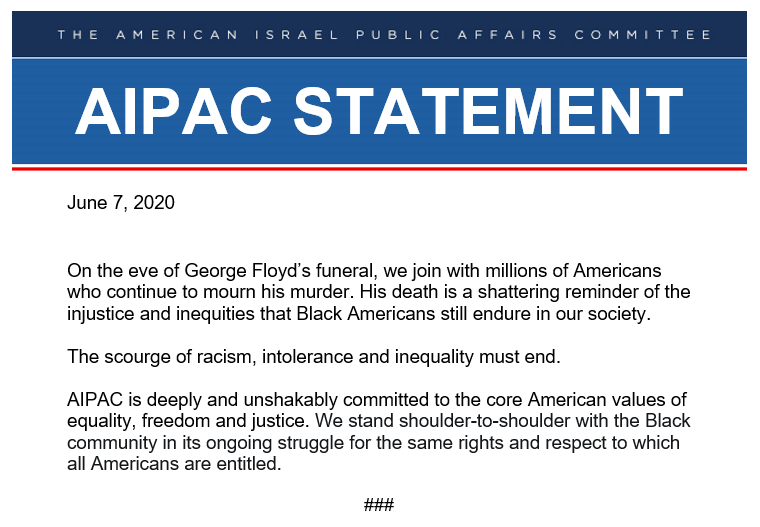
AIPAC, which sent a letter to its African-American members six days after Floyd’s death expressing solidarity, received criticism for being slow to issue a public statement in response to the events, but Joseph wasn’t concerned by that. What mattered more was the messages of support he received from friends at AIPAC and in the pro-Israel community, people who asked him how they could support him and the cause. “It’s a bipartisan organization… the fact that people decided that whether this is a partisan issue or not, I support you and your community, not because of everything you’ve done for me but because it’s the right thing to do, to me means more than any statement,” Joseph explained.
He views his position in the Jewish community as a bridge-builder, someone who supports Israel and fights antisemitism but also helps “my friends in the Jewish community understand that there’s a world outside of just the Jewish issues.” He understands that the anti-Israel policies in the official Black Lives Matter platform give some Jews pause. “But the idea of ‘black lives matter’ is black lives matter. There’s other ways to support a community,” Joseph said.
“At the end of this,” Joseph explained, he hopes to see “more education and a more genuine partnership, not an ‘I scratch your back, you scratch mine,’ but a ‘please tell me how I can help.’”


