Wikimedia Commons/ Persian Dutch Network
Iran International holds Iranian regime accountable — from afar — with aggressive journalism
From Washington, the London-based Persian-language network is expanding its footprint — connecting Iranians inside the country with global policymakers and challenging Tehran through independent, anti-regime reporting


 Add JewishInsider on Google
Walk into any think tank in Washington and you’re likely to bump into more than a few so-called “Iran watchers”: researchers whose job is to try to interpret the actions of the often-opaque Iranian regime and help policymakers figure out how to approach the Islamic Republic.
Given the adversarial relationship between Washington and Tehran, making sense of the two nations’ policy choices toward each other is big business. But according to some Iranians, something is missing.
“Most of the people who are working on Iran, they have never been to Iran. Americans, I mean. That brings with itself certain limitations,” said Mehdi Parpanchi, who was born in Iran but now lives in Washington. The U.S. does not have a diplomatic presence in Iran, and vice versa. “In my opinion, the image of Iran is not being seen properly from outside the country.”
Parpanchi is the director of U.S. news at Iran International, one of the biggest independent Persian-language news outlets in the world. Based in London, Iran International broadcasts inside of Iran via satellite — much to the chagrin of Iranian officials, who have called the network a terrorist organization. It also reaches Iranians expats and dissidents around the world. While the network mainly operates with the goal of offering independent news from an anti-regime perspective to the global Iranian diaspora, Iran International also serves as a crucial source to Iran watchers of all stripes, including those who have never set foot in the country.
“There is always a decade of delay between the reality inside Iran and how it is being seen from the West, especially from the U.S.,” Parpanchi, who moved to Washington in 2020 to launch a U.S. headquarters for Iran International, told Jewish Insider last month.
A new show from Iran International, filmed in Washington and broadcast around the world, aims to at least partly remedy that problem. “Iran International Insight,” which launched in June, pledges to put Iran International viewers who live in Iran in conversation with the political figures and diplomats across the world whose policy choices will affect their lives.
“The concept was that there’s a tremendous opportunity for policymakers and experts in D.C., but especially policymakers, to be engaging with and taking questions from the Iranian people directly,” said Aaron Lobel, a co-producer of the new show and the founder and president of America Abroad Media, an international media organization.
The growth of Iran International’s programming in Washington comes after the Trump administration slashed funding for the U.S. Agency for Global Media, which supports independent outlets such as Voice of America, Radio Free Europe/Radio Liberty (RFERL) and Middle East Broadcasting Networks that air pro-democracy content around the world. Parpanchi previously spent two years at RFERL, which has a Persian-language branch.
Iran International is not expressly trying to fill that niche, and the new program was in the works starting in 2024, before Trump even came to office. Regardless, the new program arrives at a time that America has pulled back from cultural diplomacy.
“This is in the best traditions of the United States. It advances American values and it advances American interests,” said Lobel. “The more credible media organizations outside Iran that are trying to reach the Iranian people with information and to give them some sense of hope as well — the more the better.”
So far, three interviews — hourlong conversations between one or two guests and an Iran International anchor — have been filmed, all in front of a live audience, including many Iranians who live and work in Washington. Iran International’s producers and journalists solicit questions from the network’s viewers in Iran. The interviews take place in English, but they are dubbed in Persian before being aired.
“I’ve met with groups of Iranian diaspora, who have family in Iran and who are activists with them. But I don’t think I received online questions like that,” Israeli Ambassador to the U.S. Yechiel Leiter, who was the first guest, told JI. “That was the primary agenda, to speak to the people.”
Leiter’s interview with Iran International was a journalistic gold mine for the network: scheduled in advance, it happened to come at a particularly timely moment, hours after President Donald Trump announced a cease-fire between Israel and Iran at the end of the countries’ 12-day war in June. Leiter touted Israel’s military victories in its campaign to destroy Iran’s nuclear capabilities. Yet many Iranians wondered why Israel would attack Iran, but ultimately not seek to remove the ayatollah from power. (Hundreds of questions were submitted.)
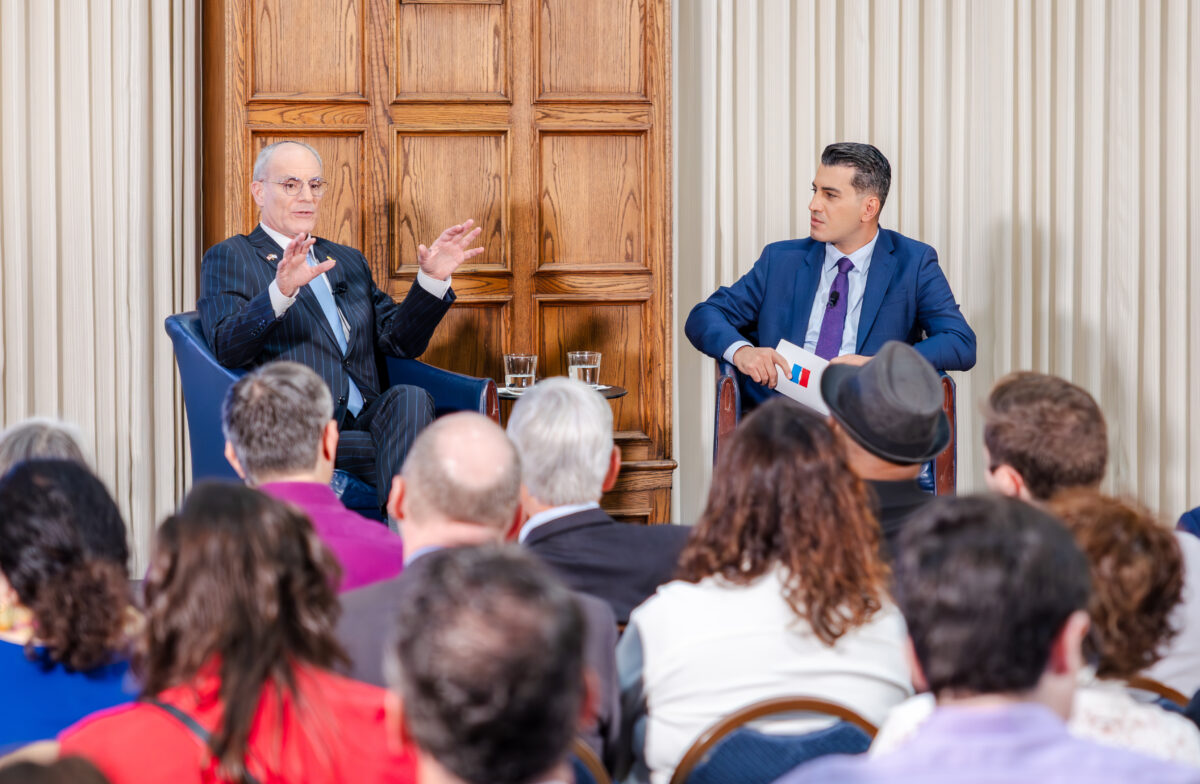
“One of the themes that came out that was so striking was, of course, many Iranians wanted Israel to continue the campaign, and they were, I think it’s fair to say, you could hear in that show, disappointed that Israel stopped the war. Or to put it differently, they were upset that the Israeli government had, in their view, raised their expectations of ‘regime change’ and then failed to deliver,” said Lobel.
Leiter offered unusually candid responses to those questions, going beyond the diplomatic language that would’ve gotten the job done even if leaving viewers unsatisfied.
“I appreciated the opportunity to explain why we weren’t going to go further and actually topple the regime by force,” Leiter explained. “I understand them. Remember when the chancellor of Germany said that Israel is doing the ‘dirty work’ for the world? I guess that the people wanted us to do the work completely for the world. But we can’t do that. And it was important for me to be able to explain that.”
Two other programs were recorded this fall. One featured Elliott Abrams, who served as Iran envoy in Trump’s first term, and Dennis Ross, a fellow at The Washington Institute for Near East Policy who previously held several high-level jobs at the State Department in Democratic and Republican administrations. Another featured former CIA official Norman Roule and Mark Dubowitz, CEO of the Foundation for Defense of Democracies. Iran International’s main Instagram account has 16 million followers, and video clips from the Roule-Dubowitz event got about 1 million views each.
Those four experts have different ideological backgrounds, but each falls closer to the hawkish end of the spectrum on Iran. So does Sen. Tom Cotton (R-AR), who was scheduled to appear in an interview in September before the congressional schedule led Cotton to cancel. (Parpanchi said they hope to reschedule.)
Parpanchi said Iran International aims to include a broad range of perspectives from Washington, noting that the program is only just beginning.
“It’s not only hawkish. There are other people who have different views about Iran, and we will reflect them all,” Parpanchi said. Iran International plans to ramp up to a more regular filming schedule in 2026.