


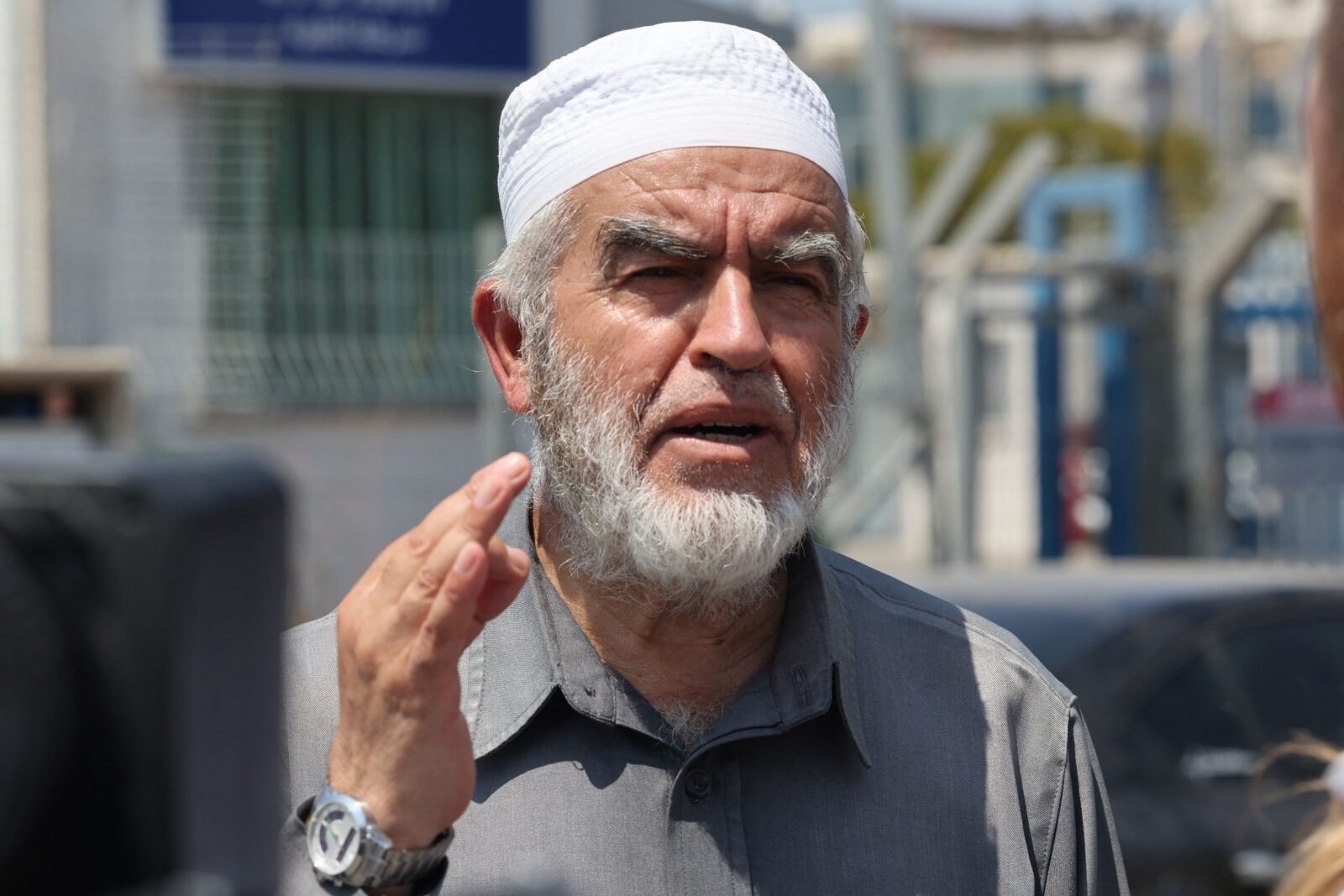
AHMAD GHARABLI/AFP via Getty Images
Israel’s neighbors have banned the Muslim Brotherhood, but Israel hasn’t. Why not?
One of its branches is banned for Hamas ties. The other sits in the Knesset


 Add JewishInsider on Google
While Congress is working on a bill to designate the Muslim Brotherhood a terrorist organization in the U.S., and the Islamist group is banned from Egypt, Syria, Saudi Arabia, the United Arab Emirates and beyond, the group’s status in Israel is much more complicated.
The matter drew renewed attention this week after Mansour Abbas, the leader of the Ra’am party in the Knesset, an ideological offshoot of the Muslim Brotherhood, declined to call for the eradication of Hamas on Israeli radio.
In an interview with Israeli public broadcaster KAN, Abbas mostly lamented the high rate of crime and gun violence in Israeli-Arab society, but when he mentioned Gaza, the interviewer, Asaf Liberman, asked whether he sees Hamas as part of the enclave’s future.
“Palestinian society needs to pick its leadership and go on a new path towards peace and reconciliation,” Abbas responded.
Liberman twice repeated his question and sharpened it: “Does Hamas need to be destroyed?”
Abbas added that an international force must enter Gaza and after an interim period a security force of the Palestinian Authority would be trained, but after being pressed to make his position on Hamas clear, he said the interview was beginning to feel like an “interrogation,” and pointed out that he had gone on air to talk about domestic issues facing Arab Israelis. “If you want to talk about crime, fine, if not, bye,” he said, before hanging up.
Abbas has previously condemned Hamas’ Oct. 7 attacks, calling them unjustifiable and inhumane, and called for the release of the hostages. The other reporter who conducted the interview, Suleiman Maswadeh, later noted that Abbas and his family had recently received death threats, and hinted that was the reason the Knesset member avoided repeating his previously articulated position — which Maswadeh said does not include a future for Hamas in the governance of Gaza.
In 2021, the Ra’am party became the first Arab party in 50 years to join an Israeli governing coalition, which was celebrated by many in Israel and abroad as a milestone for coexistence, while the Israeli right criticized the 2021-2022 government for what it characterized as working with the Muslim Brotherhood.
Monday’s interview sparked headlines and analysis in right-leaning Israeli media and comments by politicians on the right about the viability of center and left-wing parties once again forming a coalition with Ra’am to oust Prime Minister Benjamin Netanyahu, when Ra’am’s leader would not say that he is for eradicating Hamas.
“The Muslim Brotherhood is a very generic term,” said Michael Milshtein, head of the Palestinian Studies Forum at the Moshe Dayan Center at Tel Aviv University. “It’s not membership in an organization; it’s a denomination. Mansour Abbas is the Muslim Brotherhood. Raed Salah, his rival, is also the Muslim Brotherhood. Hamas is the Muslim Brotherhood. [Turkish President Recep Tayyip] Erdogan is the Muslim Brotherhood.”
The historic and recent connections between Hamas and Ra’am, both of which were founded by adherents of the Muslim Brotherhood, shed light on the nuances of the international Sunni Islamist movement and its status in Israel.
Michael Milshtein, head of the Palestinian Studies Forum at the Moshe Dayan Center at Tel Aviv University, emphasized, in an interview with Jewish Insider on Wednesday, that the Muslim Brotherhood is an ideology aiming to make Muslim societies more religious, and is not one centralized organization spanning the Muslim world.
“The Muslim Brotherhood is a very generic term,” Milshtein said. “It’s not membership in an organization; it’s a denomination. Mansour Abbas is the Muslim Brotherhood. Raed Salah, his rival, is also the Muslim Brotherhood. Hamas is the Muslim Brotherhood. [Turkish President Recep Tayyip] Erdogan is the Muslim Brotherhood.”
Muslim Brotherhood founder Hasan al-Banna’s brother, Abd al-Rahman al-Banna, founded the group’s branch in Mandatory Palestine in 1935; its leaders included Mufti of Jerusalem Hajj Amin al-Husseini, who incited the deadly Hebron riots against Jews in 1929 and collaborated with Hitler, and Izz al-Din al-Qassam, leader of the 1935 Arab Revolt against the British and namesake of Hamas’ short-range Qassam rockets.
Gaza-based Sheikh Ahmad Yasin formed the Muslim Brotherhood-inspired Hamas in the 1980s. Sheikh Abdullah Nimar Darwish founded the Islamic Movement in Israel in 1971, which also espoused Muslim Brotherhood ideology.
In 1979, Darwish founded an underground group in Israel called The Family of Jihad with a goal of establishing an Islamic state. However, after his arrest and conviction for involvement in killing an accused collaborator and membership of a terrorist organization, he renounced violence and decided to promote Islamism within the confines of Israeli law.
Fissures began in the Islamic Movement in Israel after the Oslo Accords, with the northern branch, led by Sheikh Raed Salah, opposing it, while the southern branch supported it. The two parts of the movement officially split when the southern branch ran for the Knesset in 1996 as Ra’am, and Salah advocated boycotting national elections.
The leaders of the northern branch were arrested in 2003 for aiding Hamas and in 2015, the branch was banned, after the police and Shin Bet demonstrated that it had close ties to Hamas and the Muslim Brotherhood, and received funds from groups affiliated with Hamas.
Darwish, however, continued to be the spiritual leader of the Islamic Movement’s southern branch and said he was committed to obeying the laws of Israel. He engaged in interfaith dialogue events, often with former Labor lawmaker Rabbi Michael Melchior, and spoke out against Holocaust denial.
While Islamic Movement Southern Branch leaders have met with Hamas leaders and taken part in mediation efforts between the Palestinian Authority and Hamas, in 2022, then-leader of Hamas Yahya Sinwar declared Mansour Abbas a traitor for joining the governing coalition and saying Israel is a Jewish state. Abbas has said that his decision to join the governing coalition in 2021 came from the values he “absorbed from the legacy of Sheikh Abdullah Nimr Darwish.”
As such, the more radical of the two major offshoots of the Muslim Brotherhood is outlawed in Israel.
Yet, more recently, the Islamic Movement Southern Branch has come under scrutiny for its own possible ties to Hamas.
In the decades since its establishment, the Islamic Movement has faced repeated crackdowns on its charities. The Islamic Relief Committee, founded in 1987 with the stated goal to help the needy in the West Bank and Gaza, was shut down by Israeli authorities in 1995 for aiding Hamas members’ families, the first in a series of such actions.
“Israel’s anti-terrorism law and the whole discipline has been to focus on specific organizations and declaring them as terrorist organizations because of their goals, because of the means that they use, rather than focusing on an idea, which the Muslim Brotherhood really is,” Lt.-Col. (res.) Maurice Hirsch, the former director of the IDF Prosecution for Judea and Samaria, told JI.
In July, the Israeli Justice Ministry unit dealing with nonprofit organizations found grounds to shut down “Aid 48,” a charity affiliated with Ra’am, on suspicion of providing funding to terrorist organizations. “Aid 48” is the Islamic Movement Southern Branch’s main charity. According to an investigation by the ministry, in 2020-2021, the organization transferred NIS 2 million to a charity in Hebron that Israel had declared in 2012 to be part of a terrorist organization; in 2023, “Aid 48” worked with three such Palestinian charities; in 2020, the organization gave NIS 933,000 to a Turkish organization run by Hamas members, which funneled money to the terrorist organization.
Lt.-Col. (res.) Maurice Hirsch, the former director of the IDF Prosecution for Judea and Samaria, currently the director of the Initiative for Palestinian Authority Accountability and Reform in the Jerusalem Center for Public Affairs, explained to JI that Israeli law makes it easier to crack down on smaller subgroups than an umbrella term like the Muslim Brotherhood.
“Israel’s anti-terrorism law and the whole discipline has been to focus on specific organizations and declaring them as terrorist organizations because of their goals, because of the means that they use, rather than focusing on an idea, which the Muslim Brotherhood really is,” he said on the sidelines of a JCFA conference last week.
In order to declare the Muslim Brotherhood a terrorist organization, “you have to break it down into intelligence,” Hirsch said, adding that the authorities would have to determine who they are seeking to arrest and what money and possibly weapons need to be seized.
Hirsch recounted taking part in the Israeli Security Cabinet meeting in 2015 when the government decided to outlaw the Islamic Movement Northern Branch.
“Some of the questions that were asked were, what is the next step? Who do we operate against now? It was a bit clearer than the entire Muslim Brotherhood, but even then there was a question,” he said.
“I would be very careful because, at its core, the Muslim Brotherhood is a movement that aims to change society. They have a lot of social organizations. It’s very different from Islamic Jihad or ISIS, who are not interested in social activism,” said Milshtein, adding that the Muslim Brotherhood ideology is up for interpretation by its adherents.
When it comes to the southern branch, Hirsch, who has worked with the “Choosing Life” organization of relatives of victims of terror whose lawsuit led to the shuttering of “Aid 48,” argued that “there is a clear connection between Ra’am and funding Hamas … That connection was there all along. It’s partly ideological and partly the idea of the Muslim Brotherhood in its different constellations, including in Israel.”
Milshtein acknowledged that there have been cases of leaders of “Aid 48” meeting with Hamas leaders and funding going to Hamas ahead of its invasion of Israel on Oct. 7, 2023, but said that Abbas “took care of” those responsible when he learned of the incidents.
“I would be very careful because, at its core, the Muslim Brotherhood is a movement that aims to change society. They have a lot of social organizations. It’s very different from Islamic Jihad or ISIS, who are not interested in social activism,” he said, adding that the Muslim Brotherhood ideology is up for interpretation by its adherents.
“If you ask Mansour Abbas, there is no problem with being part of the Muslim Brotherhood and part of the government in a state that defines itself as Jewish,” he said. “If you ask Hamas, they want jihad against Israel.”


Please log in if you already have a subscription, or subscribe to access the latest updates.