










































































Plus, Ireland draws Risch’s ire

Avi Ohayon/PMO


 Add JewishInsider on Google
Good Monday morning.
In today’s Daily Kickoff, we preview Israeli Prime Minister Benjamin Netanyahu’s meeting with President Donald Trump that is slated for this evening, and talk to former Rep. Mike Rogers, who is mounting a Senate bid in Michigan, about the Trump administration’s approach to Iran. We also interview the chancellors of Washington University and Vanderbilt about their approaches to antisemitism and anti-Israel activity on campus, and look at the regional effects of the deepening relationship between Israel and Azerbaijan. Also in today’s Daily Kickoff: Sen. Jim Risch, Yoram Hazony and Dennis Ross.
What We’re Watching
- If it’s the week after July 4, all eyes are turning to Sun Valley, Idaho, for the annual Allen & Co. leadership retreat, which is set to kick off tomorrow. Attendees this year include Mark Zuckerberg, Jeff Bezos, Andy Jassy, Sam Altman, Barry Diller, Alex Karp, Evan Spiegel, Ynon Kreiz, Charles Rivkin, David Zaslav, Brian Grazer, Bob Iger, David Ignatius, Bari Weiss, Senate Minority Leader Chuck Schumer (D-NY), Mike Bloomberg, Govs. Wes Moore and Glenn Youngkin, Jeffrey Katzenberg and Casey Wasserman.
- Israeli Prime Minister Benjamin Netanyahu will meet with President Donald Trump this evening at the White House. Earlier in the day, Netanyahu will meet at the Blair House, where he is staying, with Secretary of State Marco Rubio and Middle East envoy Steve Witkoff to prepare for his sit-down with the president.
- Elsewhere in Washington, the Senate Armed Services Committee’s subcommittees will hold markups on the National Defense Authorization Act.
- Leaders from the BRICS alliance wrap up their two-day summit in Rio de Janeiro today. Absent from the gathering of officials from Brazil, Russia, India, China and South Africa was Chinese President Xi Jinping, while Russian President Vladimir Putin, who has largely curbed his travel abroad since Russia’s invasion of Ukraine, addressed the gathering by video.
What You Should Know
A QUICK WORD WITH JI’S MELISSA WEISS AND LAHAV HARKOV
When Israeli Prime Minister Benjamin Netanyahu sits down with President Donald Trump today, one question will be on observers’ minds: What will each walk away with?
Netanyahu appeared to come away empty-handed from his April meeting in Washington, after the U.S. imposed tariffs on Israel, among other countries. Weeks later, Trump skipped Israel on his first trip abroad, while visiting three other countries in the region.
Few knew at the time about Netanyahu’s plans to take on Iran. Following last month’s joint U.S.-Israel military effort to degrade Iran’s nuclear program and military infrastructure, relations between the two leaders have improved to such a degree that last week Trump called twice for an end to the legal proceedings against Netanyahu. A post-strikes-on-Iran victory lap is top of the public agenda for Netanyahu’s White House visit today, while Trump’s other goals, as they relate to Israel, remain works in progress.
The White House wants to wind down the war in Gaza, as Trump has said many times in recent months. After the American bunker busters dealt Iran the final punch that Israel pushed for, the president has newly gained leverage to push Netanyahu to end the war in Gaza — a move the Netanyahu government has thus far resisted until it has achieved its goal of “total victory” against Hamas. Trump told reporters on Sunday night that “there’s a good chance we have a deal with Hamas during the week pertaining to quite a few of the hostages.”
ROGER THAT
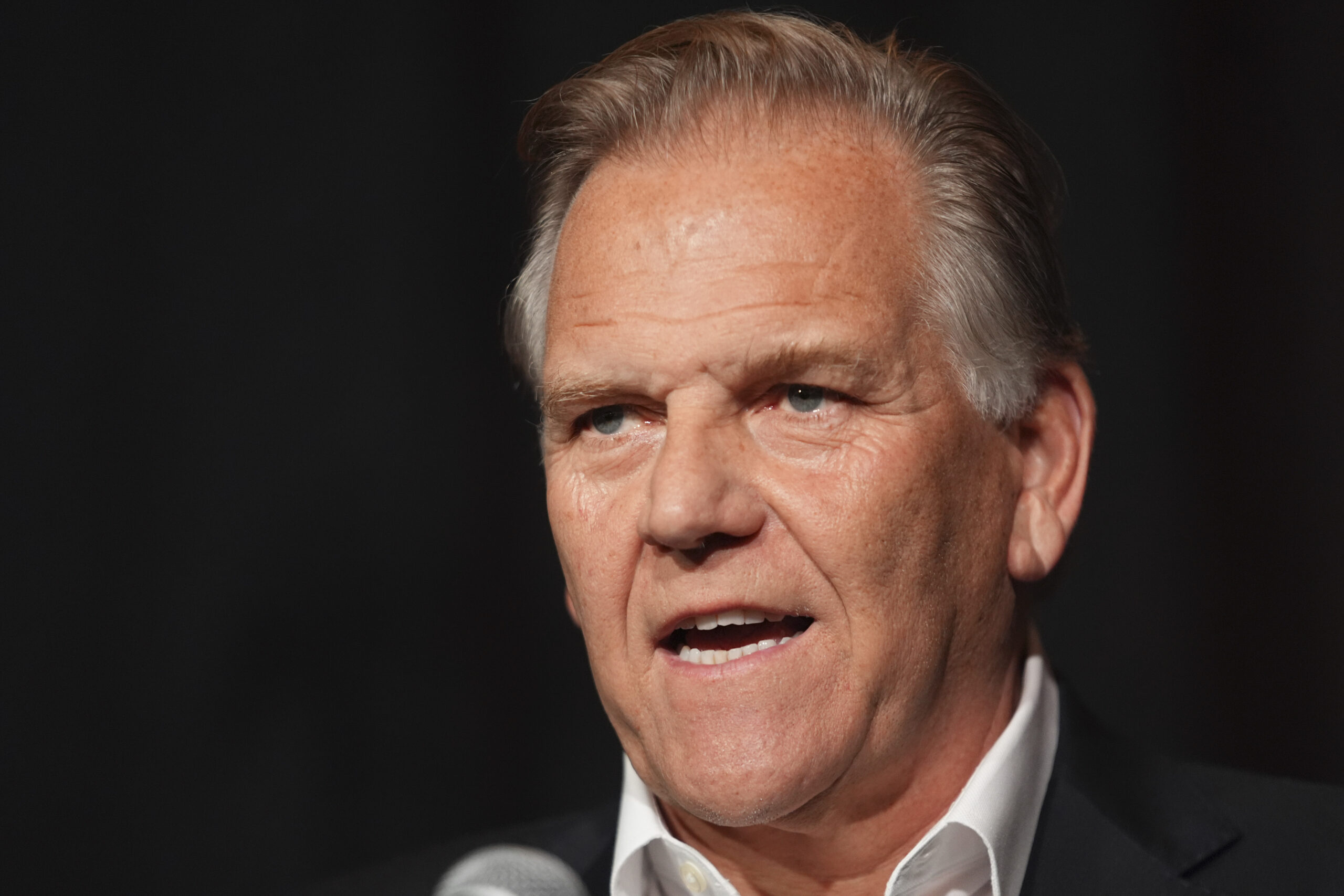
Former Rep. Mike Rogers (R-MI), making his second bid for Michigan’s Senate seat, is leaning into his support for the Trump administration’s decision to strike Iran’s nuclear program on the campaign trail, Jewish Insider’s Marc Rod reports.
Iran angle: Rogers emphasized, in an interview with JI last week, that he has long been suspicious and concerned about Iran’s nuclear program and other malign activities dating back to his time as the chairman of the House Intelligence Committee in the early 2010s, when he had access to highly classified information. “I couldn’t have supported [the operation] more,” Rogers, who served in the House from 2001 to 2015, said. “I was for all of this when it wasn’t very cool to be for all of this. The former lawmaker said he believes that Iran was much closer to a nuclear weapon than many believe, noting that its development of advanced supercomputers would likely have allowed it to reliably simulate a nuclear weapons test, an undetectable alternative to actually testing a nuclear bomb.
Bonus: Rogers’ Senate campaign recently named a conservative influencer with an extensive history of anti-Israel posts as county chair for his campaign in five counties — but Rogers distanced himself from the volunteer’s views on the Middle East in an interview with Jewish Insider’s Marc Rod.
CAMPUS BEAT
Many universities are still navigating the post-Oct. 7 maelstrom, trying to handle competing concerns from students, parents, alumni and faculty — all while facing civil rights investigations by the federal government. In March, Education Secretary Linda McMahon wrote a letter to 60 schools under investigation for antisemitic discrimination, including Harvard, Yale, Northwestern, Stanford and Princeton. Vanderbilt University and Washington University in St. Louis were not on the list. That presents an opening for them to reach Jewish students with concerns about what they’re seeing elsewhere, particularly as the Jewish student populations at many top universities have shrunk. Vanderbilt Chancellor Daniel Diermeier and WashU Chancellor Andrew D. Martin talked to Jewish Insider’s Gabby Deutch about why they’re pushing back against “creeping politicization” on college campuses.
Political play: The two university leaders have joined together in something of an informal pact — a joint effort to promote principled leadership in higher education, presenting their two schools as a refreshing counterweight to the dysfunction plaguing higher-ranked competitors like Harvard and Columbia. Martin and Diermeier see themselves and their institutions as the stewards of a forward-looking case for higher education at a time when the institution is under attack, both from Washington and from Americans, whose trust in higher education has plummeted. It’s not just about values: It’s a savvy political move. After all, both Vanderbilt and WashU would be in trouble if federal research dollars stopped flowing to the schools, or if President Donald Trump made the call that they could not admit international students, as is the case with Harvard.
BAKU BUSINESS

Following the Israel-Iran ceasefire and amid questions about the extent of the damage Israel and the U.S. inflicted on the Islamic Republic’s nuclear program, an important piece of news flew under the radar: Azerbaijan’s national energy company, SOCAR, finalized its purchase of a 10% stake in Israel’s Tamar gas field. The deal and its timing amid hesitation from other countries that have considered investing in Israel, reflect a growing strategic partnership between Jerusalem and Baku — one that has garnered increasing pressure from Iran toward Azerbaijan, Jewish Insider’s Lahav Harkov reports.
Details: The day after the ceasefire between Israel and Iran was announced toward the end of last month, Union Energy, owned by Israeli businessman Aharon Frenkel, received the final approval from Israel’s Petroleum Council and Competition Authority to sell half its shares of the gas field in the Mediterranean, which provides 60-70% of Israel’s electricity each year, to Azerbaijan’s SOCAR. Chevron owns 25% of the Tamar field and the UAE’s Mubadala sovereign wealth fund owns an 11% stake. Azerbaijan supplies as much as two-thirds of Israel’s oil, and Israel was the largest supplier of arms to Azerbaijan from 2016-2020. Israel continued to sell drones and missiles to Baku during its war with Armenia over the disputed Nagorno-Karabakh region in 2020, as well as satellites and a missile-interception system in 2023, during another war between Azerbaijan and Armenia.
DUBLIN WARNING

Irish Foreign Minister Simon Harris urged the U.S. to end the war in Gaza at the American Embassy in Dublin’s Fourth of July party, days after the chairman of the Senate Foreign Relations Committee, Sen. Jim Risch (R-ID), warned that the U.S. may reconsider its economic ties with “antisemitic” Ireland. Harris, who is also Ireland’s deputy prime minister and defense minister, began his speech by focusing on the close relationship between the U.S. and Ireland, according to Dublin-based The Journal, before pivoting to the war in Gaza, Jewish Insider’s Lahav Harkov reports. Harris said at the event on Thursday that his country “want[s] the bombs to stop, the killing to stop … because the cry of a child is the same in any language.”
U.S.-Ireland tensions: “It compels us to provide comfort and protection from harm. As human beings in positions of power, we can no longer bear the heartbreaking cries of the children of the Middle East,” Harris added. “And I join, I know, with everyone here in urging everybody involved to support and engage in efforts underway to reach agreement on a new ceasefire and hostage release agreement, to redouble those efforts and to end the violence once and for all.” U.S. Ambassador to Ireland Ed Walsh did not applaud the remarks, The Journal reported. Harris has previously called Israel’s war against Hamas terrorists in Gaza a “genocide.” Earlier last week, Risch posted on X that “Ireland, while often a valuable U.S. partner, is on a hateful, antisemitic path that will only lead to self-inflicted economic suffering.” The post came after Harris introduced legislation to ban trade with Israelis operating in the West Bank and parts of Jerusalem.
Worthy Reads
Tragedy in Tamra: In The Wall Street Journal, Fania Oz-Salzberger reflects on how the death of her student, an Israeli-Arab woman whose home was struck by an Iranian ballistic missile, underscores the ways in which the Israeli government has fallen short in protecting citizens. “Prime Minister Benjamin Netanyahu attacked Iranian nuclear and military sites to defend the country — rightly, in my view. But the current Israeli government has failed in multiple ways to defend its citizens, both Jewish and Arab. … The Khatib family was killed by Iran, and they represent the exact opposite of the ayatollahs’ regime. They are democrats, moderates — crucial partners in any future Israeli society that might emerge from the current ruins and smoke.” [WSJ]
China First: In The Free Press, Yoram Hazony posits that President Donald Trump is guided by a doctrine that prioritizes alliances with regional powers and stunting China’s global ambitions. “According to the Trump Doctrine, America’s role in such a world is focused on countering China and on rebuilding itself at home. Beyond that, America will be interested in alliances with powerful, independent nation-states that can take care of themselves and their regions, coordinate with each other where beneficial, and look to America to supplement their strategic capabilities where necessary.” [FreePress]
Bibi Still Needs a ‘Day-After’ Plan: In The Washington Post, Dennis Ross suggests that Israeli Prime Minister Benjamin Netanyahu will need to end the war in Gaza and present a viable plan for the enclave’s future in order to cement his own legacy. “Almost a decade and a half later, Netanyahu has now acted on what he considered to be his primary mission as prime minister. He has done so after the Israeli military, on his watch, transformed the regional balance of power by devastating Hamas and Hezbollah, Iran’s most formidable regional proxies, with the Assad regime in Syria collapsing soon thereafter. But these admittedly breathtaking decisions will not automatically vault Netanyahu ahead of Israel’s founder in the history books. To surpass [founding father David] Ben-Gurion, Netanyahu will need to take these great military achievements and turn them into enduring political outcomes.” [WashPost]
Word on the Street
The Wall Street Journal reports on a letter from a group of sheikhs from the West Bank city of Hebron to Israeli Economy Minister Nir Barkat calling for “cooperation” and “coexistence” with Israel as well as the city’s break from the Palestinian Authority in an effort to bolster ties with the Jewish state…
The Financial Times looks at initial plans for a “Trump Rivera” in Gaza that included the creation of “MBS Ring” and “MBZ Central” highways named after the leaders of Saudi Arabia and the United Arab Emirates, as well as an “Elon Musk Smart Manufacturing Zone” for electronic vehicle production along the Israel-Gaza border…
Nvidia is planning to expand its footprint in Israel as it looks to build a high-tech campus in the country with building rights up to 180,000 square meters…
Columbia University is continuing negotiations with the Trump administration to restore hundreds of millions of dollars in federal funding and grants; recent conversations have not included discussion of a “consent decree” that had previously been considered, under which a federal judge would have oversight of the school’s compliance with the terms of a potential agreement…
The New York Times reports that New York City Democratic mayoral candidate Zohran Mamdani identified as “Asian” and “Black or African American” on his application to Columbia University; the Queens assemblyman, who was born in Uganda to parents of Indian descent, told the Times last week he “did not consider himself either Black or African American”…
Victoria, Australia, Premier Jacinta Allan announced the creation of a new anti-hate task force following the weekend firebombing of a Melbourne synagogue and the vandalism of an eatery in the city owned by Shahar Segal, a spokesperson for the Gaza Humanitarian Foundation; Australian Prime Minister Anthony Albanese vowed to apply the “full force” of the law against “those responsible for these shocking acts”…
Former U.K. Labour party leader Jeremy Corbyn said he is in “ongoing” discussions about the creation of a new political party, a day after MP Zarah Sultana announced that she was leaving Labour to form a new party with Corbyn…
The New York Times looks at an ongoing effort to locate and return a Stradivarius violin to the descendants of the Jewish family who had owned the violin until it was looted near the end of World War II…
The Bank of Israel will hold its interest rates at 4.5% for the 12th consecutive time, amid the shekel’s rally following last month’s ceasefire between Israel and Iran…
The Washington Post looks at efforts by members of the Syrian Jewish diaspora to restore sites and rebuild connections inside Syria, whose Jewish population was just six people by the end of the Assad regime…
The Guardian reports on Israeli court documents that detail Iranian efforts to recruit spies inside Israel…
The International Atomic Energy Agency’s inspectors left Iran, days after Tehran suspended cooperation with the U.N. nuclear watchdog…
Iranian Supreme Leader Ayatollah Ali Khamenei made his first public appearance since last month’s war between Israel and Iran…
Hezbollah head Naim Kassem, speaking outside Beirut during an event marking the Shiite Muslim holiday of Ashura, doubled down on the terror group’s refusal to cease fighting until Israel withdraws from southern Lebanon…
Israel carried out strikes against Houthi targets in Yemen over the weekend, the first attacks on the Iran-backed terror group since Israel’s 12-day war with Iran last month…
The crew of a Liberian-flagged commercial vessel transiting through the Red Sea abandoned ship following an attack believed to have come from the Houthis in Yemen…
Broadway executive Paul Libin, who for many years ran Circle in the Square Theater, died at 94…
Pic of the Day

German President Frank-Walter Steinmeier laid a wreath earlier today at the Paneriai Holocaust Memorial in Vilnius, Lithuania.
Birthdays

Cardiologist and former president of CRIF, the umbrella organization of French Jews, Richard Prasquier turns 80…
Retired president of The Seeing Eye, the world’s premier guide dog school for the blind, Kenneth Rosenthal turns 87… Early collaborator on object-oriented computer programming in the 1970s, Adele Goldberg turns 80… Michigan-based real estate developer, he served as U.S. ambassador to Slovakia during the Bush 43 administration, Ronald N. Weiser turns 80… Board member of the Israel Policy Forum, he spent 27 years as a bankruptcy attorney at Cooley LLP, Lawrence C. Gottlieb turns 78… Israeli businessman with vast holdings in energy (Delek Group) and real estate (El-Ad Group), Yitzhak Tshuva turns 77… Former president of Hebrew University and a past member of the Knesset, Menachem Ben-Sasson turns 74… Co-founder and CEO of the biotechnology company Regeneron Pharmaceuticals, Leonard Steven Schleifer turns 73… Pioneer of Israeli punk rock, nicknamed “HaMeshuga,” Rami Fortis turns 71… USAID official for 28 years until 2008, he now consults internationally on Rule of Law issues, Richard Gold… President of The Lapin Group, Avrum Lapin… Rosh yeshiva of Yeshivat Har Etzion located in Alon Shvut, Rabbi Mosheh Lichtenstein turns 64… Academy Award-winning screenwriter, director, and producer, Akiva Goldsman turns 63… President of the United Synagogue of the U.K., Michael Howard Goldstein turns 62… President and CEO of HIAS since 2013, he first joined HIAS in 1989 as a caseworker in Rome, Mark Hetfield turns 58… Comic book creator and a cappella singer, he published the Passover Haggadah Graphic Novel, Jordan B. Gorfinkel turns 58… Chief judge of the U.S. Court of Appeals for the 1st Circuit, David Jeremiah Barron turns 58… Television and film actress, Robin Weigert turns 56… Azerbaijani-born businessman, he is a VP of the Russian Jewish Congress and the president of the International Charity Foundation of Mountain Jews, German Zakharyayev turns 54… Communications director for the Democratic Majority for Israel since 2019, Rachel Rosen… Consultant and project manager for nonprofits, Amy Handman… Head coach of the Florida Gators men’s basketball team that won the NCAA national championship last season, Todd Raymond Golden turns 40… WNBA player in her 13th season, she has also played on Israeli teams for six seasons, Alysha Angelica Clark turns 38… Ethiopian-born Israeli actress, Netsanet Mekonnen turns 37… Prime Video analytics expert on “Thursday Night Football,” Sam Schwartzstein turns 36… Olympic sports sailor, she competed for Israel in both the 2012 and 2016 Summer Olympics, Gil Cohen turns 33… Originally a figure skater and later a pairs skater, now a skating coach, Megan Wessenberg turns 27… Shalom Klein… U.S. editor at Jewish Insider, Danielle Cohen…
The two university chancellors have been speaking out against ‘creeping politicization’ on college campuses
GETTY IMAGES
Three people with backpacks on sidewalk in front of the campus administrative building on sunny day moving away.
By the time a group of activists attempted to erect an encampment at Washington University in St. Louis in late April 2024, Andrew D. Martin, the chancellor of the university, had already carefully considered how he would respond. It was a benefit, he said recently, of being “in the middle of the country,” far from the national media that ceaselessly covered the anti-Israel encampments at Columbia University and other high-profile campuses.
Campus police arrested more than 100 people, the vast majority of whom had no ties to the university, and the encampment was shut down. Faculty, staff and student leaders all spoke out against university leadership for bringing in the police. But Martin saw it as an opportunity to enforce university rules and avoid the chaos playing out elsewhere.
“We take a very strong pro-free speech approach,” Martin, a political scientist, told Jewish Insider in an interview last month. “But we also have restrictions which are based on time, place and manner. And for us, it was really clear, and we made it very clear to the campus community. Look, you can protest all you want. … But you can’t take over our buildings, you can’t deface our property and you also can’t set up an encampment.”
Since then, Martin has teamed up with Daniel Diermeier, the chancellor of Vanderbilt University, in something of an informal pact — a joint effort to promote principled leadership in higher education, presenting their two schools as a refreshing counterweight to the dysfunction plaguing higher-ranked competitors like Harvard and Columbia. Both campuses largely steered clear of major antisemitic incidents in that intense spring semester in 2024. (The period has not been without criticism for Diermeier, either; he faced pushback from some faculty and students after canceling a vote on an anti-Israel boycott resolution.)
This February, Diermeier and Martin wrote a joint op-ed in The Chronicle of Higher Education calling on other universities to reject “creeping politicization.”
“The universities we oversee have drawn a line against politicization so that we can continue contributing to the nation’s competitiveness and strength abroad, and to stability and prosperity here at home. All American research universities should do the same,” Diermeier and Martin wrote.
Published just days after President Donald Trump took office with the promise of scrutinizing elite liberal universities, the article was an attempt at setting out a marker, signaling to Trump and potential applicants that Vanderbilt and WashU haven’t lost focus like so many other universities who have found themselves in crisis mode since the Oct. 7 attacks in 2023.
Both schools were committed to institutional neutrality — a position that has now been adopted by more than 100 American universities, including Harvard, Stanford, Columbia and Syracuse — well before Oct. 7 and its aftermath led other university administrators to conclude it is in their interests to not weigh in on complex political and social causes.
“Whether it’s fossil fuel divestment or Ukraine or other things, we’re just not going to engage. Our faculty have strong views on those issues, as do our students. It’s their job to be advocates. It’s our job to create a playing field, if you will, for them to have those views,” said Martin.
Diermeier said universities that had not adopted a stance of principled neutrality were susceptible to “competitive lobbying,” where students demand a response on one side or another.
“We saw this in gory detail after Oct. 7, where you had one group who wanted to say, ‘Well, you need to denounce Israel of genocide,’ and the other one said, ‘No, you have to support Israel,’” Diermeier told JI in June. “It ripped many university campuses apart. And we were very, very clear from the beginning that we are committed to institutional neutrality. We will not divest from companies that have ties to Israel. We will not denounce Israel’s ‘genocide.’ We will not boycott products that are associated with Israel in any way, shape or form.”
It comes down to the role of a university — and whether it is up to university administrators to pick a side. Doing so, the chancellors argued, undermines trust in their institutions. (Others take a different position, like Ora Pescovitz, president of Oakland University, a small public university in Michigan: “A president’s voice is precious,” she told JI last year.)
“There’s a certain arrogance for us, that we think that if, like, Harvard speaks, that somehow an issue is settled,” said Diermeier, a political scientist and management scholar. “What is the purpose of the university? What we’re very clear on is that universities are about the creation and dissemination of knowledge through research and education and related activities. They are not in the business of becoming partisans in any type of political or ideological battle.”
Many universities are still navigating the post-Oct. 7 maelstrom, trying to handle competing concerns from students, parents, alumni and faculty — all while facing civil rights investigations by the federal government. In March, Education Secretary Linda McMahon wrote a letter to 60 schools under investigation for antisemitic discrimination, including Harvard, Yale, Northwestern, Stanford and Princeton.
“I think people that visit us see the difference, and they say this is a great place for Jewish families and for Jewish students to thrive, and we’re very proud of that,” said Diermeier. “We want to be a place where every member of our community can thrive. And right now, in the current environment, I think the contrast between what’s happening at other universities and what’s happening at Vanderbilt is visible for people.”
Vanderbilt and WashU were not on the list. That presents an opening for them to reach Jewish students with concerns about what they’re seeing elsewhere, particularly as the Jewish student populations at many top universities have shrunk. According to Hillel International, just 7% of Harvard’s undergraduates are Jewish, compared to 14% at Vanderbilt and 22% at WashU.
“The Jewish community at Washington University is very robust. Our students are comfortable and proud living out their Jewish identity on our campus, and have been able to do so for generations. And we’ll make sure that they’re able to do this over generations to come,” said Martin. WashU implemented a new transfer program soon after Oct. 7 to allow students to transfer for the spring semester, rather than waiting until the following fall. Several Jewish students took advantage of it after facing antisemitism on their old campuses.
WashU’s appeal to Jewish students is not new; it has for years been tagged with the nickname “WashJew.” And more than two decades ago, Vanderbilt’s former chancellor said that targeting Jewish students was an explicit part of the university’s bid to better compete with Ivy League schools. Diermeier seeks to continue that push.
“I think people that visit us see the difference, and they say this is a great place for Jewish families and for Jewish students to thrive, and we’re very proud of that,” said Diermeier. “We want to be a place where every member of our community can thrive. And right now, in the current environment, I think the contrast between what’s happening at other universities and what’s happening at Vanderbilt is visible for people.”
“It became clear to Daniel [Diermeier] and me that we’re never going to be able to have the sustained federal support or, for that matter, state support of our institutions, without broad support of the American people, and that the American people, in some respect, lost faith in us because of places where we have diverged from those important core principles,” said Martin. “That was amplified by the events of Oct. 7, or what happened after Oct. 7.”
Martin and Diermeier see themselves and their institutions as the stewards of a forward-looking case for higher education at a time when the institution is under attack, both from Washington and from Americans, whose trust in higher education has plummeted. Nearly 6 in 10 Americans said in 2015 that they have a great deal or quite a lot of confidence in U.S. higher education, according to Gallup. In 2024, that number was 36%. Among Republicans, the number dropped from 56% to 20% in nine years. Among Democrats, the decrease was milder — but still present, moving from 68% to 56%.
Oct. 7 only sharpened that distrust, Martin said. Regaining that confidence, he argued, is imperative to saving the institution of higher education — and staving off federal funding threats from Trump.
“It became clear to Daniel [Diermeier] and me that we’re never going to be able to have the sustained federal support or, for that matter, state support of our institutions, without broad support of the American people, and that the American people, in some respect, lost faith in us because of places where we have diverged from those important core principles,” said Martin. “That was amplified by the events of Oct. 7, or what happened after Oct. 7.”
It’s not just about values. It’s a savvy political move. After all, both Vanderbilt and WashU would be in trouble if federal research dollars stopped flowing to the schools, or if Trump made the call that they could not admit international students, as is the case with Harvard.
When asked about his approach to the Trump administration, Diermeier repeatedly declined to answer questions about the matter on the record.
Martin acknowledged that he is concerned.
“I’m worried about everything coming out of Washington, whether that’s legislative action or actions of the administration, around endowment excise tax, federal research funding, the ability to have federal financial aid, the ability to admit international students. All of those things are up for grabs,” Martin said.
But what WashU and Vanderbilt are willing to do is acknowledge that there are big problems in American academia. In other words, they’re saying that Trump’s got a point.
“Here are two institutions that are willing to stand in the public square and say, American higher education has lost its way in some respects,” said Martin. “We’re great institutions, and we’re committed to working to ensure that our institutions and higher education writ large will do better in the future.”
Please log in if you already have a subscription, or subscribe to access the latest updates.
 Continue with Google

 Continue with Apple