













































































Leading rabbis across the state are urging their congregants to vote for Stevens — even if they’re not saying so explicitly
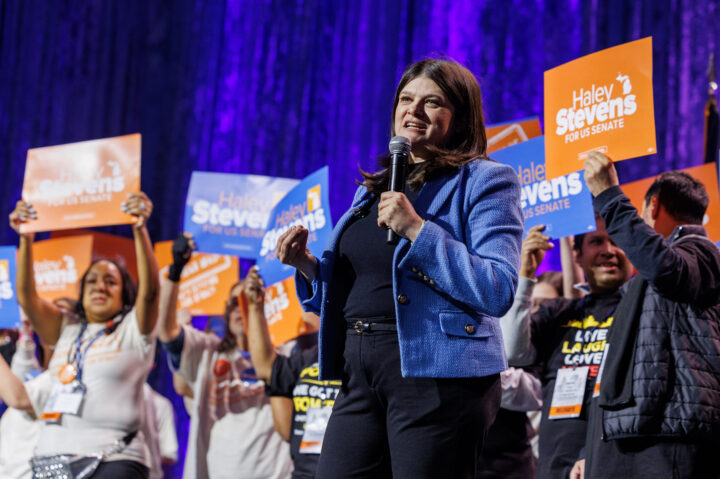
Andrew Roth/Sipa USA
Rep. Haley Stevens (D-MI) speaks at the Michigan Democratic Party Endorsement Convention in Detroit, Mich., on April 19, 2026.


 Add JewishInsider on Google
Several large Detroit-area synagogues emailed their congregants earlier this summer to urge them to vote in Michigan’s Aug. 4 primary — what seemed at first to be a somewhat bland call to make their voices heard and exercise their civic duty.
Then, as primary day drew closer, the messages took on a sharper edge from the usual staid, nonpartisan rhetoric that houses of worship might have sent in the past ahead of major elections.
“While we aren’t going to tell you who to vote for and we have never sent a message like this in our congregation’s history, these are no ordinary times,” the leaders of Temple Israel, the Reform synagogue in West Bloomfield that was the site of a violent antisemitic attack in March, wrote in an email last month.
The rabbis did not directly tell congregants whom to support in the Democratic Senate primary between Rep. Haley Stevens (D-MI) and Abdul El-Sayed, a former public health official. Instead, they merely described a politician who sounded a lot like Stevens: “a candidate whose record, actions, and rhetoric demonstrate the strongest commitment to protecting Jewish lives by combating antisemitism, seeking federal security funding for American Jewish communities, and supporting Israel’s security and right to exist as a Jewish state.” (The Conservative Congregation Shaarey Zedek in Southfield used similar language in a letter to its congregants in June.)
El-Sayed, who has made attacking AIPAC a central tenet of his campaign, has refused to say whether he believes in Israel’s right to exist as a Jewish state. El-Sayed condemned the Temple Israel attack — which did not result in any casualties aside from the assailant, a Hezbollah sympathizer who drove a truck into the synagogue preschool before opening fire — but said that “hurt people hurt people,” referring to the attacker’s ties to family members in Lebanon affiliated with Hezbollah who were killed in Israeli strikes.
The email from a nonprofit religious institution was just one of many that are being forwarded between the inboxes of Jewish Michiganders in the final days of the Senate primary, which is open to all registered voters regardless of party affiliation. Rabbis’ unprecedented advocacy in the race reflects the urgency surrounding what many Michigan Jews view as one of the most important elections in their lifetime: between a moderate, pro-Israel lawmaker who has represented the hub of Detroit’s Jewish community for nearly eight years and an insurgent far-left candidate whom they view as dangerously misguided when it comes to matters of Jewish communal concern.
Rabbi Aaron Starr, of Shaarey Zedek, told Jewish Insider on Tuesday that Stevens is “a longtime friend of the Detroit Jewish community.” But he stopped short of publicly naming her as his preferred candidate. Still, he said that the stakes feel different in this election, prompting the stronger-than-usual message to congregants.
“This is not difficult at all because I just feel it is so important,” Rabbi Asher Lopatin, who leads the Orthodox Kehillat Etz Chayim synagogue in Detroit and is director of community relations at the Ann Arbor Jewish federation, told JI. “We really have seen a lot of energy, I would say really just in the last month. People have woken up, I think, to this danger.”
“We’ve spoken in condemnation of and in praise of elected officials’ and candidates’ rhetoric on both sides of the aisle,” he said of the synagogue’s past political commentary. “Yet this election feels like a more existential moment for the Jews of Michigan, of the United States and around the world.”
Other rabbis are being more overt in their support for Stevens. Rabbi Asher Lopatin, who leads the Orthodox Kehillat Etz Chayim synagogue in Detroit and is director of community relations at the Ann Arbor Jewish federation, sent an email this week to his personal contact list urging them to vote for Stevens. He also noted that his position does not formally represent the views of his employers.
“This is not difficult at all because I just feel it is so important,” Lopatin told JI. “We really have seen a lot of energy, I would say really just in the last month. People have woken up, I think, to this danger.”
Three dozen members of Detroit’s Orthodox community, including several rabbis, signed a letter calling on observant Jews to support Stevens, whom they described as an “outspoken supporter of Israel and a devoted ally to the Jewish community.”
Among Orthodox Jews, who are more likely than secular Jews to identify as Republican, there is an educational push to remind voters that in Michigan, they can vote in whichever primary they choose — Democratic or Republican — regardless of their party affiliation.
“In the primary, many of the Democratic challengers to these candidates are hostile to our community. It is imperative to vote for those who support us,” the Orthodox Jewish leaders wrote. “Having a voice in deciding who the Democratic candidate is will be important no matter who you vote for in November in the general election. You do not need to be a registered Democrat to vote in the Democratic primary.”
“We need all the help we can get, the people we can get, to represent the Jewish population,” Gail Mash, an 81-year-old resident of a senior housing facility operated by the Detroit Jewish Federation, told JI. “There are people who are homebound and have nothing to do. This is the best thing they can do: take an active part and feel that they’re doing something for the community.”
The frantic email campaigns and WhatsApp chains are joined by the actual bread-and-butter of campaigning: phone banking and canvassing. Gail Mash, an 81-year-old resident of a senior housing facility operated by the Detroit Jewish Federation, calls herself and her group of politically engaged girlfriends the “Bubbe Brigade.” (Mash described herself as a former “Kennedy girl” who has been a Democrat her whole life.)
The “Bubbe Brigade” makes phone calls each week to members of the Michigan Democratic Jewish Caucus, a grassroots group representing Jewish Democrats within the state party, and reminds them to vote.
“We need all the help we can get, the people we can get, to represent the Jewish population,” Mash told JI in a phone call on Tuesday. “There are people who are homebound and have nothing to do. This is the best thing they can do: take an active part and feel that they’re doing something for the community.”
The Democratic Jewish Caucus campaigned with Stevens in the Detroit suburbs over the weekend at a canvassing event that was also promoted by the Jewish Democratic Council of America, a national group that is supporting efforts to rally Jewish voters for Stevens. JDCA is hosting more than a dozen phone banking events, and it has also made a five-figure digital ad buy in support of Stevens.
“When Jewish Americans needed a champion, Haley Stevens stepped up,” the ad says. It touts Stevens as a leader in fighting antisemitism, “creating jobs” and “delivering for Michiganders.”
Polling has shown El-Sayed with a small lead, though the dynamics of the race have shifted in Stevens’ favor since a third candidate, state Sen. Mallory McMorrow, dropped out earlier this month.
In the final debate of the campaign on Monday, El-Sayed repeatedly went after AIPAC and attacked Stevens for her support of the U.S.-Israel relationship. The rhetoric has left some Jewish Democrats in the state confused — and frustrated — at the way Israel, and its political supporters in the U.S., have become so central to a primary for a pivotal Senate swing seat.
“We have concerns that are sometimes unique from other communities’ concerns,” Ari Weisenfeld, the director of state relations at Agudath Israel, told JI. “If you want your elected officials to take them seriously, whether that’s at the local, state or federal level, you need to get out and vote.”
“The Jewish community is just like, why is there this obsession with this organization that a lot of us do not have an affiliation with?” said Decky Alexander, who chairs the Democratic Jewish Caucus. “It is just mind-blowing that this is such a consumptive issue when we have real threats to our Constitution, our democracy and the economics that are going on.”
Early voting is already underway, but campaigning will continue until polls close on Tuesday. Ari Weisenfeld plans to travel to Detroit from his home in Connecticut to urge Orthodox Jews to vote. As the director of state relations at Agudath Israel, an Orthodox umbrella organization, Weisenfeld is not promoting a particular candidate — all he cares about is that observant Jews get out and vote. He plans to try to visit as many synagogues as he can for morning minyanim between 6 a.m. and 9 a.m, reminding people to vote. If people need a ride to the polls, he’ll provide it.
“We have concerns that are sometimes unique from other communities’ concerns,” Weisenfeld told JI. “If you want your elected officials to take them seriously, whether that’s at the local, state or federal level, you need to get out and vote.”
The two voted for the first time last week in favor of blocking some U.S. arms sales to Israel
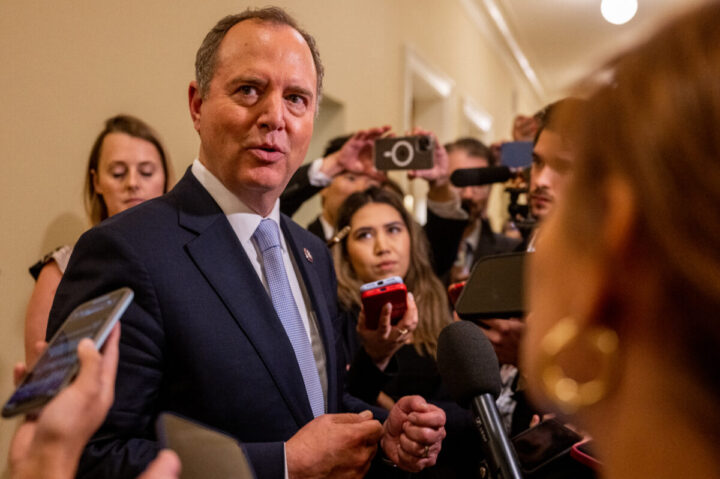
Brandon Bell/Getty Images
Rep. Adam Schiff (D-CA) speaks with reporters after closing remarks during the fifth hearing on the January 6th investigation in the Cannon House Office Building on June 23, 2022, in Washington, D.C.
Sens. Adam Schiff (D-CA) and Mark Kelly (D-AZ), who both voted for the first time last week in favor of blocking some U.S. arms sales to Israel, said that their future positions on such votes would be made on a case-by-case basis, determined by the specific sales in question and the circumstances surrounding the votes.
The two were somewhat surprising votes in favor of Sen. Bernie Sanders’ (I-VT) effort to block U.S. arms sales, having generally maintained pro-Israel records while in Congress.
“I was, and am, strongly opposed to the war in Iran, and I couldn’t justify voting against our own supplemental funding bills, which I plan to, and supporting funding for the same war in a JRD,” Schiff told Jewish Insider, referring to the Joint Resolutions of Disapproval to block specific arms sales to Israel. “I’ll evaluate each circumstance as they come.”
Kelly disputed the notion that his vote had flipped, saying, “I make these decisions based on what is the current situation, and what is the vote on — I don’t make these [decisions] in a vacuum.”
“This isn’t ‘yes’ or ‘no’ in any given moment, I’m always going to be looking out for Israel,” Kelly said. “And I think Israel is weaker, and the Israeli people are at further risk because of the current prime minister of Israel. He’s made a lot of mistakes, and he’s not operating in accordance with our values — but nor is our president. So I’ll look at every one of these [votes] based on what it is and what the current situation is.”
Asked whether his calculus would change if Israeli Prime Minister Benjamin Netanyahu were to lose the next election, he said that the decision is up to the Israeli people, “but I do not think Netanyahu has done Israel as a nation any favors.”
Even after their fourth failed attempt, Democrats say they intend to continue forcing such votes weekly

Kevin Carter/Getty Images
The U.S. Capitol Building is seen at sunset on May 31, 2025 in Washington, DC.
An effort by Senate Democrats to force an end to the war in Iran was again blocked by Republicans on Wednesday, the fourth such failed attempt mounted by Senate Democrats since the war began in late February.
The measure failed by a vote of 52-47, with all Democrats except Sen. John Fetterman (D-PA) voting for a procedural motion on the war powers resolution, and all Republicans except Sen. Rand Paul (R-KY) voting against it. Sen. Jim Justice (R-WV) was not present for the vote.
Nevertheless, Democrats intend to continue their efforts. They have nine such resolutions that have been filed, and top Senate Democrats said this week they intend to continue forcing such votes weekly, in the hopes that more Republicans will change their votes as the war drags on.
Some Republicans have begun to express hesitation about the war, and top members of the caucus have said they hope it comes to an end soon. But thus far most have not been willing to openly break with President Donald Trump on the effort.
Separately, Sen. Bernie Sanders (I-VT) plans to call up a vote later on Wednesday on a pair of measures to block sales of bombs and bulldozers to Israel, which Sanders has also framed as referenda on the war in Iran. Twenty-seven Democrats have previously voted for such resolutions, and supporters of the effort expect that number to increase this time.
But at least one lawmaker, Sen. Kirsten Gillibrand (D-NY), who introduced a war powers resolution on Iran this week, for future consideration, said that she views the two issues differently.
“I think of them very differently,” Gillibrand told Jewish Insider during a virtual press conference on Wednesday. “I oppose the war in Iran, but I do not believe we should leave an ally who is being attacked without support,” she said, referring to Israel.
Please log in if you already have a subscription, or subscribe to access the latest updates.
 Continue with Google

 Continue with Apple