





































































In the first meeting between the pontiff and a major AJC delegation since his election, Leo reaffirmed Nostra Aetate and, in a shift from Francis, steered clear of the Gaza war
Vatican Media
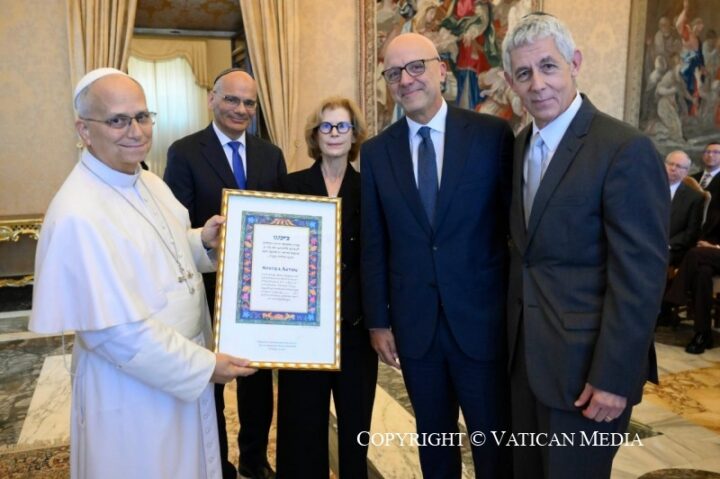
American Jewish Committee CEO Ted Deutch and other AJC leaders meet with Pope Leo XIV at the Vatican, Oct. 22, 2026


 Add JewishInsider on Google
In a meeting at the Vatican with American Jewish Committee CEO Ted Deutch and other AJC leaders from around the country on Thursday, Pope Leo XIV pledged to combat antisemitism.
“Rooted in our shared spiritual heritage, this friendship also calls us to defend human dignity, to serve the poor, to protect religious freedom and to promote justice and peace,” the pope told the Jewish leaders. “Essential to this commitment is the rejection of all forms of religious and ethnic hatred and discrimination.”
Speaking to Jewish Insider after the meeting, AJC leaders emphasized the significance of the meeting and of the pope’s commitment to rejecting antisemitism, given both the massive influence that the pope and the Catholic Church hold around the world and the Church’s own history of fomenting antisemitism.
Leo reaffirmed his commitment to the 1965 Nostra Aetate declaration, in which then-Pope Paul VI rejected antisemitism and the charge of deicide against Jews and highlighted the shared spiritual heritage between Jews and Catholics.
“Differences of opinion, however profound, must never give rise to prejudice and hostility, which undermine the moral foundations of our society,” Leo said.
Deutch told JI that the meeting was “very powerful because of what the Pope said to us about his commitment, the Church’s commitment to fighting antisemitism and ongoing commitment to engage in the dialogue that we participate in throughout the year.”
“There was a genuine connection as he spoke about the Church’s longstanding engagement with AJC and the importance of maintaining the strong relationship, and the importance of approaching these challenging issues with mutual respect,” Deutch continued.
Rabbi Noam Marans, the director of interreligious affairs for AJC, emphasized that Leo’s reaffirmation of Nostra Aetate is a declaration that “the millennia of demonizing Jews and Judaism was not in the spirit of the original Christian teaching.”
Given the pope’s and the Catholic Church’s influence with 1.4 billion Catholics worldwide as well as those of other religions who listen to and respect him, Marans added that “it’s impossible to overstate [their] power … to make a significant contribution in confronting antisemitism.”
The AJC and the United States Conference of Catholic Bishops have collaborated on a project that aims to teach about antisemitism and antisemitic sentiments through a specifically Catholic lens, and are launching an updated version of the project next month, according to Marans.
“We learned that the church is reaching out across the world to its leadership, to encourage them to prioritize the confronting of antisemitism and the development of Jewish friendships,” Marans said. “These are laudable, and we need more because of our belief that antisemitism is not a Jewish problem; it is a societal problem. The Catholic Church and its history has a particular responsibility. We’re grateful for what they’ve done, and we hopefully will do even more.”
Deutch said that AJC intends to continue conversations with the Church to ensure that its commitment to combating antisemitism “extends to all of the forces confronting the Jewish community today all around the world, and the different ways they manifest themselves,” and called the meeting with the pope “an opportunity” to deepen that work.
Deutch said that Pope Leo’s decision to meet with the group so soon after undergoing surgery for lung cancer is an “important statement” and a “powerful reminder of why dialogue matters” which created opportunities for “deeper engagement with the Catholic Church at a time when it’s never been more important.”
Though AJC and Marans have met with Pope Leo and other senior Catholic leaders, this was the first major AJC delegation to meet with the pope since he assumed his position last year.
The group presented Pope Leo with an artwork created in Jerusalem featuring an excerpt from the Nostra Aetate declaration in both the original Latin and in Hebrew. The piece is inspired by an Italian ketubah from 1822.
AJC leaders also had an opportunity to address the pope one-on-one to thank him for his comments and wish him well in his recovery. Deutch said that, based on what he’s read about Pope Leo’s surgery, the pope seemed remarkably healthy.
“He was engaged and personable, and warm, and seemed genuinely thrilled to be able to participate in the meeting with us,” Deutch said.
Marans said that Pope Leo “chose not to focus” on issues related to Israel and the war in Gaza while speaking with AJC, which proved to be a point of friction between his predecessor, Pope Francis, and the Jewish community and Israel.
Marans said he believes that Pope Leo has undertaken a “seemingly deliberate effort … to ease the tension” and shift away from Francis’ intense focus on the war in Gaza, at least in terms of the rhetoric that he and other Church officials use.
He said that Pope Leo has “focused on addressing the challenges and differences of opinion in the spirit of the 60-year dialogue” and using “careful language when talking about sensitive topics,” which Marans said has been helpful for Catholic-Jewish relations, “even when he has spoken about difficult issues regarding the Israeli-Palestinian conflict.”
The group also met with Cardinal Pietro Parolin, the functional head of government for the Holy See. During the meeting, Marans said that Parolin also delivered an “unequivocal commitment by the Church to combat antisemitism,” and also directly addressed the subject of Israel head-on, linking the Church’s diplomatic relationship with Israel directly to its commitment to fighting antisemitism.
“At a moment when we constantly face leaders in politics who attempt to distinguish between their so-called commitment to fighting antisemitism and their obvious disdain for the state of Israel, this was one of the leaders of the Vatican, specifically linking the commitment, the Church’s commitment to fighting antisemitism, with its [agreement establishing relations with Israel],” Deutch said. “It’s a very, very powerful statement.”
Marans said AJC has worked hard to convey to the Church the “indispensability of identification with the state of Israel and Zionism to modern Jewry.”
While in Rome, the AJC group also met with Rabbi Riccardo Di Segni, the chief rabbi of Rome, and will meet with other Vatican leaders, leaders of the Jewish community and Italian government officials, which Deutch said are critical at a time when antisemitic and anti-Zionist content has cropped up in sometimes-violent protests in Italy and throughout Europe.
Deutch said that AJC will communicate to Italian leaders the way that demonization of Israel, including accusations of genocide, have fomented rising antisemitism and highlight the need to continue to stand with Israel against those seeking to deny its right to exist.
Marans said that the group heard from Di Segni that the Jewish community in Italy is “deeply concerned” and “feel[s] threatened, particularly by the bleeding from the anti-Israel rallies into antisemitic tropes.”
Deutch said that the message from Italian Jewish community members has matched what AJC has been hearing across Europe, that the protests and riots have had a “dramatic” impact in the Jewish community and left it “very much on edge.”
He said he was particularly struck by seeing young Jewish students running from the school to their parents’ cars at the end of the day at a Jewish school in Rome — something they’ve been trained to do for decades since a 1982 terrorist attack on a synagogue in Rome. The school has also removed a Jewish insignia from students’ shirts out of concern about violent antisemitic attacks.
“This is not a world that we should have to live in, and that conversation that we had, and watching the young kids run, and older kids in their plain shirts, is something that I think is going to guide us in the work we do for some time to come,” Deutch said.
Respected for his interfaith outreach and courage, Cardinal Pierbattista Pizzaballa departed the Holy Land as speculation swirled about his potential to become the next pope

MENAHEM KAHANA/AFP via Getty Images
Cardinal Pierbattista Pizzaballa, Latin Patriarch of Jerusalem, gestures during an interview at the patriarchate headquarters in the old city of Jerusalem on April 22, 2025.
Cardinal Pierbattista Pizzaballa left the Church of the Holy Sepulcher in Jerusalem’s Christian Quarter on Wednesday to head to the Vatican for his first-ever conclave to select the next pope. He departed as the Latin Patriarch of Jerusalem, but some have speculated that he could have a new title — pope — in the coming weeks.
“This is a moment during which we need to be united in prayer, first for me, because this is a time in which I carry a great and important responsibility. And we must pray for the church, for we are a part of a big body which is [the] universal church, the Catholic Church. I am sure that your prayers, all together, will bring the right choices for the good of the universal church,” Pizzaballa said in a recorded statement before his departure.
Pizzaballa is widely viewed as one of the favorites to succeed Pope Francis, who died on Monday. The vast majority of popes have come from Italy, where Pizzaballa hails from, though he has lived in Israel for the past 35 years and is fluent in Hebrew. His knowledge of the Middle East, as well as his support for inter-religious dialogue, are viewed as advantages, while his age, 60, is seen as too young for a pope, according to Politico.
Pizzaballa moved to Jerusalem in 1990, when he pursued a master’s degree in the Bible at Hebrew University while studying and teaching at the Franciscan Faculty of Biblical and Archaeological Sciences in Jerusalem. He later became responsible for the pastoral care of Hebrew-speaking Catholics and then was elected Custos of the Holy Land, a senior position in the church in Israel, Palestinian-controlled territories, Jordan, Syria, Cyprus, Rhodes and part of Egypt, from 2004-2016.
Pope Francis appointed Pizzaballa to be the Latin Patriarch of Jerusalem in 2020, and made him the first-ever cardinal based in Jerusalem in 2023.
Pizzaballa said that the appointment of a cardinal in the city elevated the “voice of Jerusalem” within the Catholic Church.
Wadie Abunasser, who was the spokesman of the Catholic Church in Israel for 30 years and is now coordinator of the Holy Land Christian Forum, a Christian laity group in Israel, told Jewish Insider that he hoped the honor bestowed on Pizzaballa would lead to recognition of Jerusalem as a city whose patriarch’s elevation to cardinal would be fast-tracked.
Ben-Gurion University Vice President Michal Bar Asher-Siegal, who is an expert in Christian-Jewish relations, told JI that Pizzaballa’s advancement to cardinal was “crazy, it shows the importance of Jerusalem in Pope Francis’ eyes … There are only 130 cardinals in the world.”
The promotion “reflects the importance of [Jerusalem], but also the person,” Bar Asher-Segal added. “[Pizzaballa] is an important figure who reached an important status.”
Pizzaballa, according to a profile by prominent Catholic affairs reporter John L. Allen Jr. from 2016, was “very much Francis’s man.” The pope entrusted Pizzaballa with organizing a peace prayer summit in the Vatican in 2014 with Israel’s then-President Shimon Peres and Palestinian Authority President Mahmoud Abbas.
More recently, Pizzaballa, who was appointed cardinal only days before the Oct. 7, 2023, Hamas attacks in Israel, made waves with his public positions on the subsequent war. Pizzaballa called the massacre “barbaric.” Later that month, Pizzaballa answered in the affirmative when asked if he would be willing to be exchanged for Israeli children taken hostage by Hamas in Gaza: “If this can lead to freedom, to bring the children home, no problem. There is total willingness on my part.”
Yet, when two Catholics in Gaza were shot, Pizzaballa accused Israel of killing them “in cold blood,” though the IDF said that soldiers shot in response to an RPG that was fired from near the church. In December 2023, photos of the Pizzaballa wearing a keffiyeh, a traditional Palestinian scarf, courted controversy in Israel.
From the start of the war, Pizzaballa campaigned to be able to visit Catholics in Gaza and spoke out about their plight. As of last year, there were 1,017 Christians in Gaza, 135 of whom are Catholic; about 300 people, mostly Christians, were living in the Holy Family Catholic Church compound in Gaza.
According to the Catholic publication First Things, the patriarchate told Catholics in Gaza not to comply with the IDF’s evacuation order in Gaza City, for fear that it would be viewed as “complicity in an Israeli campaign to depopulate Gaza [that] risked setting Mideast Muslims against their Christian neighbors.” At the same time, they informed the IDF that Christians would shelter in the church and Israel facilitated the flow of food and supplies to them.
Israel allowed Pizzaballa to enter Gaza days before Christmas last year and he met with the community that had been living in the church compound from the start of the war.
Abunasser said that Pizzaballa “has especially cared, since the start of the war, for the Christian presence in Gaza. He was the only church leader who repeatedly asked the Israelis, despite all the risks, to go and visit.”
The 2016 profile said that some in the Middle East have “long looked on [Pizzaballa] with suspicion because of his closeness to Israel and Jewish culture.”
“In the zero/sum political game of the Middle East, in which a friend of Israel often is automatically seen as an enemy of Palestine and the Arab cause, all that has made Pizzaballa suspect in the eyes of some Arab clergy, and something of an arresting choice to lead a patriarchate whose membership is overwhelmingly Arab,” Allen Jr. wrote at the time.
Allen wrote that those critics highlight a comment Pizzaballa reportedly made about Palestinian leaders blaming Israel for all of their problems: “If the weather isn’t good, the cause is the occupation.”
Pizzaballa “talks relatively openly and the pope listened and was very interested. That means [Pizzaballa] brought the topic of Christians in the Holy Land to international attention,” Ben-Gurion University Vice President Michal Bar Asher-Siegal, who is an expert in Christian-Jewish relations, said.
In an interview with First Things this year, Pizzaballa referred to the Palestinian Authority as “weak,” which he said left Catholics vulnerable to attack.
Bar Asher-Segal said that Pizzaballa has not hesitated to criticize the PA, under whose rule Christians “suffer attacks from Muslims and in villages where Muslims are the majority, they are pushed to the sidelines. There have been very difficult attacks in Ramallah and Bethlehem … He speaks out against the Palestinian Authority, where Christians are targets of hate and the PA does nothing.”
“It takes courage to come out against the PA,” Bar Asher-Siegal added.
Pizzaballa “talks relatively openly and the pope listened and was very interested. That means [Pizzaballa] brought the topic of Christians in the Holy Land to international attention,” Bar Asher-Siegal said.
The cardinal has also spoken out against Israel’s “neglect” of its Christian community, she continued. She pointed out that Christians are the most educated population in the country, but many emigrate, a matter of concern for Pizzaballa.
Christians in Israel have increasingly complained of harassment, especially in Jerusalem, Bar Asher-Siegal said, arguing that there has been a major increase in recent years of incidents of Jews spitting on Christians and vandalizing their property.
“Israel said it is committed to freedom of religion and taking care of the holy sites in Jerusalem, but it isn’t meeting its commitments … Israel comes out very bad here … It’s a strategic and moral mistake,” she said.
Jerusalem Deputy Mayor Aryeh King told JI that he had looked into the matter and that the Jerusalem Police said there had not been a rise in such incidents.
Abunasser said that Pizzaballa “played a major role in improving ties with political authorities in Israel, the Palestinian Authority and even Jordan. He improved relations with Muslims and Jews on the religious and political level … He is very respected among the diplomatic corps in Israel and Jerusalem.”
The cardinal, Abunasser continued, “is wise and knows, despite all the contradictions and challenges, how to manage things even in difficult times. He succeeded in imposing his respect on everybody, including those who might sometimes disagree with him.”
King, someone who has clashed with local Christians in the past, said that “there are others who led a very anti-Israel line. I can’t say that he did. Some Christians did, but he is not like that.”
The Jerusalem deputy mayor has led protests against Christian missionaries in Jerusalem, though he emphasized that he also spoke out against recent incidents of harassment against the local community.
“There’s a clear line. We have no problem with Christians who mind their own business, but we will fight against Christians trying to change Jews’ religion,” King said. “I don’t remember [Pizzaballa] as someone who led such steps in recent years.”
“He is really a special person who enjoys wide respect among Jews and Arabs,” Wadie Abunasser, who was the spokesman of the Catholic Church in Israel for 30 years and is now coordinator of the Holy Land Christian Forum, said. “He is a person who is charming and close to the people.”
“Jerusalem is a microcosm of Jewish-Christian relations,” King added. “It’s a very sensitive place and there are constantly things happening in interreligious relations … I am deputy mayor and pretty involved in what is happening in the Old City and east Jerusalem, and I can’t point to him as someone who acted against Jews.”
King posited that “maybe there’s a place for optimism if [Pizzaballa becomes] the head of the church and he understands what is happening in Jerusalem where there are politically hot conflicts between religions.”
Abunasser said that Pizzaballa is well-liked across different populations in Israel and beyond.
“He is really a special person who enjoys wide respect among Jews and Arabs,” Abunasser said. “He is a person who is charming and close to the people.”
Pizzaballa “is someone who always, like Pope Francis or Jesus, gives priority to the weak people. He cares for the weak and the poor,” he said.
Abunasser said he heard many stories from disadvantaged people about how Pizzaballa helped them, though the cardinal himself would keep his efforts quiet — “even his close associates sometimes don’t know what he does in that regard.”
“I discovered that he started many initiatives in the Latin Patriarchate. He launched several microfinancing projects to help unemployed people, especially in the Bethlehem area,” he said.
Abunasser also highlighted reforms and improvements that Pizzaballa made to the administration of the church, both as Custos of the Holy Land, who is in charge of holy sites, and as the Latin Patriarch.
“[Pizzaballa’s] long service in the church of the Holy Land is something that was known worldwide. The church of the Holy Land is always in the news, not only in the media but also in the church. Therefore, I believe he has a good reputation,” he added.
Despite his enthusiasm for Pizzaballa, Abunasser emphasized that he is not lobbying for him to be pope. Abunasser pointed out that, contrary to regular politics, campaigning and self-promotion are frowned upon in Vatican conclaves.
“Even [Pizzaballa] himself, when people joked with him ‘you will be the next pope,’ he said ‘please don’t curse me.’ He believes we must trust the spirit,” Abunasser said.
Please log in if you already have a subscription, or subscribe to access the latest updates.
 Continue with Google

 Continue with Apple