













































































The renewed solidarity comes after a foiled attack against a Hindu temple in suburban Chicago
Laura Bargfeld/AP
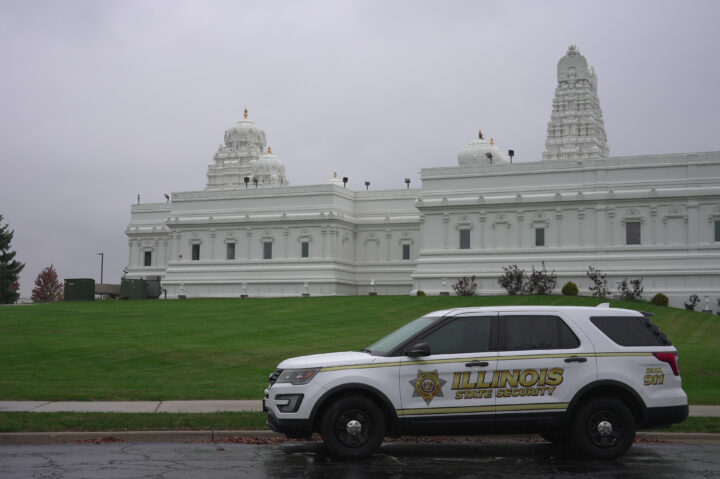
A security vehicle is parked outside of Sri Venkateswara Swami (Balaji) Temple in Aurora, Ill., Thursday, Oct. 15, 2026.


 Add JewishInsider on Google
In the aftermath of an attempted terror attack on a Hindu temple last week, Jewish leaders are drawing on a shared experience of confronting religious hatred to strengthen ties between the two communities — including by expanding sustained advocacy to protect houses of worship.
The long-standing outreach has grown as both communities confront ongoing fears of religiously motivated threats. Hindu advocates have historically supported Jewish community security initiatives, including government grants to help protect religious institutions and legislation establishing buffer zones around houses of worship. Now, Jewish leaders are extending that same spirit of solidarity to Hindu Americans and underscoring the importance of interfaith cooperation in confronting religious hatred.
Authorities on Wednesday arrested Alexandros Paporakis, 19, who they said drove to the Sri Venkateswara Swami (Balaji) Temple in Aurora, Ill., on Oct. 11, armed with a rifle and body armor and leaving behind an eight-page manifesto detailing white supremacist and neo-Nazi ideologies. The suspect, who was allegedly planning the attack for two years, fled the scene after his rifle jammed.
The foiled attack comes seven months after a terrorist rammed a truck full of explosives into Temple Israel, a synagogue in West Bloomfield, Mich., in an attack the FBI later characterized as an act of terrorism inspired by Hezbollah. While neither incident caused injuries, both highlighted the persistent security risks facing faith-based communities.
Following last week’s thwarted attack, Jewish leaders and organizations expressed solidarity with the Hindu community, noting the shared vulnerabilities of religious minorities and the critical need to protect houses of worship.
The Anti-Defamation League said the attack “underscores why Congress must increase funding for the Nonprofit Security Grant Program, so at-risk communities have the resources they need to protect themselves.”
Sen. Jacky Rosen (D-NV) also called on Congress to “sufficiently fund” the Nonprofit Security Grant Program, which provides security funding to religious institutions.
Rep. Raja Krishnamoorthi (D-IL), who was inside the temple with his family when the attempted attack occurred, told Jewish Insider, “Jewish and Hindu communities face threats that demand solidarity across religious and cultural lines. The attempted mass shooting at my family’s Hindu temple in Aurora, by a suspect whose hatred also targeted Jewish and Black Americans, shows how these forms of bigotry are connected. We must stand up for one another and strengthen partnerships across communities to confront antisemitism, anti-Hindu hatred, and all forms of bigotry. I will continue working with faith and community leaders to ensure every American can live and worship without fear.”
“I’m disturbed to learn of an alleged plot to carry out a mass shooting targeting the largest Hindu temple in Aurora, Illinois. While I’m grateful for local law enforcement’s swift response in preventing a tragedy, this hateful plot has shaken the Hindu community across the country,” said Rosen. “This should outrage all of us. It’s unacceptable for any religious community to be targeted simply because of who they are.
“We cannot wait for another attack to act. Congress must sufficiently fund the Nonprofit Security Grant Program now so we can ensure all religious communities are safe in their places of worship.”
Elad Strohmayer, consul general of Israel to the Midwest, said in a video message: “To the Hindu community of Illinois and everywhere in the United States — we stand with you … Your safety matters to us a lot … Know that Israel is always with you.”
Hindu American groups have also joined Jewish organizations in advocating for protections around houses of worship. Last month, the Hindu American Foundation and the Coalition of Hindus of North America backed federal legislation known as the Right to Worship Act, which seeks to protect congregants from targeted harassment and disruption outside religious institutions.
The attempted attack came one week before Stand Up Sunday, a nationwide, multifaith initiative led by Robert Kraft’s nonprofit Blue Square Alliance Against Hate and the Appeal of Conscience Foundation that brought together houses of worship to condemn antisemitism and other forms of religious hatred. This year’s event, held Sunday, aimed to engage more than 2 million Americans across religious denominations, including congregations affiliated with BAPS Swaminarayan Sanstha, a Hindu organization.
“As Hindu Temples and other Houses of Worship continue to be attacked and vandalized, simply because of the way we look or worship, we remain steadfast and proud to participate in Stand Up Sunday,” Bawa Jain, an Indian advocate for interfaith dialogue and secretary general of the World Council of Religious Leaders, said in a statement ahead of the event. “An attack against one is an attack on all of us. Let us stand in solidarity with each other and strive to rid our society of the plague of hate.”
FEMA announced that over 1,600 nonprofits would receive funding from the program, totaling $300 million
Andrew Lichtenstein/Corbis via Getty Images
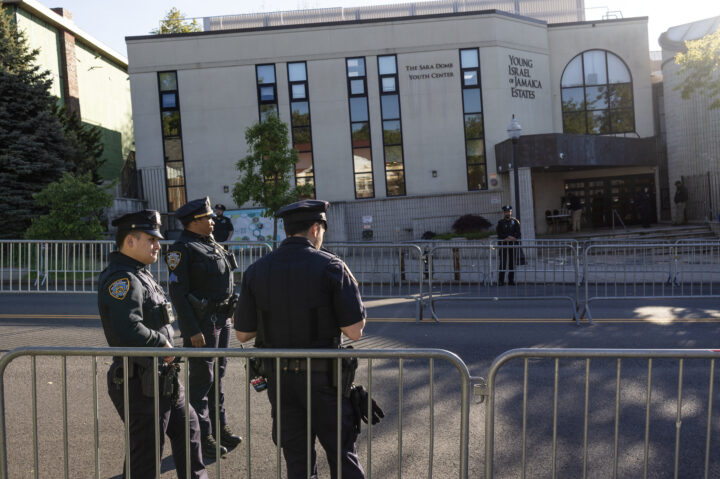
New York City police officers fence off and guard the Jewish Orthodox synagogue Young Israel of Jamaica Estates on May 12, 2026, in the borough of Queens, New York City.
In a year when the Jewish community was rocked by a terror attack at a Detroit-area synagogue alongside other antisemitic threats, the Nonprofit Security Grant Program fulfilled less than 23% of applications submitted for funding in 2026, according to new data obtained by Jewish Insider.
The chronically underfunded and overstretched program provides security funding to synagogues and other nonprofits that survivors of antisemitic attacks say has directly helped save lives.
The Federal Emergency Management Agency announced this week that more than 1,600 nonprofits would be receiving funding from the program in 2026, totaling $300 million in funding. Congress appropriated $305 million, with the remaining $5 million eligible to support NSGP program operations.
The state agencies that work with the federal government to administer the NSGP program and accept applications from individual nonprofits received more than 7,000 applications, totaling more than $1 billion in funding requested.
The majority of the funding will be provided to houses of worship from various denominations, according to a source familiar with the situation, but other recipients include schools, medical facilities, senior centers, camps, museums, shelters and community centers. It was not immediately clear what portion of the grant funding was provided to Jewish institutions.
“In the face of violent criminals and radical organizations, the Trump-Vance Administration is stepping up to protect American communities. This week, the Federal Emergency Management Agency (FEMA) announced $300 million in grant awards to more than 1,600 nonprofit organizations across the United States,” a FEMA spokesperson said in a statement to JI. “This funding, administered through the Nonprofit Security Grant Program, will empower faith-based institutions and other nonprofits to harden their defenses against potential attacks.”
Application numbers and total funding requested seem to be down somewhat from 2025, when the program received in excess of 8,000 applications totaling more than $1.3 billion in funding requested, with an acceptance rate of just 20%.
Even so, the amount of funding requested was higher and the acceptance rate was lower than in any year in documented program history other than 2025.
Grant applications in 2026 were also released late, on a significantly compressed timeline and before grant awards for the long-delayed 2025 program were finalized and announced, which advocates warned could make it more difficult for institutions to apply for 2026 funding.
“Our nation is facing an epidemic of antisemitism and Jewish communities around the country are living their lives in fear. We need funding to match the growing demand from at risk institutions — including houses of worship and non-profit organizations — to help keep them safe and secure,” said Sen. Jacky Rosen (D-NV), who has led calls for increased NSGP funding in the Senate. .
She called on Congress to pass the Jewish American Security Act, which proposes increasing funding for the NSGP to $1 billion.
Jewish community advocates said that the small percentage of applications that were fulfilled shows the need to expand funding for the program. Jewish groups have coalesced behind a push for $1 billion in funding for the program.
“As the past three years have shown, we are experiencing a domestic anti-Jewish terror crisis in this country. Our community has had to form its own security infrastructure, spending over $1 billion each year to maintain it and prevent these attacks from turning deadly,” Jewish Federations of North America CEO Eric Fingerhut said in a statement.
“It is undeniable that we need the federal government’s help and while we appreciate the recent increase in NSGP awards for faith-based institutions, the fact that only 23% of NSGP applications were approved this year shows that it’s not enough. That’s why we’ve been calling on Congress to pass the bipartisan Jewish American Safety Act and fund the NSGP at $1 billion.”
Nathan Diament, the executive director of the Orthodox Union Advocacy Center, said that Congress must “provide dramatically more funding for NSGP.”
“America is in a moment of crisis,” Diament continued. “The houses of worship are more fearful than ever — in a nation founded by those seeking to guarantee religious freedom. We don’t only have a security problem, we have a cultural crisis when people don’t feel the ‘sanctuaries’ they are going to to pray are indeed sanctuaries of safety from the tumultuous world.”
Lauren Wolman, the Anti-Defamation League’s senior director of government relations and strategy, welcomed the announcement but said, “once again, the gap between need and available funding is staggering.”
“Only 23% of applicants received an award this year. More than $1 billion would have been needed to fund all eligible applications, far exceeding the $300 million Congress appropriated for the program,” Wolman added. “Congress now has a clear opportunity to close that gap by passing the Jewish American Security Act to authorize $1 billion annually for NSGP and ensure every at-risk nonprofit has a meaningful opportunity to safeguard its community.”
Michael Masters, the CEO of the Secure Community Network, said that the announcement “demonstrates a critical shortfall in security funding for nonprofits and houses of worship across the country.”
“While it is welcome that FEMA is working to get awards out more quickly, the fact that 75% of the demonstrated need is unfunded speaks to the need for increased NSGP dollars to support faith communities,” Masters continued. “We encourage Congress to appropriate as much funding as possible as they approach this next appropriations cycle.”
He called the funding a “force multiplier for law enforcement.”
Rabbi A.D. Motzen, national director of government affairs for Agudath Israel of America, emphasized the volume of applications even in this year’s short application timeline.
“Twenty five years after 9/11, as terrorists continue to target innocent Americans, the federal Nonprofit Security Grant Program serves as an important tool in protecting vulnerable nonprofits. This year, despite a very tight timeline, more than $1 billion was requested by eligible institutions. Yet, more than three quarters of applicants were rejected due to lack of funds,” Motzen said. “Agudath Israel of America is grateful for every grant awarded, but urges Congress to increase the annual allocation to meet the need.”
Plus, this rising Michigan Dem won't back El-Sayed
AFP via Getty Images
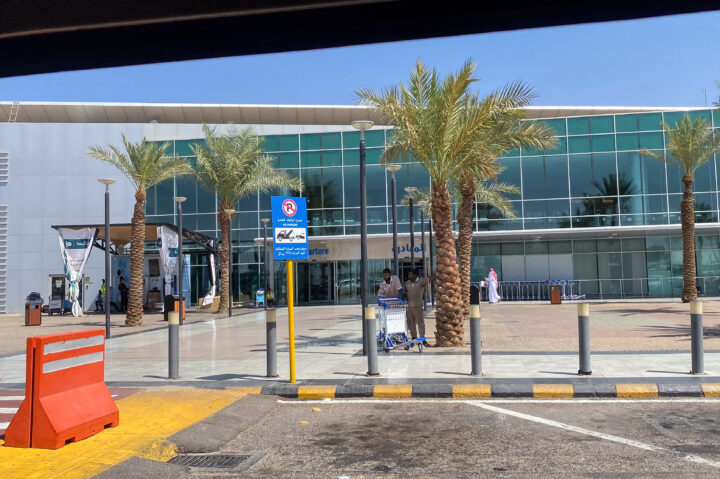
Departure hall of Prince Sultan bin Abdulaziz Airport in Tabuk on September 30, 2026 after a flydubai plane bound for Tel Aviv was forced to land in Saudi Arabia on September 30.
Good Wednesday morning.
In today’s Daily Kickoff, we report on a suspected terror attack on an Israel-bound flydubai flight earlier this morning, have the scoop on prominent Michigan Democratic state legislator Noah Arbit’s decision not to endorse Senate candidate Abdul El-Sayed in the November election and cover New York City Mayor Zohran Mamdani’s newly released plan to combat antisemitism, which received a mixed response from Jewish communal leaders. Also in today’s Daily Kickoff: Eric Cantor, Fatima Ezzahra El Mansouri and Elaine Luria.
Today’s Daily Kickoff was curated by JI Executive Editor Melissa Weiss, with an assist from Danielle Cohen-Kanik.
Today’s Agenda
U.S. forces completed their withdrawal from their last bases in Iraq earlier today, ending the more than two-decade-long American military presence in the country.
The U.S. Holocaust Memorial Museum, State Department Office of the Special Envoy to Monitor and Combat Antisemitism, Moment magazine and the Romanian Embassy are holding an event today honoring Elie Wiesel. The author’s son, Elisha Wiesel, is slated to speak at the event commemorating his father’s life and works.
Far-left streamer Hasan Piker is slated to speak at a University Democrats-sponsored event at the University of Texas at Austin. The event will take place in the location originally reserved by organizers, after administrators denied requests from University Democrats to move Piker’s talk to a larger venue.
One Thing To Know
BREAKING
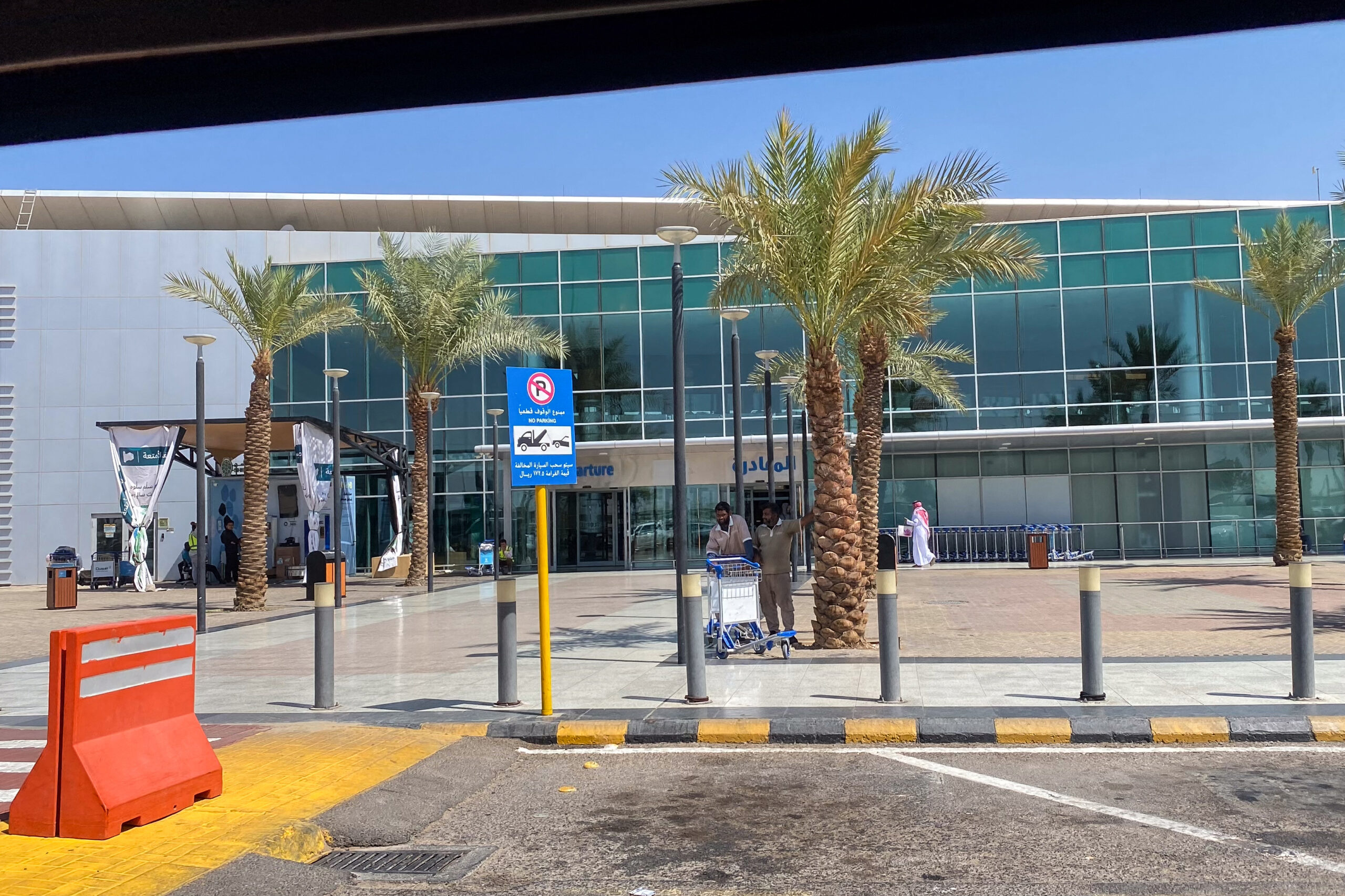
A flydubai flight from the United Arab Emirates bound for Israel’s Ben Gurion Airport made an emergency landing in Saudi Arabia this morning in what Israeli security officials said may have been a terrorist incident following a violent altercation in which the plane’s captain, reportedly assisted by a passenger, wrested control from his co-pilot after the plane was thrown into a brief, rapid descent.
Images emerged in the hours following the incident of several passengers in bloody clothing. “We just heard screams, and then the cockpit door opened and we saw a huge amount of blood,” one passenger told Israeli media after landing in Saudi Arabia’s Tabuk Airport, near the Gulf state’s border with Jordan. Video also showed passengers tending to the pilot covered in blood on the floor, while the co-pilot appears tied up and possibly unconscious.
Israel’s i24News reported that the co-pilot who was subdued and restrained was of Omani origin, and that two additional pilots on board the aircraft, but not working the flight, were nationals of South Africa and New Zealand.
The Big Reads
DRAWING A LINE
Noah Arbit, a rising Jewish Democrat in Michigan’s state Legislature, has been a vocal critic of Abdul El-Sayed, a fellow Democrat whose Senate campaign in the key battleground state has exposed deep divisions within the Jewish community. But until now, Arbit had not yet publicly clarified if he is willing to set aside his differences and endorse El-Sayed, like some prominent Jewish Democrats in the state who have recently announced their support despite reservations with his hostile stances on Israel and approach to countering antisemitism. In an interview with Jewish Insider‘s Matthew Kassel on Monday, Arbit, 31, confirmed that he would not be endorsing El-Sayed, pointing to what he called the nominee’s promotion of antisemitic conspiracy theories and affiliations with extremist figures on the far left, among other issues he cast as deal-breakers in the closely contested race.
big apple blueprint
New York City Mayor Zohran Mamdani’s administration on Tuesday released what it calls the country’s first municipal strategy to combat antisemitism, a 30-page plan that provides $7.4 million for security and prevention grants, but declines to adopt a definition of antisemitism and does not address Israel-related hate, Jewish Insider’s Haley Cohen reports. Jewish leaders offered a mixed response to the mayor’s new strategy, with some welcoming increased security funding and other measures while also arguing that the plan fails to address what they see as a key driver of anti-Jewish hostility — rhetoric targeting Israel and its supporters. In a joint statement, UJA-Federation of New York, JCRC-NY, AJC New York and New York Board of Rabbis said that “any effort to confront antisemitism in New York City must fully address the realities Jewish New Yorkers face today.”
campus in focus
An independent federal commission on civil rights concluded, following a yearlong probe, that campus antisemitism is a “serious and growing civil rights concern,” but also suggested the Trump administration’s efforts to combat it went against both statute and established procedure, Jewish Insider’s Marc Rod reports. The report by the U.S. Commission on Civil Rights highlights that “recent federal enforcement has sometimes represented a departure from established practice” and that some of the administration’s punitive measures have been overturned in court. The report also called for greater staffing and better training for the Department of Education’s Office for Civil Rights — which the Trump administration slashed even as complaints grew significantly — to ensure adequate responses to campus antisemitism.
The Rundown
DEMOCRATIC SHIFT
high seas stakes
definition debate
virginia in view
friends on the trail
euro slip
On Our Radar
● The Live Briefing. Word on the street, clips, podcasts and quick updates — the items we’re tracking all day in our Live Briefing on the app (on Apple and Android) and website.
The Treasury and State Departments announced sanctions on 13 individuals and entities alleged to have assisted Iran in procuring weapons…
Anthropic’s Dario Amodei, SpaceX’s Elon Musk, Meta’s Mark Zuckerberg and former White House AI czar David Sachs were on hand at a press conference following a meeting on AI between President Donald Trump, White House officials and the tech leaders…
Organizers of a16z‘s upcoming Tech Week in San Francisco said that a hackathon event associated with the conference had been removed from its calendar for violating Tech Week’s terms of service after an Israeli applicant was told he could not participate by an organizer who cited Israel’s 2024 pager attack on Hezbollah, saying, “Hackathon participants carry pagers, smartphones and laptops … What happened in Lebanon shouldn’t happen in California”…
Immigration officials are moving to deport an anti-Zionist Israeli member of the Satmar Hasidic community who was present during an incident in which an Israeli flag was removed from a local government building in Rockland County, N.Y….
A new report from the U.K.’s Community Security Trust found that antisemitic incidents at universities in the country rose by 14% during the 2025-26 academic year, with 95 reported incidents compared to 83 the prior year…
Several dozen West Bank settlers clashed with Israeli security forces, several of whom were injured, as they were attempting to help a Palestinian family return to its home in the village of Jalud, from which the family had fled in July amid ongoing attacks by settlers…
eJewishPhilanthropy’s Jay Deitcher spotlights the Har Initiative, a post-Oct. 7 donor collective that plans to distribute $120 million in the coming months to groups fighting antisemitism; the initiave, which is made up of 12 funders including The Tepper Foundation, The Einhorn Collaborative, Charles and Lynn Schusterman Family Philanthropies and Maimonides Fund, is being led by Lindsey Spindle, president of the Samueli Foundation, and Fay Twersky, president of the Arthur Blank Family Foundation…
Hamas, Palestinian Islamic Jihad and former top Fatah official Mohammed Dahlan, an advisor to Emirati President Mohamed bin Zayed, have reportedly agreed to form a coalition in the Nov. 28 Palestinian election if Palestinian Authority President Mahmoud Abbas allows the election to move forward; Abbas has repeatedly postponed national elections, which have not happened in 20 years…
UAE Vice President Sheikh Mansour bin Zayed met with Saudi Crown Prince Mohammed bin Salman in Riyadh on Tuesday, marking the first high-level bilateral meeting since tensions between the two Gulf countries erupted publicly over Yemen last year…
Moroccan King Mohammed VI appointed Fatima Ezzahra El Mansouri as the country’s first female prime minister on Tuesday, after her Authenticity and Modernity Party won the most seats in last week’s parliamentary election…
Former House Majority Leader Eric Cantor (R-VA) is joining PhRMA as CEO after more than a decade at Moelis & Company…
Worthy Reads
Find more Worthy Reads in our Live Briefing via our app (on Apple and Android) and website.
The Missile Mess: The Atlantic’s Christopher Leonard spotlights the challenges associated with THAAD missile interceptors, which were frequently used by the U.S. and its allies during the height of tensions with Iran despite their high cost and dwindling stockpiles. “Munitions stockpiles have long been a neglected element of U.S. military strategy. Pentagon budget writers favor flashier line items, such as new fighter jets and naval destroyers. And munitions procurement relies on a fragile U.S. industrial base that is plagued by points of failure. They are produced by large U.S. defense contractors — such as Lockheed Martin, which makes the THAAD — whose business models constrain them from ramping up production even when a missile shortage is evident.” [TheAtlantic]
Mideast Misadventures: Wall Street Journal columnist William Galston considers the lessons learned over the course of the conflicts with Iran. “This is America’s third Middle Eastern misadventure in the past quarter-century, and likely the last. It signals the end of our effort to dominate the region, and it could set in motion a gradual drawdown of U.S. forces. … Our allies will have to choose between yielding to Iran’s regional dominance and creating a formal anti-Iranian alliance that could eventually include Israel.” [WSJ]
An Oct. 7 Reckoning: In the Jewish Review of Books, Matti Friedman reviews journalist Amos Harel’s 06:29: Anatomy of a Failure, a Hebrew-language account of the events of Oct. 7, 2023, and its aftermath. “Harel has no state budget, team of lawyers, or power of subpoena. But this book is the closest thing we have so far to a comprehensive and public reckoning with the failures that led to October 7. 06:29 is yet another example of a scenario that we in Israel have seen again and again since that fateful hour nearly three years ago, and that indeed can be said to have saved the country: The state fails, and a citizen rises to the occasion.” [JewishReviewofBooks]
Picture of the Day
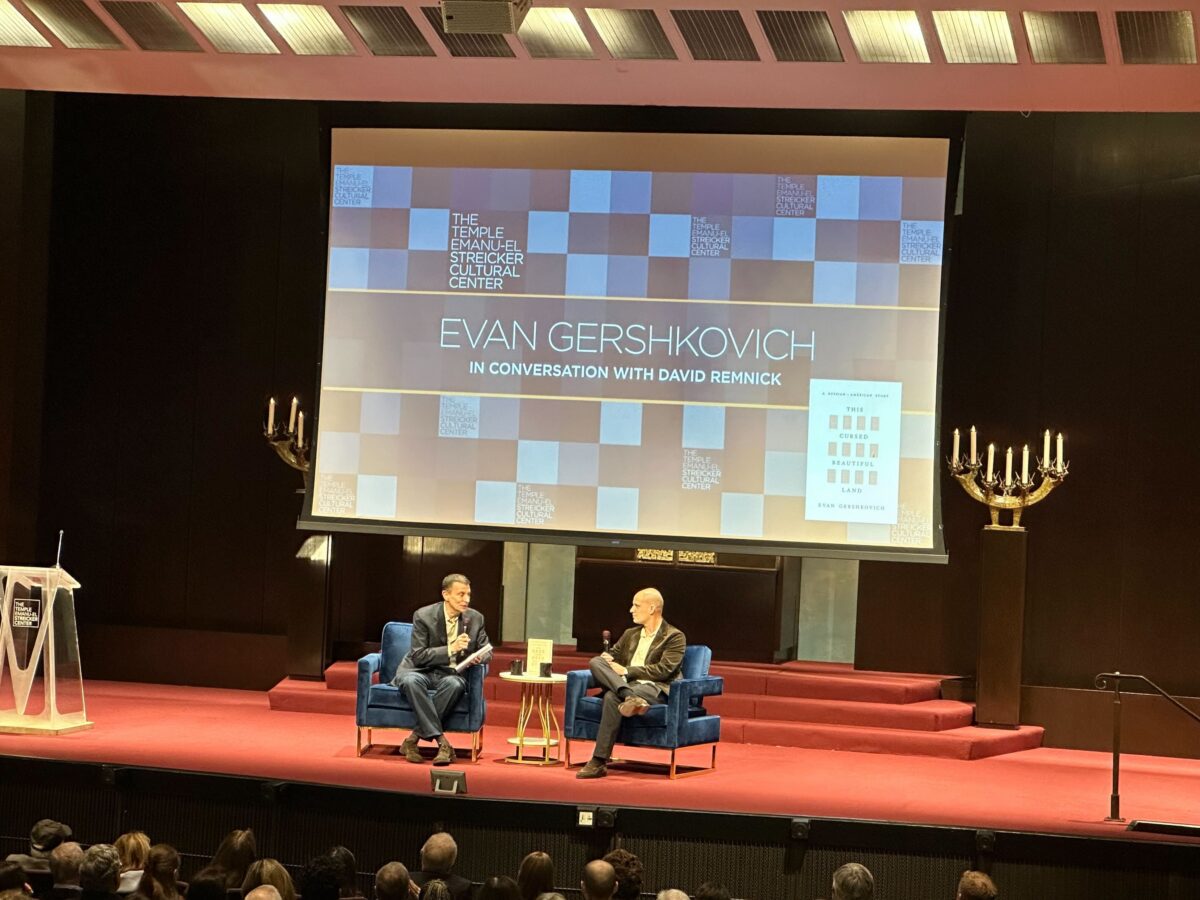
Interviewed by The New Yorker‘s David Remnick (left) at New York’s Streicker Center on Tuesday night for the launch of his new memoir, Wall Street Journal reporter Evan Gershkovich (right), who was wrongfully detained in Russia for 16 months, reflected on the country he covered for six years — and on how dramatically life there has changed for Russian Jews since the start of the war in Ukraine. Read more from Jewish Insider’s Haley Cohen here.
Birthdays
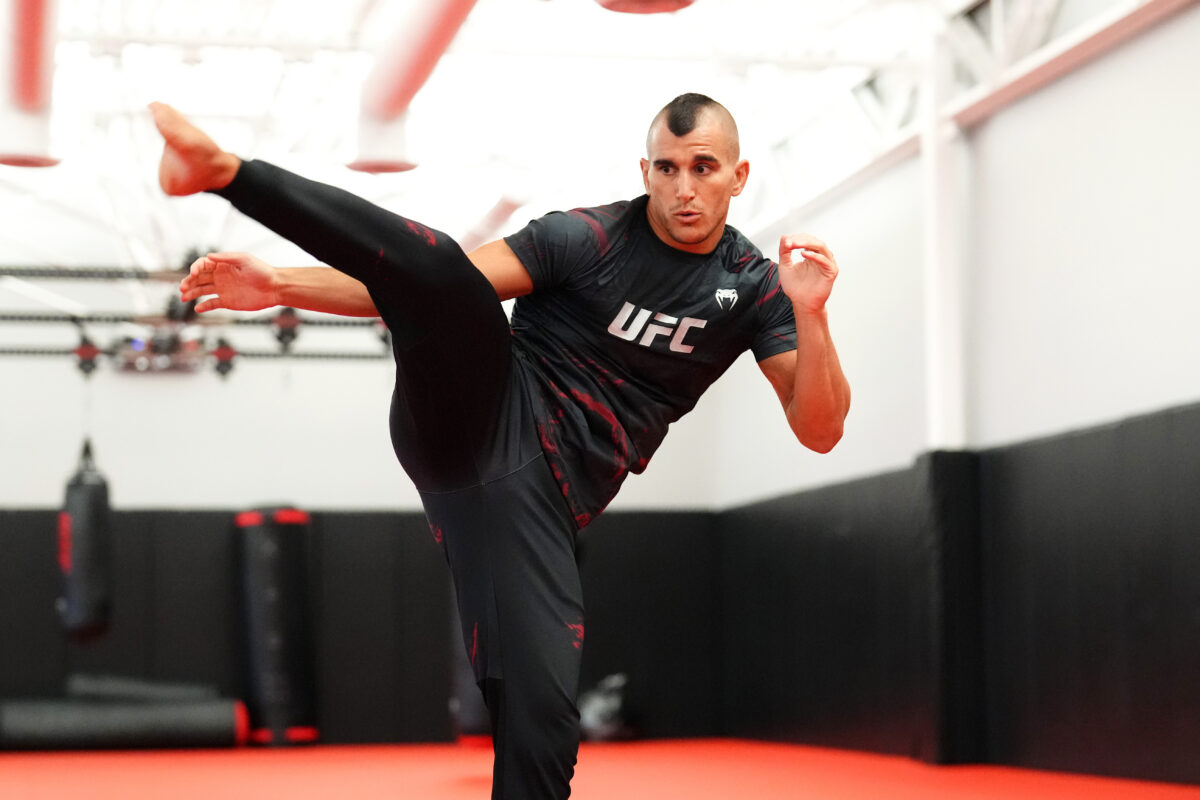
Natan Levy, mixed martial artist who competed in the lightweight division in the Ultimate Fighting Championship, turns 35
Ehud Olmert, former prime minister of Israel, turns 81
Sanford Kadish, retired volunteer and tutor
Rochelle A. “Shelly” Kassen, past president of the Washington Institute for Near East Policy, she is on the board of the Tikvah Fund
Adam Maximilian Aron, chairman and CEO of AMC Entertainment, he is a former co-owner of the Philadelphia 76ers, turns 72
Fran Drescher, actor and activist, she was president of the SAG-AFTRA labor union, turns 69
Ehud Hrushovski, professor of mathematical logic at Oxford, turns 67
Haim Taib, founder and president of the Menomadin Group and president of the Menomadin Foundation, turns 66
Allison Sommer, journalist for Haaretz since 2012
Jonathan Gruber, professor of healthcare economics at MIT and an architect of Romneycare and Obamacare, turns 61
Lisa K. Robbins
Gilad Menashe Erdan, Israel’s U.N. ambassador from 2020 to 2024, now global president of Magen David Adom, turns 56
Anastasia Goodstein, senior digital director at Inseparable
David Herszenhorn, international editor for The Washington Post
Jacques Stambouli, CEO of Via Trading Corporation, a liquidator of consumer merchandise
Rabbi Eliezer Kaunfer, president and CEO of Hadar Institute in Manhattan
Hildy Kuryk, founder and partner at Artemis Strategies, a boutique consultancy, turns 49
Ari Michael Shapiro, CNN contributor, former host of NPR’s “All Things Considered,” turns 48
Daniel Grossberg, member of the Kentucky House of Representatives since 2023, he lost his May 2026 Democratic primary, turns 48
Jonathan Peter Kasdan, screenwriter, director, producer and actor, turns 47
Yonatan Neril, founder of the Jerusalem-based Interfaith Center for Sustainable Development, turns 46
Stephen Cohen, computer scientist and entrepreneur, he is best known as a co-founder and president of Palantir Technologies, turns 44
Steven Russolillo, chief news editor at Business Insider
With no Trump meeting, a scrapped Musk visit and renewed U.S.-Iran talks, the trip Netanyahu envisioned a month before elections had already unraveled before Neria Leiter was wounded
(Erik Marmor/Getty Images)
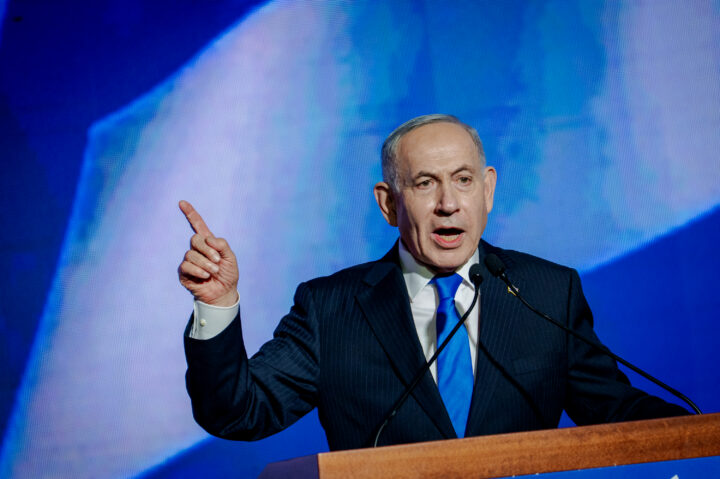
Israeli Prime Minister and Likud party leader Benjamin Netanyahu speaks at the lectern to supporters during a party campaign rally at Expo Tel Aviv on September 17, 2026 in Tel Aviv, Israel.
For a few hours, Israel’s deeply polarized political arena, just a month before the elections, found rare unity. It came following the news that Neria Leiter, son of Israel’s ambassador to the U.S., Yechiel Leiter, was critically injured in a car-ramming terror attack in the West Bank. Neria chose to continue his reserve duty, including serving in Lebanon, even after his brother Moshe fell in battle in northern Gaza in November 2023.
Ambassador Leiter was on his way to a CNN interview ahead of Israeli Prime Minister Benjamin Netanyahu’s address to the U.N. General Assembly, set to take place this afternoon, when he received the news about his son, and quickly departed for Israel. That speech will likely now take a turn following the attack.
But even beforehand, Netanyahu’s trip to New York was set to be entirely different from anything seen before. The prime minister’s brief video message about his speech on Tuesday referenced only one individual: New York City Mayor Zohran Mamdani. Not Iran, not Hamas, nor Turkish President Recep Tayyip Erdogan. Of all the adversaries facing Israel, Netanyahu singled out just one.
Sources close to the prime minister claim Mamdani is the reason for Netanyahu’s unprecedented brief visit: a quick stop of just a few hours in New York, and nothing more. The concern, his aides claim, stems from potential protests or political posturing by Mamdani, despite him admitting he has no authority to arrest Netanyahu, a key campaign pledge of the mayor’s. However, a former official involved in coordinating prime ministerial trips offered a different explanation: As long as Netanyahu remains in New York for only a few hours, the absence of a meeting with President Donald Trump becomes far less conspicuous.
This is not how the prime minister envisioned his annual U.N. trip, especially a month before an election. He hoped to schedule a meeting with Trump, which would have been their ninth since January 2025 — but it did not materialize. He wanted to visit Texas, meet Elon Musk, and talk about AI, but that too fell through. And Netanyahu, who recently predicted that the Iranian regime would soon be toppled, certainly did not expect that a day before his arrival, U.S.-Iran negotiations would resume, with White House Special Envoy Steve Witkoff and Jared Kushner meeting with Iranian Foreign Minister Araghchi.
“In his address to the General Assembly, Prime Minister Netanyahu intends to speak about both the challenges and the opportunities facing the region. The prime minister will call for continued pressure on Iran, the primary exporter of terrorism in the Middle East,” Israel’s ambassador to the U.N., Danny Danon, told Jewish Insider.
When asked whether the prime minister’s speech is aimed at a domestic Israeli audience or an international one, Danon offered a diplomatic response: “The U.N. General Assembly provides an opportunity for the State of Israel to make its voice heard before hundreds of leaders from around the world, particularly at such a sensitive time.”
Netanyahu promised some surprises in his upcoming speech, which, Danon said, may be connected to Israel’s relationship with the Arab world.
“Netanyahu will also address the diplomatic opportunities emerging in the Middle East, as we mark six years since the Abraham Accords and following the signing of the agreement with Morocco last week,” Danon noted, referring to the deal whereby the two countries upgraded their diplomatic ties..
According to the Prime Minister’s Office, while there will be no meeting with U.S. administration officials during his short stay, the prime minister will meet with the presidents of Argentina, Bolivia, Paraguay, Panama and Ethiopia, as well as the vice president of Colombia and the prime ministers of Greece, Slovenia and Papua New Guinea. “Many world leaders requested to meet with the prime minister during the visit, but due to a tight schedule and the need to return before the onset of Sukkot, the prime minister was only able to accommodate some of them,” the Israeli PMO said.
Danon described the overall atmosphere during the UNGA as almost festive, with delegations gathering from around the globe, yet overshadowed by deep friction between the Israeli delegation and Secretary-General Antonio Guterres, who has historically been exceedingly critical of the Jewish state. Unfortunately, that atmosphere has become even more complicated following the latest terror attack in the West Bank that looms over the entire Israeli delegation to the U.N.
Worldwide, 20 people were killed last year in four antisemitic attacks across three continents
Christopher Furlong/Getty Images
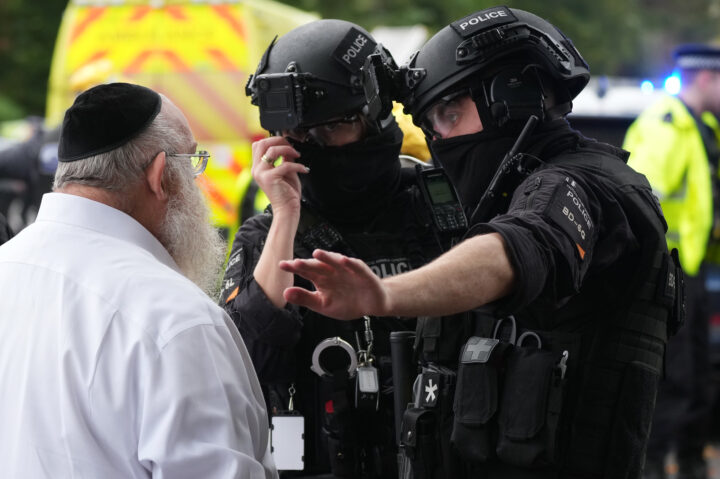
Members of the public and congregants seen as Police and other emergency responders attend the Heaton Park Hebrew Congregation Synagogue, where multiple were injured after stabbing and car attack on Yom Kippur, on October 2, 2025 in the Crumpsall suburb of Manchester, England.
Germany remained the country with the most antisemitic incidents relative to its Jewish population in 2025, among Diaspora countries with major Jewish populations, according to a new report from leading Jewish groups released on Wednesday.
According to the report, nearly 70 antisemitic incidents per 1,000 Jewish residents were recorded in Germany in 2025.
Not since the terror attack on a Jewish community center in Buenos Aires, Argentina, more than 30 years ago has the Jewish Diaspora experienced as deadly a year as 2025.
Worldwide, 20 people were killed last year in four antisemitic attacks across three continents — all in “J7” countries, the seven countries with the largest Jewish Diaspora populations — including deadly incidents in Sydney, Australia, and Manchester, England. Eighty-five people were killed in the 1994 AMIA attack in Buenos Aires, which still marks the deadliest terror attack on Jews outside of Israel.
The data comes from the second annual Report on Antisemitism by the J7 — a global alliance formed in July 2023 by major Jewish organizations representing the seven largest diaspora communities outside Israel: the United States, the United Kingdom, France, Germany, Canada, Argentina and Australia.
Tel Aviv University published a study with the same findings in April.
The J7’s 52-page report tracked over 23,000 antisemitic incidents across J7 countries in 2025 — a 136% total increase and a 97% surge in violent acts compared to 2022, prior to the Oct. 7, 2023, Hamas attacks in Israel.
While the number of antisemitic incidents in the U.S. plummeted by a third last year, assaults with a deadly weapon spiked, according to a May report by the Anti-Defamation League. The May 2025 killing of two Israeli Embassy staffers outside the Capital Jewish Museum in Washington marked the first Jews to be killed in antisemitic attacks on U.S. soil since 2019. One month later, a Jewish victim died from her injuries sustained in a firebombing attack in Boulder, Colo., at a march in support of the Israeli hostages.
Every J7 country’s antisemitic incidents remain dramatically above pre-Oct. 7 levels. Australia saw the sharpest rise of antisemitic incidents since 2021 (+270%), followed by Germany (+215%), the U.S. (+131%) and France (124%). Anti-Zionism was a key motivation behind a significant share of incidents: 48% in the U.K., 45% in the U.S. and 23% in Germany.
The report also features a new “in focus” section highlighting Ireland, which saw 143 antisemitic incidents — a rate of 65 per 1,000 Jewish people — while the country lacks a national strategy to combat antisemitism and dedicated security funding for religious institutions.
“The J7 Annual Report makes clear that antisemitism is no longer a temporary surge, but a sustained global crisis affecting Jewish communities across all seven countries,” said William Daroff, CEO of the Conference of Presidents of Major American Jewish Organizations, which represents the U.S. along with the ADL in the J7. Daroff called on governments, institutions and technology companies to “act with urgency, enforce the law, strengthen security and ensure that Jews can live openly and safely.”
Rabbi Yehoram Ulman, the director of Bondi Beach’s Chabad, and Ahmed al Ahmed, the civilian who disarmed one of the gunmen, are visiting the U.S. this week
Nathan Posner/Anadolu via Getty Images
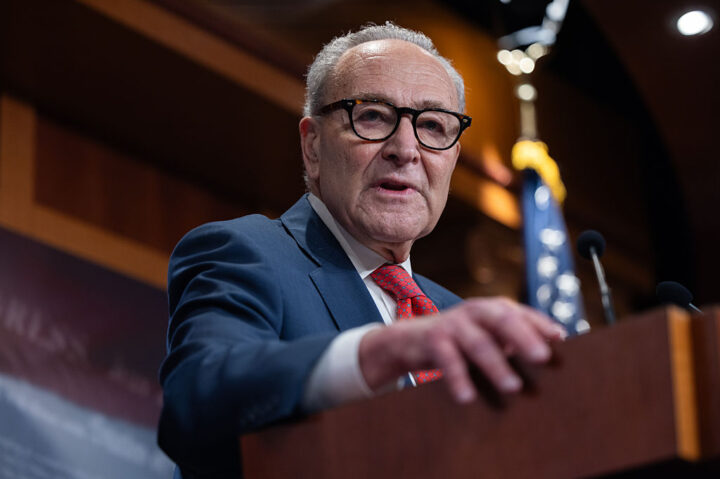
Senate Minority Leader Chuck Schumer (D-NY) speaks at a press conference following recent elections as the government shutdown continues in Washington, DC on November 5, 2025.
Senate Minority Leader Chuck Schumer (D-NY) will meet at the U.S. Capitol on Thursday morning with two survivors of the deadly terrorist attack during a Hanukkah celebration at Bondi Beach in Sydney, Australia, Jewish Insider has learned.
The two survivors are Rabbi Yehoram Ulman, director of Chabad-Lubavitch of Bondi, and Ahmed al Ahmed, the civilian who tackled and disarmed one of the gunmen during the attack. Ulman hosted the Hanukkah event where 15 people were killed, including his son-in-law, Rabbi Eli Schlanger.
Australian Ambassador to the U.S. Kevin Rudd, the country’s former two-term prime minister, will also be in attendance.
A source familiar with the matter told JI that the Senate minority leader will “listen to their stories and discuss the work that he and the Australian government are doing respectively to combat antisemitism.”
Ulman and al Ahmed are currently in the U.S. together for a joint trip. Ulman brought al Ahmed to Queens, N.Y., on Tuesday to pray together and pay respects at the gravesite of the Lubavitcher rebbe. Ulman said the trip was an opportunity for the American Jewish community to express their gratitude to al Ahmed, a Syrian-born Muslim, for his heroic actions last month.
“Ahmed did what he did that day because he believed that God placed him at the scene for a reason, and that’s what gave him the strength to save lives,” Ulman said from the gravesite. “This is something people from all walks of life can and must learn from.”
Al Ahmed suffered two gunshot wounds while taking down one of the two gunmen during the Hanukkah massacre, which also left more than 40 people injured, later undergoing a successful surgery.
Australian Prime Minister Anthony Albanese called the attack, among whose victims was a Chabad emissary, an ‘act of terror’
George Chan/Getty Images
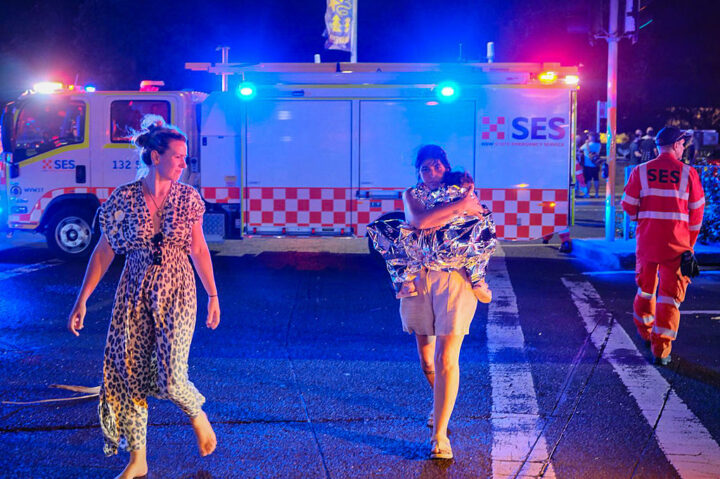
A member of the public leaves the scene with her child, who is covered in an emergency blanket, after a shooting at Bondi Beach on December 14, 2025 in Sydney, Australia.
At least 15 people were killed on Sunday in an attack at a Hanukkah event in Sydney, Australia, in what authorities described as a targeted terror attack on the Jewish community.
The event was hosted by Chabad of Bondi, a neighborhood with a major Jewish community in Sydney.
Two gunmen opened fire with long rifles from outside the gated-off event, killing at least 15, and injuring 40. Among the victims were Rabbi Eli Schlanger, the Chabad emissary to Bondi, Holocaust survivor and immigrant from the Former Soviet Union Alex Kleytman, 87, and a 10-year-old girl identified by the Australian press only as Matilda.
The terrorists were Naveed Akram, an unemployed bricklayer and his father, Sajid, a grocer, who was killed at the scene. Naveed was shot, as well, and was in critical condition in the hospital on Monday. They were known to Australian Federal Police, which were investigating their possible ties to the ISIS offshoot the Islamic State of East Asia.
Police also found unexploded bombs in the area, near Sydney’s most popular beach, as well as additional weapons in the Akrams’ car.
Chris Minns, the premier of New South Wales, the province in which Sydney is located, said that the shooting was a “targeted attack on the Sydney Jewish community.” NSW Police declared the attack a terrorist incident. One of the two assailants was identified by authorities as Naveed Akram, and was killed at the scene.
Australian Prime Minister Anthony Albanese said following the attack that his government would implement parts of its special envoy on antisemitism’s recommendations, including additional funding for security.
“This senseless attack is one which is an act of terror. It is aimed at creating fear. But we will stand with the Jewish community and Jewish Australians at this time,” Albanese said in a statement to the press.
Kobi Farkash, an Israeli tourist in Sydney and an eyewitness to the attack, told Jewish Insider that he went to the beach and happened upon the Chabad event.
“It was surrounded by a simple fence. There were four or five Jewish security guards without weapons, and maybe two police officers there before the attack,” he recalled. “Someone from Chabad, a man with a kippah and tzitzit, invited me in … he told the security guard to let me in because I’m Israeli. I put on tefillin, ate a sufganiya [jelly doughnut]. There were activities for kids, like at any community event.”
After spending some time at the event, Farkash said, “I heard gunshots … I saw people running and someone on the floor, bleeding. I started running away with everyone else.”
“People were running in all directions, like the Nova,” Farkash said, referring to the Hamas massacre of revelers at a rave in southern Israel on Oct. 7, 2023. “It’s an event where people are celebrating and happy, and you can’t believe this happened a moment later. It felt like the Nova.”
When things seemed quieter, Farkash returned to the scene and found that first responders “were working very slowly. In Israel, we’re used to this and things work much faster. The ambulances, police, news reports, come sooner. My sense was that [Australian authorities] don’t know how to deal with mass casualty events. … I didn’t see anything on the news for almost an hour, and when I asked locals why they weren’t calling news hotlines or reporting on news apps, they said Australia doesn’t have that. In Israel, it would be in the news three minutes later.”
“I have never been in a terrorist attack in Israel,” Farkash, who grew up in Bnei Brak, near Tel Aviv, said. “It’s crazy that I went to the end of the world and experienced a terror attack here.”
Lissy Abrahams was walking with her adult daughter to a Bar Mitzvah party being held nearby and parked by where the Chabad party was being held. As they were walking, she and her daughter heard gunshots.
“We looked at each other and said ‘run,’” Abrahams recounted to JI. “I was wearing high heels that were strapped on and couldn’t just flick them off. My daughter was wearing flat shoes, and she kept coming back for me, but I told her to go. … She looked at me and made a decision that she couldn’t.”
Abrahams and her daughter saw a storage area, where lifeguards keep their equipment, and ran down to the beach to take shelter with beachgoers, including parents holding babies.
“People were standing in the doorway and didn’t know what to do, but as Jews, we understood what was going on,” she said. “I said ‘this is a terrorist attack. We need to be very careful and we need to pull this [garage] door down.’ … We needed a barrier. I had to be very firm with them, because they didn’t understand, but I had Oct. 7 footage in my mind.”
“Time was distorted, it was moving fast and slow, so I have no idea how long it took, but someone from the [local] council came and said we can go. We decided to trust that advice and go out … My daughter and I just ran. … We hitchhiked; we jumped into a stranger’s van. … We were so lucky,” she said.
Abrahams said she kept thinking about the Oct. 7, 2023, Hamas attacks on Israel: “It really struck me how many decisions I had to make and I had no idea where they would lead me. I didn’t know how many terrorists there were. I was making decisions that could have ended my life. … Jews on Oct. 7, they just had to make decisions, too.”
Abrahams was part of a group of Sydney residents who would meet weekly to read the names of the hostages taken in the Oct. 7 attacks, and she said she was very moved to see the letter written by the Hostage Families Forum to the community.
“On Saturday [the group] met for lunch. We were happy; we could breathe; we were proud of our commitment. And there we were the next day, with our community suffering,” she said. “We are feeling the love from Israel and around the world. We are one big Jewish family.”
Abrahams spoke to JI on Monday, after returning to Bondi Beach to retrieve her car, and said she saw Chabad rabbis had set up a booth at the site to help people put on Tefilin: “These are the cousins, the brothers-in-law and the best friends of people killed.”
Prominent pro-Israel activist Arsen Ostrovsky, who recently moved back to Australia after living in Israel for 13 years to head the advocacy group Australia Israel & Jewish Affairs Council, was injured by a bullet that grazed his head during the attack. His wife and two daughters also attended the event, but were not injured.
“I was here with my family, it was a Hanukkah event, there were hundreds of people, there were children, families, elderly, enjoying themselves,” Ostrovsky told Australia’s News 9. “All of a sudden, there’s absolute chaos, there’s gunfire, people ducking. … I saw blood gush in front of me, I saw people hit. … My only concern was where are my kids? Where is my wife? … I survived Oct. 7, I lived in Israel 13 years. We came here only two weeks ago to work with the Jewish community, to fight antisemitism, to fight this bloodthirsty ravaging hatred. … We’ve lived through worse. We’re going to get through this and we’re going to get the bastards that did this.”
“It was an absolute bloodbath, blood gushing everywhere. Oct. 7, that’s the last time I saw this. I never thought I’d see this in Australia, not in my lifetime,” Ostrovsky added.
Ostrovsky’s brother-in-law, Rabbi Menachem Creditor, founder of Rabbis Against Gun Violence, posted a photo of Ostrovsky being evacuated, writing, “Antisemitism is blasphemy against life, and I know this will not slow my brave brother Arsen down. It will fuel his work with AIJAC … on behalf of the Jewish community in Sydney … All Jews are family and are responsible for one another. In this case, that hit even closer to home. We will not be quiet. We will not hide. We are Jews. We are proud. We are strong. And we have work to do in the world, and this will not slow us down. Am Yisrael Chai!”
There has been a sharp increase in antisemitic attacks in Australia since the Oct. 7, 2023, Hamas attacks on Israel and the subsequent war. In the decade before October 2023, there was an average of 342 anti-Jewish incidents a year in Australia; since then, the average has risen to 1,858. Two days after the Oct. 7 attacks, thousands gathered outside the Sydney Opera House to protest Israel and chanted “f*ck the Jews.” Incidents since October 2024, the period that the latest antisemitism report from the Executive Council of Australian Jewry measures, included an arson attack on a kosher caterer, burning of cars and vandalizing buildings in a Sydney suburb, and the firebombing of a synagogue in Melbourne.
Australia expelled the Iranian ambassador earlier this year and designated the Islamic Revolutionary Guard Corps a terrorist organization, after intelligence services found that Iran was linked to the arson attacks.
Israeli President Isaac Herzog said, “The heart of the entire nation of Israel skips a beat at this very moment, as we pray for the recovery of the wounded … and we pray for those who lost their lives.”
Herzog and Israeli Foreign Minister Gideon Sa’ar noted that Israel had warned Australia that it needs to do more against antisemitism.
“We repeat our alerts time and again to the Australian government to seek action and fight against the enormous wave of antisemitism which is plaguing Australian society,” Herzog stated.
Sa’ar posted that the attack is “the results of the antisemitic rampage in the streets of Australia over the past two years, with the antisemitic and inciting calls of ‘globalize the Intifada’ … The Australian government, which received countless warning signs, must come to its senses!”
John Ondrasik met with hostage families, injured soldiers and first responders on his first trip to Israel this month

Courtesy
Five for Fighting performs in Hostage Square in Tel Aviv on April 13, 2024.
Three months after Hamas launched its deadly terror attack in Israel, singer John Ondrasik, known by his stage name Five for Fighting, penned the song “OK,” a ballad paying tribute to Israeli resilience in the aftermath of Oct. 7.
More than two decades earlier, in the wake of the Sept. 11, 2001, terror attacks, Ondrasik’s then-recently released “Superman (It’s Not Easy)” became the anthem for Americans reeling from the attacks, and to honor the first responders and victims of the deadliest terror attack on American soil. He would go on to perform the song at The Concert for New York City, held a month after the attacks on the Twin Towers and the Pentagon.
Ondrasik made his first trip to Israel this month, where he met with hostage families, first responders and soldiers who were recovering from injuries sustained while fighting Hamas in Gaza. After playing at a jam session honoring hostage Evyatar David, a musician, Ondrasik was invited to perform at the weekly Saturday night rally in Tel Aviv calling for the release of the remaining 133 hostages. His performance came hours before missiles and drones launched by Iran entered Israeli airspace, setting the country on high alert in the first direct confrontation between Tehran and Jerusalem.
Ondrasik spoke to Jewish Insider about his five-day visit, meetings with Israelis and how the music he created more than two decades ago has taken on new meaning in light of his experiences in Israel.
Jewish Insider: This was your first time in Israel. What expectations did you have before coming here?
John Ondrasik: Well, I heard the food was great. (laughs)
JI: It is!
JO: And that was proven very quickly. Obviously concerning why I was coming, I was anxious and interested about meeting with the hostage families, the troops, perhaps singing. So typically, I would be interested in touristy things, but there was so much to do here. We were so busy. I was really focused on doing whatever I can to support Israel and let them know in so many facets that there were artists and Americans who supported them and stood shoulder-to-shoulder with them. But at the end, I never could have imagined how our trip ended.
JI: We’ll get there, don’t worry. But before we do, talk to me about some of the folks that you met while you were here. Who stuck out to you?
JO: You know, I met some really cool people we can talk about, but it was just the people on the streets that I met. At our first restaurant, the waitress sat down at our table and started talking to us and was so friendly. I’m like, you don’t see that in the United States. And just the difference, talking to 18-year-old girls who are in full army uniform carrying machine guns. That’s something I’ve never done before. But, of course, meeting [former Soviet refusenik] Natan Sharansky is kind of like meeting [Nelson] Mandela, right? [He’s] such a powerful figure, and just spending time with him. … I met one of the leaders of United Hatzalah, and to see what they’ve done and to go into the control room and see what they have built, it’s just another example of Israeli ingenuity that no one else in the world can do.
Of course, the hardest, the most heartbreaking, the most agonizing people I met were the hostage family members. And I actually ended up meeting with three different sets of hostage families, including on my last day, the mother and brother of [Evyatar David, the honoree of the] Thursday night jam session came to the Hostage Forum and I sat with them and talked to some people and there’s no words to explain that. Anything I say would be diminishing their suffering. And so that was, of course, excruciating, but I think it was helpful for them to be able to tell their stories and know that there are some people that are not Jewish and in America advocating for them. I think they were surprised, and I think that telling them how people reacted to my song, and now millions of people in America have now heard about the hostages, and every day were calling for their release. I think that gave them a little bit of solace. So that was probably the most important thing we did. Playing with the troops, that was amazing.
JI: You played with the troops?
JO: Oh, yeah, I went and visited some troops at Sheba [Medical Center]. Three of them had lost their legs. And so we sat there and jammed on guitar and they ended up giving me guitar lessons because they’re so much better than me. They tend to have a pretty more optimistic view. You know, they’re young, they’re teasing each other. They know that they’re gonna have a great life. I actually met with one American IDF soldier who came from Florida, seven or eight years ago. And we spoke a lot about his experience and going door to door instead of just razing buildings, trying to save lives even though his commander was killed and he got shot four times trying to save him. [It was interesting to] hear from their mouths why they have these values that no one in the world wants to talk about. So, meeting with the troops was great. And then meeting the Hostage Family Forum and the people there that put together that thing literally overnight, and really took over the plight of the hostages. The government was way behind them and to see them every day have to deal with this horrible grief, they are heroes in their own right. So I just met amazing people and inspiring people and then I met some artists. I met Idan Raichel. We had a long talk about what’s going on and we have some projects possibly in the works. I met with Danny Sanderson. I met with Gilad Segev.
So I met with artists because we have these projects in the work that was really the main initial reason for my trip but then things got a lot bigger. I feel like I packed in a month of stuff in five days. I just wish I had more time. I would have stayed another week or two, but I have [shows in the U.S].
JI: So you performed on Saturday night at Hostage Square, literally as Iran was launching its missiles and drones at Israel. What was that like? They didn’t come until hours and hours later, but they were firing them off while you were performing. What was that whole experience like?
JO: I have not processed it yet. But I’ll tell you this — I’ve never played a gig where before the show, they make an announcement of what to do during a missile attack and nobody leaves.
JI: Only in Israel.
JO: Only in Israel. I have learned so much about Israel. That alone was surreal. The only experience I can compare that performance with, for me, is when I played the concert for New York after 9/11. At that concert, looking out at the emergency workers, meeting the families, [performing at Hostage Square] was very similar to that, to walk on that stage, to be able to play “Superman,” knowing that was the 9/11 song, and here we are in the Oct. 7 aftermath. To be able to speak to them and say my words, I was honored to do that. To perform “OK,” and to look at 5,000-10,000 people, many in the beginning holding signs of their loved ones, singing back to me — there’s no there’s no words for that. It’s heartbreaking, but it’s also why music can matter in so many ways. To see them crying and singing reminded me of a guy that I saw at the concert for New York who was crying and singing “Superman” at the top of his lungs, and sometimes music provides solace like that and lets people know they’re not alone.
So many in Israel, every interview I did, first of all I said, ‘Where’s everybody else? Where are all the artists? Why is nobody speaking up for us?’ So be able to show them that no, they’re not crazy, they’re not alone, there are artists who understand that Israel is fighting the good fight, and that people recognize that. [Performing at Hostage Square was], probably with the concert in New York, the most significant, important thing I’ve ever done as a musician, and then to walk off stage, kind of with that mindset of ‘wow,’ to be greeted by all the hostage families and hug them and take pictures with them. And then be told that we have to be in our hotel 11, by a safe room because there’s gonna be a missile attack.
My Israeli friends were like, ‘Well, let’s just go get dinner first.’ I’m like, ‘No, I’m going to the hotel!’ So we go to the hotel, they’re all drinking and eating dinner. It’s 10:30 and I go to my room and then they launched the missiles. Look, I had brought my son. And my wife was very reluctant to bring him, but she allowed him to come. And so I was scared. I was scared, especially when they launched the ballistic missiles. My wife is calling me crying, everybody from the States is reaching out. And so I was like everybody, I’m human. I had my bag packed for the safe room, we knew where it was, we were ready to go. I had my son with me and then we’re sitting there, then I actually connected with Fox News and ended up going on Fox News from Tel Aviv.
I’ve always wanted to do my best [Fox News reporter] Trey Yingst impersonation, so it’s 3 in the morning in Tel Aviv, I’m outside my window, things are kind of slowing down. And I’m on Fox News talking about it. And I thought it was going to be over, but then we saw that Jerusalem interceptions so like, wow, it’s still coming this way. And in the meantime, I’m trying to get a flight, which nobody could get flights [because] everybody’s panicking. But that was the most surreal, insane, important, inspiring 12 hours of my life and I’ll never forget it. I’ll never recover from it, but I’m so grateful. I’m still grateful at the end of the day that I was there. I was so grateful that I was there to experience that, to experience the people. And then the next day I went into the Mediterranean Sea and got stung by jellyfish.
JI: It’s early for that. You already got stung?
JO: I found out in Israel that the thing that is more dangerous than Iran is jellyfish.
JI: What is the main message that you want to communicate to your friends back home, to your neighbors, colleagues, to other people in the industry about your time here?
JO: I’m already doing it. I’ve gotten a lot of press inquiries, and I’m doing radio and television. And I like to tell people about the fortitude of Israeli people, but people know that. I like to tell them about the courage, the innovation of the Israeli people, but people know that. But what I really was moved by was in this dark time, in this horrible time in Israel, everybody finds a way to have joy within the fear. And that’s what I took from Israel with me. And I guess it makes sense because Jewish people have been dealing with this for millennia. But to see it firsthand and to see people dealing with these really hard things and, you know, the day that everybody says Iran’s going to attack, everybody’s at the beach and everybody’s playing volleyball and running, and living their lives and [having] dates at dinner. We could not get a seat at a restaurant on that Friday. I was just really moved by how Israelis live life and appreciate life. And I think that’s why they have joy. I guess they’re ranked fifth happiest in the world. And I understand it, because when you’re always at risk of being bombed or [being targeted by a] suicide bomber, you have a sense of, ‘I gotta live today. I’m gonna live today.’
I wrote a song called “100 Years,” which is all about that. I don’t think I ever really lived it, but seeing them, they lived that. I can’t wait to bring my wife back and my daughter, when things get a little safer, and let them share the experience, you know, go to the Western Wall in Jerusalem and leave a prayer note and all that stuff. So that’s what I’m telling people and I’m also doing a lot of press here to keep the focus on the hostages and really try to be a strong voice for Israel as much as I can.
Please log in if you already have a subscription, or subscribe to access the latest updates.
 Continue with Google

 Continue with Apple