














































































A new survey from the Jewish Federations of North America illustrates the complexities of supporting Israel and the word ‘Zionism’ in a post-Oct. 7 landscape

Alexi Rosenfeld/Getty Images
NYPD officers stand on the side during the Celebrate Israel Parade up Fifth Avenue on May 18, 2025 in New York City.


 Add JewishInsider on Google
Young American Jews have less of an emotional attachment to Israel than older Jews, but the overwhelming majority of all American Jews, across age groups, believes in Israel’s right to exist as a Jewish and democratic state, new survey data from Jewish Federations of North America reveals.
The results from the survey, which was conducted in March 2025 and released this week, makes clear that a baseline belief in Israel’s existence is still a consistent feature of American Jewish life among at least three-quarters of all Jews in the United States. At the same time, illustrating the complexities of the post-Oct. 7 landscape, one-third of young Jews describe themselves as anti-Zionist or non-Zionist.
Overall, nearly 9 in 10 American Jews believe in Israel’s right to exist, though there is a disparity among age groups. Ninety-eight percent of Jews between the ages of 55 and 74 believe in Israel’s right to exist as a Jewish, democratic state, compared to 76% of American Jews between 18 and 34.
Among younger Jews, a majority still describe feeling emotionally attached to Israel, although there is a larger discrepancy from their parents’ generation. Fifty-seven percent of American Jews between 18 and 34 said they feel emotionally attached to Israel, compared to roughly three-quarters of Jewish Americans between 55 and 74. Among American Jews who are older than 75, 88% described feeling emotionally attached to Israel.
According to the survey, fewer than half of American Jews — across nearly all age categories — identify as Zionists. Among those between the ages of 18 and 34, 35% identify as Zionist. Among Jews over 75, just 33% identify as a Zionist.
JFNA’s chief impact officer, Mimi Kravetz, argued in a Jewish Telegraphic Agency op-ed explaining the survey results that Jews’ reluctance to describe themselves as Zionists, while agreeing with the fundamental tenets of Zionism, is a result of misperceptions about the word, which Kravetz said had experienced “definition creep,” shaped by “political agendas, public discourse, and broader social forces.”
She urged Jewish advocates to respond with unity and a recommitment to the term’s earliest definition.
“For us, Zionism means supporting the State of Israel and the Israeli people and uniting the Jewish people behind this shared commitment,” Kravetz wrote.
But while relatively few American Jews describe themselves as Zionists across age groups, the data shows that far more young Jews identify as anti-Zionists or non-Zionists than older Jews. About one-third (32%) of Jews between 18 and 34 describe themselves as anti-Zionists or non-Zionists. That’s a much larger number than any other demographic: 13% of Jews between 35 and 44 say the same, compared to 15% of Jews between 45 and 54, 1% of Jews between 55 and 64, 4% of Jews between 65 and 74 and 9% of Jews older than 75.
A new survey by JFNA found that communal engagement by LGBTQ Jews, Jews of color, Jews with disabilities and financially vulnerable Jews is still higher than pre-Oct. 7 but down year over year
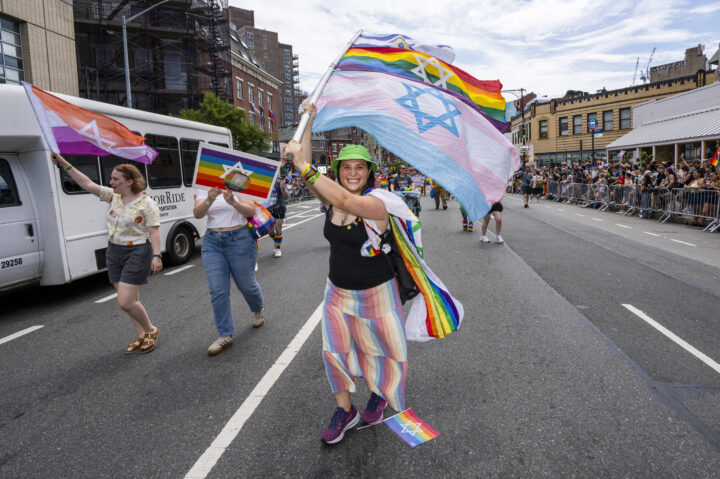
Craig T Fruchtman/Getty Images
People take part in the 2025 NYC Pride March on June 29, 2025 in New York City.
In the aftermath of the deadly Oct. 7 attacks two years ago, American Jews were pulled off the sidelines and got much more involved in Jewish life — a trend, dubbed “the surge,” that has continued into a second year, according to a survey released this spring.
But a further breakdown of that survey data, shared this week by the Jewish Federations of North America (JFNA), shows that the impact of “the surge” is waning more quickly among Jews from minority populations, including LGBTQ Jews, Jews of color, Jews with disabilities and financially vulnerable Jews, than it is among the broader Jewish community.
The survey found that 31% of Jewish respondents said this year that they are engaging more with the Jewish community now than before Oct. 7, down from 43% last year — still significant post-Oct. 7 growth, but slightly down from the immediate aftermath. But among historically marginalized populations, that decrease was even more pronounced.
“We’re sad and disheartened to see that these marginalized groups are engaging so much less than they were at this time last year,” JFNA’s chief impact and growth officer, Mimi Kravetz, told Jewish Insider on Wednesday. “It’s still higher than baseline. There’s still people showing up more. But there has been a more significant drop among these most marginalized groups.”
Roughly one-fifth of people with an LGBTQ+ member of their household say they are now engaging more with the Jewish community in 2025, down from 49% from the year before. Among Jews who are not white and Ashkenazi, 30% of people are “surging” this year, a decrease from 57% the year before. Thirty-two percent of financially vulnerable Jews are “surging” now, compared to 49% a year earlier.
Across these different populations, there is no single answer as to why there was a sharper decline in engagement than among the broader Jewish community. The Jewish leaders analyzing this data have not yet identified what they think accounts for the disparity, but they have some ideas — and suspect that some of the differential can be explained by simmering tensions over Israel.
Overall, the JFNA survey found that roughly one-third of American Jews believe conversations about the war in Gaza are “negatively impacting community engagement and belonging,” according to a presentation for Jewish community stakeholders hosted by JFNA on Tuesday. Thirty-five percent feel that if they shared their views on Israel, they wouldn’t be welcome in the Jewish community.
But just because people are sometimes afraid to voice their opinion, that doesn’t mean they are all in alignment. Similar percentages of American Jews feel the community is too hard-line in its support for Israel (39%) and feel that it is not outspoken enough in its support for Israel (34%).
Among LGBTQ Jews, or those who live with someone LGBTQ, “we do see a slightly lower sense of pride and emotional attachment to Israel, and we do see that they are more likely to believe that the community is too hard-line in its support of Israel,” Kravetz offered as one possible explanation for why the community is now “surging” less.
That’s different from financially vulnerable Jews, who are “more likely to feel pride in an emotional attachment to Israel than the general Jewish public,” Kravetz said on the webinar. One challenge for them may be a sense of feeling uninformed compared to others in the community.
“They’re actually far less likely to say that this issue of the community and Israel is affecting their sense of engagement and belonging,” she added. “They are much more likely, though, to say that they don’t know enough to participate in the conversation.”
But the Israel hypothesis falls short when looking at why Jews of color are “surging” less than a year ago. “Their views actually mirror the general population,” said Kravetz. But part of that may account for diversity within the broad “Jews of color” umbrella — which encompasses Mizrahi Jews, Black Jews, Latinos and more.
The data is particularly concerning for Jewish leaders who had invested in understanding diverse segments of the community and helping them feel more included. But the same barriers that existed before Oct. 7 are still present.
“What’s really affecting their sense of surge and engagement and belonging are the same things that affected them prior to Oct. 7, and those are that they need to see a reflection of themselves in leaders and other participants,” said Kravetz. “They need space to show up as their whole self, whatever that looks like for them. They need to see visible evidence of diversity and inclusion policies and practice, and that those policies will be followed, and they need to know before they enter.”
Please log in if you already have a subscription, or subscribe to access the latest updates.
 Continue with Google

 Continue with Apple