














































































The decision to drop the subpoena was welcomed by the campus Jewish community — which had spoken out against the administration’s initial request

Getty Images
Exteriors of University of Pennsylvania (UPenn) located in Philadelphia


 Add JewishInsider on Google
The Trump administration withdrew its controversial subpoena requesting that the University of Pennsylvania provide lists of Jewish university affiliates and their personal contact information, according to a Thursday court filing.
“With the support of many members of the community who have stood with Penn throughout, the University has been able to protect its employees’ rights and none of the subpoenaed personal contact information was disclosed,” a university spokesperson told Jewish Insider.
The Equal Employment Opportunity Commission had requested, as part of its investigation into antisemitism at Penn, lists of Jewish-related organizations on campus, their membership rosters and contact information for the employees involved, among other information.
The decision to drop the subpoena was welcomed by the campus Jewish community — which had spoken out against the administration’s initial request.
“Over the past year, I have spoken with hundreds of students, faculty, and staff across the University of Pennsylvania regarding this issue,” Rabbi Gabriel Greenberg, executive director of Penn Hillel, told JI. “Every single person expressed objections to the attempt to compel the university to surrender data on Jewish identity and affiliation.
“While many in our community share Penn Hillel’s conviction that campus antisemitism requires urgent, sustained action, demanding ‘lists of Jews’ was a fundamentally incorrect and inappropriate way to address it.”
Rabbi Rick Fox, who leads Meor Penn, told JI, “We are grateful that this resolution protects the privacy and safety of Jewish people on campus.”
At the same time, Fox expressed hope that “this outcome motivates Penn to take every step to ensure that our campus remains free from antisemitism, anti-Israel bigotry and discrimination against students in all forms.”
The decision follows a monthslong legal battle between Penn and the EEOC over the body’s authority to enforce the subpoena issued last July. The EEOC sued Penn in November, saying the subpoena was necessary to obtain contact information for potential victims of antisemitism, but the Ivy League university refused to comply, calling the agency’s methods “extraordinary and unconstitutional.”
In March, Judge Gerald Pappert of Philadelphia’s Federal District Court ordered Penn to comply with the subpoena by May 1, but the school continued to withhold the personal contact information.
The subpoena was highly scrutinized by critics on campus who likened the move to Nazi-era methods of collecting information about Jews. Experts told JI in January that a more typical investigation might involve agency officials interviewing people who issued complaints directly with the agency, then visiting the campus and publicizing their investigation, calling the EEOC’s methods in the Penn case “incredibly unusual, if not completely unprecedented.” In April, EEOC Chair Andrea Lucas defended the move, saying, “There is no other way to protect victims of harassment or discrimination unless you collect information about them.”
The court filing did not explain the government’s decision to drop the subpoena. The Trump administration did not respond to a request for comment from JI.
The university had argued the subpoena was an ‘extraordinary and unconstitutional’ overreach that resembled nefarious efforts to gather lists of Jews over history
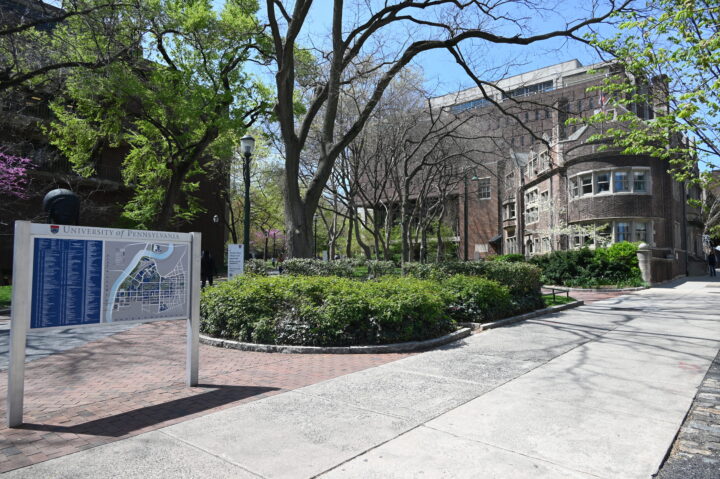
Kyle Mazza/Anadolu via Getty Images
A view from the University of Pennsylvania on April 18, 2025.
A federal judge ordered the University of Pennsylvania on Tuesday to comply with a subpoena from the Trump administration requesting detailed information about Jewish university affiliates as part of the government’s crackdown on campus antisemitism.
The decision follows a monthslong legal battle between Penn and the United States Equal Employment Opportunity Commission’s over the EEOC’s authority to enforce the subpoena issued last July, which stemmed from an ongoing investigation into Penn’s handling of antisemitism.
The EEOC sued Penn in November, saying it had failed to comply with the subpoena, which demands that the university turn over lists of Jewish employees and members of Jewish organizations — including their identifying details and phone numbers — saying the information is necessary for the agency to contact potential victims of antisemitism.
The battle escalated in January when the Ivy League university issued a court filing calling the agency’s methods of investigating whether the school allowed an antisemitic work environment “extraordinary and unconstitutional.”
Judge Gerald Pappert of Philadelphia’s Federal District Court ruled in Tuesday’s brief that “for their legal arguments, respondents contend the charge of discrimination is invalid and the subpoena violates the United States Constitution in various ways. But the charge is valid and the constitutional claims are easily dispensed with.”
Penn has until May 1 to respond to the subpoena, but will not have to “reveal any employee’s affiliation with a specific Jewish-related organization,” Pappert, who was appointed by President Barack Obama, wrote in the 32-page ruling.
A Penn spokesperson told Jewish Insider that the university plans to appeal the ruling. “We remain committed to confronting antisemitism and all forms of discrimination, and have taken multiple steps to prevent and address these despicable events,” the spokesperson said.
“While we acknowledge the important role of the EEOC to investigate discrimination, we also have an obligation to protect the rights of our employees. We continue to believe that requiring Penn to create lists of Jewish faculty and staff, and to provide personal contact information, raises serious privacy and First Amendment concerns. The university does not maintain employee lists by religion. We intend to appeal.”
An EEOC spokesperson declined to comment.
Jewish groups on and off campus, including Hillel, Chabad, Meor and the local federation have asserted that the demands in the subpoena represent a significant overreach in the Trump administration’s nationwide campus investigations into alleged antisemitism.
Turning over the information would disregard “the frightening and well-documented history of governmental entities that undertook efforts to identify and assemble information regarding persons of Jewish ancestry,” the university said in the January legal filing.
Over the past year, the EEOC has played a key part in the Trump administration’s negotiations with several elite universities —- many of which have been related to antisemitism. In July, Penn reached a deal with the White House to restore some $175 million that was frozen over alleged discrimination of a transgender student athlete.
Please log in if you already have a subscription, or subscribe to access the latest updates.
 Continue with Google

 Continue with Apple