










































































JFNA CEO Eric Fingerhut: ‘There's no other religious faith that has to incur this kind of expense just to protect itself in its places of worship and communal gathering’

Tom Brenner For The Washington Post via Getty Images
Metropolitan Police Department and Federal Bureau of Investigation officers stand guard at a perimeter near the Capital Jewish Museum on May 22, 2025 in Washington.


 Add JewishInsider on Google
The American Jewish community spent over $1 billion on security in 2025, according to a new Jewish Federations of North America study — a record high and a 33% increase over 2024. The results, published today, showed that on average, Jewish communal organizations, including Jewish community centers, synagogues, schools, summer camps and nonprofits, spend roughly $225,000 on security per institution.
“Even the old number, $765 million [spent in 2024], was just a demonstration of the impossible situation that the Jewish community is being put in,” Eric Fingerhut, JFNA’s president and CEO said. “To have to raise extraordinary sums of money and dedicate extraordinary sums of money to security just to be able to fully live a flourishing Jewish life in this great and free country,”
Fingerhut said the statistics didn’t shock him. According to the Anti-Defamation League, last year was the deadliest year for Jews in three decades. The security threats had grown, alongside the necessary precautionary measures.
“This is just not the way America is supposed to work,” Fingerhut said. “There’s no other religious faith that has to incur this kind of expense just to protect itself in its places of worship and communal gathering.”
According to the latest FBI Hate Crime data, Jews remain the most targeted religious group in America — making up 64% of all religiously motivated hate crimes. While the numbers of antisemitic hate crimes have decreased since 2024 — from 1,938 to 1,528 — last year remains the third highest year on record.
The statistics arrive as Fingerhut and other leaders are pushing Congress to pass the bipartisan Jewish American Security Act, legislation which would fund the nonprofit security grant program at a billion dollars and better address antisemitism online, on campus and across the country.
Although the U.S. government has “been on our side,” Fingerhut said, “they have to do more to address this crisis of terror that’s directed at the Jewish community.”
The nonprofit security grants would be available to other nonprofits, but would have a disproportionate impact on the Jewish world, Fingerhut said. “Given that we’re 2% of the population and over 50% of all the hate crimes, it obviously is going to make a significant difference in our institutions.”
The study only looked at Jewish nonprofits, leaving out the cost incurred by the privately-owned businesses including over 1,600 kosher restaurants, 500 markets and Judaica shops and bookstores.
This funding spent on security could be used towards other initiatives, Fingerhut said, with the JFNA estimating that it would be able to send 44,000 kids to Jewish day schools and cover the costs of every attendee at Jewish camp.
Members of synagogues and schools understand the need for increased security and have stepped up, Fingerhut said. “There’s been extraordinary generosity in the Jewish community with regard to security [but] clearly there are limits.”
The majority of the cost for security goes towards personnel, including security guards, with additional funding goes towards protecting windows and doors, improving security cameras and putting bollards in front of buildings.
“Those are capital expenses, which largely occur one time, and the personnel costs are ongoing and growing expenses,” Fingerhut said. “Demand for security guards is growing … Maybe there was a time a few years ago, you thought, ‘Well, we only have to have [security] if we’re having high holidays or big crowds or a special event.’ Now, it’s a necessity anytime there are people coming in and out of the building.”
Needing constant security is the reality the Jewish world lives in now, Fingerhut said, and it’s not going to change in the foreseeable future.
“There’s not a synagogue in America that isn’t spending money on security for the high holidays,” he said. “It’s an extraordinary expense, and so … it’s on everybody’s mind. But … this is a year-round crisis, this isn’t just a high holiday crisis. It’s affecting our ability to live full and complete Jewish lives because every time a synagogue or a school or a camp or JCC is planning a program, they have to factor in this extraordinary cost of security for that program, and that may mean that the programs don’t go forward because you can’t afford the cost of security.”
Still, Fingerhut said, not practicing Judaism, not celebrating, not coming together — that isn’t an option. “We’re not going to let Jewish life be curtailed because of the cost of security.”
A lesson plan on the background and history of antisemitism meaningfully reduced students’ belief in the trope that Jews are more loyal to Israel than the U.S., among others

Getty Images
Students in a classroom
One 45-minute lesson on contemporary antisemitism can meaningfully cut teenagers’ belief in antisemitic conspiracy theories, according to a new study by the Anti-Defamation League.
The study evaluated 372 middle and high school students across nine schools in a North Carolina school district between September and November 2025, finding that students who received the lesson, titled “What Is Antisemitism and What Are Features of Antisemitism?” were 14% more likely than a control group to reject the claim that Jews have too much power in the United States.
The lesson also drove a 16-point drop in students’ endorsement of the trope that Jews are more loyal to Israel than to the U.S., and they were also less likely to believe in other tropes involving Jewish control and media influence. They were also 14% less likely to minimize antisemitism as a problem.
In a separate online study of 5,005 U.S. high school students conducted by the ADL, a single lesson was found to cut down stereotype agreement. This drop reportedly happened even in students who usually hold firm views.
Teachers without prior training taught the lesson designed by the multimedia curriculum program Echoes & Reflections. The lesson explores what antisemitism means, how it has appeared in the past and today, how stereotypes and conspiracy beliefs are cyclical and how they harm both Jewish communities and society as a whole.
The study comes amid reports of political activists increasingly seeking to push antisemitic content and extremist perspectives in K-12 classrooms across the country.
“This research is significant in that it features evidence from real classrooms,” said Matt Williams, vice president of the ADL Center for Antisemitism Research. “We now have data showing that a single, well-designed lesson, taught by educators with no special training, can measurably shift how teens think about antisemitism. That’s a solvable problem for schools. Based on our research, districts don’t need a semester-long unit or a major new investment to make progress, they need the right 45 minutes, and now we’re closer to knowing what that looks like.”
The research found that 42% of surveyed Jewish faculty members who belong to an association report feeling alienated because they are Jewish or perceived as pro-Israel
Bryan Bedder/Getty Images for Anti-Defamation League
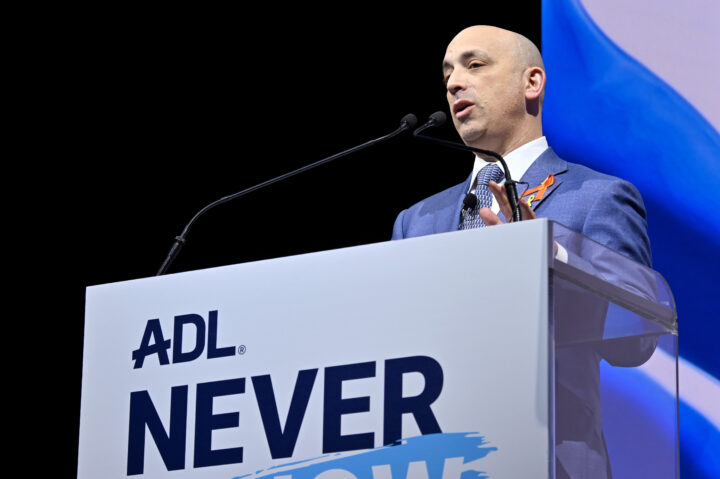
ADL CEO Jonathan Greenblatt speaks onstage ADL's Never Is Now at Javits Center on March 03, 2025 in New York City.
Antisemitism is on the rise within 20 major U.S.-based professional academic associations, according to a study published Thursday by the Anti-Defamation League.
The research, conducted in September, found that 42% of surveyed Jewish faculty members who belong to an association report feeling alienated because they are Jewish or perceived as Zionist; 25% report feeling the need to hide their Jewish or Zionist identity from colleagues in their association; and 45% report being told by others in their associations what does and does not constitute antisemitism. The data was collected using the International Holocaust Remembrance Alliance’s working definition of antisemitism.
Among the associations the report profiles is the Association of American Geographers, which faced pressure from members to adopt a boycott of Israel in August. Other organizations in which the ADL reported antisemitism include: National Women’s Studies Association, American Public Health Association, American Psychological Association and American Educational Research Association.
A Jewish member of the American Anthropological Association interviewed for the study said that the organization’s 2023 conference, held one month after the Oct. 7, 2023, terrorist attacks in Israel, “was one of the first times I felt afraid professionally as a Jewish person. I felt very vulnerable … if I had been wearing a Star of David, which I wasn’t, I would have taken it off. I did not feel safe.”
“Antisemitic biases in professional academic associations are widespread and reveal a problem that goes far beyond traditional scholarly circles,” said ADL CEO Jonathan Greenblatt.
“When antisemitism and biased anti-Israel narratives are normalized within these influential spaces, they seep into curricula, research, and public discourse, quietly but profoundly shaping how students and future professionals interpret the world,” continued Greenblatt. “By assessing these associations and how they are responding, we are delineating a path forward to ensure that academic spaces remain intellectually rigorous, inclusive and free of antisemitism and accountable to the public they serve.”
The report outlines suggestions for reform, based on practices implemented by associations that have successfully mitigated the spread of antisemitism within their organizations. These guardrails include anti-harassment policies and guidelines preventing an association from straying from its stated mission.
The study follows one published in September by the ADL and Academic Engagement Network that found much of the antisemitism on college campuses is fueled by faculty and staff — both on campus and within professional academic organizations.
Please log in if you already have a subscription, or subscribe to access the latest updates.
 Continue with Google

 Continue with Apple