














































































George Moraitis is running against Boca Raton Mayor Scott Singer and businessman Dan Franzese to take on Moskowitz
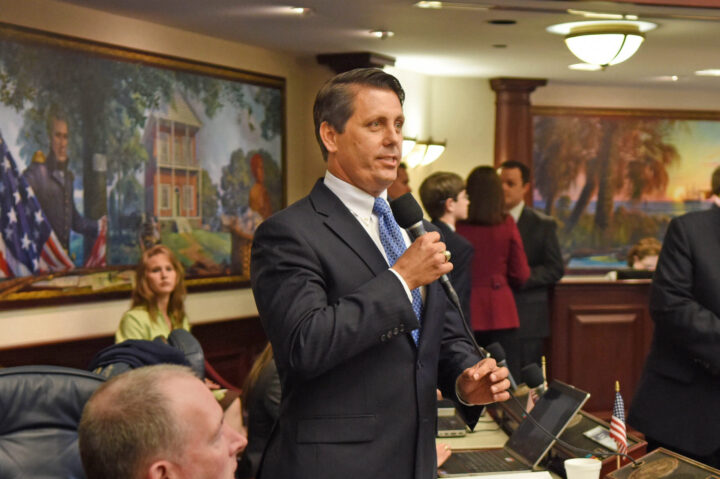
George Moraitis campaign website
Former Florida state Rep. George Moraitis.


 Add JewishInsider on Google
Former Florida state Rep. George Moraitis is hoping that a bipartisan approach and his background in the Statehouse and as a military veteran will make him a formidable candidate to take on Rep. Jared Moskowitz (D-FL) in South Florida in November.
Moraitis is running in the Republican primary in Florida’s 25th Congressional District against former Boca Raton Mayor Scott Singer, who is Jewish, and businessman Dan Franzese. In the general election, the winner will face Moskowitz — or his socialist primary challenger — in the district redrawn to favor Republicans.
Republicans are also seeking to block a Libertarian candidate from making it onto the ballot in November, fearing that a third-party candidate could strip away some of the GOP vote and hand a victory to Moskowitz.
Moraitis trails Singer and Franceze in fundraising — Singer has raised nearly $2 million to Franzese’s $1.5 million and Moraitis’ $840,000 — but recently picked up the endorsement of the Sun Sentinel, the largest newspaper in the area.
Moraitis told Jewish Insider he spent his “whole life in public service,” serving in the Navy on submarines and as a state representative. He said he wants to work to “restore the American dream,” protect U.S. national security and defend “our God-given freedoms” of worship, speech and assembly, including combating rising antisemitism, as well as what he described as efforts to shut down churches and Christian prayer.
During his time in the Navy, Moraitis was stationed with the 6th Fleet in Naples, Italy, a role that included helping to defend allies such as Israel, which was at the time part of the U.S.’ European Command. He never had the opportunity to travel to Israel while in the Navy but said he would plan to do so as a member of Congress.
He said that Israel is an important part of both Jewish and Christian “shared spiritual heritage.”
“I appreciate that the Israeli government has done so much to protect religious minorities, particularly the Christians,” Moraitis said. “In addition to having a Jewish state, they’ve done more than anyone in history has done, frankly, to protect the Christians.”
He said he’s seeing challenges on the left and “to some extent on the right” to Israel’s status as a Jewish state. He argued that many of those opposing Israel’s right to exist fail to understand Israel’s creation in the aftermath of the Holocaust and centuries of antisemitism.
“I am committed to the Jewish people having a homeland in the nation of Israel. I mean, I think there’s a spiritual component to that. We definitely have a national component … our own national security is tied to being strong in the Middle East. Israel has been our strongest ally in the world,” Moraitis said. “I am 100% committed to Israel existing as a Jewish homeland and being a strong and important ally of the United States.”
Moraitis said he also supports continued U.S. military aid to Israel — increasingly a hot-button issue on both sides of the aisle.
He said he was supportive of the administration’s efforts to stop Iran from obtaining a nuclear weapon, adding that it was an “open question” whether that goal could be accomplished diplomatically.
He acknowledged that polling has shown the American people would not support an expanded war with Iran but said he supports U.S. efforts to control the Strait of Hormuz and impose a blockade on Iranian ports.
“I do want to give peace a chance. We can’t make this about regime change because we really can’t ultimately control that without huge numbers of casualties and a much bigger effort than what we’re putting into it, and I don’t think the American people are prepared for that,” Moraitis continued.
“I do want to see us get to a peace where Iran gives up their nuclear weapons,” he said. “I do feel that we’ve had to do this. I also feel that we need to move this to a place where we do stop Iran from acquiring a nuclear weapon, whether or not this regime continues on.”
He warned that the United States will regret if it fails to take the opportunity to stop Iran from obtaining a nuclear weapon and continuing to spread terrorism around the region, warning that Iran could attack the United States or Israel if it obtained a nuclear bomb.
In a stance that’s becoming increasingly unpopular among Republicans, Moraitis said he still believes that there will ultimately need to be some form of a two-state solution between Israel and the Palestinians, while emphasizing that neither Hamas nor the Palestinian Authority are equipped to run a Palestinian state and that such a state would need to be demilitarized and might take decades to bring to fruition.
“Israel has to have the right to defend itself. They can’t give up their security to do it, the way they tried to do it … pulling out of Gaza [in 2005]. Obviously it didn’t work because ultimately the vacuum was created and Hamas stepped into it. And so, I think this next effort would have to be something a lot more supervised,” Moraitis said. “But I do ultimately support a transition to an autonomous state.”
In the long run, he said that resolving the continued conflict would be beneficial for both sides.
Asked about addressing antisemitism at home, Moraitis touted the hearings and other efforts by congressional Republicans over the past four years to address antisemitism on college campuses, which he said should continue. He said that the federal government should leverage federal funding to compel schools to take action on antisemitism.
“I just think we need to take a stronger stand on it,” Moraitis continued, specifically raising concerns about Florida Republican gubernatorial candidate James Fishback, who has campaigned on an openly antisemitic line. “There’s just really no place for that in our party or really even in America.”
He also emphasized the need to call out antisemitism when it appears and to continue to fund security grants for communal institutions.
Moraitis argued that he’d be the best-positioned Republican to win the seat in November given his status as a veteran and his experience in the Statehouse. He also argued that he has a “track record of winning — I’ve never lost an election,” arguing that some of his competitors have underperformed the GOP ticket in the past.
“I do feel like if I get up there, I’m doing this for the right reasons. I want to get things done. I have a record of reaching across the aisle to get things done,” he continued. “There’s a lot of things we can do on a bipartisan basis. I think Washington’s gotten too polarized, and I think some of the candidates, the way they’re running is going to make it difficult to govern with these small majorities that we have.”
And he emphasized that, while he’s not Jewish himself, “there’s really not going to be any daylight between myself and [the Jewish candidates running in the seat] on supporting Israel and fighting antisemitism.”
He also said that the Republican Party is “better positioned to support Israel and fight antisemitism” — a pitch to pro-Israel Jewish voters who have been a strong base of support for Moskowitz in the past.
State Rep. Houston Gaines has secured Trump’s endorsement, while executive Ryan Millsap wants to defeat what he calls the Republican ‘cabal’
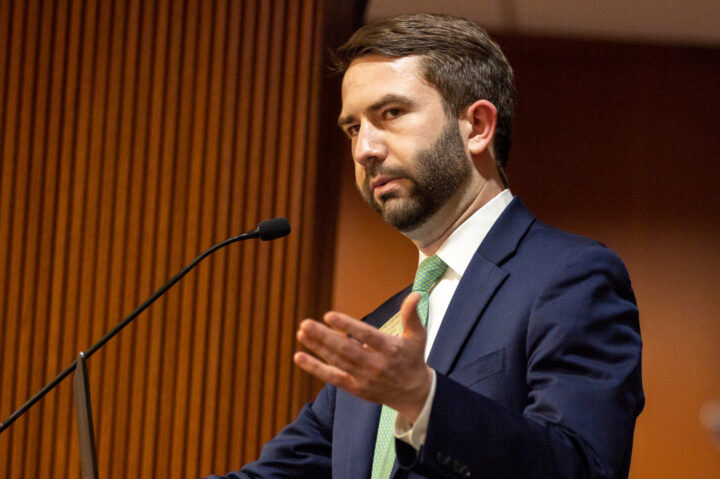
Arvin Temkar/Atlanta Journal-Constitution via AP
Georgia State Rep. Houston Gaines speaks before the House Public Safety and Homeland Security Committee meeting at the Paul D. Coverdell Legislative Office Building in Atlanta, Tuesday, Feb. 27, 2024.
State Rep. Houston Gaines is in many ways a prototypical House candidate — the 36-year-old Georgia native has served in the Statehouse since 2019, and quickly jumped into the race to replace Rep. Mike Collins (R-GA), who is running for Senate, picking up the backing of President Donald Trump and House Speaker Mike Johnson (R-LA).
But he faces a potentially potent challenge in Tuesday’s GOP primary from Ryan Millsap, a real estate and film industry executive who is pumping $4 million of his own money into his congressional bid and made a name for himself locally in a protracted legal battle against far-left agitators who camped out on his land to protest a proposed police training center.
The race has turned into a nasty — and heated — battle between the two men.
Gaines is leaning on his background in the state Legislature in his run, arguing to Jewish Insider in an interview that “we need folks in Congress who know how to get things done” and that he’s “proven in my time in the state Legislature” that he delivers results on a variety of issues. He emphasized his focus on public safety issues and immigration, as well as supporting farmers and the Second Amendment.
The solidly Republican district includes parts of suburban Atlanta, as well as the college town of Athens and rural areas in northeast Georgia.
Millsap told JI in an interview that his interest in running for office started with his “five-year war with Antifa.” Far-left agitators set up camp and destroyed property on Millsap’s land next to a police training facility site, with which Millsap was not involved, known derisively to critics as “Cop City.” He said that elected officials refused to take action against the trespassers out of fear of violence.
“We can’t just sit around as a society and let violent criminals rule our political process and take over our lands because we’re afraid of violence,” Millsap told JI. “That is capitulation to a bullying enemy. … I found that the career politicians were largely spineless, feckless and unwilling to take any risks because they don’t want to risk their careers.”
He said the demonstrators have also graffitied his house and threatened his wife. He said his goal in running for Congress is to prevent the far-left from overrunning the country.
Millsap accused the Republican “cabal” of smearing him to “protect their rubber stamp candidate” — Gaines — a “30-year-old kid who didn’t have any real life experience.”
He also argued that Trump’s endorsement hasn’t been decisive in the district in the past, and suggested that the president’s support for Gaines was a “political deal that was negotiated by Speaker Johnson and the RINO [Republican in Name Only] cabal in Congress” because Johnson “doesn’t want to deal with Ryan Millsap.”
Gaines argued that Millsap is trying to misrepresent his legislative record, and framed the executive as a carpetbagger from California who until recently cast himself as a moderate Republican who had donated to Democrats. “This guy is trying to cover up and hide all the things that he’s done, and some of the things that he has said are just horrific,” Gaines said.
Gaines was referring to comments — some of which were reported by the Atlanta Journal-Constitution and ProPublica in 2024 — in which Millsap allegedly complained about “nasty Jews,” among other disparaging remarks about Jewish business associates, and other racist comments.
Those remarks, from alleged texts between Millsap and his ex-girlfriend, were revealed as part of litigation involving a former lawyer for Millsap’s company, who also claimed Millsap made a range of other antisemitic and offensive comments in the workplace.
“It’s just horrific,” Gaines told JI. “It’s just totally unacceptable for someone in public life. As a Christian, I’ll always stand against antisemitism and what my opponent has said is just, in my opinion, disqualifying.”
At the time of the original AJC/ProPublica reporting, Millsap appeared to acknowledge the veracity of the text messages — as did his ex-girlfriend — and apologized in a statement, while emphasizing that he had won the case against his former lawyer, received punitive damages and planned to file a formal complaint against the lawyer.
“Unfortunately, in the course of this litigation, comments which I never intended to share publicly have come to light, and people I care about and who have put their trust in me have been hurt. I want to extend my sincere apologies to my dear friends, colleagues and associates in both the black and Jewish communities for any and all pain my words have caused,” he said at the time. “My sincere hope is that the bonds and friendships that we have forged speak far louder than some flippant, careless remarks. I intend to work privately with all of you to use this as an opportunity to have a healthy and authentic dialogue about race and culture, in a productive, not destructive, manner.”
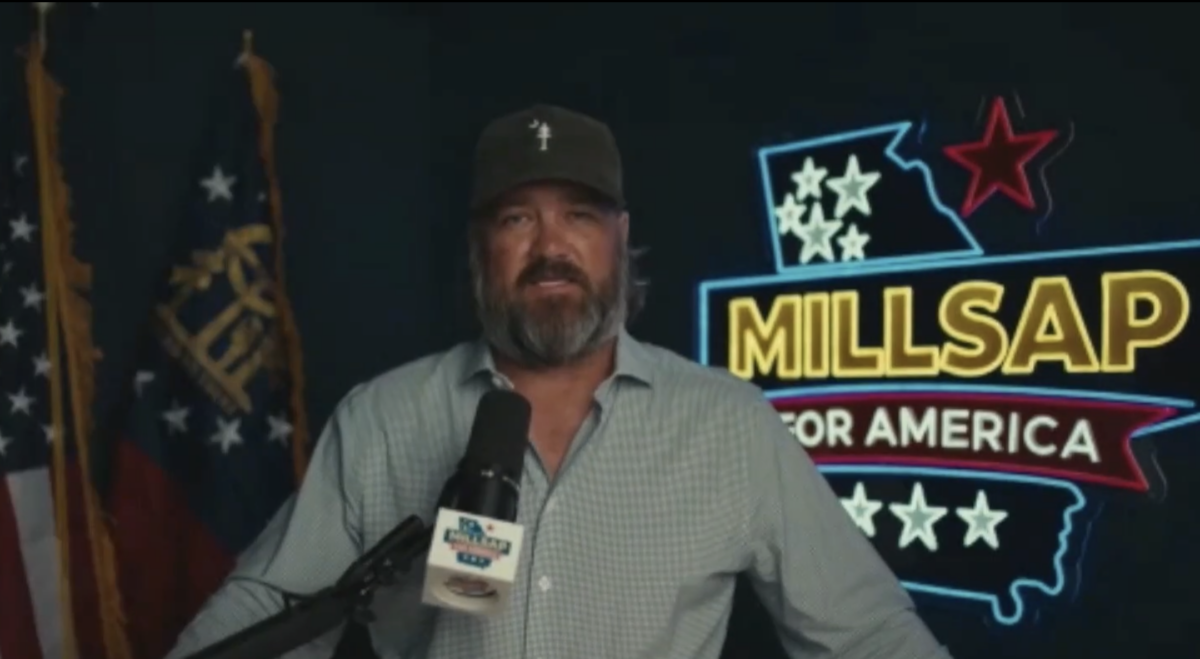
Millsap now argues that the alleged comments may have been fabricated by his former lawyer, and that their veracity can’t be taken at face value.
“The guy who is responsible for creating all of this supposed mess is a disgraced attorney of mine who tried to extort me for $24 million, was sued because of that and now owes me close to $6 million,” he said. “Everything he claims as hearsay is utterly fabricated and false.”
Regarding the text messages, Millsap said that he has “no recollection of anything like this,” but his public relations team at the time urged him to issue an apology. He said has found out since then that “we have no idea where this data came from, we have no idea of if it’s real or false,” adding that “it just appears like it’s whole-cloth creation” by his ex-lawyer.
Pressed on why neither he nor his ex-girlfriend denied or questioned the veracity of the messages at the time, Millsap said, “these are very old claims and I am not antisemitic.” But he appeared to acknowledge he could have made those or similar comments, in a different context.
“I’ve been doing business with Jewish friends and colleagues, and I’m married to a Jewish woman,” he continued. “But in the midst of all of life, would we ever say anything that somebody could take out of context and try to twist? I’m not willing to say that that’s absolutely impossible, but in the context that it’s being used, it’s absolutely impossible. I’m not antisemitic. I’m not against Jewish people.”
He said that he’s had “nothing but great experiences” throughout his life with Jewish friends and colleagues, but said that it’s “not impossible” that he might have “joke[d] with them.”
“Have I ever had any bad experiences in business with all kinds? Yes. And would there be any context under which I might refer to having bad experiences? Sure. But these particular texts are not credible,” he continued.
He also framed the article in ProPublica, a left-leaning nonprofit investigative journalism group, as part of a long-running far-left campaign against him tied to the police training complex protest.
More broadly, Millsap said there is “no place in America for people to be abused for their religion” and that he is willing to “go to the mat for Jewish people” to worship as they choose.
Gaines said he’s “proud” of supporting antisemitism legislation in the state Legislature, of working with local groups combating antisemitism and of championing legislation to force greater disclosure of foreign funding to Georgia schools, which he said has sought to force anti-Israel and anti-Jewish messages into school curricula.
He called Israel one of the U.S.’ “strongest allies” and said that he would stand with Israel in Congress, as he said he has in the state Legislature. He praised Trump’s “bold and decisive action to decimate” Iran’s nuclear capacity, regime and other aggressions. He called slain Iranian Supreme Leader Ayatollah Ali Khamenei “one of the worst people in the history of the world” but said there are “still a lot of bad folks in Iran” against whom he is glad the administration had continued to take action.
Amid the U.S.-Iran ceasefire, he praised Trump’s peacemaking efforts, while emphasizing that an Iranian nuclear weapon or continued sponsorship of terrorism “[is] not peace.” He said he also wants to ensure that Israel does not face “constant threat on every single border, because that’s not peace.” He expressed confidence that the administration would be able to secure favorable solutions to both challenges.
Millsap praised Israel as “a bunch of studs,” describing the country as “filled with fighters, guys who are committed to their homeland and committed to defending their homeland,” something he said the U.S. and Israel share in common.
“When we combine as a force, we are unstoppable. You see that in Iran,” he continued. “We’re very, very lucky, and I think Israel is lucky too. It’s a special, beautiful relationship between two countries that value their own cultures and value their own freedoms and are willing to be great allies and [work] together to protect each other. That’s all you can ask for in an ally.”
Millsap said he has visited Israel several times, including a monthlong backpacking trip at age 20, and has done business deals with Israeli businessmen. He said he supports continued military aid to the Jewish state.
He said Trump has “earned my trust” in military engagements, describing Iran as a longtime enemy of the U.S. and Israel. He said he does not want to see the war in Iran turn into a long-term “slog” but that he wants to see the U.S. move quickly to eliminate Iran’s nuclear capabilities and gain control over its oil flows to stop its support for terrorism and strike a blow against China, the primary importer of Iranian oil.
“If Trump pulls this off and secures all those things cleanly, it will turn out to be a stroke of genius that he went in, along with Israel, and pulled this off. It will be a hugely important geopolitical event that will shape global politics for the next 50 years,” Millsap said.
Please log in if you already have a subscription, or subscribe to access the latest updates.
 Continue with Google

 Continue with Apple