














































































State Sen. Ron Latz: ‘It is unacceptable to give this purveyor of hate speech a platform to spread his hateful messages’
Sam Barnes/Web Summit via Sportsfile via Getty Images
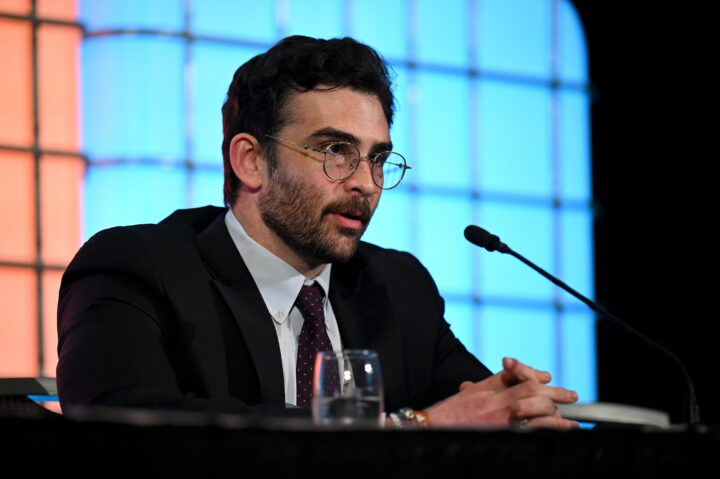
Hasan Piker during day two of Web Summit Vancouver 2026


 Add JewishInsider on Google
Minnesota state Sen. Ron Latz, a Democrat, on Tuesday urged Rep. Ilhan Omar (D-MN) and his state Senate colleague, Omar Fateh, to call off plans for an appearance with far-left streamer Hasan Piker next week, and called on fellow members of the Democratic-Farmer-Labor Party to speak out.
Latz and the DFL Feminist Caucus, which issued its own statement on Tuesday, join an emerging backlash to the event. Sen. Amy Klobuchar (D-MN), Rep. Angie Craig (D-MN), the DFL Jewish Caucus and the local Jewish Community Relations Council previously spoke out.
Latz, a DFL member who is Jewish, said that he is “deeply disturbed” by Omar and Fateh’s plans to host Piker, highlighting Piker’s history of antisemitic and otherwise offensive comments. “It is unacceptable to give this purveyor of hate speech a platform to spread his hateful messages,” Latz said. “It is also unacceptable to tolerate those who give him a platform to do it.”
While praising those who have spoken out clearly, he questioned “where are the other voices” and criticized Fateh and Omar for not listening to those who have spoken out thus far. “I urge all Minnesotans to stand together in rejecting Mr. Piker’s hateful messages. And Senator Fateh and Congresswoman Omar should not lend him their platform.”
Latz said that he is not concerned by what Piker might say, but rather by the message that the invitation itself sends, arguing that inviting him “lends credibility” to Piker’s views.
He said Democrats must call out hate on their own side and that “[f]ailing to do so is dangerous,” adding that “[a]ll Minnesotans of good conscience … should join in condemning his appearance and rejecting his hate.”
The DFL’s Feminist Caucus issued its own statement on Tuesday opposing the event as well.
“We are bound in principle to denounce the reckless, dehumanizing, hateful and inflammatory rhetoric of [Hasan] Piker. That is why we strongly oppose a joint appearance of Mr. Piker with U.S. Rep. Omar and Minnesota [state Sen.] Omar Fateh,” the caucus said. “Such an appearance would be deeply divisive within both our party and the broader community.”
The Feminist Caucus argued that the “last thing we need in the Twin Cities is yet another divisive episode” and urged Omar and Fateh to call off the event “and pursue instead ways to unite, rather than divide, our community.”
The state Democratic Party has invested more than $2 million to boost state Rep. Nabeela Syed, one of several legislators who issued a statement on Oct. 8, 2023, seeming to blame Israel for Hamas’ terror attacks
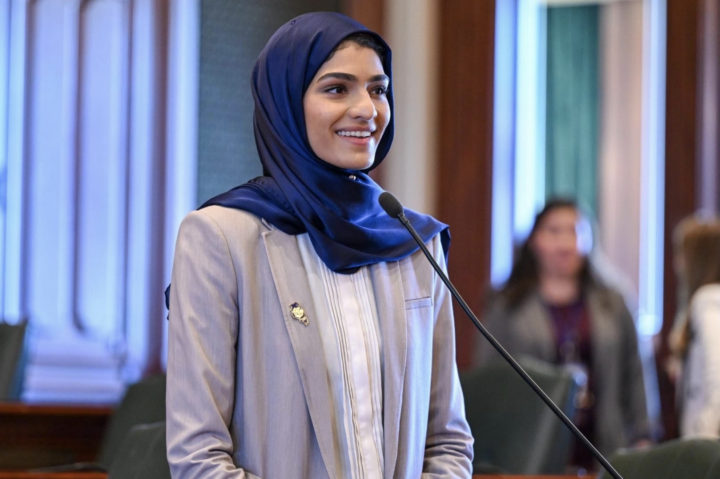
State Rep. Nabeela Syed
State Rep. Nabeela Syed
Illinois Democrats are pumping significant cash into a state Senate race in the Chicago suburbs, hoping that an anti-Israel state representative can take down a Republican appointed to the seat.
Since Labor Day, Democratic leadership has put more than $2 million — a substantial investment for a state-level race — behind state Rep. Nabeela Syed, boosted further by more than $500,000 in individual contributions. Republican state Sen. Darby Hills, an attorney and Barrington Hills Village Board member, has been massively outraised and outspent by Syed and her allies.
Hills was appointed to the seat, in the 26th District, after Republican Dan McConchie resigned from the Senate to work for a nonprofit organization. Now, Democrats see the district, which former Vice President Kamala Harris carried in the 2024 presidential election, as potentially winnable.
Syed was one of several Illinois Democratic legislators who issued a joint statement on Oct. 8, 2023, which appeared to point blame for Hamas’ deadly terror attacks the day prior toward Israel.
“Hundreds of Israelis and Palestinians have been killed, and thousands injured,” the statement read. “We will not be able to achieve peace when millions of Palestinians are denied basic human rights. We urge the United States and the international community to work toward long-term solutions that end the inequality that is at the root cause of the violence.”
Syed has also accused Israel of genocide and said the U.S. is culpable for it, also blaming U.S. aid to Israel for the lack of social programs for Americans. She also accused states of trying to crack down on free speech through efforts to combat antisemitism.
The Chicago Tribune recently endorsed Hills, describing her as a Republican willing to break with party leadership and work in a bipartisan fashion.
Elevating Syed to the Senate would give anti-Israel forces an additional Senate vote in efforts to overturn the state’s anti-Boycott, Divestment and Sanctions law — one of the first such statewide efforts to gain steam. The bill already has 14 cosponsors in the state Senate, after being introduced in 2025, and Syed has cosponsored it in the state House.
The measures have thus far stalled.
Frank Calabrese, a Chicago-based political analyst, explained that the district — a relatively wealthy suburb on the northwest side of Chicago — is experiencing similar leftward shifts seen in other suburbs around the country as a result of national political forces.
“These high-income districts that used to be reliably Republican [are] shifting to being reliably Democratic over the last decade,” he said.
Calabrese predicted that Syed is likely to win, benefiting from the momentum that’s helped drive young, up-and-coming progressives around the country, boosting her fundraising and organizing.
The district does not have a substantial Jewish population, unlike other parts of the Chicago suburbs, and her record on Israel is not likely to make much of an impact with voters, Calabrese continued, adding that Syed is a progressive but has not aligned herself with the Democratic Socialists of America or the far left in a way that might alienate wealthy suburbanites.
He said that the massive Democratic investment in the district is largely attributable to the fact that the state Democratic Party has strong fundraising but relatively few competitive districts in which to spend its money.
A Brookings Institution study found that of the 104 Democratic Socialists of America-backed candidates running for state legislature, nearly 75% have won their primaries
Spencer Platt/Getty Images
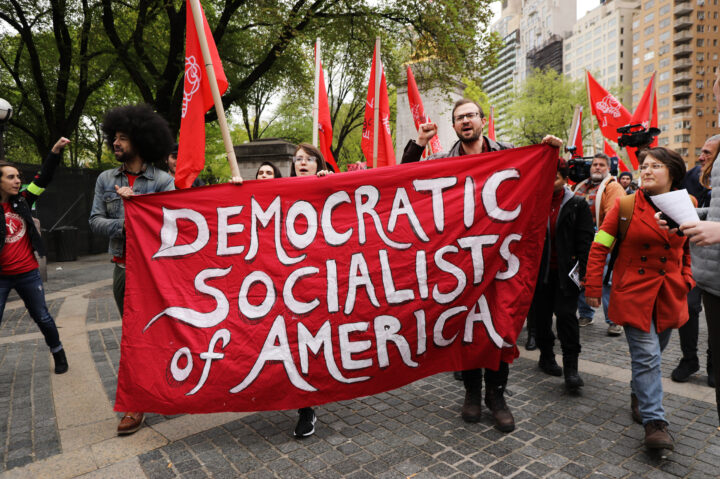
Members of the Democratic Socialists of America May 01, 2019 in New York City.
The Democratic Socialists of America notched another win this week in Florida’s Democratic Senate primary, with the shock victory of state Rep. Angie Nixon, a DSA member, over a much better-funded, establishment-backed challenger.
The far-left group has also notched at least six new victories in deep-blue House districts where its members are all but guaranteed to be elected, and could lead four major U.S. cities — New York, Los Angeles, Seattle and Washington, D.C. — after the midterm elections.
But some of the group’s more overlooked victories have happened at the state level, where the DSA members could wield significant power if they win. A new study by the Brookings Institution, released Wednesday, found that of the 104 state legislative candidates endorsed by national or local DSA chapters in 2026, 76 have won their primaries or advanced to the general election without a primary.
At the local level, another 64 of the 99 DSA-endorsed candidates are moving on to the general election. By comparison, at the congressional level, only 20 of the 64 total DSA-endorsed candidates have made it to general election races.
In New York City, already a comparative bastion of DSA representation in the state Assembly and Senate, eight DSA endorsees have advanced to the general election, including state Senate candidate Aber Kawas, who downplayed the 9/11 attacks, as well as seven state Assembly candidates. In total, the group is expected to have at least 15 members in Albany next year.
Sara Forman, the former executive director of the New York Solidarity Network, a state-level Jewish advocacy organization, said that after New York City Zohran Mamdani’s victory, the DSA seems to be emboldened to “flex their muscles” nationwide, after previously taking a more “surgical” approach at the state and local level.
Forman, who is now a senior advisor at Optimistic Labs, said she thinks the group learned lessons from the Mamdani race, including targeting highly engaged communities and neighborhoods. She also emphasized that the group has spent two decades building out the infrastructure that fueled the recent victories highlighted in the Brookings data.
“The Jewish community needs to take a hard look at this and really decide whether or not we’re willing to break bread” with a group that only looks at the Jewish community for “how they can use us,” she continued, while adding that Jewish community members will likely need to engage with some DSA elected officials in some capacity..
The national DSA organization endorses only a small subset of the DSA-affiliated candidates running nationwide. But outside of New York, five of its endorsees have advanced to general election races in state assembly seats around the country, with some set to coast to election and others facing competitive general election races: Robert LeVertis Bell in Kentucky, Tammy Carpenter in Oregon, Chris Gilmer-Hill in Michigan, Luke Alfaro-Jungmann in New Mexico and Mathewos Samson in Georgia.
Local DSA groups have racked up many more wins, such as state Rep. Maryam Khan’s ouster of an incumbent in a recent Hartford, Conn.-area state Senate seat.
“It’s interesting to me that the places where you’ve seen a lot of the newer elected officials pop up were a little unexpected, Connecticut being one example,” Forman said.
The state-level wins carry the potential to advance the DSA’s agenda, particularly in places such as New York, where the DSA expects its endorsees to work as a bloc in coordination with DSA leaders.
The Brookings study found that most DSA candidates hailed from already liberal areas — 111 were from California and New York alone — and most from districts that heavily favor Democrats. And DSA candidates contested and were nominated in a small fraction of the 7,386 total legislative seats around the country.
“From one perspective, the story of DSA candidates’ influence is overblown. The scarcity of candidates and their lack of strong success rates overall make this look more like a skirmish than a war,” the study’s authors conclude. “Nonetheless, the high-profile wins, fueled by young, white, educated voters, represent a warning to the rest of the party. They signal that unhappiness with the Democratic establishment and, in the post-Biden world, opposition to elderly officeholders can be leveraged by young, charismatic DSA candidates — and reflect an impatience with party leadership that transcends ideology.”
The rapid rise of the far left has alarmed Jewish leaders, who have seen candidates aligned with the DSA or affiliated with other virulently anti-Israel groups and in some cases, embracing antisemitic views. Those ties haven’t stopped them from winning deep-blue primaries across the country.
“Just judging on Missouri, it’s worse than people are realizing,” said Stacey Newman, a former Democratic state lawmaker who now leads the Missouri Alliance Network.
She emphasized that St. Louis-area Democrats elected a growing number of far-left candidates — albeit most not formally DSA-endorsed — and others hostile to Jewish community interests to the Legislature even while reelecting a close Jewish community ally in Rep. Wesley Bell (D-MO). “They all have the same anti-Israel, anti-Jew platforms,” she said.
Forman said that Jewish advocates and their allies at the state level “need to be prepared for what I’m assuming is going to be the incoming push to try to make Israel a state and local issue,” as Mamdani and other DSA members did in New York State with legislation such as the Not On Our Dime Act.
“We really need to be making sure that our advocates and our allies are prepared to push back on that narrative,” Forman said, “but second of all, to remind people that state and local office has nothing to do with foreign policy.”
She said that the existing Jewish educational infrastructure needs to have the “toolkit to be able to say and push back hard and aggressively that this has no place in the state legislature,” and have its messaging clear and prepared.
Newman, whose group led advocacy for an antisemitism bill in the Missouri Legislature, said she feels that the Jewish community increasingly can’t rely on Democrats in Missouri’s legislature to support their priorities. And, she emphasized, much more policy work happens at the state level than the federal level.
“As a former Jewish state legislator, I’m petrified, because we’re all watching what’s happening around the country,” Newman said. “We’re watching Michigan, Wisconsin, we’re watching the Democratic Party throw caution to the wind.”
Rocque Perez, a former Tucson city council member, has throughout his campaign fixated to an unusual degree on Hernandez’s pro-Israel views
Samantha Chow/AP
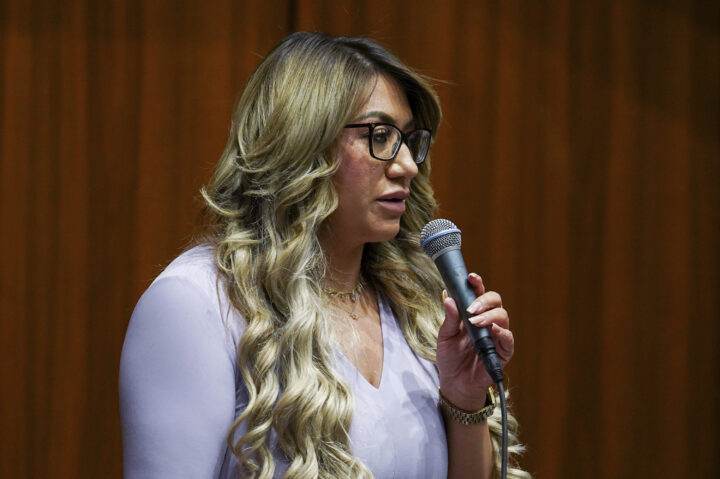
State Rep. Alma Hernandez, D-Tucson, speaks during a House session, Wednesday, April 23, 2025, at the state Capitol in Phoenix.
Alma Hernandez, a Jewish Democrat and Arizona representative now running for an open state Senate seat in Tucson, is raising alarms about rhetoric from her primary opponent that she and other Jewish leaders claim has crossed a line into antisemitism — with no pushback from local elected officials.
Hernandez, who is term-limited in Arizona’s House, has long been an outspoken supporter of Israel and identifies as a “proud Zionist,” fueling tensions with some Democratic colleagues, particularly on the left.
But her left-wing rival in the state’s July 21 primary election, Rocque Perez, a former Tucson city council member, has throughout his campaign fixated to an unusual degree on her pro-Israel views, while using language that Hernandez says promotes antisemitic tropes about dual loyalty and Jewish control of U.S. politics.
“At the end of the day, I consider this guy to be an antisemite, and someone who is so obsessed that this is all he talks about,” Hernandez told Jewish Insider in an interview. “He hasn’t told voters what he would do differently from me. He is just telling voters that I support genocide.”
In fundraising solicitations, campaign literature and online posts, Perez has frequently cast Hernandez as influenced by “foreign” and “overseas interests” in a thinly veiled allusion to Israel, saying that he is vying “to unseat” an “Israel-First Dem tied to big money.”
“Wish I was fooling with y’all, but I don’t think genocide is a joke,” Perez wrote in a characteristic post in April. “If anything, it’s made me even more determined to give Tucson a real choice — someone who isn’t beholden to corporations of allegiances abroad.”
Elsewhere, he has accused Hernandez of being “bankrolled” by AIPAC, the increasingly villainized federal lobbying group whose political arm does not engage in state-level races, where foreign policy is not typically a top issue. In a recent message, meanwhile, he asked his supporters to contribute $5 to “unseat a Zionist!”
“Alma’s record of placing her own political identity above the needs of her district is the true concern,” Perez wrote in the Arizona Daily Star last December, equating Hernandez’s efforts to secure funding for a Holocaust education center in Phoenix to pro-Israel legislative advocacy he dismissed as “largely directed toward international posturing” at the expense of other urgent local challenges.
For Hernandez and Jewish activists in the state who have been troubled by Perez’s messaging, his attacks are a local example of how rising anti-Zionism on the far left has increasingly intersected with antisemitism that has often been met with silence from Democratic Party leaders.
While Perez has won endorsements from several Tucson city council members as well as the county attorney, among others, none have commented on his rhetoric or responded to concerns from Jewish community members. On Tuesday, he said in a post that he had also been endorsed by Rep. Adelita Grijalva (D-AZ) and Tucson Mayor Regina Romero.
Last month, the Center for Jewish Resilience at Jewish Philanthropies of Southern Arizona, which tracks local incidents of antisemitism, sent a letter to city council members supporting Perez, highlighting what the group called his “repeated pattern of public rhetoric” espousing “longstanding antisemitic tropes and narratives.”
The organization, which did not return a request for comment on Tuesday, invited the officials “to speak further” but did not hear back from them, according to Hernandez.
“What is alarming about this cycle is there is this individual who is so out there with his rhetoric and people are just pretending that it’s not a big deal,” said Hernandez, 33. “I have been in office for a total of eight years representing this community. The fact that I’m a Mexican Jew has never been disqualifying for anyone to say, ‘Hey, I can’t support you because of that.’”
Perez’s campaign did not respond to a request for comment.
Erika Neuberg, a Jewish community leader in Arizona who is close to Hernandez, said the “race is exposing” Democratic leaders as unwilling to even acknowledge rhetoric that Jewish voters have found concerning. “You don’t have one Democratic leader looking at this rhetoric and saying this is alarming,” she told JI. “This is an attempt to disenfranchise a segment of the population.”
Andrew Kunsberg, a Jewish Democratic leader in Tucson who is backing Hernandez, said, “When you accuse somebody of being a Zionist, to me, you’re accusing them of being Jewish, and it’s already affected her race.” In canvassing for her campaign recently, he has heard from voters who say they won’t vote for a Zionist, he told JI. “To me, this is not normal.”
Kunsberg said that he has been involved in a range of local legislative races, “but quite frankly, I have never seen anything like it in my entire life.”
“She is running against the most flawed candidate I have ever seen and yet is being supported by almost our entire city council and our county attorney,” he said.
Perez’s backers have continued to stand behind him, even as the 27-year-old has faced unrelated scrutiny over past deleted posts advocating political violence against conservatives, which he has called “material put out without my consent.”
“It just seems that in our Democratic politics, individuals do not care, as we’re seeing with what’s going on with” Graham Platner, Hernandez told JI, referring to Maine’s Democratic Senate nominee. “I mean, the man literally had a Nazi tattoo, and people are like, ‘Oh, he’s fine, he’s great, he’s a progressive.’”
As early voting begins next week, Hernandez, who has clashed with local Democrats for her votes with Republicans in the Legislature, echoed other Jewish supporters in saying she was not certain whether she would prevail in the primary, even as she dismissed Perez as unserious.
“I don’t want to say that I’m completely safe in this election, because I don’t think that anyone is at this point,” she said. “Do I consider him a serious person? Absolutely not. I think he’s a joke.”
But that “doesn’t mean he can’t win an election when he is receiving the support of the establishment,” she added.
“In any other world, I felt like people would be ringing the alarms,” she told JI. “Unfortunately, these folks are encouraging the behavior.”
Former Rep. Andy Levin, an anti-Israel Democrat, is discussing a bid to reclaim his old seat

Jeremy Moss State Senator/Bill Clark/CQ-Roll Call, Inc via Getty Images
Michigan state Senate president pro tempore Jeremy Moss and former Rep. Andy Levin (D-MI)
Michigan state Senate president pro tempore Jeremy Moss and former Rep. Andy Levin (D-MI) are publicly floating runs for the House seat held by Rep. Haley Stevens (D-MI), who announced on Tuesday that she’s making a bid for Michigan’s open Senate seat — a primary battle that could rehash the bitter Israel policy divisions that characterized the 2022 race when Stevens defeated Levin.
Dave Woodward, the chair of the Oakland County Board of Commissioners and a former state lawmaker, is also considering a run.
Both Moss and Levin are Jewish but have differing approaches to issues key to the Jewish community. Debates over Israel policy, an important issue in a district in the Detroit suburbs with a significant Jewish population, were a prominent feature of the 2022 primary between Stevens and Levin.
The organized, mainstream Jewish community largely backed Stevens in that race, feeling betrayed by Levin’s increasingly antagonistic stances on Israel.
Moss, in a statement on Tuesday, aligned himself closely with Stevens and praised her decision to run for the Senate. He said he’d make a decision on his own campaign soon.
“Her entrance in that race leaves a critical opening for us to fill in the 11th Congressional District at a moment when so much is at stake. I’ve represented hundreds of thousands of residents in this district and I share their concerns about our economy and our democracy,” Moss said. “We need to send a proven fighter to Congress to lower everyday costs for Michiganders, protect our fundamental freedoms, and stand up to Donald Trump’s and Elon Musk’s dangerous attacks on our rule of law.”
From his current role, Moss has been outspoken against antisemitism and in support of the U.S.-Israel relationship, including criticizing Rep. Rashida Tlaib (D-MI) for her use of the slogan “from the river to the sea,” arguing that both Jews and Hamas view it as a call for the death of Jews.
He has also spoken out about anti-Israel protests in the state, such as those targeting University of Michigan regents, saying that some of the demonstrations crossed the line into antisemitism, and highlighting how Jews have felt increasingly endangered in the United States since Oct. 7.
“The overwhelming majority of Jews believe in a place of refuge in a Jewish homeland. But if you even mention how woven the Jewish religion is with Jewish sovereignty in Israel, today you get called a ‘colonizer,’ a ‘racist,’” Moss said a year ago. “Zionist is now being weaponized as a slur, and it is infuriating that the same people who will say that also post ‘Happy Passover’ to all who are observing without acknowledging what we’re actually observing.”
Levin, meanwhile, established himself as a leading left-wing Jewish voice critical of Israel while in Congress and appears to have moved further left on the issue in the time since then.
Levin endorsed and was an advocate for the “Uncommitted” campaign opposing former President Joe Biden in the Democratic primary over Israel policy disputes, though he said he would support Biden in the general election. He urged Biden and later Vice President Kamala Harris to step up their criticisms of Israel.
He has also suggested he could support a one-state solution in Israel and the Palestinian territories, said Israel must free “political prisoners” including Marwan Barghouti who was convicted of terrorism and said that the U.S. should “rethink U.S. military aid” to Israel.
Levin, who focused heavily on Israel policy in his 2022 campaign against Stevens, and his allies have largely blamed pro-Israel outside spending for his loss by nearly 20 points.
Please log in if you already have a subscription, or subscribe to access the latest updates.
 Continue with Google

 Continue with Apple