












































































State Sen. Ron Latz: ‘It is unacceptable to give this purveyor of hate speech a platform to spread his hateful messages’
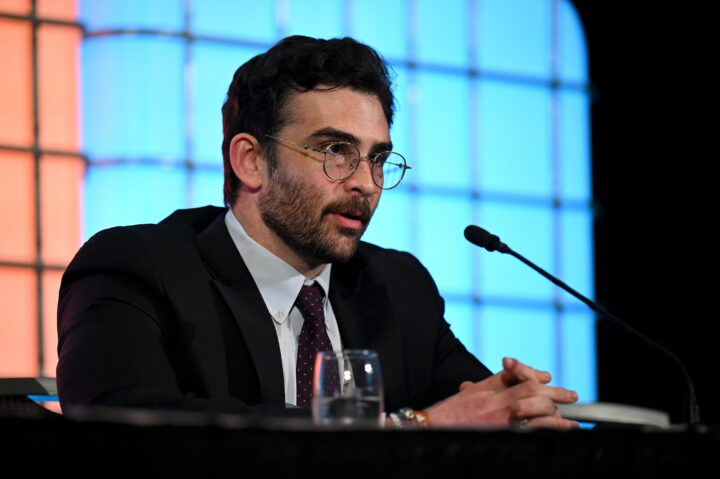
Sam Barnes/Web Summit via Sportsfile via Getty Images
Hasan Piker during day two of Web Summit Vancouver 2026


 Add JewishInsider on Google
Minnesota state Sen. Ron Latz, a Democrat, on Tuesday urged Rep. Ilhan Omar (D-MN) and his state Senate colleague, Omar Fateh, to call off plans for an appearance with far-left streamer Hasan Piker next week, and called on fellow members of the Democratic-Farmer-Labor Party to speak out.
Latz and the DFL Feminist Caucus, which issued its own statement on Tuesday, join an emerging backlash to the event. Sen. Amy Klobuchar (D-MN), Rep. Angie Craig (D-MN), the DFL Jewish Caucus and the local Jewish Community Relations Council previously spoke out.
Latz, a DFL member who is Jewish, said that he is “deeply disturbed” by Omar and Fateh’s plans to host Piker, highlighting Piker’s history of antisemitic and otherwise offensive comments. “It is unacceptable to give this purveyor of hate speech a platform to spread his hateful messages,” Latz said. “It is also unacceptable to tolerate those who give him a platform to do it.”
While praising those who have spoken out clearly, he questioned “where are the other voices” and criticized Fateh and Omar for not listening to those who have spoken out thus far. “I urge all Minnesotans to stand together in rejecting Mr. Piker’s hateful messages. And Senator Fateh and Congresswoman Omar should not lend him their platform.”
Latz said that he is not concerned by what Piker might say, but rather by the message that the invitation itself sends, arguing that inviting him “lends credibility” to Piker’s views.
He said Democrats must call out hate on their own side and that “[f]ailing to do so is dangerous,” adding that “[a]ll Minnesotans of good conscience … should join in condemning his appearance and rejecting his hate.”
The DFL’s Feminist Caucus issued its own statement on Tuesday opposing the event as well.
“We are bound in principle to denounce the reckless, dehumanizing, hateful and inflammatory rhetoric of [Hasan] Piker. That is why we strongly oppose a joint appearance of Mr. Piker with U.S. Rep. Omar and Minnesota [state Sen.] Omar Fateh,” the caucus said. “Such an appearance would be deeply divisive within both our party and the broader community.”
The Feminist Caucus argued that the “last thing we need in the Twin Cities is yet another divisive episode” and urged Omar and Fateh to call off the event “and pursue instead ways to unite, rather than divide, our community.”
Moss said that audio allegedly depicting him expressing loyalty to Israel over the U.S. is ‘manipulated’ and includes ‘things I never did and never would say’
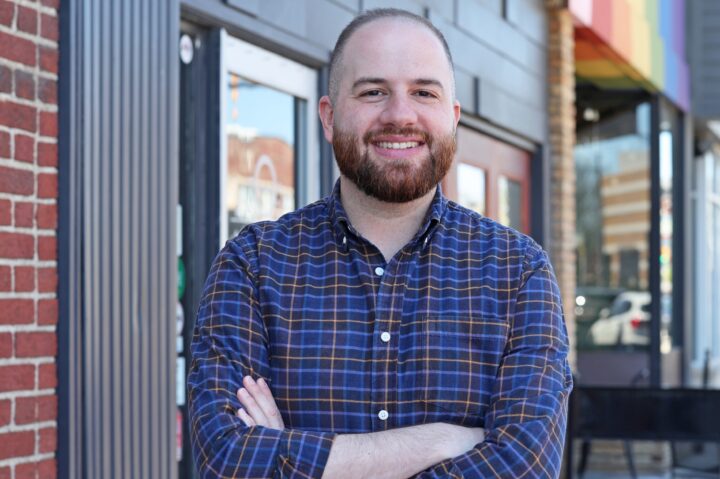
Courtesy Jeremy moss
Democratic Michigan state Sen. Jeremy Moss
Michigan state Sen. Jeremy Moss, the Democratic nominee in Michigan’s 11th Congressional District, pushed back on Tuesday against what Moss alleged was a doctored audio clip circulating online designed to portray him as more loyal to Israel than the United States.
“There is a manipulated and unsourced audio, with things I never did and never would say, that is nothing more than political disinformation intended to portray me as anti-American,” Moss, who is Jewish, said on X. “It peddles in offensive tropes and lies — especially the lie of dual loyalty suggesting that Jews are never fully citizens of or loyal to their home countries.”
The unsourced and undated audio depicts Moss saying that the entire purpose of his campaign is to support Israel and that Jews should support Israel over the United States.
The original source of the audio is unclear, but it has been shared over the past few weeks on X by former Moss opponent Aisha Farooqi and by multiple antisemitic X accounts.
Ryan Grim, co-founder of the Hamas-sympathetic outlet Drop Site News, posted an alleged quote from the clip this week, but subsequently removed the post after acknowledging he had not verified the recording.
“We are in a dangerous era of disinformation. Circulating a lie because it affirms your bias or belief is equally bad whether it comes from the left or the right,” Moss said. “We all have a choice not to spread fabricated images, videos, and audio about candidates and campaigns. We all have a role in stopping the erosion of our democracy.”
“I’m a proud Michigander. I was born in Detroit. I grew up in Oakland County. I won’t stand for people using lies to diminish my American story and my career delivering for Michigan families,” Moss continued.
Moss has repeatedly faced attacks over his support for Israel, including from the Oakland University College Democrats, which refused to endorse him over his support for Israel. In an article about the decision, the news outlet The Midwesterner also shared the audio.
Recent polling has shown a relatively close race between the moderate Stevens and far-left El-Sayed, with El-Sayed leading in several surveys
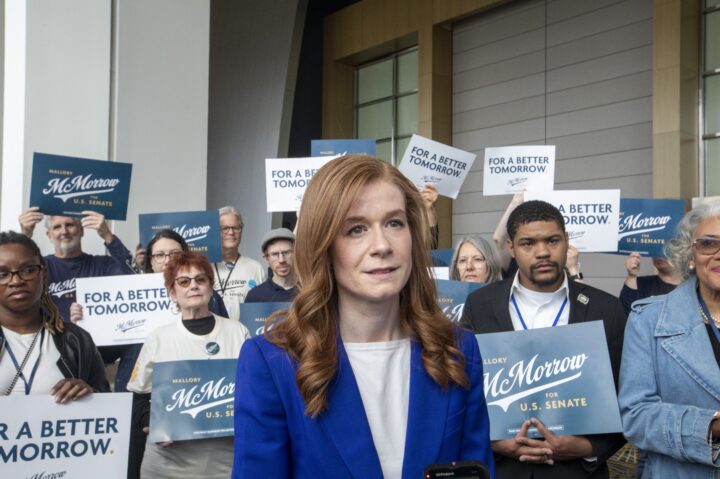
Jim West/UCG/Universal Images Group via Getty Images
Mallory McMorrow, a candidate for U.S. Senate, campaigns at the Michigan Democratic Nominating Convention
Michigan state Sen. Mallory McMorrow dropped out of the Democratic primary for U.S. Senate on Sunday, narrowing the race to a contest between Rep. Haley Stevens (D-MI) and Abdul El-Sayed, a former public health official.
McMorrow suspended her campaign without endorsing either of her rivals, saying only that “whoever wins this primary on August 4th will have my full support.”
Recent polling has shown a relatively close race between the moderate Stevens and far-left El-Sayed, with El-Sayed leading in several surveys. With McMorrow generally claiming around 10% of the vote in polls, her withdrawal could shift dynamics in the race.
At the same time, mail-in ballots in the state have already been dispatched — with McMorrow’s name still on them.
The end of McMorrow’s campaign marks a significant fall for the up-and-coming state senator, who posted strong performances in early polls but has seen flagging support and enthusiasm in recent months.
McMorrow’s voting base will likely end up divided among both candidates, and both are making efforts to attract her supporters.
McMorrow had sought to carve out a middle ground between Stevens and El-Sayed, running as a somewhat progressive anti-establishment candidate but claiming a more pragmatic lane than El-Sayed, who some Democrats worry will not be electable in a general election against former Rep. Mike Rogers (R-MI), the expected GOP nominee.
That positioning extended to the tightrope she tried to walk on Israel policy issues, criticizing Israel and agreeing with those who characterized the war in Gaza as a genocide while also condemning antisemitism in the anti-Israel movement.
Democrats who backed McMorrow for electability reasons, and some female voters, will likely end up in Stevens’ camp. But others, who were attracted by McMorrow’s anti-establishment message and more progressive posture than Stevens, will likely move toward El-Sayed. El-Sayed is also likely to pick up those voters turned off by Stevens’ staunch support for Israel — to the extent such voters hadn’t already abandoned McMorrow.
In her statement on McMorrow’s withdrawal, Stevens said she plans to continue to make her case that she’s “the strongest Democrat to defeat Mike Rogers.” In his statement, El-Sayed emphasized, “we cannot allow the establishment to decide our nominee for us.”
McMorrow’s withdrawal from the race may give space for Michigan’s political establishment to coalesce behind Stevens to block El-Sayed. Shortly after McMorrow dropped out, Attorney General Dana Nessel endorsed Stevens, saying that the “choice is clear.”
Former Sen. Debbie Stabenow (D-MI) previously endorsed Stevens, who has also been privately backed by Senate Minority Leader Chuck Schumer (D-NY).
Also in the wake of McMorrow’s decision, Republicans have continued to work to boost El-Sayed. Sen. Bernie Moreno (R-OH) accused Washington Democrats of “working overtime to stack the deck against” El-Sayed and boost Stevens.
Outside spending will also likely play a significant role in shaping the final month of the campaign. The AIPAC-linked United Democracy Project super PAC has already spent more than $10 million in the race, launching its first negative ads attacking El-Sayed late last week.
And after McMorrow withdrew from the field, the anti-Israel American Priorities super PAC told Politico it is “fully committed” to ensuring El-Sayed is the Democratic nominee “and we will do what it takes to get there” — the biggest test yet of the progressive, anti-Israel movement’s ability to win in a critical swing state.
The state lawmaker did not offer an endorsement of either of her former Democratic primary rivals, Rep. Haley Stevens and Abdul El-Sayed
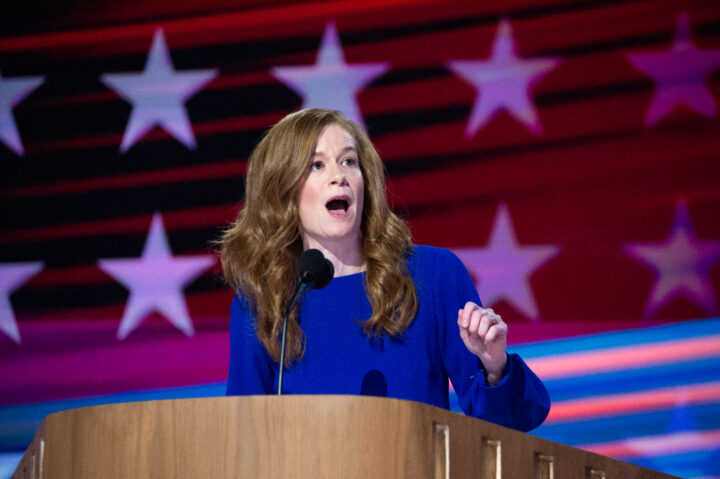
Jacek Boczarski/Anadolu via Getty Images
State Sen. Mallory McMorrow, a Democrat from Michigan speaks during the 2024 Democratic National Convention in Chicago, Illinois, United States on August 19, 2024.
Michigan state Sen. Mallory McMorrow dropped out of the Democratic primary for U.S. Senate on Sunday, without offering her support to either of her opponents in the hotly contested race.
“Here’s what we do next. Every day through November 3rd. We win this Senate seat and send Mike Rogers back to Florida for good,” McMorrow wrote in her announcement on X, referring to the expected GOP nominee.
“Whoever wins this primary on August 4th will have my full support,” she continued, declining to endorse either Rep. Haley Stevens (D-MI) or Abdul El-Sayed.
Fundraising figures released at the end of the first quarter of the year showed Stevens trailing El-Sayed in fundraising but having the most cash on hand, at $3.4 million to El-Sayed’s $2.5 million. El-Sayed has held a slight lead in the latest polls.
Following McMorrow’s announcement, Michigan Attorney General Dana Nessel, a Jewish Democrat, said the “choice is clear” and “wholeheartedly” issued her endorsement of Stevens.
Stevens also has the backing of other Democratic leaders including Senate Minority Leader Chuck Schumer (D-NY) and former Sen. Debbie Stabenow (D-MI).
El-Sayed, meanwhile, is backed by leading progressives including Sens. Bernie Sanders (I-VT) and Chris Van Hollen (D-MD), and Rep. Alexandria Ocasio-Cortez (D-NY). Last week, the AIPAC-linked United Democracy Project super PAC, which has boosted Stevens with more than $10 million, issued its first negative ad against El-Sayed.
The California lawmaker was forced to leave a transgender community march amid harassment from anti-Israel activists shouting antisemitic slurs at him
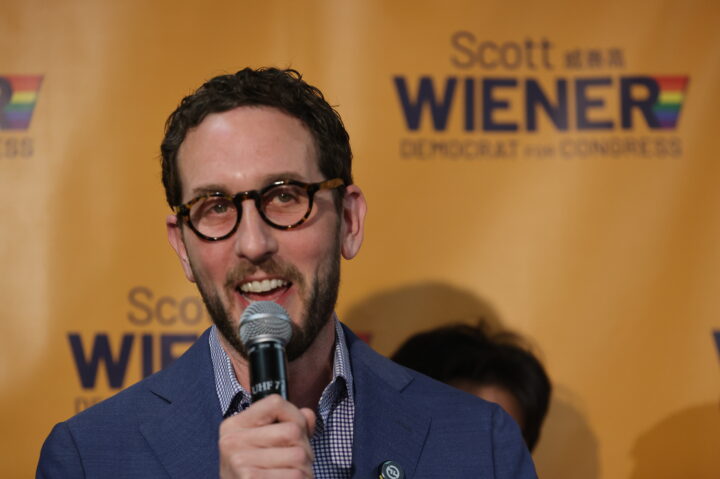
Gabrielle Lurie/San Francisco Chronicle via Getty Images
California state Sen. Scott Wiener's election party at his congressional campaign headquarters on election night in San Francisco, Calif. on June 2, 2026.
California state Sen. Scott Wiener, the front-runner to succeed retiring Rep. Nancy Pelosi (D-CA) in Congress, has become the target of antisemitic harassment twice in the last week in his San Francisco district, marking the latest example of a high-profile progressive Jewish politician being singled out and facing threats for his background.
The latest episode occurred Friday when Wiener, who was on his way to participate in a Pride Shabbat service at a transgender community march in San Francisco, was chased out of the event by anti-Israel activists following the state lawmaker and shouting antisemitic slurs at him.
In a video posted by one local anti-Israel activist, the activist follows Wiener around, attacking him for “being terrible on Gaza,” adding, “You do not belong here anymore, Scott. And it breaks my f—ing heart.” Soon after the initial engagement, other even-more hostile activists start cursing at Wiener, with one calling him a “genocidal piece of sh—” and another saying, “F— you and your Zionist handlers.”
Wiener is a longtime supporter of the transgender community, noting in a statement on Saturday about the incidents that he’s attended the march he was harassed out of every year since it began in 2004.
Two days earlier, Wiener, while watching a World Cup game with staffers at a local bar, was berated over his support for Israel by another anti-Israel activist who demanded he say the words “Free Palestine” on camera. The same individual, Wiener said, had stalked him on a plane several years earlier, shouting obscenities about his “tainted bloodline.”
”I have no objection whatsoever to anyone disagreeing with me, opposing me, or protesting me. All of that is core to democracy,” Weiner said, as videos of the confrontations went viral on Saturday.
“But when opposition and disagreement transition to harassment, including cornering me, touching me, or trying to physically bully me out of a public event, that crosses a line. We’re living in a time when violence is all too often threatened or used against people in public life. In San Francisco, we’re better than that.”
Wiener, a progressive stalwart in the California state legislature who has worked closely with the Jewish community the Bay Area, called Israel’s war against Hamas a “genocide” earlier this year after facing intense pressure from left-wing activists to do so. At the time, Wiener was facing primary opposition from a candidate who was attacking him over his support for Israel.
He stepped down as co-chair of the California Legislative Jewish Caucus, after his decision to placate progressives drew opposition from the state’s sizable Jewish community.
Activists have continued to harass the lawmaker even as he finished in first place in the state’s June Democratic primary. (He is facing San Francisco supervisor Connie Chan, who has Pelosi’s endorsement.)
The antisemitic threats against Wiener come after Rep. Dan Goldman (D-NY), who lost a primary last week amid relentless attacks over his support for Israel, faced online harassment from a Brooklyn coffee shop owner after he bought a drink in the store.
“We see that you stopped by our shop today for a coffee. Do you see how it doesn’t taste like genocide juice?” Poetica Coffee wrote in an Instagram post with an image of Goldman standing at the register. “We don’t need your money (it’s probably coming from AIPAC anyways). Don’t ever come to Poetica.”
The Department of Justice’s Civil Rights Division is investigating Poetica Coffee for possible discrimination.
State Sen. Scott Wiener has called Israel’s actions in Gaza a genocide and is open to conditions on offensive aid to the Jewish state, but is still derided as a ‘Zionist’
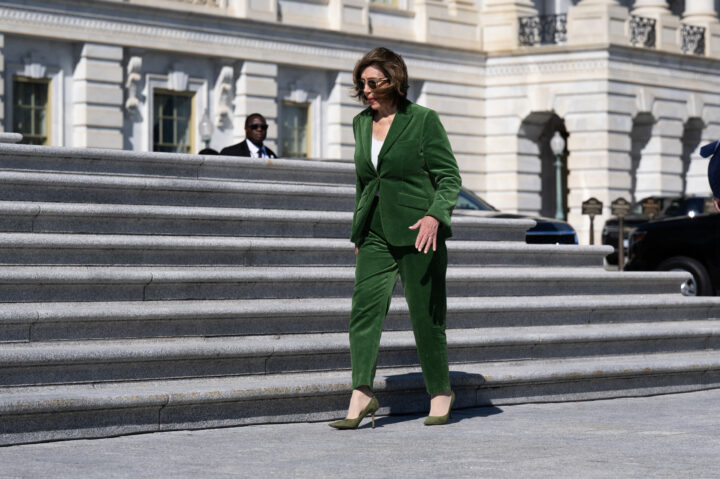
ROBERTO SCHMIDT/AFP via Getty Images
Rep. Nancy Pelosi (D-CA) attends a press conference with House Minority Leader Hakeem Jeffries (D-NY) on the steps of the U.S. Capitol in Washington, D.C., on October 15, 2025.
A solemn California state Sen. Scott Wiener looked directly into the camera.
He was recording a video to “clarify” whether he believed Israel had committed genocide in Gaza. Four days earlier, he wavered on that question in front of a live audience during a candidate forum for the race to fill the seat of Rep. Nancy Pelosi (D-CA) in California’s 11th Congressional District.
Both of his opponents had quickly answered “yes,” that Israel had committed genocide. Wiener did not answer “yes” or “no,” drawing loud jeers.
“For many Jews, associating the word genocide with the Jewish State of Israel is deeply painful and frankly traumatic,” Wiener said in the follow-up video. Wiener grew up in a Conservative family in New Jersey, supports a two-state solution to the Israeli-Palestinian conflict and has long been a critic of the government of Israeli Prime Minister Benjamin Netanyahu. “We all have eyes,” he continued, “and we see the absolute devastation and catastrophic death toll in Gaza.”
Referring also to what he described as “genocidal statements” from Israeli officials, he said the Israeli government had “tried to destroy Gaza and to push Palestinians out. That qualifies as a genocide.”
The striking about-face, which drew swift rebukes from mainstream Jewish organizations in the Bay Area, was indicative of the immense pressure on Wiener, a gay, progressive Jew who has often been assailed as a “Zionist” by the far left in San Francisco, but who is also harshly critical of the Israeli government’s policies.
One of Wiener’s top challengers for the San Francisco seat, Saikat Chakrabarti, is running a well-funded campaign closely aligned with the anti-Israel left, embracing some of the most extreme voices in that camp.
The race has become somewhat of a proxy battle in the war for the identity of the Democratic Party, where describing Israel’s war in Gaza as a genocide, supporting arms embargoes to Israel and attacking Zionism as a racist ideology have become much more common since the Oct. 7, 2023, Hamas terrorist attacks and the subsequent war in Gaza. The outcome of the race to succeed Pelosi will help answer an important question: Can a progressive candidate still win in a deep-blue district like San Francisco without fully embracing the politics of the anti-Zionist left?
The race is by most accounts a three-way contest between Wiener, Connie Chan, a progressive member of the San Francisco Board of Supervisors who has the backing of major labor organizations but has struggled to compete in fundraising, and Chakrabarti, a wealthy tech entrepreneur who entered progressive politics working for Sen. Bernie Sanders (I-VT) during his 2016 presidential bid and later served as Rep. Alexandria Ocasio-Cortez’s (D-NY) chief of staff.
Chakrabarti has attacked Wiener for being too supportive of Israel, describing him as “horrible on Palestinian rights” in an interview with Zeteo’s Mehdi Hasan.
Wiener had already been sharply critical of Israel’s tactics in Gaza prior to the controversy in January. He had called for a ceasefire early in the conflict, and has described Israel’s actions as a “moral stain” and “indefensible.”
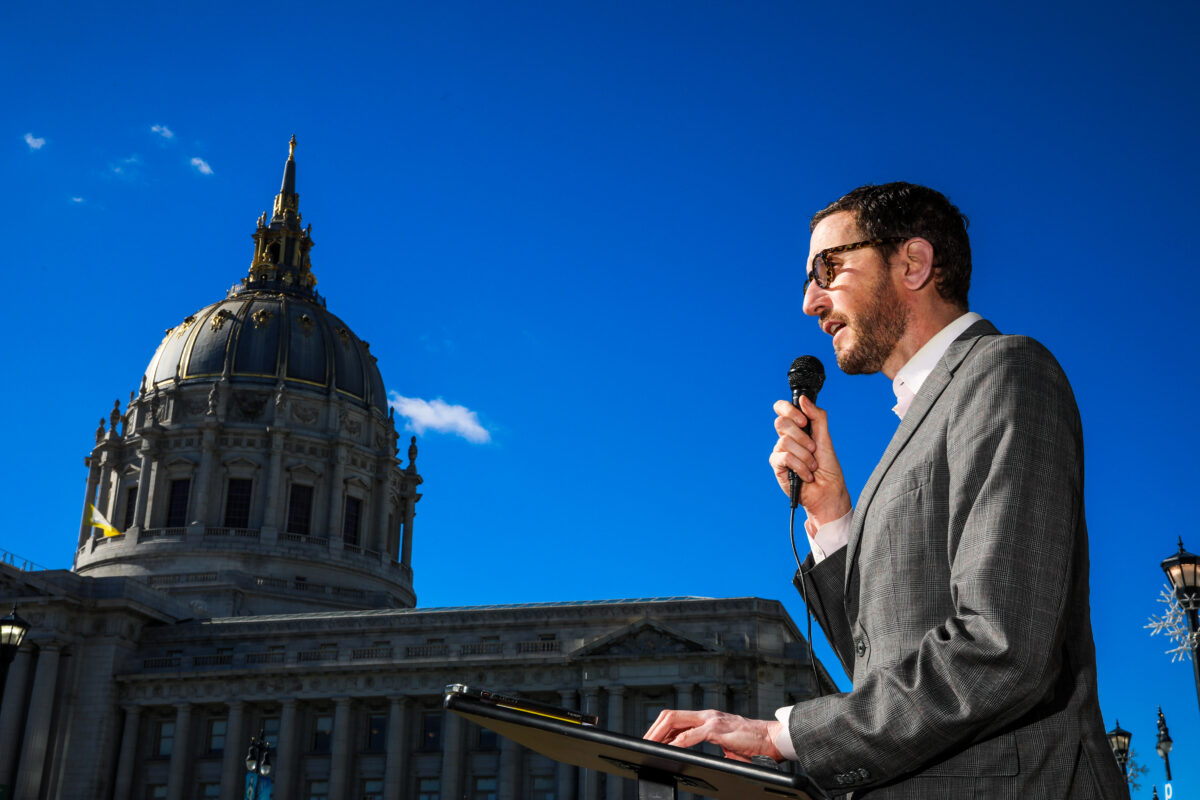
Amid the controversy of his embrace of the term genocide and the ensuing fallout with mainstream Jewish community organizations in the Bay Area, Wiener stepped down as co-chair of the California Legislative Jewish Caucus.
Chakrabarti, for his part, has raced to the left of Wiener and embraced far-left streamer Hasan Piker as a prominent campaign supporter, appearing on Piker’s stream and inviting Piker to campaign with him at a rally in San Francisco last week.
Earlier this spring, in a video the Chakrabarti campaign published on social media, the candidate and Piker sat down for dinner in San Francisco so Chakrabarti could make his pitch to Piker’s audience of millions of mostly young viewers. Behind them sat a poster showing the outline of the map of Israel, the West Bank and Gaza — the entire map filled in with the colors of the Palestinian flag.
“There’s this massive change moment. There’s a bunch of popular outrage,” Chakrabarti said in between bites of food. “We could channel that into an actual political revolution.”
As a wealthy former tech entrepreneur who has poured millions into his own campaign, Chakrabarti might seem like an unusual candidate for that role. But he is banking on enthusiasm from the progressive left in an insurgent campaign for a seat that has not been vacant for a generation.
He is described as a “centimillionaire” in the local press and was an early employee at Stripe, the payment processing company. But his campaign has touted his progressive bona fides as a co-founder of Justice Democrats, the organization built to recruit and elect progressives.
Ocasio-Cortez has repeatedly declined to endorse her former top staffer, dealing a blow to his efforts to consolidate the left behind his campaign.
Jewish community leaders have at times described the race in stark terms, painting Chakrabarti as a threat.
Speaking about what he called the “extreme story” that Chakrabarti is telling voters, Tyler Gregory, CEO of the local Jewish Community Relations Council, said, “this is more than a policy difference [in the] race at this point. There is someone scary, who is actually going to undermine Jewish safety if elected.”
The Chakrabarti campaign did not respond to an emailed list of concerns raised by Jewish groups.
Polling shows Chakrabarti making inroads but lagging behind Wiener. An EMC Research poll conducted in early May and commissioned by a pro-Wiener super PAC showed Wiener at 38%, Chan at 22% and Chakrabarti at 21%. Polls sponsored by Chakrabarti’s campaign, however, show a much slimmer margin; one conducted in early April by Data for Progress had Wiener only leading Chakrabarti by five points, 33-28%.
The top two vote-getters, regardless of party, will move to a runoff in November, meaning the race is unlikely to be decided until the general election.
Close observers of San Francisco politics say the race reflects political divides that have long been salient in the city, but have intensified in recent years amid widespread dissatisfaction on issues such as street crime, public drug use, homelessness and disorder more broadly.
Chakrabarti is “running against the establishment, when people feel like it’s not working for them,” said Gregory. “San Francisco has been tacking to the middle in recent cycles,” Gregory added, pointing to the 2024 election of Daniel Lurie to be the city’s mayor and the 2022 recall of progressive prosecutor Chesa Boudin.
“Are we in an anti-establishment cycle, or are we in a moderate cycle?” Gregory said. “We’ll find out.”
Chakrabarti’s campaign has decisively outspent his opponents, according to the most recently available campaign filings, though Wiener has also raised millions of dollars. As of the most recent filing deadline, the Chakrabarti campaign raised about $5.2 million, of which $4.82 million came via a loan from the candidate himself. Wiener’s campaign had raised about $3.5 million as of the last filing deadline, but had only spent around $900,000 relative to Chakrabarti’s nearly $5 million. Chan’s campaign was lagging with just $459,000 in money raised.
Chakrabarti opposes all U.S. military funding to Israel, including for the Iron Dome missile-defense system, and said during a candidate forum that he supports “breaking the Israel lobby’s hold on our government.” For his part, Wiener said he supports funding for Iron Dome but also would support congressional efforts to block the sale of offensive weapons to Israel.
Chakrabarti also opposes a new California law aimed at combating antisemitism in K-12 schools that critics, including anti-Zionist activists, say infringes on the free speech of teachers. Chakrabarti has attacked Wiener for being an outspoken supporter of the measure, describing it as a Trump-like effort to tamp down on pro-Palestinian speech.
Wiener called AB 715, which establishes a statewide antisemitism prevention coordinator and seeks to curb teacher activism in the classroom after the proliferation of anti-Israel material across California, “a big step for the Jewish community.”
Raising concerns among Jewish community groups, Chakrabarti enthusiastically accepted an endorsement from the Arab Resource and Organizing Center Action, the political arm of the city’s most prominent anti-Zionist activist group, which helps organize rowdy anti-Israel protests in the Bay Area.
“In Congress, I look forward to working with AROC Action as we fight to end our country’s complicity in genocide and apartheid and pursue a just future for all,” Chakrabarti’s campaign wrote on Instagram last month.
Mail-in voting has already begun for the open primary, which takes place on June 2.
Among Wiener’s campaign supporters are wealthy tech and venture capital figures including Garry Tan, CEO of the prestigious VC firm Y Combinator, Yelp co-founder Jeremy Stoppelman and tech investor Chris Larsen.
Political insiders in the city say that Wiener will almost certainly be among the top two vote getters and advance to the general. Chan is popular with a number of established progressive institutions. Chakrabarti’s success will depend in part on whether he is able to get out voters who have not consistently participated in midterm elections.
Wiener “has a very strong base of frequent voters, in the LGBTQ community, in the YIMBY community, and with the majority of moderate — by San Francisco standards — voters in the city,” said Sam Lauter, a political strategist with BMWL public affairs and a Democratic activist who sits on the board of the Democratic Majority for Israel.
“Connie Chan has a passionate base within the politically engaged progressive community,” he added. “The unions, for example.” He added that he expects Chan to have considerable support from the Chinese American community.
Chakrabarti’s support “seems to be coming from people who haven’t, to date, frequently turned out to vote. Progressives who aren’t in tune with the established progressive community,” he said.
“Having said that, he certainly has increased his name recognition significantly with his personal spending,” Lauter added. “I think he has a very good shot of being in the final two.”
Among Chakrabarti’s top aides is the consultant and activist Nadia Rahman, an outspoken anti-Zionist who serves as the campaign’s political director. Rahman, who publishes a stream of harsh critiques of Israel, Zionism and Zionists on her social media feeds, attributed the Democrats’ loss in the 2024 presidential election to what she described as the party’s refusal to “break from genocide, militarism and imperialism.” She recently reposted an X post stating that “Zionism is racism,” and in another post criticized how “entrenched Zionist ideology is in many California state legislators.”
Wiener is endorsed by the state’s Democratic Party and has been a fixture in San Francisco city politics since his election to the city Board of Supervisors in 2010. Still, he has not won the endorsement of Pelosi, who appeared at a Chan fundraiser but has declined to endorse anyone.
On Jewish support after Wiener’s genocide statement, Gregory said donors fell into three camps. Some continued to back Wiener without hesitation. Others “needed to take a beat and process what happened.” The third group “hasn’t come around,” but Gregory added, “I’m becoming more and more confident they are going to come home” to Wiener.
Gregory added of Chakrabarti, considering the tendency for left-wing candidates to turn out low-propensity voters, “Our community would be foolish to underestimate him.”
The congressional candidate faced blowback from state Jewish leaders after flip-flopping on his genocide accusation, a word that he previously opted not to use
Yalonda M. James/San Francisco Chronicle via Getty Images
California state Sen. Scott Wiener (D-San Francisco) on Tuesday, November 18, 2025.
California state Sen. Scott Wiener announced on Thursday that he is stepping down from his role as one of the co-chairs of the California Legislative Jewish Caucus, capping off nearly two weeks of controversy and frustration among Jewish leaders in the state after the San Francisco Democrat declared Israel’s actions in Gaza to be a genocide.
Wiener said in a statement, which was obtained by Jewish Insider, that the decision was prompted in part by the fallout of his genocide comments.
“My campaign is accelerating, and my recent statements on Israel and Gaza have led to significant controversy in the Jewish community. The time to transition has arrived,” Wiener said. He will remain in the role until Feb. 15.
Wiener, who is running for Congress in a competitive Democratic primary to fill the seat being vacated by retiring Rep. Nancy Pelosi (D-CA), has long declared himself a progressive Zionist while also criticizing the government of Israeli Prime Minister Benjamin Netanyahu and Israel’s actions in Gaza.
But after a candidate forum this month where his two competitors were quick to say Israel has committed genocide in Gaza, Wiener faced pressure from his left to use the word himself, and released a video a few days later changing his stance.
“I’ve stopped short of calling it genocide, but I can’t anymore,” Wiener said. A coalition of local and statewide Jewish advocacy groups responded with a statement saying his position “is both incorrect and lacks moral clarity.”
Wiener said Thursday that the American Jewish community “is navigating an extremely difficult moment in time,” and called for more dialogue.
“As we move through this moment, it is even more important for Jews here and globally to foster open dialogue and acceptance of disagreement, even on the hardest of issues,” Wiener said. “Since I stated my view that the Netanyahu government committed a genocide in Gaza, I have had many in-depth conversations with members of the Jewish community with a range of perspectives. While many in the community strongly disagree with my view, I am grateful for their willingness to engage with me and hear my perspective, showing once again the deep respect for difference in our community.”
In an interview with Politico this week, Wiener said he had avoided using the word “genocide” until now because of the harm and hurt it would cause the Jewish community.
“Until now, I have not used the word genocide really for two reasons: First of all, it is an extremely sensitive issue in the Jewish community,” Wiener said. “And [second] particularly because the word genocide has been weaponized against Israel and against Jews for a long time. There are people who think Israel’s mere existence is genocide.”
He said he’s heard from Jewish voters and leaders in the days since who are unhappy with his statement, but asked them to remember his record.
“If you’re mad at me, if you feel betrayed, I respect and honor that. But just also remember how many times I’ve gone to the mat for this community, and the bullets I’ve taken for this community,” Wiener said.
The Michigan Democratic Senate candidate previously agreed that Israel was committing a genocide; she now claims Democrats are ‘getting lost in this conversation’
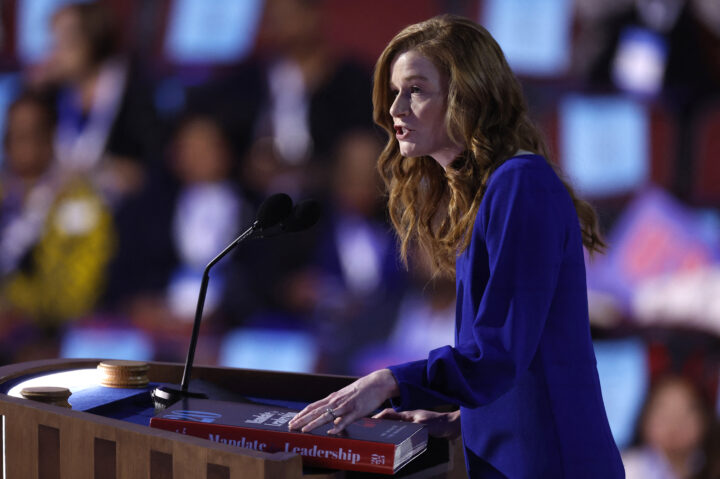
KAMIL KRZACZYNSKI/AFP via Getty Images
Michigan State Senator Mallory McMorrow speaks on stage with a copy of the Heritage Foundation's "Mandate for Leadership," a major component of the "Project 2025" political initiative, on the first day of the Democratic National Convention (DNC) at the United Center in Chicago, Illinois, on August 19, 2024.
Michigan state Sen. Mallory McMorrow, a Democratic candidate for Senate, said in a recent radio interview that accusations of genocide against Israel — with which she has previously agreed — have become a “political purity test,” arguing that there has been too much emphasis on that specific word.
McMorrow herself has backed accusations of genocide, affirming in response to a question at an October event that she believes the war in Gaza is a genocide “based on the definition” — though she didn’t specifically utter the word “genocide” herself.
Asked on local radio station WDET last week whether her stance has changed since October, when she affirmed that she believed the war in Gaza met the definition of a genocide, McMorrow did not offer a direct yes or no answer.
“I am somebody who looks at the videos, the photos, the amount of pain that has been caused in the Middle East, and you can’t not be heartbroken,” McMorrow said.
“But I also feel like we are getting lost in this conversation, and it feels like a political purity test on a word — a word that, by the way, to people who lost family members in the Holocaust, does mean something very different and very visceral — and we’re losing sight of what I believe is a broadly shared goal among most Michiganders, that this violence needs to stop, that a temporary ceasefire needs to become a permanent ceasefire, that Palestinians deserve long term peace and security, that Israelis deserve long term peace and security, and that should be the role of the next U.S. senator,” she continued.
McMorrow went on to criticize an unnamed opponent for campaigning on the issue of the war in Gaza, presumably referring to Abdul El-Sayed, the far-left Democrat who has made his opposition to Israel a centerpiece of his campaign.
“Particularly in this primary, we’ve got some candidates who are using this as a political weapon and fundraising off of it, and I think that that is just losing the humanity of what we’re seeing in the Middle East. And we deserve better,” McMorrow continued.
El-Sayed has repeatedly sent fundraising emails highlighting his criticisms of Israel, including one on the second anniversary of Hamas’ Oct. 7, 2023, attack, which ignored Hamas and criticized Israel. Other fundraising appeals have accused Israel of genocide and highlighted the deaths of journalists, accusations of famine and the death toll in Gaza, as well as blamed AIPAC funding for U.S. lawmakers’ support for Israel.
El-Sayed’s campaign has declared in such fundraising appeals that he is “the only candidate in this race with the courage to speak up — even if AIPAC and MAGA billionaires come after him for doing so” and “one of AIPAC’s top targets to defeat.”
El-Sayed’s campaign did not respond to a request for comment.
McMorrow and El-Sayed are, functionally, competing for the votes of anti-Israel voters in the state, with Rep. Haley Stevens (D-MI) maintaining a pro-Israel stance and securing backing from Democratic Majority for Israel.
In the WDET interview, McMorrow said that she continues to support legislation to block offensive weapons sales to Israel.
“The more that [Israeli Prime Minister Benjamin] Netanyahu pushes into Gaza, the worse this gets,” McMorrow said — though Israeli territorial advances in Gaza stopped months ago with the ceasefire deal. “And to be very clear, being in support of Israelis is not being in support of Netanyahu, in the same way that being in support of Palestinians is not the same as being in support of Hamas. … So we need to use the leverage that we have as the United States as an ally to ensure that this war ends and that the ceasefire is a permanent ceasefire.”
Please log in if you already have a subscription, or subscribe to access the latest updates.
 Continue with Google

 Continue with Apple