



























The letter warns that New Jersey ‘cannot lag behind in equipping our state to confront rising antisemitism’
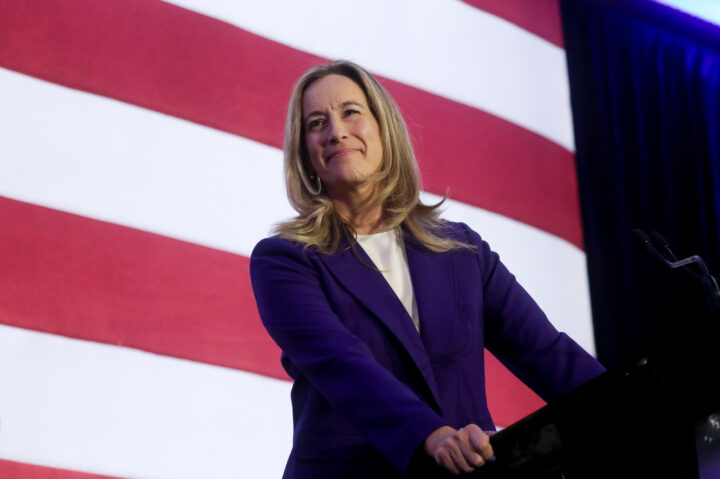
Michael Nagle/Bloomberg via Getty Images
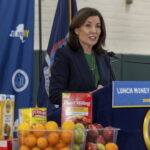
New Jersey Gov. Mikie Sherrill during an election night event in East Brunswick, New Jersey, on Nov. 4, 2025.


 Add JewishInsider on Google
More than 2,000 New Jersey rabbis and lay leaders signed a petition to New Jersey Gov. Mikie Sherrill and state lawmakers urging them to take prompt action to implement the International Holocaust Remembrance Alliance’s working definition of antisemitism in the state.
Legislation on the issue picked up broad support in the New Jersey Statehouse last year, but was ultimately halted by then-Gov. Phil Murphy and other state Democratic leaders over concerns that the bill — while enjoying support from a majority of assemblymembers — would require some Republican support to pass, and that voting for the measure could fuel progressive primary challenges to some Democratic members.
“We were deeply dismayed that legislation to adopt the IHRA definition was recently shelved for political reasons, despite broad support in the legislature and clear evidence of rising antisemitism,” the letter, which was organized by the Jewish Majority, reads. “At a moment when Jewish communities seek protection and clarity, this delay sends a troubling message about whether Jewish safety is prioritized.”
The letter argues that the IHRA definition is a “practical necessity” and that, given its substantial Jewish population, the state “cannot lag behind in equipping our state to confront rising antisemitism.”
The bill has been reintroduced in the current legislative session, but one Jewish leader said it does not appear that it has much momentum or institutional backing at the moment, or that the state of play has substantially changed since Murphy’s term ended and the new governor came into office.
Sherrill, a Democrat, had previously expressed support for the IHRA legislation.
Rabbi David-Seth Kirshner of Temple Emanu-El in Closter, N.J., who was one of the driving forces behind the petition, said he was “really furious” when Murphy “played a game with this legislation,” calling it “strange and uncharacteristic” from a leader who was once a “fierce advocate of the Jewish community.”
Kirshner said that, given New Jersey’s large Jewish population, it should have been among the first states to adopt IHRA, rather than lagging behind more than 35 other states. He said that he and other leaders in the state want to support the effort to pass and implement IHRA in any way they can.
He said he would also like to see Sherrill act on the issue through an executive order — even one that is time-limited to allow the Legislature to pass the IHRA bill. He said he would have liked her to implement such an order on her first day in office.
“This is not complicated, and the idea that the governor’s office or that any of our legislators want to complicate this process is a passive-aggressive form of continued antisemitism,” he said.
Rabbi Matthew Gerwitz of Temple B’nai Jeshrun in Short Hills, N.J., another organizer of the petition, said that New Jersey Jews need to “find all ways and operate at all levels” to address rising antisemitism in the state, and not let it become normalized, lest they “end up contributing to our own downfall and demise.”
“[The governor has] expressed her support of us. And this is part and parcel of supporting Jews right now, is making sure that every legal, ethical, communal device is put into place, so that we can feel protected during a time where [antisemitism] has become … normalized,” Gerwitz said.
He said that the Jewish community felt like it had the “rug pulled out from under our feet during a perilous time for Jews” by Murphy.
Gerwitz said that he has no issue with an executive order, as long as it has teeth, but said that he wants to ultimately see legislation passed, so that the state government speaks in one voice on the issue.
“I would like to see the stamp of approval from the Assembly, from the state Senate and from the governor to say every single branch of this government is going to be behind you … the way they should be behind any group that is feeling persecuted,” he said.
Rabbi Samuel Klibanoff of Etz Chaim in Livingston, N.J., inside Sherrill’s former House district, who also helped lead the petition, said it was a “great show of unity amongst the rabbis, because [it’s] not that often that you see a Conservative, Reform and Orthodox rabbi do something together.”
“I hope that [Sherrill] will [act on] her conviction and not party lines or party pressure or whatever it might be,” Klibanoff said. “I just hope she’ll do the right thing, and not play politics with this.”
He said it’s important to bring renewed attention to the issue, and that the longer the bill takes, the longer the Jewish community is left in peril.
Jonathan Schulman, the executive director of Jewish Majority, described the petition as a follow-on and expansion to a previous letter from around 100 rabbis in the state urging passage of the IHRA legislation, explaining that rabbis had heard interest from their congregants about joining the effort as well.
He said he’s hearing widespread support among local leaders for a stopgap executive order, which he said would also create political cover for Democratic lawmakers to “finally be able to vote their conscience and support legislation like this.”
Congressional candidates in New York and Illinois also signed onto the campaign, linked to Shanghai-based magnate Neville ‘Roy’ Singham and a series of anti-Israel groups
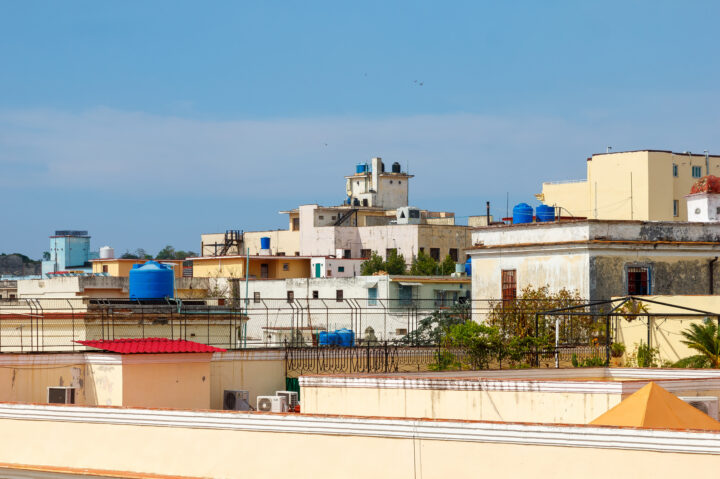
Roberto Machado Noa/UCG/Universal Images Group via Getty Images
Havana, Cuba, Residential district cityscape from an elevated point.
A raft of Democrats — including 23 members of the 51-seat New York City Council, multiple state lawmakers and four candidates for Congress — have joined forces with a Beijing-aligned tech tycoon to bail out the fuel-starved dictatorship in Cuba.
The officials in question lent their names to the “Let Cuba Live” campaign, which denounces President Donald Trump’s oil embargo on the island nation and seeks to triage solar panels and generators to defray the crippling impact on its energy production.
All donations for the effort run through the People’s Forum, a Manhattan-based nonprofit established and financed by Shanghai-based magnate Neville “Roy” Singham, part of his sprawling web of organizations promoting the interests of China and its allies Russia and Iran.
The People’s Forum and Singham, a devout Maoist who reaped a fortune from the sale of his software firm Thoughtworks, were at the center of a House hearing last week on foreign influence operations and overseas funding of activist groups.
Let Cuba Live’s website reveals the involvement of other Singham-linked groups, including CODEPINK — co-founded by his wife, Jodie Evans — and the ANSWER Coalition, both of which spearheaded anti-Israel protests beginning the day after the Oct. 7, 2023, Hamas attacks on Israel. Jewish Voice for Peace and the Democratic Socialists of America are also signatories, along with well-known left-wing celebrities such as Susan Sarandon and Roger Waters who have long been vocally hostile to Israel.
But unlike Singham’s other attempts to influence U.S. policy and promote its geopolitical foes, this effort has attracted backing from dozens of leading Democrats, the vast majority of them representing parts of New York City.
Several of the elected officials who have joined the crusade are DSA members: Councilmembers Alexa Aviles, Tiffany Caban, Chi Ossé, Shahana Hanif, state Sen. Julia Salazar and Assemblymembers Diana Moreno and Claire Valdez.
Moreno was Mayor Zohran Mamdani’s handpicked successor to his old seat in the New York Legislature, while Mamdani has endorsed Valdez to replace Rep. Nydia Velazquez (D-NY) in Congress.
However, the bulk of the New York co-signers are not card-carrying DSA members, but simply members of the Council’s long-standing left-of-center Progressive Caucus. These include Councilmembers Harvey Epstein, Gale Brewer, Althea Stevens, Amanda Farias, Crystal Hudson, Christopher Marte, Elsie Encarnacion, Farah Louis, Jennifer Gutiérrez, Kayla Santosuosso, Pierina Sanchez, Sandy Nurse, Rita Joseph, Shanel Thomas-Henry, Shekar Krishnan, Shirley Aldebol, Julie Won — also a candidate for Velazquez’s soon-to-be-vacant seat — and Deputy Council Speaker Nantasha Williams.
Other prominent Democrats who have joined the Singham campaign include congressional hopefuls Jake Levine and Byron Sigcho-Lopez, seeking the seats of Rep. Brad Sherman (D-CA) and Rep. Chuy Garcia (D-IL), respectively. Levine did not respond to a request for comment. Sigcho-Lopez, a Chicago city alderman, told Jewish Insider that he had signed on at the request of DSA, of which he is a member.
He said he was aware of CODEPINK’s participation in the campaign, but not of the larger Singham network’s involvement, though he expressed no regrets joining.
“Outside of the geopolitical struggle, it is important that we protect the well-being and lives of anyone,” Sigcho-Lopez said. “I think they’re fighting for the same things we’re fighting for in Chicago: we want to protect people’s humanity.”
None of the elected officials responded to JI questions, although two New York City Council sources — who requested anonymity to avoid jeopardizing their positions — said that the Progressive Caucus had urged members to sign on.
Several of the other names attached to “Let Cuba Live” are leading members of the Party for Socialism and Liberation, a small but prominent fringe party that has spearheaded anti-Israel protests, promotes the interests of Tehran, Moscow and Beijing, and provides staff and support to Singham’s network. The Justice Department has identified the PSL as a key force in organizing the wave of protests that have targeted synagogues in recent months.
As of Wednesday evening, the campaign was about $60,000 away from hitting its $200,000 fundraising goal, funds it has vowed to expend. “We are rushing solar generators and panels to our neighbors 90 miles away so that hospitals can keep their doors open and their lights on.”
New York state legislators are considering legislation that would establish a 25-foot buffer zone outside houses of worship
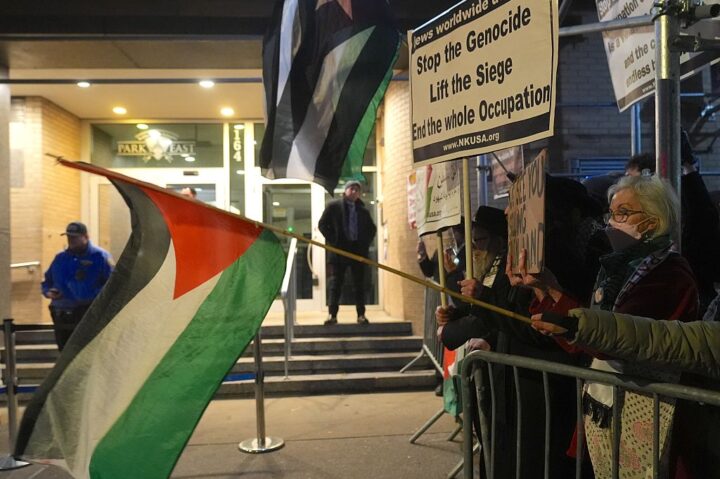
Selçuk Acar/Anadolu via Getty Images
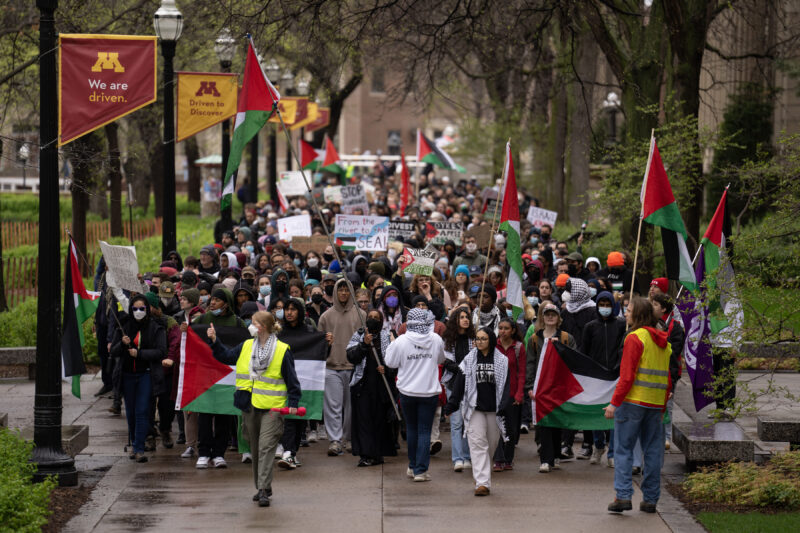
Anti-Israel demonstrators gather at 'No Settlers on Stolen Land' protest against a Nefesh b'Nefesh event at the Park East Synagogue in Manhattan in November 2025.
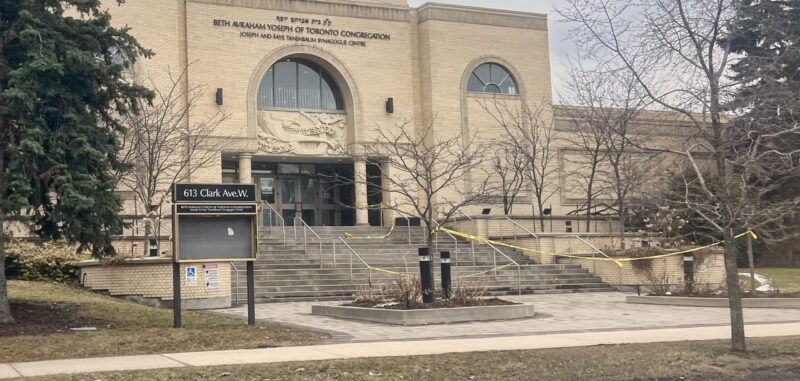
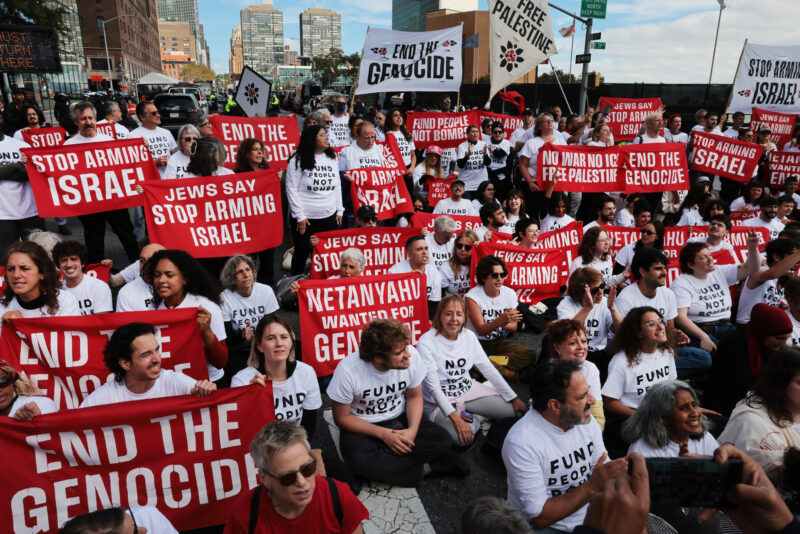
As anti-Israel demonstrators increasingly target synagogues in protests that have turned violent and used antisemitic rhetoric, some Jewish leaders and state lawmakers are now calling for more expansive legislative safeguards to help bolster protections for houses of worship.
The new efforts have come in the wake of threatening behavior outside synagogues in New York City and Los Angeles that drew forceful condemnation from elected officials and raised concerns among Jewish leaders who fear that such incidents will normalize antisemitic harassment disguised as anti-Zionism.
In New York, state lawmakers this week introduced a new bill to ban protests directly outside houses of worship. The legislation seeks to amend the existing state penal law by establishing a 25-foot buffer zone around religious sanctuaries to insulate congregants from facing intimidation and potential clashes with demonstrators that have occurred more regularly in recent years.
The bill, which would also apply to abortion clinics, was advanced in response to a controversial protest last month outside Park East Synagogue, a Modern Orthodox congregation in Manhattan, where about 200 activists disrupted an event educating attendees about immigration to Israel while chanting slogans including “death to the IDF” and “globalize the intifada,” interpreted as calls to violence against Jews.
“We’re in a very troubled time, and that’s going to mean we need to adapt, including with legislation,” Micah Lasher, an assemblyman in Manhattan who introduced the legislation with a fellow Jewish state senator, Sam Sutton, told Jewish Insider on Thursday.
He said that he had weighed free speech concerns while drafting the bill to protect “the right of people to speak out, even when that speech is hateful, with the right of people to express their religion freely.”
“We’re going to see more and more of this until we can more broadly curb antisemitism,” he cautioned, calling the protest in Los Angeles this week, which ended in the arrests of two demonstrators, “a harbinger of things to come” in the absence of further legislative action.
Nily Rozic, a Democratic assemblywoman from Queens who is co-sponsoring the bill, echoed that view. “Houses of worship should serve as peaceful sanctuaries, not punching bags for protesters,” she explained. “Following incidents in NYC and LA, it’s becoming apparent that creating no-protest zones outside houses of worship is absolutely necessary.”
In contrast with the incident in New York City, the protest that erupted in Los Angeles on Wednesday was more intrusive, with video showing anti-Israel demonstrators shouting inside the historic Wilshire Boulevard Temple — where one activist shattered a vase during a public safety event held with Korean community members.
Jewish community activists in California said they viewed the incident, coupled with the recent protest in New York City, as an impetus to take a closer look at state law relating to such demonstrations.
Julia Mates, the director of policy and government affairs at Jewish Community Relations Council Bay Area, said that the state already has an existing law that protects access to houses of worship as well as abortion clinics — similar to the federal Freedom of Access to Clinic Entrances Act, which has been used by the Justice Department under President Donald Trump to target protesters charged with disrupting Jewish spaces.
Mates said that her organization last year had “started to reexamine the act” with an eye toward potentially expanding what she called the “bubble zone” protecting congregants, but tabled that effort in favor of focusing exclusively on legislation aimed at countering antisemitism in public schools.
But now, in light of recent events, “it might be a good time to reexamine a fixed distance rule and gaps in enforcement,” she told JI on Thursday.
“The environment is such that we need to take another look at this,” Tyler Gregory, CEO of the Bay Area JCRC, vowed. “This is getting a lot of chatter in the community. I think that Jewish legislators and organizations haven’t figured out where we want to land yet,” he continued. “But it’s certainly the topic du jour.”
Noah Farkas, who leads the Jewish Federation of Los Angeles, said that his organization, for its part, has “been pushing for” legislation to more forcefully regulate such demonstrations “for a long while.”
“While we recognize the right of anyone to assemble lawfully to express themselves,” he explained to JI Thursday, “it should not endanger the lives or limit the liberty of anyone else. And while this is a matter on a legal and political level of balancing one set of rights next to another, there is yet a deeper strain of values that needs to be addressed.”
Rep. Laura Friedman (D-CA), a Jewish Democrat from Los Angeles, said the Wilshire demonstration was “deeply personal,” noting that she had attended services at the synagogue during the High Holidays.
“At a time of surging antisemitism, no one should have to choose between their safety and their right to worship,” she said in a statement shared with JI. “I’ll always protect free speech, but when protests cross into criminal intimidation, threats or blocking access, authorities must step in to uphold the law and protect Americans’ right to gather and worship without intimidation.”
Julie Fishman Rayman, senior vice president of policy and political affairs at the American Jewish Committee, called the Los Angeles protest “horrific and beyond unacceptable,” while citing legal “tools that already exist and should be used to maximum impact” in order to hold anti-Israel demonstrators accountable.
As Jewish community activists are now considering efforts to strengthen such laws, Lasher said his new legislation “strikes the right balance” on free speech and safety issues, and “could potentially be a model for other states.”
“For as long as we’re dealing with these sorts of hateful events,” he said, “we should make sure we are giving appropriate tools that are constitutional to enable people to enter synagogues without fear of intimidation.”
New York Gov. Kathy Hochul, a Democrat, voiced interest in supporting the bill on Thursday, saying that she was “willing to look seriously at a buffer to protect that fundamental right we have, which is to express ourselves and practice the faith we choose to without fear and intimidation.”
“I don’t say whether or not I’ll support bills,” she told reporters, “but if it shows up in another place, I’m taking that very seriously. I think it’s time. I will be supportive of that.”
Zohran Mamdani, the mayor-elect of New York City and a democratic socialist long vocally critical of Israel, has also expressed interest in learning more about such legislation, after he had faced backlash for accusing the Park East Synagogue of promoting activities “in violation of international law,” even as he sought to distance himself from the protesters.
Mamdani’s team did not respond to a request for comment from JI about the newly proposed bill.
Please log in if you already have a subscription, or subscribe to access the latest updates.
 Continue with Google

 Continue with Apple