









































































The agency said state administrative agencies and the extended DHS shutdown caused the lengthy delay in issuing the grants
Brandon Bell/Getty Images
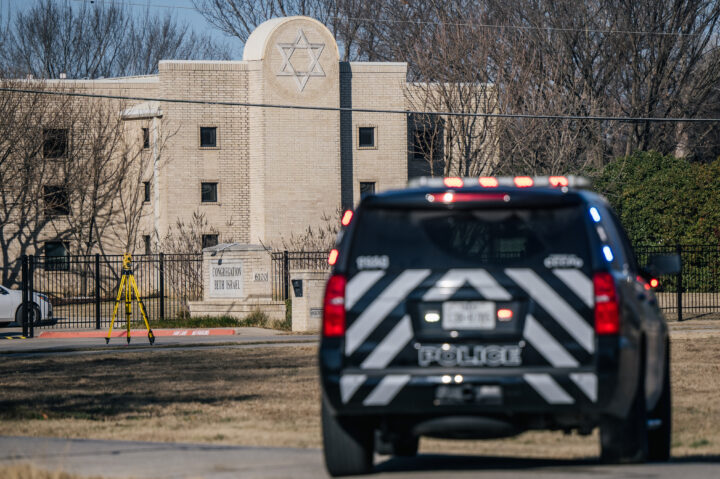
A law enforcement vehicle sits near the Congregation Beth Israel synagogue on January 16, 2022 in Colleyville, Texas.


 Add JewishInsider on Google
The Federal Emergency Management Agency announced on Wednesday that 1,600 out of 6,000 applications received for the long-delayed 2025 Nonprofit Security Grant Program cycle were approved, meaning that under 27% of organizations that applied received any funding — a significant dip from previous years.
The grants were approved nearly a year after applications opened for the 2025 cycle on Aug. 13, 2025, and after applications for 2026 NSGP funding were already due last week. FEMA indicated that state agencies responsible for administering the grants on the state level and repeated Department of Homeland Security shutdowns relating to immigration enforcement disputes were responsible for the delays.
FEMA said it had provided initial allocations to state agencies in September of last year and subsequently received the applications from individual nonprofits from the state agencies, which the agency did not finish reviewing until earlier this month.
FEMA said that more than 60% of the grant funding had been provided to houses of worship, including Christian, Muslim, Hindu, Buddhist, Sikh and Jewish institutions.
The program was funded at $274.5 million in 2025, with $266 million of that being provided to nonprofit institutions. The grant awards represent a significant drop in application acceptances, as well as a moderate dip in applications received as compared to 2024. In 2024, 3,288 applications were approved, around 40% of the 7,584 applications received, with $454.5 million made available overall.
More applications were also approved in 2023 and 2022 than in this grant cycle. In 2023, with $305 million available, FEMA approved 2,201 applications out of 5,257, and in 2022, FEMA approved 1,821 applications out of 3,470, with $250 million available.
The administration distributed an additional $220 million in supplemental funding in two tranches last year, from emergency funding passed by Congress in 2024.
FEMA did not respond to a request for comment on how much total funding had been requested in 2025, nor how many Jewish institutions had received funding.
Lauren Wolman, senior director of government relations and strategy for the Anti-Defamation League, expressed gratitude that the grants had been released but emphasized that “many vulnerable organizations remain without the support they need.”
“Congress must pass the Jewish American Security Act, which would authorize $1 billion annually for this critical program,” Wolman continued. “We also hope future application timelines provide organizations with the opportunity to incorporate prior award decisions into their planning.”
The application period for 2026 grants closed before the administration announced the 2025 awards, which lawmakers and advocates said complicated the 2026 application process for institutions that did not yet know if they would be receiving funding under the previous year’s program.
“It was troubling that government disputes that led to shutdowns of DHS delayed the 2025 NSGP grants,” Nathan Diament, the executive director of the Orthodox Union Advocacy Center said. “We are thankful for [Homeland Security] Sec. [Markwayne] Mullin and his team at DHS — as well as the White House Faith Office — working to get these funds finally awarded. “
Eric Fingerhut, the CEO of the Jewish Federations of North America, said JFNA is “relieved and grateful” that the grants have been finalized.
“These grants will allow synagogues and Jewish institutions to get the vital security upgrades necessary to protect our community and support flourishing Jewish life,” Fingerhut said. “We also know the need continues to outpace the availability, which is why we continue to call on Congress to increase funding for this vital program and [pass] the Jewish American Security Act.”
Rabbi A.D. Motzen, national director of government affairs for Agudath Israel of America, also expressed thanks for the grant announcement, while noting the significant shortfall in funding.
“Every grant means another institution and community that is better prepared to prevent a terror attack,” Motzen said in a statement. “The fact that nearly three quarters of grant applicants were turned away due to lack of funds, however, highlights the need for additional funding, especially with the terror attack at a West Bloomfield [Mich.] synagogue still fresh in our minds.”
The members say the compressed timeline give states and institutions too little time to complete applications for the 2026 Nonprofit Security Grant Program
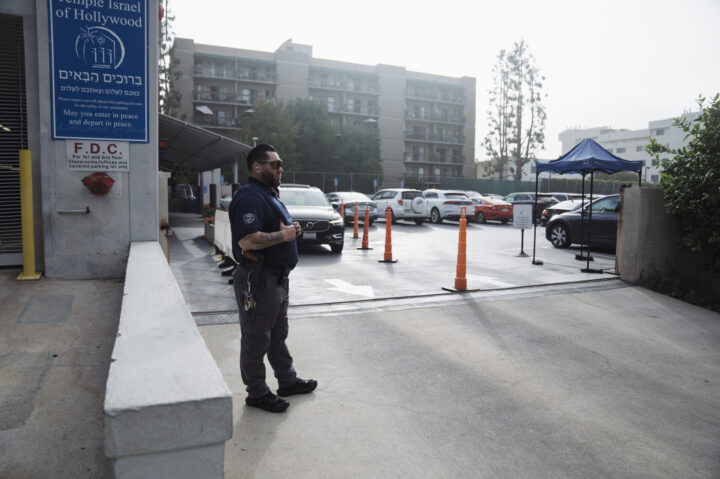
Photo by Eric Thayer/Getty Images)
A security guard stands watch in front of a synagogue on October 9, 2023 in Los Angeles, California.
A bipartisan group of 58 House members urged the Federal Emergency Management Agency on Thursday to extend the deadline for 2026 Nonprofit Security Grant Program applications, arguing that the current timeline gives states and institutions “insufficient time to complete the application process” and fulfill the program’s goals.
Applications for the program were announced on June 24 and are due to the federal government from state emergency management agencies by July 24. Those state agencies must set their own earlier deadlines for individual institutions to submit applications.
“It is essential that eligible applicants have a fair shot to apply for these funds and fully realize the program’s intended purpose,” the lawmakers, led by Reps. Grace Meng (D-NY) and David Joyce (R-OH), wrote in a letter to acting FEMA Administrator Robert Fenton. “The current timeline imposes significant administrative constraints on both applicants and [state administrative agencies], potentially limiting full and fair participation in this year’s grant cycle.”
The lawmakers argued that organizations would have a short amount of time — potentially just days — to review the program, obtain necessary assessments, develop proposals, gather documents and submit applications. The signatories noted that FEMA has historically provided as many as 80 days from the application announcement to the deadline.
The letter notes that the application period also overlaps state hate crimes grant program application periods in some states, “overburdening” institutions, particularly smaller ones that don’t have large teams to handle grant-writing.
FEMA’s continued delays in releasing 2025 NSGP awards create further issues, the lawmakers explained: “organizations will be applying without knowing their eligibility, creating additional complications since eligibility for this year’s grant is affected by the recipient’s status for last year’s grant.”
The letter urges FEMA to extend the 2026 application deadline, to give state agencies more time to review applications, nonprofits more time to prepare their applications and to guarantee “FEMA receives the strongest possible pool of eligible projects for consideration.”
The Jewish Federations of North America said it organized the letter and was the first to publicize it.
“At a time of rising threats against faith-based communal institutions, Congress has made clear that protecting vulnerable communities is a bipartisan priority,” JFNA CEO Eric Fingerhut said. “Giving state administrative agencies and nonprofit organizations adequate time to complete FEMA’s application process will help ensure these critical security resources reach those NSGP is designed to protect.”
Lauren Wolman, the senior director of government relations and strategy at the Anti-Defamation League, said that “a one-month application window presents significant challenges for the nonprofits that need this funding the most, particularly smaller organizations without dedicated grant writing staff.”
Wolman added, “Extending the deadline would help ensure every eligible organization has a meaningful opportunity to secure the resources they need to protect their communities.”
Rabbi AD Motzen, the national director of government affairs at Agudath Israel of America, said, “Agudath Israel strongly supports the bipartisan Meng Joyce letter and the request for a longer application period. We have heard from nonprofits that are not sure if they were awarded the grant from the previous year and have to make a rushed decision whether or not to apply for this year.”
Nathan Diament, the executive director of the Orthodox Union Advocacy Center, said that the OU also agrees that an extension of the deadline would be “very helpful.”
Separately, 15 Democrats on the House Homeland Security Committee wrote to Homeland Security Secretary Markwayne Mullin and Fenton, raising concerns about the administration’s handling of various FEMA grant programs including NSGP, accusing them of including language in the application materials “that is confusing, impractical, incomplete, and potentially unlawful.”
The Democrats specifically accuse the administration of “deliberately slow processing” of 2025 NSGP applications, noting the continued delay in announcements of 2025 funding and calling for the outstanding grants to be issued “immediately.”
“At-risk nonprofits are forced to navigate overlapping application cycles without knowing if they even need to apply for the FY 2026 NSGP,” the letter reads. “With the FY 2026 application window already open and set to close in less than a month, FEMA’s internal delays and contradictory directives are creating unnecessary burdens for subrecipients.”
It also criticizes the administration for “conflicting instructions on required documentation” and requirements related to immigration and elections imposed on grant recipients. “Imposing these complex mandates on small, volunteer-run, nonprofit organizations, threatens to penalize the very institutions the program is designed to protect,” the Democrats wrote.
Please log in if you already have a subscription, or subscribe to access the latest updates.
 Continue with Google

 Continue with Apple