














































































Ossoff also defended his votes on arms sales to Israel, saying Israel had a right to go to war with Hamas but U.S. lawmakers must ensure compliance with American and international law

(Miguel Martinez/Atlanta Journal-Constitution via AP)
Republican U.S. Rep. Mike Collins, left, debates incumbent Democratic U.S. Sen. Jon Ossoff during the Loudermilk-Young Senate Debate Series at the Georgia Public Broadcasting studio in Atlanta on Tuesday, Oct. 13, 2026.


 Add JewishInsider on Google
Rep. Mike Collins (R-GA) on Tuesday dodged a question about his son-in-law, a white nationalist influencer who has apparently recorded and posted antisemitic and white nationalist videos while living on Collins’ property, at the second Georgia Senate debate.
Sen. Jon Ossoff (D-GA) had hammered Collins on the issue, and Collins’ other ties to extremist figures including former congressional staff, at a previous debate last week, accusing Collins of hiring “half of the Third Reich.”
Asked by the debate moderator about Ossoff’s accusations and his former staff, Collins said that he condemns “any sort of hate speech, antisemitism, hate of any kind, it’s abhorrent. I fire people when things happen.”
Asked about Sen. Jon Ossoff’s comments accusing him of hiring “half of the Third Reich," Rep. Mike Collins condemned “any sort of hate speech, antisemitism, hate of any kind" and said, "I fire people when things happen.” Read @marcrod97’s full coverage: https://t.co/t3PxpEE2kO https://t.co/s6C2upomiQ
— Jewish Insider (@jewishinsider) October 14, 2026
“I’ll tell you, young people on both sides, Republicans and the whole DSA wing of the Democrat Party, we do have a problem with antisemitism and hate around the world,” Collins said. “These young people feel like they’ve been forgotten, and they’re just lashing out. And this hate speech has got to stop. We’ve got to educate them. We’ve got to help them by giving them opportunities.”
Ossoff responded by pressing Collins to commit to ensuring that no more neo-Nazi propaganda would be shared from his home before the election.
“I’m a little tired of this, Jon,” Collins responded. “There’s a crazy person in jail right now because of your rhetoric — threatened my son-in-law, threatened to kill me. Had another threat just yesterday. That’s because of you and your rhetoric that you’re out there spewing, just vitriol, hate.”
Collins sought to turn the tables on Ossoff, emphasizing his support for Michigan Senate candidate Abdul El-Sayed, and El-Sayed’s connections to antisemitic streamer Hasan Piker and the Democratic Socialists of America.
“Mike, if any of those folks were based in my house, then I’d understand you’d ask me to take responsibility for them,” Ossoff shot back. “What I asked you, Mike, was can you commit for just three weeks to stop the production of neo-Nazi propaganda from your home? We all know what’s happening. Why can’t you stop it? Why won’t you commit right now to stop it?”
The two continued to talk over each other until moderators forced them to move on.
Collins also defended his support for the Iran war, praising the administration for having the “leadership” to send in U.S. forces to prevent Iran from obtaining nuclear weapons.
“My opponent and the Democrats, all they’re interested in is sending more money to Iran,” Collins said. “We’re in Iran to make sure they don’t get a nuclear bomb and destroy America, because that’s what they want to do. And I’ve got kids and grandkids, and we want to make sure that they have a future.”
Ossoff, for his part, called Secretary of State Marco Rubio, whom he voted to confirm, a “deep disappointment” and said that Secretary of Defense Pete Hegseth “has lied repeatedly about the war in Iran.”
Asked by a moderator about his stance on U.S. aid to Israel, Ossoff largely repeated an answer he offered at a previous debate, standing by his votes on resolutions to block arms sales to the Jewish state while emphasizing that he wants security for both Israelis and Palestinians.
“When it comes to selling weapons or giving weapons to a foreign government, we should assess in every case whether that foreign government is acting consistent with our interests, our laws and our values,” Ossoff said. “Israel had every right to go to war with Hamas after the despicable Oct. 7 terrorist attack. I also believe that it’s right for U.S. senators to ensure that American laws and international laws are being respected by those who fight with our weapons.”
A day after JI revealed the posts, the Republican gubernatorial nominee said his son had apologized and deleted them, and argued the campaign should focus on Maryland issues

Bill O'Leary/The Washington Post via Getty Images
Republican gubernatorial candidate Dan Cox addresses supporters at an election night watch party, in Annapolis, MD.
Maryland Republican gubernatorial nominee Dan Cox responded on Tuesday night to a Jewish Insider report exposing his son’s past antisemitic social media posts, calling the story a “travesty” and accusing Democrats of pushing the issue into the campaign while stating he “absolutely” disagrees with his son’s views.
Cox, who served in the Maryland House of Delegates from 2019 to 2023 and unsuccessfully ran for governor in 2022, is the Republican nominee challenging Democratic Gov. Wes Moore in the November election.
Responding to a JI scoop on his son’s antisemitic social media posts, Dan Cox called the story a “travesty” and accused Democrats of pushing the issue into the campaign while stating he “absolutely” disagrees with his son’s views. Read more: https://t.co/oUFCNckDZT https://t.co/NB5t3RtiGq
— Jewish Insider (@jewishinsider) October 7, 2026
Cox’s comments came one day after JI reported that his son, Josiah Cox, had posted a series of antisemitic messages on Facebook. The posts included predictions that “Israel will fall,” descriptions of Jews as “scum who killed my savior Jesus” and the “Synagogue of Satan,” and claims that Jewish customs “disgust” him and that Jewish people are “pedophiles” who “slaughter innocents all around the world.”
Asked about the report in an interview with Fox 45 Baltimore on Tuesday night, Cox initially dismissed the story as a Democratic attack and criticized the decision to bring his family into the issue.
“I think it’s an absolute travesty that that [the article] was done and brought up and bringing family in, that’s ridiculous,” Cox said. “That was the Democrats that did that.”
Asked whether he agreed with his son’s statements, Cox said, “I absolutely do not!”
But while Cox rejected his son’s views, he pointed to his son’s response to the controversy as a reason to move past the issue, noting the younger Cox’s decision to apologize and remove the posts.
“I called him [my son] up and expressed my sincere upsetness about it,” Cox said. “And to his credit, he apologized and deleted [the posts]. I think at the end of the day, the issues about Maryland are what needs to be talked about because I will represent every Marylander.”
Ambassador Yechiel Leiter said his son ‘needs a miracle’; Neria Leiter’s older brother was killed fighting in Gaza in 2023
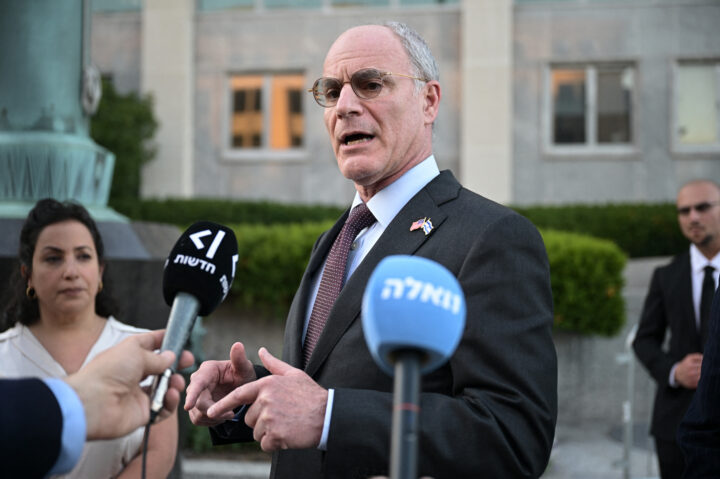
Oliver Contreras / AFP via Getty Images
Israel's Ambassador to the U.S. Yechiel Leiter speaks to reporters after a meeting between Israeli and Lebanese delegations hosted by the United States at the State Department in Washington, DC, on June 3, 2026.
Neria Leiter, the son of Israeli Ambassador to the U.S. Yechiel Leiter, was seriously wounded in a car-ramming terror attack at a West Bank checkpoint on Wednesday, the ambassador confirmed.
Leiter, an IDF reservist in his 30s, was stationed at the Maccabim checkpoint on Route 443 when an assailant accelerated toward a police cruiser and ran over Leiter, according to Israeli police. IDF troops at the scene opened fire and killed the driver.
The assailant was identified as a 29-year-old Palestinian from the nearby West Bank village of Beit Ur al-Tahta.
Leiter was evacuated to Shaare Zedek Medical Center in Jerusalem in serious condition. He was unconscious when emergency responders treated him at the scene, according to Magen David Adom.
The ambassador said following the attack that doctors were “fighting for the life” of his son, who he said “needs a miracle.”
“Neria continued to serve in the reserves after losing his older brother, Moshe Yedidya Leiter, of blessed memory, and has served hundreds of days in the reserves on various fronts since October 7,” the ambassador said.
Neria’s older brother, Maj. (res.) Moshe Yedidya Leiter, 39, was killed alongside three other Israeli reservists in northern Gaza on Nov. 10, 2023. The four soldiers were killed by a blast from a booby-trapped tunnel shaft in the Beit Hanoun area.
A father of six, Moshe was a company commander in the IDF reserves and served as a paramedic. He was studying medicine and was due to begin a hospital training placement.
The Well — named for the biblical story of Eliezer finding Isaac’s wife, Rebecca — combines the best of matchmakers and technology, founder Erica Schwartz told JI

Liri Agami
Erica Schwartz mingles with prospective users of The Well at the app's launch event on July 278, 2028, in Manhattan.
When the biblical Abraham sought a wife for his son Isaac, he dispatched his trusted servant to the city of Nahor in Mesopotamia. The servant, Eliezer, stopped at a well and prayed for a sign: the right woman would offer water not just to him, but to his camels as well. Rebecca did exactly that — and became Isaac’s match.
That story now has a modern namesake. A new dating app called The Well, slated to launch in the coming weeks, exclusively matches Jewish day school alumni. It’s aiming to fill a void for the very affiliated Jews searching for their bashert but tired of swiping.
“As I started to watch the way the world — at least in my Modern Orthodox circle — was meeting or not meeting each other, something felt very broken to me,” Erica Schwartz, the app’s founder, told Jewish Insider on Tu B’Av, the Jewish holiday of love, which began at sundown on Tuesday.
“Back in my day, we’d go to a synagogue and you’d meet and mingle outside and somebody might give you a call. Now everything is through a matchmaker and people aren’t meeting in person so everything is moving to more formal apps or shidduch résumés.”
Schwartz graduated from the Modern Orthodox Ramaz School on Manhattan’s Upper East Side, where she now serves as board chair. She also sent all six of her children to Jewish day schools. She said the aforementioned methods of dating were not “speaking to what I look at as this large middle niche I’m putting under the banner of the day school crowd, where they have a Jewish background and identity so they’re not a random Jew out there on a dating site, and they’re also not the ultra-Orthodox dater who is going to, through a matchmaker, go on six dates and then get married.”
“In that middle camp are all these day school graduates who are looking to meet somebody,” continued Schwartz. “It seems like such a natural place of overlap and connection, they just need to become aware of each other. That’s what The Well is trying to do — build a niche area of Jewish dating.”
Unlike mainstream dating apps — including other Jewish ones — known for endless swiping, The Well features no swiping at all, which makes it feel more personal, said Schwartz. She describes the platform as “human intuition and wisdom working in tandem with technology.”
The Well enters a crowded field of established Jewish dating apps — swipe-based JSwipe, application-only Lox Club and older-skewing JDate. But it’s betting that its swipe-free, day-school-verified niche can reach daters that those other platforms don’t.
Users, who must be in their 20s and 30s, begin by filling out a profile form. The first thing they’re asked to note is the day school they attended and year of graduation. Day school graduates of all backgrounds — from pluralistic to yeshiva — are welcome to join, but users must submit two names of people who can vouch that they attended that school. “That’s our current verification system. We need to see how that works and are prepared to tighten it a bit,” said Schwartz.
The profile form then prompts users to speak with a chatbot named Elli — a nod to Eliezer from the biblical story.
Elli is trained to ask follow-up questions in nuanced ways and pick up the user’s personality, said Schwartz. It asks users to describe their religious beliefs, share their profession and include key dating details like height preference or college alma mater.
Users also have the option to fill out the form manually, but Schwartz said taking advantage of Elli is preferred.
The Well also offers a small, vetted cohort of matchmakers if users wish to open their profile to them. Daters can also book an individual phone session with a matchmaker for $180, but otherwise the app is entirely free of charge.
A team of about a dozen advisors and matchmakers has been involved since the app’s inception, including two Modern Orthodox rabbis: Rabbi Elie Weinstock, senior rabbi of the Jewish Center of Atlantic Beach on Long Island, and Rabbi Daniel Kraus, director of community education at Congregation Kehilath Jeshurun in Manhattan.
“The future of Jewish dating isn’t choosing between technology and people,” Kraus told JI. “It’s combining the best of both. There are many excellent dating apps today. But no single platform can serve every community equally well. Every week I meet remarkable young adults who are ready to build Jewish homes, yet many still struggle to meet the right person. The challenge isn’t a lack of commitment. It’s creating meaningful opportunities for the right introductions.”
“The Well’s model is especially compelling because it pairs the scale and intelligence of technology with the wisdom, intuition and personal touch of experienced shadchanim [matchmakers],” continued Kraus. “Technology broadens the possibilities. People bring the judgment that no algorithm can fully replicate.”
The name itself, said Kraus, is “deeply rooted in Jewish tradition.”
“Throughout Tanach, wells are places where lives change,” he said. “Rivkah, Rachel and Tzipporah each met their future spouse at a well. While the platform is new, the mission is timeless: to help more young Jews find one another and build the next generation of Jewish families.”
The Well features two levels of profiles: public and private. The private one is only seen by Elli or a matchmaker. There’s also a dashboard where matchmakers can discuss the profiles of their clients so they can make suggestions in addition to the ones Elli makes.
Names are drawn for users every Monday and Thursday — the days biblical Jews traditionally went to the market — and they have a certain amount of time to respond; they can say “pass” or can choose to start a conversation. They can also share someone’s profile with another user in their “village,” which is the equivalent of Facebook friends.
“Some of that we’re fine tuning to make sure we’re not infringing on privacy,” said Schwartz, adding that the platform uses vanishing pictures to ensure profiles aren’t screenshotted and sent around.
Since dating apps first launched in the 2010s, they have instantly put hundreds of profiles at users’ fingertips, making them the favored method for nearly half of Americans looking for love, according to a Forbes Health survey. But apps that claim credit for matches made five or ten years ago now face user burnout, with many people saying they prefer to meet in person rather than swipe through an endless pool of potential mates. Seventy-eight percent of users report dating app burnout, according to another Forbes survey conducted last year.
Addressing this, Schwartz said The Well also features an events section of the app that will advertise social gatherings for this demographic across the country. She described that as a “crucial” component.
Before officially going live, The Well hosted an invitation-only launch event Tuesday night at the swanky Bowery Hotel on Manhattan’s Lower East Side, timed to coincide with Tu B’Av, drawing some 200 young professionals eager to mingle and learn about the app.
“What makes The Well stand out is that it rejects the culture of infinite swiping and disposable connections,” Erez Kahan, a 35-year-old who works as a relationship manager in the family office space and attended the launch event, told JI. “Instead, by thoughtfully introducing just a couple of carefully considered matches each week, it encourages people to slow down, be present and give each connection the attention it deserves. It’s a refreshingly human approach — one that values individualized care, quality over quantity and genuine intention over endless choice.”
Kahan, a graduate of The Frisch School, a Modern Orthodox school in New Jersey, said he’s particularly drawn to the symbolism behind The Well’s name — something he expressed hope to experience through the app: “A chance meeting at a well became something guided by purpose rather than endless searching.”
Please log in if you already have a subscription, or subscribe to access the latest updates.
 Continue with Google

 Continue with Apple