














































































The renewed solidarity comes after a foiled attack against a Hindu temple in suburban Chicago
Laura Bargfeld/AP
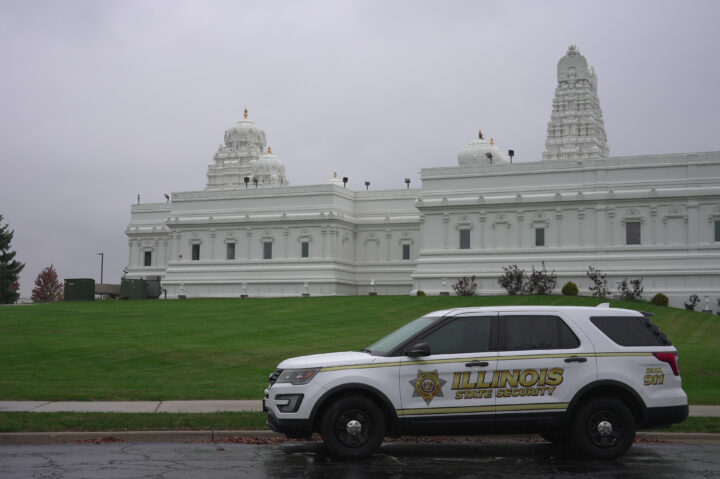
A security vehicle is parked outside of Sri Venkateswara Swami (Balaji) Temple in Aurora, Ill., Thursday, Oct. 15, 2026.


 Add JewishInsider on Google
In the aftermath of an attempted terror attack on a Hindu temple last week, Jewish leaders are drawing on a shared experience of confronting religious hatred to strengthen ties between the two communities — including by expanding sustained advocacy to protect houses of worship.
The long-standing outreach has grown as both communities confront ongoing fears of religiously motivated threats. Hindu advocates have historically supported Jewish community security initiatives, including government grants to help protect religious institutions and legislation establishing buffer zones around houses of worship. Now, Jewish leaders are extending that same spirit of solidarity to Hindu Americans and underscoring the importance of interfaith cooperation in confronting religious hatred.
Authorities on Wednesday arrested Alexandros Paporakis, 19, who they said drove to the Sri Venkateswara Swami (Balaji) Temple in Aurora, Ill., on Oct. 11, armed with a rifle and body armor and leaving behind an eight-page manifesto detailing white supremacist and neo-Nazi ideologies. The suspect, who was allegedly planning the attack for two years, fled the scene after his rifle jammed.
The foiled attack comes seven months after a terrorist rammed a truck full of explosives into Temple Israel, a synagogue in West Bloomfield, Mich., in an attack the FBI later characterized as an act of terrorism inspired by Hezbollah. While neither incident caused injuries, both highlighted the persistent security risks facing faith-based communities.
Following last week’s thwarted attack, Jewish leaders and organizations expressed solidarity with the Hindu community, noting the shared vulnerabilities of religious minorities and the critical need to protect houses of worship.
The Anti-Defamation League said the attack “underscores why Congress must increase funding for the Nonprofit Security Grant Program, so at-risk communities have the resources they need to protect themselves.”
Sen. Jacky Rosen (D-NV) also called on Congress to “sufficiently fund” the Nonprofit Security Grant Program, which provides security funding to religious institutions.
Rep. Raja Krishnamoorthi (D-IL), who was inside the temple with his family when the attempted attack occurred, told Jewish Insider, “Jewish and Hindu communities face threats that demand solidarity across religious and cultural lines. The attempted mass shooting at my family’s Hindu temple in Aurora, by a suspect whose hatred also targeted Jewish and Black Americans, shows how these forms of bigotry are connected. We must stand up for one another and strengthen partnerships across communities to confront antisemitism, anti-Hindu hatred, and all forms of bigotry. I will continue working with faith and community leaders to ensure every American can live and worship without fear.”
“I’m disturbed to learn of an alleged plot to carry out a mass shooting targeting the largest Hindu temple in Aurora, Illinois. While I’m grateful for local law enforcement’s swift response in preventing a tragedy, this hateful plot has shaken the Hindu community across the country,” said Rosen. “This should outrage all of us. It’s unacceptable for any religious community to be targeted simply because of who they are.
“We cannot wait for another attack to act. Congress must sufficiently fund the Nonprofit Security Grant Program now so we can ensure all religious communities are safe in their places of worship.”
Elad Strohmayer, consul general of Israel to the Midwest, said in a video message: “To the Hindu community of Illinois and everywhere in the United States — we stand with you … Your safety matters to us a lot … Know that Israel is always with you.”
Hindu American groups have also joined Jewish organizations in advocating for protections around houses of worship. Last month, the Hindu American Foundation and the Coalition of Hindus of North America backed federal legislation known as the Right to Worship Act, which seeks to protect congregants from targeted harassment and disruption outside religious institutions.
The attempted attack came one week before Stand Up Sunday, a nationwide, multifaith initiative led by Robert Kraft’s nonprofit Blue Square Alliance Against Hate and the Appeal of Conscience Foundation that brought together houses of worship to condemn antisemitism and other forms of religious hatred. This year’s event, held Sunday, aimed to engage more than 2 million Americans across religious denominations, including congregations affiliated with BAPS Swaminarayan Sanstha, a Hindu organization.
“As Hindu Temples and other Houses of Worship continue to be attacked and vandalized, simply because of the way we look or worship, we remain steadfast and proud to participate in Stand Up Sunday,” Bawa Jain, an Indian advocate for interfaith dialogue and secretary general of the World Council of Religious Leaders, said in a statement ahead of the event. “An attack against one is an attack on all of us. Let us stand in solidarity with each other and strive to rid our society of the plague of hate.”
The gathering, showing support after the disruptive protest last month, drew more than 1,000 attendees from all Jewish denominations and major groups
Rod Morata/Michael Priest Photography
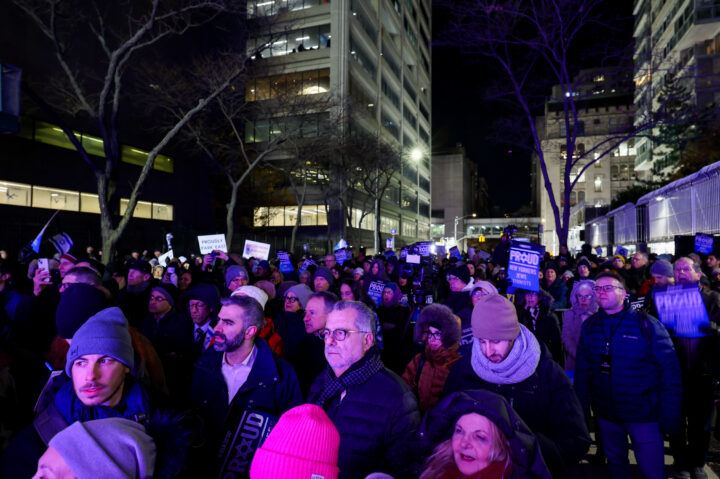
Solidarity rally outside Park East Synagogue, Dec. 4, 2025
More than 1,000 New Yorkers braved the frigid temperatures on Thursday night, stretching across Lexington Avenue on the Upper East Side outside of the historic Park East Synagogue, surrounded by heavy police presence and voicing a unifying message: “We are proud New Yorkers, proud Jews and proud Zionists.”
“The stakes in this moment could not be higher, because how we act will define our community for years to come,” Eric Goldstein, outgoing CEO of UJA-Federation of New York, told the crowd. “We gather outside the sacred space that was targeted weeks ago, standing together to defend our rights as Jews to worship safely and to support Israel’s right to exist as our Jewish homeland.”
The scene was a sharp contrast from the one two weeks ago on that same street when a mob of anti-Israel demonstrators protested outside of the Modern Orthodox synagogue, which was hosting a Nefesh B’Nefesh event providing information on immigration to Israel, shouting chants including “death to the IDF” and “globalize the Intifada.” NYPD Commissioner Jessica Tisch later called the protest “turmoil.”
The solidarity gathering, organized by UJA-Federation as a response to the Nov. 19 protest, drew a diverse coalition of participating Jewish groups, including more than 70 synagogues, schools and Jewish institutions, representing a wide range of denominations and political leanings. Other major Jewish groups acted as cosponsors, including the Jewish Community Relations Council of New York, the Anti-Defamation League and American Jewish Committee, the Conference of Presidents of Major American Jewish Organizations and the New York Board of Rabbis.
Members of B’nai Jeshurun, a non-denominational and progressive Upper West Side synagogue stood side by side with congregants of The Altneu, an Orthodox congregation on the Upper East Side, to condemn antisemitism; Columbia University Hillel student leaders, who have witnessed some of New York City’s worst antisemitic protests on campus, came out in solidarity, as did Yeshiva University students and high schoolers from the Modern Orthodox SAR Academy in Riverdale and Manhattan’s Modern Orthodox Ramaz School and pluralistic Heschel School. Brooklynites representing the Park Slope Jewish Center and Prospect Heights Shul crossed the river to participate, as did members of Long Island and Westchester Jewish communities.
The rally marked the first major gathering of diverse Jewish groups since the release of the remaining living hostages kidnapped during the Oct, 7, 2023, attacks and a ceasefire in the Israel-Hamas war in October. Throughout the war, such gatherings had become common across the U.S., with a unifying focus on bringing home the hostages.
Speakers at the hourlong event, in addition to Goldstein, were Rabbi Arthur Schneier, who leads Park East Synagogue; Hindy Poupko, UJA-Federation senior vice president of community organizing and external relations; Rabbi Joe Potasnik, executive vice president of the New York Board of Rabbis; Rabba Sara Hurwitz, spiritual leader of the Hebrew Institute of Riverdale; Rabbi Joanna Samuels, CEO of the Marlene Meyerson JCC Manhattan; Rabbi David Ingber, founding rabbi of the non-denominational Romemu synagogue and senior director for Jewish Life at the 92nd Street Y; NYC Comptroller-elect Mark Levine; and Mark Treyger, CEO of JCRC-NY. The gathering also featured live performances by rapper Matisyahu and the Park East Day School choir.
“We’re not going back — we’re only going forward,” said Treyger. “We’re going to work and fight to make sure that we see a day where every Jewish New Yorker, every member of our community, is safe, not just in our houses of worship but in every corner of our great city.”
Schneier, who has served as senior rabbi of Park East Synagogue for more than 50 years, told Jewish Insider that the recent protest was “meant to incite fear and intimidation.”
“Chants of antisemitism, demonizing the State of Israel and its right to exist, and calling for a global intifada. Silence and indifference are not an option. No faith community should ever be met with threats, or fear risking their life to gather and pray. This gathering sends a powerful message,” he said
Schneier called for “safety and security and immediate legislation from the city and state to ban demonstrations in front of synagogues and all houses of worship,” which has been introduced by New York state legislators in recent days.
“Let our voices be heard in solidarity — and together, we stand united against a surge of antisemitism that threatens peaceful coexistence in our city. What starts with the Jews doesn’t end with the Jews,” Schneier said, remembering his experience as an 8-year-old child in Vienna in 1938.
“I witnessed my cherished synagogue smoldering to the ground during Kristallnacht — an organized, calculated assault on the Jewish community that was meant to terrorize and intimidate. It was just the precursor of what I lived through during the Holocaust.”
Please log in if you already have a subscription, or subscribe to access the latest updates.
 Continue with Google

 Continue with Apple