














































































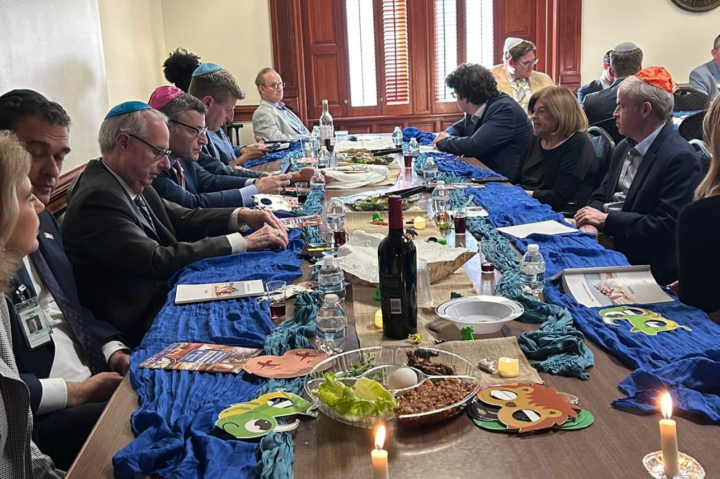
State lawmakers, lobbyists, interns and more joined for a Seder on the second night of Passover, held at the Capitol on the final night of the state legislative session
Courtesy
'Sine Die Seder' at the Georgia state Capitol on April 2, 2026.


 Add JewishInsider on Google
On Thursday, a group of Jewish Georgia politicos gathered for a first-of-its-kind-event at the Georgia statehouse: the “Sine Die Seder.”
Organized by state Rep. Esther Panitch, a Democrat and the only Jewish member of the Georgia General Assembly, the event brought together around 30 Jewish staffers, journalists, lobbyists, interns, a former attorney general and more to celebrate Passover on the final night of the legislative session, known as sine die.
Panitch said that she had asked the House majority leader to cancel the House session on Wednesday, the first night of Passover — and he obliged — but the House was still scheduled to be in session for the second night.
“And so I said, ‘Well, we’re going to be at the Capitol on the second night. Why don’t we have a Seder for probably the 10 of us in the building that are Jewish,’” Panitch told Jewish Insider, referring to herself and a handful of interns, staff and reporters, during the hour-long dinner break during the session.
Interest in the event ballooned, with the group ultimately growing to around 30, with non-Jewish lawmakers and family members of other attendees joining the event. Panitch’s husband led the Seder from their family Haggadah.
“It was very warm … the room was full. It was really special,” Panitch said. “I was really happy the way it turned out — it exceeded my expectations. Everybody participated. People sang.”
Georgia House Speaker Jon Burns, a Republican, joined the proceedings for around 20 minutes and read the “wise son” passage from the Haggadah — a reward, Panitch joked, for bringing up and passing a bill she authored earlier in the day.
Bryan Markowitz, the executive director of the Georgia Ophthalmologic Association, said he’s had to rush home in the past from Georgia statehouse sessions for Seders, “so it was really nice to have it right there and have everybody. Anybody who didn’t know about Passover was able to learn more about it through this experience. And all of us that were there anyway got to enjoy a Seder together, which I thought was really special.”
He said that having Burns in attendance, reading the Haggadah and wearing a yarmulke, was “really very, very powerful to me.”
The highlight of the night, Panitch and Markowitz said, was a custom rendition of the song “Dayenu” commemorating the last day of the House session, “Sine Die-yenu,” written specially for the event by a rabbi from the Atlanta suburbs.
“It was very creatively done and very witty and funny,” Markowitz said.
Greg Bluestein, a longtime political reporter for the Atlanta Journal Constitution, called the event, in a column, “one of the more meaningful seders I’ve ever participated in, an important reminder that some traditions endure even in the Capitol’s most frantic hours.”
The group took in a meal of matzo ball soup, brisket, chicken, mashed potatoes and vegetables over a table decorated with blue tablecloths along both sides to resemble the parted Red Sea — plus plastic frogs scattered along the length of the table to represent one of the plagues inflicted on the Egyptians in the Passover story.
Markowitz and his son, who is interning for a local public affairs firm, both jumped at the opportunity to join the “exciting” Seder when they heard about it. His wife and daughter, he said, “were both sort of jealous, and wanted to come and be part of this experience,” so they ultimately turned it into a full-family affair.
“It was fantastic, and the food was great. The company was great. It was really great to share a special day at the Capitol,” Markowitz told JI. “I can’t think of anything I’d rather be doing on Passover than singing and saying prayers and telling the story of Exodus with the members of the legislature at the Capitol.”
What JI's wine columnist, Yitz Applbaum, will have on his Seder table this year
Getty Images
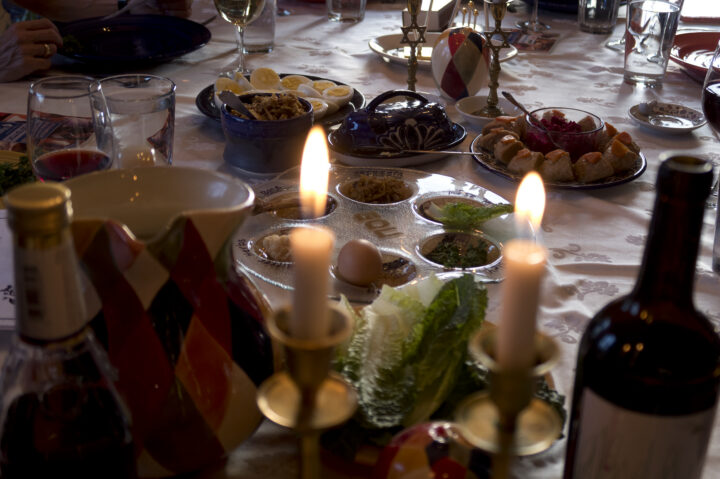
A table set for the Jewish holiday Passover
It has been quite some time since I’ve had the presence of mind to sit down and write my wine column.
Since I last wrote, I’ve welcomed a granddaughter, something I highly recommend, and started an early stage defense technology fund in Israel. Even with all of the changes in my life, the thing I’ve missed most is writing this column and hearing from readers.
As Passover approaches, I’ve received hundreds of emails asking for my Seder lineup, so I’m bringing the column back. I hope you enjoy reading it as much as I enjoy writing it.
Here’s what I’m drinking this year:
First cup: Psagot Sinai
I like to begin with something that sets the tone for the evening. The Psagot Sinai is a blend of Cabernet, Petite Sirah and Shiraz, aged in the ancient caves of the Psagot Winery.
There’s something about this wine that feels transportive. You can imagine what celebrating Passover might have felt like centuries ago. It is lively and expressive and gets the Seder off to the right start.
Second cup: Flam Noble 2023 & Matar Chardonnay 2024
Because the second cup flows directly into the meal, I like to have two wines on the table here, both with enough presence to stand up to the food.
The 2023 Flam Noble is elegant and understated. It is predominantly cabernet, with merlot and petit verdot rounding it out. It opens with a light cherry note and finishes with deeper, darker chocolate tones.
Alongside it, I always want a white. The 2024 Matar Chardonnay is a great partner for the meal. It is a full-bodied, almost meaty white, aged in oak for eight months, with a rich, buttery texture that pairs exceptionally well with heavier dishes.
Third cup: Ella Valley Red
For the third cup, I like something more classic and composed. The Ella Valley Red is a Bordeaux-style blend of cabernet, merlot and petit verdot. It has softer tannins and a deep purple color that invites you to pause for a moment, look at the glass, and slow the pace of the evening.
Fourth cup: Jezreel Valley Icon 2023
For the fourth cup, I want something that leaves an impression. The Jezreel Valley Icon is a blend of carignan and syrah, aged for 22 months in French oak. It is powerful from the start and builds into an even more intense finish, with notes of dark chocolate and a slightly smoky edge. It is the kind of wine that carries the Seder with you into the next day.
Please log in if you already have a subscription, or subscribe to access the latest updates.
 Continue with Google

 Continue with Apple