














































































The mayor pushed back on questions about pouring cash into nonprofits and not changing his Israel rhetoric
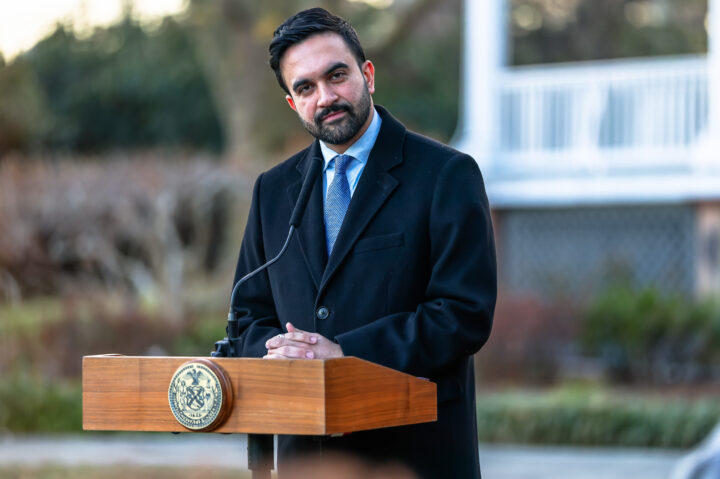
Michael M. Santiago/Getty Images
Mayor Zohran Mamdani speaks at a press conference during moving day at Gracie Mansion on January 12, 2026 in New York City.


 Add JewishInsider on Google
New York City Mayor Zohran Mamdani defended his administration’s strategy to battle spiking antisemitic offenses by spending heavily on nonprofit-based “hate crime prevention” and lower outlays for security — all while keeping up his fierce criticism of Israel on official government channels.
On Tuesday, the Mayor’s Office to Combat Antisemitism released its weeks-delayed “strategy to combat antisemitism,” which touted $1 million in security grants for houses of worship and “other sensitive locations” and $26 million in already announced funding for the Office for the Prevention of Hate Crimes.
Questioned by Jewish Insider at a press conference on Wednesday about evidence that the hate crimes office funding has made a meaningful difference, given that the increased funding has coincided with more and more bias incidents targeting Jews, Mamdani instead talked about his experience learning about the Holocaust as a teenager, and pointed to declining public awareness of the Nazi genocide.
Asked by JI's @WillBredderman about evidence that increased funding for the city’s hate crimes office has mitigated antisemitism, Mamdani instead spoke of learning about the Holocaust as a teenager and pointed to its declining public awareness.
— Jewish Insider (@jewishinsider) September 30, 2026
Read more: https://t.co/16IXo3F18B pic.twitter.com/5grW4pbSDw
“You know, I myself, I went to Bronx Science [High School], and we were lucky to have resources of Holocaust education. I remember going recently to a number of museums where we could see what that actually meant,” the mayor said, as his staff sought to talk over a JI reporter and turned his microphone off. “And that’s something I want to provide for every New Yorker.”
The plan faced immediate criticism from leading Jewish groups for omitting any reference to Israel, including cases of violence and vandalism against New York’s Jews and their institutions inspired by opposition to the Jewish state. But on Wednesday the mayor maintained the program was the product of discussions with “more than 100 Jewish leaders,” and rejected calls that he tone down his own fervent denunciations of Israeli leadership and the military campaign in the Gaza Strip.
“When it comes to criticism of the Israeli prime minister or the Israeli government, that has no bearing on our responsibility to keep Jewish New Yorkers safe,” he asserted. “The responsibility for the Israeli government’s actions lies with the Israeli government. It does not lie with Jewish New Yorkers.”
A list of the Office to Prevent Hate Crimes’ subvendors from 2025 lists a wide array of traditional Jewish and non-Jewish social service providers, many politically connected, as well as explicitly anti-Zionist nonprofits such as Jews for Racial & Economic Justice and the New York chapter of the Council on American Islamic Relations. Agudath Israel of America particularly critiqued the administration’s emphasis on secular expressions of Jewish identity, and $2.5 million in city financing for a facility for the Center for New Jewish Culture, which has hosted and supported Jewish critics of Zionism and Israel.
The mayor brushed off questions about Jewish New Yorkers who consider him an antisemite, while noting his continuing celebration of Sukkot with prominent Jewish supporters.
“I think my job as the mayor is not to get bothered by other people’s opinion,” he said. “My job is to deliver for them, no matter what their opinion is.”
The bill would also allow nonprofits to use a portion of federal grant money to pay personnel to administer grant funding

Helen H. Richardson/MediaNews Group/The Denver Post via Getty Images
Law enforcement officials are on scene to investigate an attack on the Pearl Street Mall in Boulder, Colorado on June 1, 2025.
Over a year after the deadly firebombing attack targeting an Israeli hostage awareness march in Boulder, Colo., Rep. Joe Neguse (D-CO), who represents the city, and Rep. Don Bacon (R-NE) introduced legislation to modify Nonprofit Security Grant Program conditions to allow grantees to use funding for staffing costs.
Currently, synagogues and other NSGP recipients are allowed to use funding to hire contracted security guards. Under the new bill, the Safe Spaces for All Act, grantees would also be able to use funding to hire full-time security staff, as well as off-duty police officers.
The bill would also allow institutions to use up to 5% of a grant to pay staff to prepare grant applications and administer grants. Supporters of the program have frequently highlighted that the laborious grant application process is a significant obstacle for small congregations and institutions that may not have dedicated grant-writing staff.
“We must do far more to combat the scourge of antisemitism, and to ensure that synagogues, temples and community centers have the resources to ensure that they are safe as hateful threats and violent actions metastasize in Colorado and across the country,” Neguse, who serves as the assistant Democratic leader, said in a statement. “The Safe Spaces for All Act bolsters security for our communities, and ensures that under these incredibly trying circumstances, members of the community can feel protected and supported.”
Bacon, a retiring House member who co-chairs the House antisemitism task force, said that “every nonprofit, especially faith-based and community organizations, deserves to safely serve their communities.”
“As threats increasingly target our vital civic and religious institutions, this straightforward, pragmatic measure ensures we’re providing the tools needed to keep Americans safe — without creating a new bureaucracy,” he continued.
The Anti-Defamation League, Jewish Federations of North America and the JEWISHcolorado Jewish Community Relations Council are also supporting the bill.
Jonathan Greenblatt, the CEO of the Anti-Defamation League, emphasized that Jewish community defenses must “evolve and escalate” at pace with the threats facing them, and that security personnel are often “the first person you meet” inside an American synagogue today.
“The Safe Spaces for All Act meets that reality head-on by modernizing the Nonprofit Security Grant Program so at-risk organizations can protect the people they serve,” Greenblatt said.
Eric Fingerhut, the CEO of JFNA, said that community institutions “require flexible, practical tools to keep communities safe” and that the bill “clarifies eligible uses under the Nonprofit Security Grant Program, ensuring organizations can use these resources to address their evolving security needs.”
The Colorado JCRC said that “security is not one-size-fits-all” and that security personnel and grant-management capacity “are just as critical as the cameras, barriers, and other physical improvements.”
The Safe Space for All Act, the group continued, “would provide institutions the flexibility to use NSGP funding where it can have the greatest impact — making the program more accessible, responsive, and effective.”
Anne Arundel County Executive Steuart Pittman is facing criticism from the newly created Annapolis Jewish federation

Maryland State Capital building in Annapolis, Maryland.
A Maryland Jewish group is “not taking no for an answer” after the Anne Arundel County executive repeatedly declined to include funding for security grants requested by Jewish institutions in his proposed budget.
Amid rising antisemitism in the state, the newly formed Jewish Federation of Annapolis & the Chesapeake wrote to Anne Arundel County Executive Steuart Pittman last month requesting similar security grants as neighboring counties have received for hate crime protection.
Pittman, whose second and final term ends in December, denied the request. In a county-wide email on April 24, he wrote, “I want to share some of my thinking on the tough decisions, on saying, ‘No, not this year.’”
“I’ll start with a proposal to create a county-funded and administered grant program to pay for security at organizations vulnerable to hate crimes,” Pittman wrote. “It came primarily from the four synagogues in Anne Arundel County, but has attracted support from others. I took the proposal seriously. Antisemitism is a national epidemic, as is hate against African Americans, Muslims, immigrants, and the LGBTQ+ community. All of these groups have enhanced security measures in the last year and a half.”
Still, he said his office would not be including a provision to fund a county-administered program that helps pay for security for vulnerable minority communities in the county in its final budget proposal for the next fiscal year.
“We’re not taking no for an answer from the county council,” Jennifer Laszlo Mizrahi, co-founder of the Jewish Federation of Annapolis & the Chesapeake, told Jewish Insider. “The county executive has now told us no three times. He told us in person, in an email that he sent to the entire county and now [on Friday] in a budget that he released publicly to the whole county.”
Laszlo Mizrahi said the federation, which was formed last year, has started conducting meetings with the five candidates running to replace the term-limited Pittman, and although the group cannot endorse a candidate, it plans to publish a voter’s guide to be distributed around local Jewish institutions.
While Anne Arundel County, which is home to Annapolis, the state’s capital, provides no Jewish security funding, the county — which has a fairly small Jewish population compared to other Maryland counties — receives federal and state security grants, which Laszlo Mizrahi called “extremely oversubscribed.”
“What makes us different from most small communities is that state capitals attract protesters who are angry and there have been a lot of people who are angry at Israel and come to our hometown,” she continued.
In Maryland, 356 antisemitic incidents were reported in 2024, according to the Anti-Defamation League, the sixth highest number reported in the country. This included 195 incidents of harassment, 154 incidents of vandalism and seven cases of assault.
In his email, Pittman pointed to surrounding counties — heavily Jewish Montgomery County, which has a $1.7 million safety grant program, and Howard County and Prince George’s County — having “much smaller programs in previous budgets.”
“None, in my view, come close to meeting the needs, and while some have said that even a small program sends a signal that we care, I believe that a small grant program that rejects most applicants leaves too many feeling rejected,” he wrote.
“I met with advocates for a safety grant program on March 19, with our Police Department and Hate Crimes Prevention Program present. I told them that there would be no grant program in our upcoming budget proposal, but that I wanted to hear more about the need, their security programs, and where the gaps exist. Police held a follow-up meeting with the group to go into more detail,” continued Pittman.
“A future county executive may see things differently, but I believe that the focus of our county work to protect synagogues and other vulnerable institutions should remain with our Police Department and Hate Crimes Prevention Program.”
“Our federation is brand new and we have a long way to go to play catch up,” Laszlo Mizrahi told JI. “One thing we have learned is that if you aren’t at the table, you are on the menu. When a county can find $400,000 in funding for more pickleball lighting, but can’t find security dollars, we know we need to work in partnership for a better future.”
“I believe we are going to achieve this because it is common sense,” she continued. “People understand the threat. We have a fabulous partnership with the police but when you call 911 it still takes time for them to come. When the crisis is a life or death matter of seconds, you need to have a guard on the premises. That’s where the gap is in terms of funding, particularly for the [preschools].
Pittman’s office did not respond to a request for comment from JI.
Please log in if you already have a subscription, or subscribe to access the latest updates.
 Continue with Google

 Continue with Apple