











































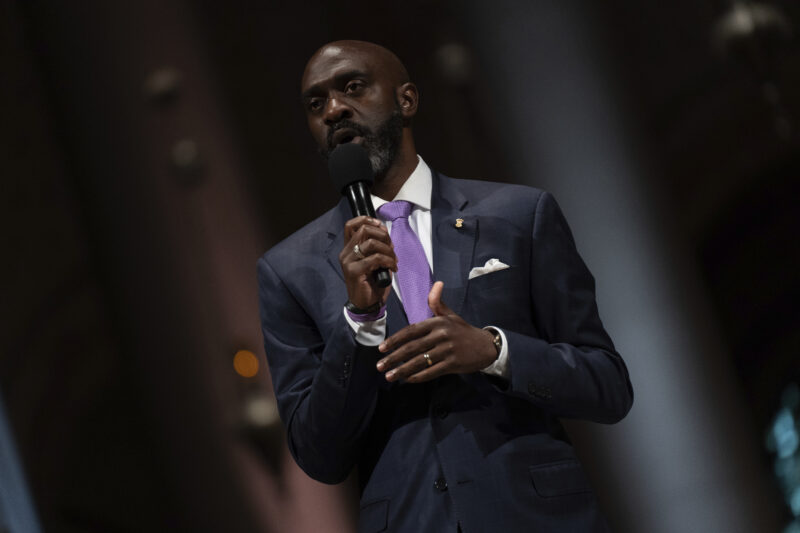

























Top IDF and government officials have clashed on a series of issues, including the appointments of more than two dozen military officials and Zamir’s opposition to the plan to take over Gaza City and expand IDF operations in the Gaza Strip

IDF
The Chief of the General Staff, LTG Eyal Zamir, the Director of the ISA, Ronen Bar, and the Commanding Officer of the IAF, Maj. Gen. Tomer Bar, in the IAF’s Underground Operations Center, commanding the strikes in Gaza overnight between March 17th and March 18, 2025


 Add JewishInsider on Google
Tensions between Israeli Prime Minister Benjamin Netanyahu and Eyal Zamir, the chief of staff of the IDF, are as high as the record-setting temperatures that have swept the region.
The IDF’s top officials and the Israeli government have clashed on a series of issues in recent days, including the appointments of more than two dozen military officials and Zamir’s opposition to Netanyahu’s plan to take over Gaza City and expand IDF operations in the Gaza Strip, which was approved by Israel’s Security Cabinet last week.
The IDF chief of staff has warned that the new approach to Gaza risks the lives of the 20 remaining living hostages in the enclave, and would further deplete the military’s resources in Gaza. The army, under strain after nearly two years of war, has — even prior to Zamir’s appointment in March — been at odds with the government over the continued exemption of the majority of the country’s Haredi population from the mandatory conscription required of most Israelis.
Israel Democracy Institute President Yohanan Plesner told Jewish Insider this morning that “historically, the relationship between the political level — prime minister, defense minister — and the top brass of the defense establishment, and mainly the IDF chief of staff, has been based on the premise that when Israel engages or embarks on significant security endeavors, operations and so on, it’s based on mutual consent,” with both parties having “de facto … veto power.”
But now, Plesner said, Netanyahu “is violating this decision-making norm that characterized the way decisions on core security [and] national security issues were made in the past.”
Plesner pointed to IDI polling conducted earlier this summer that showed Zamir being the senior official in whom Israelis had the most trust, at 68.5%. The same poll found Netanyahu with a trust rating of 40%.
The potential removal of a senior official months into his tenure “was not in the cards in the past. A chief of staff would voice their professional opinion and they wouldn’t risk being fired.”
The clash between Netanyahu and Zamir has also drawn in former Israeli Prime Minister Naftali Bennett, who is widely seen as one of the only people who could topple Netanyahu in the next election. Bennett attributed the infighting to Zamir’s opposition to the continuation of Haredi draft exemptions — an issue that has sowed division even within Netanyahu’s coalition and still threatens to topple the government.
“Instead of standing behind the army,” Bennett said, “the government has launched an attack *on* the army.”
Netanyahu has previously clashed with — and dismissed — senior military officials, most notably former Israeli Defense Minister Yoav Gallant, whom Netanyahu first tried to fire in early 2024 but was met with mass protests, before ousting him in November 2024. Last summer, Israeli media reported tensions between the prime minister and Zamir’s predecessor, Lt. Gen. Herzi Halevi, over Netanyahu’s suggestion that hostage talks had not moved forward because Hamas did not feel enough pressure from the country’s military. Netanyahu also pursued the dismissal of former Shin Bet chief Ronen Bar whom he clashed with on a number of issues — including the hostage negotiations and war strategy — citing “continuing lack of trust.”
Plesner pointed out that relations between Netanyahu and both Gallant and Halevi “very much soured around the fact that they were committed to implementing the Supreme Court ruling” that removed the Haredi draft exemption, and that Zamir, as chief of staff, similarly backs the conscription of the Haredi community as war fatigue plagues the reservists who have served hundreds of days in uniform since the start of the war.
Nearly all of the IDF’s top leaders from Oct. 7, 2023, have departed their roles, whether by choice or force, in the almost two years since the attacks. Netanyahu — who has long tried to absolve himself of responsibility for the attacks, instead blaming the military and the Shin Bet — remains the only senior government official from that time still in power. Analyst Nadav Pollak suggested that the prime minister has, since Oct. 7, been “trying to divert the blame from him to the military leadership (he didn’t know Hamas plans etc.) and as long as the focus is on the IDF leadership it’s not on Bibi.”
Now, with the Knesset out for the rest of the summer, ceasefire talks stalled and an immediate collapse of his government off the table, Netanyahu is able to buy some time — perhaps up to several weeks — as Israel’s top political and military brass game out and implement the government’s Gaza strategy. Meanwhile, observers will watch to see how Zamir will carry out Netanyahu’s orders.
Tzvika Mor, head of the hawkish Tikvah Forum, a minority group of hostages’ families, calls to prioritize defeating Hamas, says putting hostages first is ‘indescribable stupidity’

Chip Somodevilla/Getty Images
The parents of Eitan Mor, a security guard kidnapped on October 7 at the Supernova rave, wait to meet with Speaker of the House Mike Johnson (R-LA) and other fellow family members of kidnapped victims at the U.S. Capitol on February 06, 2024 in Washington,
The day after Israel’s Security Cabinet voted to seize control of Gaza City, the Hostages Families Forum organized a major protest in Tel Aviv against the decision, warning it would put their loved ones’ lives in danger.
But Tzvika Mor, father of hostage Eitan Mor, has been speaking out against the Cabinet decision for a different reason — he thinks the IDF should be pushing even more aggressively to take over the rest of Gaza.
Nearly two years since his son was kidnapped while working as a security guard at the Nova festival on Oct. 7, 2023, Mor, 48, has not wavered from his position that defeating Hamas must be Israel’s top priority in the war in Gaza, above the hostages.
Mor, who lives in Kiryat Arba, a settlement abutting Hebron in the West Bank, normally works as an ADHD coach. But since the Oct. 7 attacks, he has divided his time between advocating for the country’s victory over Hamas and serving as an IDF reservist in the Paratroopers’ Brigade. In the long term Mor wishes to see the entirety of Gaza become part of Israel, telling Jewish Insider in an interview on Sunday, “It is the land of the Tribe of Judah; it is ours.”
As chairman of the Tikvah Forum, a more hawkish minority group of hostage families than the larger and better-known Hostages Families Forum, Mor and several other hostages’ relatives oppose partial deals and the release of large numbers of terrorists, arguing that only sustained military pressure will bring all of the hostages home. Mor spoke out against the Israeli Security Cabinet’s recent decision in his interview with JI.
“The question isn’t what they’re going to do, but what is the goal. If the goal is to lead Hamas to negotiate, it will fail, just like in Gideon’s Chariots, which took five months and didn’t bring back the hostages and didn’t destroy Hamas,” Mor said, referring to the IDF operation that began earlier this year. “The goal cannot be to bring [Hamas] to talks; it must be to destroy them.”
Hamas, he said, is not motivated to return the hostages, because they have the food, fuel and water that they need to survive, but if they feared for their survival, the situation would be different.
Mor compared the situation to the story in Genesis in which Abraham’s nephew Lot is kidnapped by four kings, and Abraham took an army with him to fight the kings.
Abraham “didn’t talk to them. He didn’t pay them. He fought a war until they surrendered. That is the way,” Mor said.
Mor said fighting to pressure Hamas to return to the table reflects an order of priorities that is both wrong and ineffective.
“The war cannot be about the hostages, and I say that as the father of a hostage. How many soldiers should be killed for the hostages?” he asked. “You don’t go to war to bring back hostages. You go to war for sovereignty, for deterrence. Then, when you win, you get your captives back.”
Prioritizing the hostages “not only harms national security, but it also hurts the hostages, because Hamas learns that they’re the most important to us and raises the price all the time. It’s indescribable stupidity,” he lamented.
Mor warned that if Israel “concedes in Gaza, Hamas will never give up all of the hostages … And what would the message be to the Arabs in Judea and Samaria” – he asked, using the biblical name for the West Bank – “that kidnapping Israelis is the best thing to do?”
In the past, Mor said, “it was clear that there was no negotiating with terrorists. We would try to save our hostages and take risks, but we could not give in to terrorism.”
Mor cited research by the Yachin Research Center, which he said showed that four times more Israelis were killed in terrorist attacks between the signing of the Oslo Accords in 1993 and 2023 than in 1949-1992.
“That means that since Israel gave in to terrorism, more Israelis were murdered. It’s clear … That needs to stop,” he stated.
Asked about the concerns that other hostage families have expressed about expanded military action in Gaza putting their loved ones at risk, Mor responded with a question: “Is our war in Gaza necessary? If there weren’t hostages, would we still need to go to war?”
“The answer is yes, because [Hamas] cannot remain our neighbors after we saw what they can do, or they would do it again. They are religious people; they live for this. They don’t live for a nice house and a car and social status. Not for coffee shops and pilates. They live to kill Jews. They’re like zombies. You have to destroy them. The war would be necessary even if there were no hostages,” he said.
As such, Mor said, Israel must take the necessary steps to win the war in Gaza: “It cannot be that we will endanger 10 million Israelis because of the hostages. We need to solve that problem such that we are not harming national security.”
“We have fears, too,” he added, “but in war, some are hurt. Soldiers are injured in the war too.”
Mor and another one of his sons have been in combat units in the current war. Thirteen soldiers in Mor’s brigade have been killed.
Early in the war, after Israeli Prime Minister Benjamin Netanyahu met with members of the Tikvah Forum, Hebrew news coverage accused the forum members of being Likud plants or, at least, being easier for Netanyahu to talk to than the Hostages Families Forum, whose early leadership included political campaigners involved in protests seeking to bring down his government.
Mor, however, has been and continues to be critical of Netanyahu, who he said he hasn’t spoken to in six months, and of Likud ministers who he has spoken to more recently, including Intelligence Minister Gila Gamliel and Agriculture Minister and former Shin Bet director Avi Dichter.
“I tell them these things, but almost all of the ministers in Likud align with the prime minister and say we have to agree to partial [hostage] deals,” Mor lamented.
Mor says that he has faced pressure for raising a different voice from the more prominent hostage relatives, and that “people defame and curse me.” In December 2023, the father of another hostage accused him on live television of giving up on his son, leading Mor to start crying.
“The Israeli media doesn’t help. They lead the campaign” against him, he said. “But I feel that I am a messenger of the people of Israel. It is clear to me that the people of Israel want to win … They are connected to their roots, to the Land of Israel and to Judaism. They don’t want to be sold dreams and delusions that ‘it will all be OK, we can give in to terror and then deal with it later.’ We can’t deal with it. If we surrender, we will pay a higher price.”
Mor has not seen pictures or videos of his son Eitan, 25, since Oct. 7, 2023, but he said that the most recent sign of life he received was from Israeli intelligence services in February this year.
“We don’t know anything except that he’s alive,” Mor said.
In May, Eitan’s mother, Efrat Mor, said she learned from another hostage released in the first deal in November 2023 that Eitan is using his “incredible social skills … both for himself and for the other hostages” to lift everyone’s spirits.
Eitan is the eldest of eight children.
“He is very strong, physically and mentally. He was very Zionist. He was a fighter and commander in the Golani Brigade” of the IDF, his father said. “He’s not soft; he doesn’t whine. He is strong; he’s a leader. We are sure that if he is with other hostages, he is helping them and strengthening them.”
When Hamas terrorists attacked the Nova rave, Eitan contacted an uncle because his parents do not use phones on Shabbat. He said that he and his friends were hiding, and sent videos of terrorists on pickup trucks. He also sent his location so that his uncle could pass it on to the IDF. The last time he was in contact with his uncle was at 10:04 a.m. His parents did not know that he was at the party, and they did not find out about the Oct. 7 attacks or that their son had been taken hostage until the evening.
Later, Nova survivors said that Eitan left his hiding place and saved their lives, which his father said “tells you the most about him.”
“He could have gone home at 6:29, but he stayed to save people,” Mor said. “He hid people and ran with them until he was kidnapped at 12:30, not by Hamas but by Gazan civilians.”
Right and left rail against Israeli plan to seize control of Gaza City to further pressure Hamas
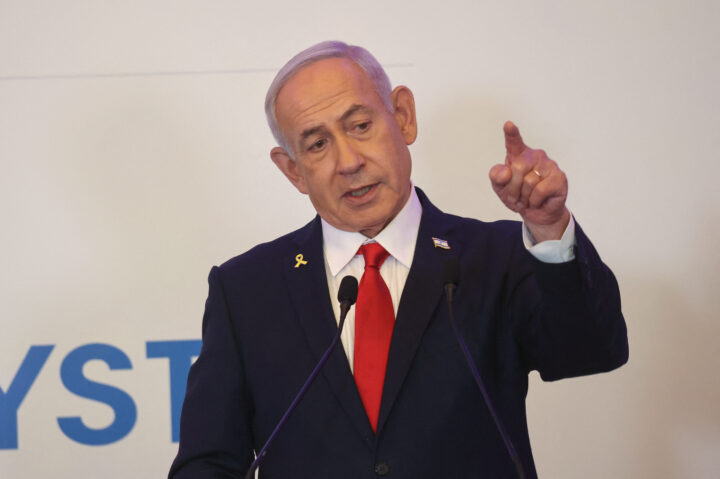
GIL COHEN-MAGEN/AFP via Getty Images
Israel's Prime Minister Benjamin Netanyahu speaks during an event at the Waldorf Astoria Hotel in Jerusalem on July 27, 2025.
Israel’s decision to take control of Gaza City is meant to prevent further prolonging the war, Israeli Prime Minister Benjamin Netanyahu said on Sunday.
The prime minister’s comments come as elements of the Israeli right and nearly all of the left have railed against the decision, further destabilizing the prime minister’s hold on Israel’s leadership.
In a video statement on Saturday night, Israeli Finance Minister Bezalel Smotrich said he had “lost trust that the prime minister can and wants to lead the IDF to a decisive victory.”
At the same time, tens of thousands of Israelis took to the streets of Tel Aviv to protest against the Cabinet’s decision, calling for an immediate hostage deal.
Speaking Sunday at a press conference for foreign media in Jerusalem, Netanyahu said that “Hamas still has thousands of terrorists in Gaza … Hamas is refusing to lay down its arms, so Israel has no choice but to finish the job.”
”Contrary to false claims,” the prime minister argued, “this is the best way to end the war and to end it speedily.”
Rather than take control of Gaza City, part of the remaining 25% of Gaza that Israel does not control, IDF Chief of Staff Lt. Gen. Eyal Zamir presented to the Security Cabinet on Thursday night a strategy of surrounding those areas, while expressing concern about the safety of the 20 hostages believed to still be alive if a military takeover is attempted.
As to whether Israel’s new plan puts hostages in further danger, Netanyahu said that “the option of just doing a war of attrition from a defensive position has not proved itself. It won’t bring [the hostages] out … [It will lead to a] protracted conflict that won’t bring the war to an end.”
”I don’t want to prolong the war. I want to end the war, and I think the other option would have prolonged the war,” he added. “Prolonging the war means that many of them could be starved to death.”
Netanyahu also emphasized Israel’s “five principles for concluding the war,” authorized by the Security Cabinet, which he said were his “day-after plan” for Gaza. They consist of disarming Hamas, returning the hostages, demilitarizing Gaza, Israeli security control of the enclave and establishing a civilian administration for Gaza led by neither Hamas nor the Palestinian Authority.
Though Netanyahu said in an interview with Fox News last week that Israel plans to take control of all of Gaza, the Security Cabinet decision announced early Friday morning fell short of that.
The Security Cabinet voted early Friday, after a 10-hour meeting that began the previous day, for the IDF to “prepare for taking control of Gaza City while distributing humanitarian assistance to the civilian population outside the combat zones.”
Netanyahu continued to speak of the IDF seizing all of Gaza on Sunday, presenting an image of the “remaining Hamas strongholds” of Gaza City and the “central camps and Moassi,” a second enclave. A spokesperson for the prime minister clarified to Jewish Insider after the press conference that “the decision that was authorized is about Gaza City. Later, if needed, the central camps as well.”
Netanyahu said that, as Israel did before maneuvering into Rafah over a year ago, it plans to move the population out of Gaza City, “safeguard the civilian population and let us go, at last, into the most important stronghold of Hamas.”
Gaza City is only part of the remaining 25% of Gaza not currently controlled by the IDF. Reports indicate that the IDF said it will take two months to move the civilian population out of the city; Netanyahu said he instructed the military to do it in less time because he wants to finish the war as soon as possible.
That two-month window leaves an opening for another ceasefire deal as Qatar, Egypt and the U.S. are reportedly working on reviving negotiations.
The plan was supported by “a decisive majority of Security Cabinet ministers,” according to the Prime Minister’s Office.
Smotrich accused Netanyahu of “making a U-turn” from a plan they devised together “to go all the way,” involving “dramatic moves to bring victory in Gaza, a combination of a quick military victory and an immediate diplomatic move to exact a painful price from Hamas, destroy its military and civilian capabilities, and put unprecedented pressure to free the hostages.”
Instead, Smotrich argued, the Security Cabinet chose to support “an immoral, unreasonable folly,” that would involve “sending tens of thousands of fighters to maneuver in Gaza City while endangering their lives and paying heavy diplomatic and international prices, only to pressure Hamas to free hostages and then retreat.”
“I cannot back this decision. My conscience doesn’t allow it … No more stopping [the war] in the middle … We must make a clear, sharp move to defeat Hamas and bring the hostages home all at once,” he stated.
Despite saying that he lost trust in Netanyahu, Smotrich did not say he was leaving the coalition. Instead, he called for another Security Cabinet meeting to further discuss Israel’s next steps in Gaza.
Israeli National Security Minister Itamar Ben-Gvir, who, like Smotrich, has pushed for more aggressive moves in the war in Gaza, told Army Radio on Sunday that Smotrich turned down his offer to present an ultimatum to Netanyahu to quit the government if it does not accept a plan to “go in, destroy, conquer.” Smotrich and Ben-Gvir have called for Israel to fully occupy Gaza and build Israeli settlements in the enclave.
Smotrich’s outspoken criticism is a signal of the growing leverage he holds within Netanyahu’s volatile government. Netanyahu currently has a minority coalition, holding just 60 out of the Knesset’s 120 seats, making his political situation tenuous. The United Torah Judaism and Noam parties left the coalition last month over disputes relating to sanctions for Haredim who do not serve in the IDF.
Tzvi Sukkot, a lawmaker from Smotrich’s Religious Zionism Party, wrote in a post on X on Sunday morning, “if we are going back to Oct. 6, 2023 and decide to give up on the war aims, it is an existential threat to the State of Israel. If that is the situation, in my humble opinion, we must go to an election.”
Israeli opposition leader Yair Lapid wrote Smotrich a letter asking for his support for a bill to disperse the Knesset, which would trigger an election.
“You admitted that the prime minister’s policy is not bringing a decisive victory in Gaza, is not bringing back our hostages and is not winning the war,” Lapid wrote. “You added that you cannot stand behind the prime minister and back him anymore. In light of this, I call you to join me in a letter to the Knesset speaker in which we can say there was a significant change in circumstances that justifies bringing up the bill to disperse the Knesset again.”
At the same time, the political opposition and the Hostages Families Forum spoke out against the more aggressive approach in Gaza approved by the Security Cabinet, pointing to Zamir’s opposition to the move.
Lapid called the decision “a disaster that will lead to many additional disasters.”
“In total opposition to the opinion of the military and security levels, without consideration for the exhaustion and attrition of the fighting forces, Ben-Gvir and Smotrich dragged Netanyahu to a move that will take many months, will lead to the death of hostages, to many soldiers killed, will cost tens of billions of Israeli taxpayer money and will lead to diplomatic collapse. That’s just what Hamas wants,” Lapid said.
“As we approach the tragic one-year anniversary of the murder of six hostages who were executed by their captors, the expansion of fighting only further endangers those still held in Gaza’s tunnels,” the forum stated. “Hamas continues to exploit military escalation as justification for its brutal treatment of our loved ones … Our government is leading us toward a colossal catastrophe for both the hostages and our soldiers. The Cabinet chose last night to embark on another march of recklessness, on the backs of the hostages, the soldiers, and Israeli society as a whole.”
Tens of thousands gathered for the weekly demonstrations in central Tel Aviv Saturday night, blocking the city’s central artery, the Ayalon Highway. Some of the hostages’ relatives called for a general strike on Sunday and for soldiers to refuse orders.
Shai Mozes, nephew of released hostage Gadi Mozes, said that following the Security Cabinet decision, “the mission you’ll be given is participation in killing the hostages. In this situation, there is no choice but to refuse.”
Several hostages’ relatives expressed support for a general strike, as did Lapid. The Hi-Tech Forum, representing dozens of Israeli tech companies and hedge funds, said they would allow their employees to miss work if a strike is held.
The Histadrut, Israel’s national labor union, declined to support a strike, following a court ruling last year that they can only strike for explicitly labor-related reasons.
Netanyahu also discussed the humanitarian situation in Gaza in the press conference Sunday, saying that Israel’s “policy throughout the war has been to prevent a humanitarian crisis while Hamas’ policy is to create it.”
Israel is working to avoid a humanitarian crisis by designating safe corridors for aid distribution, increasing safe distribution points managed by the Gaza Humanitarian Foundation and continuing airdrops by Israel and other countries, he said.
”The only ones being deliberately starved in Gaza are our hostages,” Netanyahu argued, displaying a screenshot from a video Hamas released last week of hostage Evyatar David and contrasting his emaciated arm with the much thicker one of his captor.
Netanyahu also displayed photographs of children from Gaza who appeared in the foreign media alongside claims that they had been starved by Israel, and listed the congenital diseases from which they suffered that were not originally reported. He said his office is looking into whether Israel can sue The New York Times over the matter.
The prime minister compared the claims to blood libels: “We were said to be spreading vermin in Christian society; we were said to be poisoning the wells; we were said to slaughter Christian children for blood. That was followed by massive violence, pogroms, displacement, followed by the worst of all, the Holocaust.”
”The international press is falling for Hamas propaganda, hook line and sinker,” he added, standing next to the text “Open your eyes to Hamas’s lies.”
Netanyahu also said he had ordered the IDF to allow more foreign journalists into Gaza.
However, he stated, “We will not commit suicide to get a good op-ed.
In recent months, public sentiment in Israel has shifted noticeably. With most of Hamas’ senior military leadership eliminated, growing numbers of Israelis have begun to question the feasibility of Netanyahu’s goal of 'total victory' over Hamas
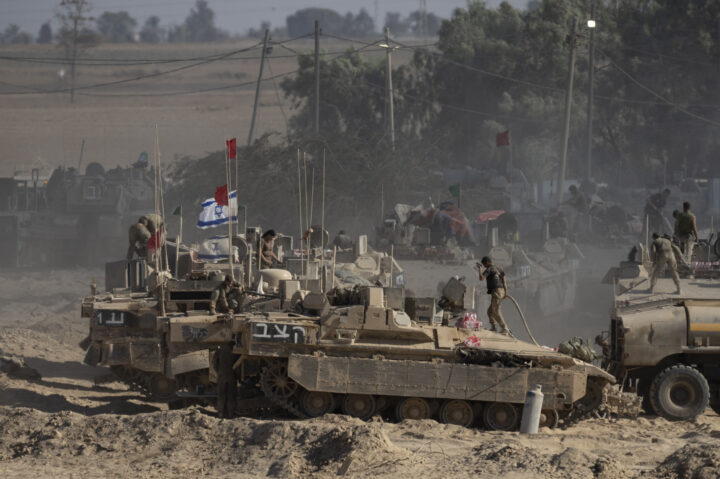
Amir Levy/Getty Images
Israeli soldiers organize military equipment while standing on armored personnel carriers near the border with the Gaza Strip on August 6, 2025 in Southern Israel, Israel.
Israeli Prime Minister Benjamin Netanyahu’s announcement on Thursday that Israel plans to take control of additional parts of the Gaza Strip before handing it over to an unspecified Arab governing authority is being met with hesitation from even some of Israel’s most stalwart defenders. The Security Cabinet voted early this morning to take control of Gaza City, stopping short of the full occupation previously discussed.
Throughout much of Israel’s war against Hamas in Gaza, the Israeli public broadly supported the military effort, even as progressive lawmakers such as Sens. Bernie Sanders (I-VT) and Elizabeth Warren (D-MA) painted the war as “Netanyahu’s war,” and the Israeli prime minister as the bogeyman-in-chief.
But in recent months, public sentiment in Israel has shifted noticeably. With most of Hamas’ senior military leadership eliminated, growing numbers of Israelis have begun to question the feasibility of Netanyahu’s goal of “total victory” over Hamas, given the terror group’s hold on the Gazan population and a lack of clarity on what’s left to accomplish militarily. Instead, polling shows that a large majority of Israelis prefer prioritizing a diplomatic resolution that secures the release of the remaining hostages, rather than expanding the military occupation of Gaza in hopes of complete surrender.
Netanyahu’s plan this week to occupy more of Gaza has begun to sap Israel’s political capital even among some of its closest allies on Capitol Hill, not to mention the isolation the Jewish state is facing from less-friendly European capitals. Even within the American Jewish community, as the war drags on into its 23rd month and with mounting IDF fatalities and no living hostages having been released since May, splits have emerged over the wisdom of Netanyahu’s double-down strategy.
Indeed, while the official Israeli position on its war against Hamas in Gaza has hardened, the approach in the Diaspora, both from Jewish groups and leaders and elected officials, has also shifted — in the opposite direction.
Meanwhile, the families of hostages, whose desperation has been deepened by recent videos and images of emaciated captives, have escalated their efforts, taking to the sea in a flotilla that sailed toward Gaza on Thursday in an effort to raise awareness about the plight of their loved ones.
Netanyahu, still mired in legal issues, finds himself in a bind of his own making amid mounting global pressure to end the war and let aid flow freely into Gaza — which contrasts sharply with right-wing members of his coalition who loudly call for the opposite, even as top IDF brass opposes a full Gaza takeover. Speaking from the Temple Mount/Al Aqsa Mosque in Jerusalem earlier this week, National Security Minister Itamar Ben-Gvir called on Israel to “conquer all of Gaza, declare sovereignty over the entire Strip, eliminate every Hamas member, and encourage voluntary emigration.”
On Capitol Hill, Israel’s traditional allies in the Democratic caucus — including some who have given Netanyahu leeway to press forward in Gaza in the past, even when it meant butting heads with the Biden administration — are beginning to shift.
Rep. Ritchie Torres (D-NY) told Jewish Insider’s Marc Rod that Israel is ultimately responsible for making its own decisions, but said he’d advise the Israeli government to seek an end to the war once the remaining 50 hostages are freed.
“The war fatigue and post-traumatic stress in Israeli civil society and in the Israeli military — as well as the humanitarian crisis in Gaza — have become unbearable,” Torres said. “Israel has degraded Hamas. And so once Israel has secured the release of the hostages, it should declare victory, end the war and focus on expanding the Abraham Accords to include relations with the likes of Saudi Arabia and Indonesia.” More reactions from Torres and other Democratic lawmakers here.
Rep. Dan Goldman (D-NY) said in a statement on Thursday that “Netanyahu’s personal and political interests are guiding Israel’s actions” and slammed the prime minister’s “ineffective military operation in Gaza,” which, he added, “has only led to more unnecessary deaths.”
Earlier this week, Rep. Valerie Foushee (D-NC) – who in 2022 was one of the first major recipients of support from AIPAC’s super PAC— announced she was signing onto legislation to ban offensive arms sales to Israel.
The New York Times’ Bret Stephens warned this week, “If Netanyahu makes the colossal mistake of trying to reoccupy Gaza for the long term, then no thoughtful person can be pro-Israel without also being against him.”
The new shift in tone — exacerbated by mounting concerns about humanitarian aid in Gaza and bolstered by Netanyahu’s recent efforts to prolong the war in Gaza — extends beyond Washington and the media elite to some of the leading Jewish communal organizations, figures and philanthropists, dozens of whom signed onto a letter to Netanyahu this week, condemning his government’s policies and rhetoric for causing “lasting damage” to Israel and Diaspora Jewry and calling for an end to the Israel-Hamas war. Read more in eJewishPhilanthropy here.
Mainstream groups and officials, such as the American Jewish Committee and U.K. Chief Rabbi Ephraim Mirvis, have in recent days expressed deep concern about the humanitarian crisis in Gaza and the prosecution of the war.
Israel finds itself, 22 months after Hamas’ attacks, at war at home and abroad. Hamas’ attack didn’t resolve the issues that had caused divisions in Israeli society in the months leading up to Oct. 7, 2023. The national cohesion following the horrific attacks has dissipated, and now segments of Israeli society are again at odds with each other, as Israel finds itself needing to win back invaluable political capital even as its leadership is taking it for granted.
The Israeli prime minister said he and Trump hadn’t discussed the plan but had agreed to a humanitarian surge beforehand

Kevin Dietsch/Getty Images
Israeli Prime Minister Benjamin speaks during a meeting with U.S. President Donald Trump in the Oval Office of the White House on April 7, 2025 in Washington, DC.
Just before convening his Security Cabinet to vote on a full IDF takeover of the Gaza Strip, Israeli Prime Minister Benjamin Netanyahu said on Thursday that Israel “intends to” take over the enclave but “doesn’t want to keep” the territory or “be there as a governing body.”
Speaking to Fox News’ Bill Hemmer from his office in Jerusalem, Netanyahu said, “We don’t want to keep [Gaza]. We want to have a security perimeter. We don’t want to govern it. We don’t want to be there as a governing body. We want to hand it over to Arab forces that will govern it properly without threatening us and giving Gazans a good life.”
Asked if President Donald Trump had given him a “green light” for the plan, Netanyahu said Trump “understands that it’s Israel who’s going to do the fighting” but that the two “haven’t gone into that kind of discussion.” Netanyahu added that the two leaders had agreed to a “humanitarian surge” to take place before what Netanyahu called “our final military action.”
Netanyahu said he and Trump also agreed on “certain principles” for a day-after plan for Gaza, including the demilitarization of both Hamas and Gaza, the release of the remaining hostages, Israel maintaining responsibility for security in and around the Strip and for Gaza to be “governed by a civilian authority that is not Israel.”
“I don’t want to occupy Gaza forever,” Netanyahu said.
In the Fox interview, Netanyahu also railed against the recent New York Times above-the-fold front page photograph of a Gazan child, presented as an example of suffering from severe malnutrition, when he had a genetic disorder. Netanyahu said he was looking into “whether a country can sue The New York Times.”
Asked if he would allow more independent reporters to go into Gaza in order to report more accurately, Netanyahu said, “That’s my conclusion. In fact, that’s my instruction as of this morning to the military … Those who are lying are going to continue lying, but give honest journalists the ability to see the truth.”
Netanyahu, Zamir and Katz held a three-hour meeting on Tuesday, which was reportedly very tense due to disagreement over the plan
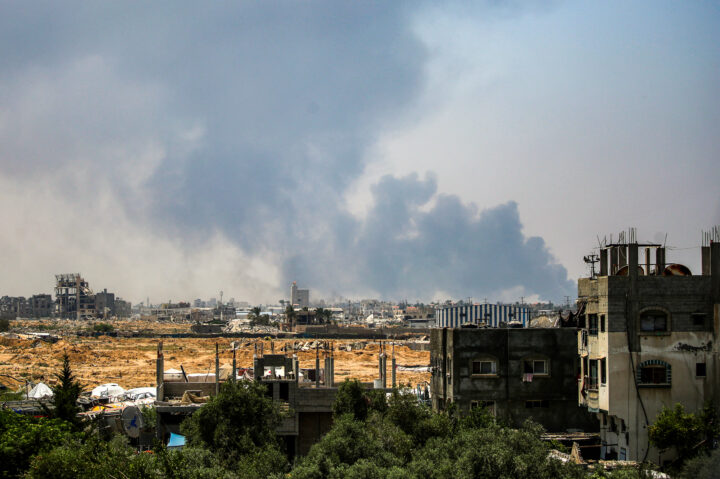
EYAD BABA/AFP via Getty Images
Smoke billows from Israeli bombardment as pictured from Deir el-Balah in the central Gaza Strip on July 21, 2025.
Israel’s Security Cabinet is set to vote this week on occupying the remaining parts of Gaza that it does not currently control, after Hamas refused last month’s ceasefire and hostage deal proposal and did not return to negotiations.
Israeli Prime Minister Benjamin Netanyahu, IDF Chief of Staff Lt.-Gen. Eyal Zamir and Defense Minister Israel Katz held a three-hour meeting on Tuesday, which was reportedly very tense due to disagreement over the plan, though Zamir ultimately said he will follow through with the government’s decision.
Zamir argued that the IDF should surround the areas in Gaza in which it currently does not have a presence, including Gaza City and towns in the center of Gaza in which hostages are believed to be held. Entering those areas, Zamir warned, would endanger the lives of the 20 hostages who are thought to be alive. Hamas has threatened to kill hostages if the IDF approaches, as it had executed six hostages a year ago.
Beyond the fraught issue of the hostages, there is the matter of what “occupation” means.
Broadly, the war in Gaza was initially conducted via raids in which the IDF would warn civilians to leave a given area, enter, destroy terrorist infrastructure and combat terrorists, and eventually leave to move to a different part of Gaza, letting the population return. Hamas terrorists would also end up returning to those areas, leading the IDF to have to enter some of the same places repeatedly.
In March, Israel embarked on Operation Gideon’s Chariots, in which Israel entered Gaza from its perimeter on all sides, and moved inwards, capturing territory and maintaining control of it, in contrast to its previous strategy. That operation has, in effect, resulted in Israel controlling 75% of Gaza.
The remaining 25% is what Israel would move to control under the plan Netanyahu supports.
Brig.-Gen. (res.) Yossi Kuperwasser, head of the Jerusalem Institute for Strategy and Security and the former head of research for IDF intelligence, told the Misgav Mideast Horizons podcast this week that the commonly used 75%-25% formulation is “a misrepresentation.”
“Almost all the population of Gaza is in areas controlled by Hamas, which allows Hamas to keep its grip over the population, and this is the source of its power … It’s not about the percentage of the area, it’s about who controls the population,” he said.
While “occupation” is the correct military term for what Israel would be doing by taking control of territory, the connotation of the word in the Israeli context tends to be the West Bank, which Israel has controlled since 1967 and where over half a million Jewish citizens of Israel live.
Some Cabinet ministers have advocated for allowing Israelis to move to Gaza, where 21 Israeli settlements were forcibly evacuated in 2005; Netanyahu has repeatedly rejected such a plan.
What senior Israeli officials have long said is that, while Israel seeks to have other countries and some Palestinians administer Gaza, they will not do so until it’s clear that Hamas has been ousted. As such, Israel may have to take control for some time until other arrangements are made.
Kuperwasser said that while Netanyahu’s decision may be risky, Zamir’s preference of surrounding the remaining 25% of Gaza is more of the same.
“In Gaza, there are no good options,” he said. “The option of continuing what we have done for the last 22 months is not a good option, because it didn’t put enough pressure on Hamas to release the hostages and accept the idea that they should give up their arms. The option of succumbing to Hamas demands … is a very bad idea, too. And taking over Gaza is also a bad idea, because you end up being responsible for the population of Gaza and there is going to be a lot of criticism around the globe … you cannot guarantee that you are going to get the hostages alive.”
Kuperwasser argued that the only way at this point for Israel to move towards freeing the hostages and removing Hamas from power is if Hamas is “convinced that we are about to take over Gaza by force and remove them from power by force … So we have to make this decision, and yes, it comes with a price.”
Starting on the new strategy may be enough to convince Hamas to reach a deal, Kuperwasser said, but in order to get to that point, he argued, Israel has to prepare to actually occupy Gaza.
“We have to convince Hamas that we are serious, that we are really preparing for this eventuality,” including for civil administration of Gaza, he said.
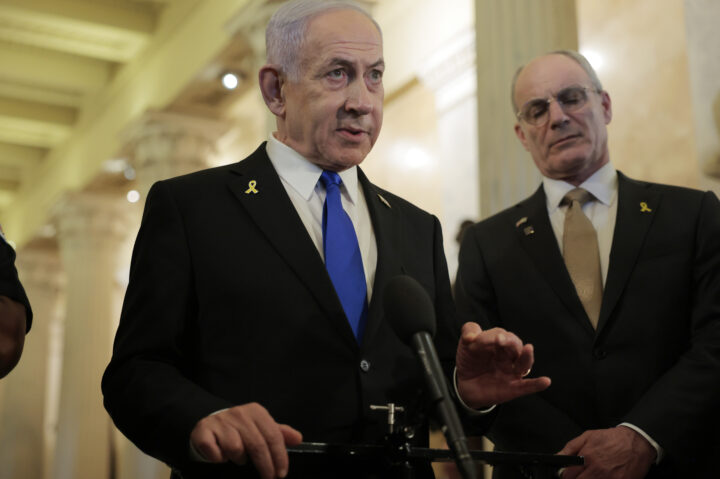
Anna Moneymaker/Getty Images
Israeli Prime Minister Benjamin Netanyahu speaks to reporters after meeting with U.S. Speaker Mike Johnson (R-LA) at the U.S. Capitol on July 8, 2025, in Washington, D.C.
Good Monday afternoon.
This P.M. briefing is reserved for our premium subscribers like you — offering a forward-focused read on what we’re tracking now and what’s coming next.
I’m Danielle Cohen-Kanik, U.S. editor at Jewish Insider. I’ll be curating the Daily Overtime for you, along with assists from my colleagues. Please don’t hesitate to share your thoughts and feedback by replying to this email.
📡On Our Radar
Notable developments and interesting tidbits we’re tracking
There has been a whirlwind of political activity in Israel today, starting with the bombshell news that Prime Minister Benjamin Netanyahu intends to ask the Security Cabinet to approve an expansion of Israel’s war in Gaza, which would see the IDF control all of the enclave.
The move will have reverberations throughout Jerusalem and Washington, from Netanyahu’s own government to hostage families, Capitol Hill and the White House. Officials on both sides of the aisle in the U.S. have been pushing hard for a comprehensive ceasefire and an end to the war — including Middle East envoy Steve Witkoff, who was in Israel just days ago at the behest of President Donald Trump. Stay tuned to Jewish Insider for how this will play out in the coming days…
In other headlines coming out of Israel, the Cabinet voted unanimously this morning to oust Attorney General Gali Baharav-Miara, with whom the current government has been at odds since it was formed, accusing her of political bias.
Shortly after the vote, the Israeli Supreme Court issued an injunction temporarily blocking the firing and ordering the government to continue abiding by Baharav-Miara’s legal opinions until the court issues a final ruling.
It’s the first time an Israeli government has ever voted to oust the AG, and with some Cabinet ministers already boycotting her and pushing back on the court’s decision, Israel could be edging toward a constitutional crisis.
Meanwhile, Likud MK Yuli Edelstein was officially pushed out of his chairmanship of the Knesset Foreign Affairs and Defense Committee today, over coalition disagreements on a Haredi conscription bill. He was replaced by Boaz Bismuth, also from Likud, whom the party hopes will be more amenable to reducing sanctions on Haredim who dodge the draft. Israeli voters across a large swath of the political spectrum, including the Likud base, are on Edelstein’s side of the debate…
Getting a front-row seat to these developments, House Speaker Mike Johnson’s (R-LA) trip to Israel with a House Republican delegation continues today. The group visited the town of Ariel, making Johnson the highest-ranking elected federal official to visit a West Bank settlement. While there, Johnson told a meeting of senior Yesha Council officials that “Judea and Samaria are the front lines of the State of Israel and must remain an integral part of it,” and stopped by Ariel University…
Also in Israel this week are two delegations of freshman House members, one from each caucus, organized by the AIPAC-affiliated American Israel Education Foundation. The Democratic trip is led by Rep. Steny Hoyer (D-MD), the former House majority leader, and Rep. Pete Aguilar, (D-CA), the caucus chair…
Back at home, Conference of Presidents of Major American Jewish Organizations CEO William C. Daroff met with Under Secretary of Defense Elbridge Colby at the Pentagon today. Though Colby had faced criticism around his nomination from pro-Israel circles for his calls to scale back U.S. involvement in the Middle East, Daroff told JI that Colby “expressed a clear and serious understanding of U.S. strategic interests in the Middle East, including the vital importance of deterring Iran, preventing regional adversaries from gaining dominance, and sustaining Israel’s security following the Twelve Day War.” Daroff said he was “encouraged by [Colby’s] principled and grounded approach”…
The Federal Emergency Management Agency said in grant notices made public Friday that states must guarantee they will not engage in boycotts of Israeli companies in order to qualify for a tranche of more than $1.9 billion in natural disaster preparedness grants…
Software analytics giant Palantir topped $1 billion in revenue for the first time, it shared in an earnings report today. The company has secured several large contracts with the Trump administration, including an agreement announced last week for $10 billion over the next decade with the U.S. Army…
Veteran Democratic political strategist Howard Wolfson, an outspoken supporter of Israel and Jewish causes, appeared on Daniel Gordis’ “Israel from the Inside” podcast today with the message that “the war for hearts and minds” in U.S. support for Israel “has been lost.” The former communications director of Hillary Clinton’s 2008 presidential campaign, Wolfson said that he’s “clanging the alarm bell as loudly as I can and hoping that the Israeli public and the decision-makers in Israel understand how far Israel has fallen in public approval in the United States and what the implications of that are.”
“Israel is getting absolutely decimated” in information warfare, Wolfson continued. “And that may not be fair, it may not be accurate, but I think those questions of fairness and accuracy, they’ve become largely irrelevant. It’s not about fairness and accuracy. It’s about effectiveness and about impact.”…
⏩ Tomorrow’s Agenda, Today
An early look at tomorrow’s storylines and schedule to keep you a step ahead
Keep an eye on Jewish Insider this week for a dive into the lessons learned from Israel’s disengagement from Gaza 20 years ago this month, an analysis of what a new poll of New York City Jewish voters means for Zohran Mamdani’s mayoral prospects and a look into the latest fundraising figures from pro-Israel campaign groups.
Tomorrow morning, Israeli Foreign Minister Gideon Sa’ar will meet with American Jewish leaders in New York, JI has learned, and then head to a meeting of the U.N. Security Council on the situation of the hostages held in Gaza. Sa’ar prompted the special session after videos of two hostages — Evyatar David and Rom Braslavski — were released by Hamas and the Palestinian Islamic Jihad, showing the two men looking haggard and severely emaciated.
Stories You May Have Missed
MARYLAND MOOD
Sen. Alsobrooks flip-flops from pledge to maintain aid to Israel during Senate campaign

Many of the state’s Jewish leaders are wary of speaking out against the Maryland Democrat’s votes to block arms sales to Israel
QATAR CALL
Landsman calls on Qatar to detain Hamas leaders until hostages are freed

The Democratic congressman, in a letter rejecting an offer for a staffer to travel to Qatar, said that the kingdom needs to do more to pressure Hamas
Last year, Hamas executed six hostages when the IDF approached their position; military reportedly opposes taking control of areas in Gaza where hostages are believed to be held
Anna Moneymaker/Getty Images
Israeli Prime Minister Benjamin Netanyahu speaks to reporters after meeting with U.S. Speaker Mike Johnson (R-LA) at the U.S. Capitol on July 8, 2025, in Washington, D.C.
Israeli Prime Minister Benjamin Netanyahu plans to ask the Security Cabinet to back expanding Israel’s military efforts in Gaza, Israeli media reported on Monday.
“We are going to conquer the [Gaza] Strip,” a senior source in Netanyahu’s office told Israel’s Channel 12. “The decision was made. Hamas will not free more hostages without us fully surrendering, and we will not surrender. If we don’t act now, the hostages will die of hunger and Gaza will remain under Hamas’ control.”
A few caveats: Netanyahu did not use the term conquer or occupy with all of the Cabinet ministers to whom he conveyed his position, according to Israeli public broadcaster KAN. Maariv reported that Netanyahu has not made a final decision yet about whether the IDF should take control of all of Gaza, and noted that legally, he cannot decide on his own without the Security Cabinet.
“Netanyahu realized … that there is no point anymore in waiting for Hamas [to agree to a deal], and therefore a decision about the next stage of the war must be made quickly,” a source involved in the matter told Maariv. “The dispute now is not about whether to act or negotiate, because a deal with Hamas is no longer on the table. Rather, it’s about how to act without a deal, whether to go for full conquest or for a siege and increased pressure.”
IDF Chief of Staff Maj.-Gen. Eyal Zamir reportedly favors a siege over occupying all of Gaza.
The IDF currently controls about 75% of the Gaza Strip, and the new plan would bring the entire area under Israel’s control. Among the areas the IDF would enter would include Gaza City, where the IDF has not maneuvered in a year and a half, and towns in central Gaza, where some 20 remaining living hostages are believed to be held.
The military’s hesitation to enter those areas was, in part, due to a concern for the hostages’ safety. Last year, Hamas executed six hostages when the IDF approached their position and former hostages have said that their captors said they would kill them if the army approached the location where they were held. Hamas has also warned the IDF that attempts to rescue hostages would result in death.
Senior officials were quoted in multiple Israeli news outlets saying that Zamir should resign if he disagrees with Netanyahu’s decision to take control of the remaining 25% of the Gaza Strip.
Netanyahu is expected to bring the proposal to a Security Cabinet vote on Tuesday.
The move comes two weeks after Hamas rejected a partial ceasefire and hostage-release deal, and Israel and the U.S. said they would only pursue comprehensive agreements to free all of the hostages moving forward. Hamas and Palestinian Islamic Jihad published videos in recent days of hostages Rom Braslavski and Evyatar David who appeared to be starving; the latter was filmed digging his own grave.
In addition to Zamir, others expected to argue against conquering the rest of Gaza, according to Channel 12, are Foreign Minister Gideon Sa’ar, Shas leader Arye Deri, National Security Advisor Tzachi Hanegbi and Mossad chief David Barnea, among others.
Netanyahu has the support of Strategic Affairs Minister Ron Dermer, Finance Minister Bezalel Smotrich, National Security Minister Itamar Ben-Gvir, Military Secretary Maj.-Gen. Roman Gofman and Cabinet Secretary Yossi Fuchs.
The Prime Minister’s Office did not respond to requests for comment on the reports.
Rather than confirm or deny that he had made a decision about Israel’s next military steps in Gaza, Netanyahu posted a video to X after Hebrew media reported on the matter, which focused on Israeli efforts to get food and medicine to residents of Gaza, and compared claims that Israel was starving Gazans to antisemitic conspiracy theories.
A security cabinet meeting on Gaza over the weekend ended inconclusively; experts say contrary to Trump claims, Netanyahu’s trial is not delaying a ceasefire

Avi Ohayon (GPO) / Handout/Anadolu via Getty Images
Israeli Prime Minister Benjamin Netanyahu convenes a meeting with members of his security cabinet following Iran's launch of a ballistic missile attack against Israel, in Tel Aviv, Israel on June 14, 2025.
Two roads diverged for Israel’s security cabinet in a Sunday night meeting about Gaza, and since they could not travel both routes, the cabinet decided not to make a decision.
The Security Cabinet met to discuss Israel’s next steps in Gaza after 633 days of war: ceasefire or escalation.
Some in the IDF high brass argued that the Gaza war’s objectives have been met — noting that the army had destroyed Hamas’ military infrastructure, killed nearly all of the senior Hamas commanders on its target list, dismantled tunnels, seized 60% of Gaza, blocked key smuggling routes — leaving Hamas weaker than it has been since its 2007 takeover of Gaza. They argued that now is the time to pursue an exit strategy, according to military analyst Amir Bohbot.
If there is no ceasefire, the IDF plans to continue its current operation in Gaza, calling up tens of thousands of IDF reservists and moving to conquer 80% of the territory. Officers in the cabinet meeting reportedly warned that doing so could bring about a large number of casualties, including some of the hostages. In the past week, the army has suffered near-daily losses of soldiers in Gaza.
On Monday, the IDF called on the residents of several neighborhoods in northern Gaza to evacuate, warning that military operations in their areas would escalate and intensify.
President Donald Trump’s choice is clear: “MAKE THE DEAL IN GAZA. GET THE HOSTAGES BACK!!!” he wrote on Truth Social on Sunday. Two days earlier, he said there could be a ceasefire within a week.
What a ceasefire would mean is unclear. The parties could agree to a temporary ceasefire, which Israelis have called the “Witkoff outline,” after Middle East envoy Steve Witkoff. Such a ceasefire would last 60 days, with the release of half of the remaining 50 hostages, 21 of whom are thought to be alive, in exchange for hundreds of Palestinian prisoners, including terrorists, and increased humanitarian aid flow into Gaza.
Israeli Prime Minister Benjamin Netanyahu denied a report last week that he and Trump discussed a sweeping plan to end the Gaza war and expand the Abraham Accords, but a source with knowledge of the matter told Jewish Insider on Monday that much of the details are, in fact, currently in talks, even if they may still be far from fruition.
Among the elements under discussion are the exile of remaining Hamas leaders from Gaza, and for Israeli troops to remain along Gaza’s perimeter — the Philadelphi Corridor along the Gaza-Egypt border is still under debate — and for the United Arab Emirates, Egypt and Saudi Arabia to take a central role in Gaza’s administration. In addition, there have been talks about normalization between Israel and Syria.
Netanyahu’s rush to deny the original report — which included Israeli acknowledgment of a future Palestinian state — underscores the degree to which he believes such a move would be politically toxic and could threaten to break up his governing coalition.
Of course, the U.S. and Israel can make plans, but Hamas has ideas of its own. Negotiators have on multiple occasions leaked the details of past ceasefire proposals, only for Hamas to reject the deals on the table. As Michael Milshtein, an expert on Palestinian affairs at Tel Aviv University, told Israel’s Kan Radio on Monday morning, “even after Iran blew up, Hamas is sticking to the same stance … [that] the IDF must fully withdraw” from Gaza.
More recently, Trump has found a different culprit for the lack of a ceasefire: the Israeli judiciary. For the second time in recent days, the president took to his social media network to lament that “it is terrible what they are doing in Israel to Bibi Netanyahu … How is it possible that the Prime Minister of Israel can be forced to sit in a Courtroom all day long, over NOTHING (Cigars, Bugs Bunny Doll, etc.). It is a POLITICAL WITCH HUNT, very similar to the Witch Hunt that I was forced to endure. This travesty of ‘Justice’ will interfere with both Iran and Hamas negotiations.”
One part of Trump’s Truth Social post raised alarm bells in the Israeli commentariat, with some interpreting the president’s words as a threat: “The United States of America spends Billions of Dollar a year, far more than on any other Nation, protecting and supporting Israel. We are not going to stand for this,” he wrote. “This greatly tarnishes our Victory [in Iran].”
The judge in Netanyahu’s trial was not convinced by Trump’s first post on social media, nor by a confidential letter from Netanyahu saying that there are urgent security matters requiring the postponement of the prime minister’s planned cross-examination this week. However, when the head of the Mossad and the head of IDF intelligence showed up at the courthouse hours after Trump’s second post on Sunday, Netanyahu received the deferral that both he and Trump wanted.
Asked whether Netanyahu’s trial is holding up a possible ceasefire in Gaza, Amichai Cohen, head of the Israel Democracy Institute’s Program on National Security and the Law, told JI that “it’s common sense that if critical things are happening in the war in Gaza, there won’t be proceedings. You don’t need the [resident of the United States for that to happen; the Israeli system knows how to handle it.”
Marc Zell, an international lawyer who is the chairman of Republicans Overseas Israel and a frequent defender of Trump in Israeli media, took issue with the interpretation that Trump is tying the issue of the hostages and the war in Gaza with to the trial, beyond the fact that “President Trump is quite understandably concerned that the prime minister is being distracted by what he considers silly political proceedings, which he understands because Trump himself was the object of a similar campaign … Trump is highly motivated to get this thing done and take advantage of what could be a sea change in the politics of the Middle East.”
Cohen and Zell were both skeptical that Trump’s entreaties would have much of an impact on Netanyahu’s case.
Cohen said that Trump may be trying to get a plea deal for Netanyahu. However, Attorney General Gali Baharav-Miara, whom Netanyahu’s cabinet ministers are currently trying to fire, would have to sign off on it. “I don’t think Trump would influence her,” Cohen said.
However, Trump could pressure Israeli President Isaac Herzog to pardon Netanyahu, which Cohen said was “the only place where politics could play a role. However, he added, “according to past rulings by the High Court, a pardon can only apply to someone who admitted wrong doing” — which Netanyahu has not done.
Zell called the proceedings against Netanyahu “specious,” but defended the independence of Israel’s judiciary. He told JI that Trump’s attempted intervention is “a direct affront to [Israel’s] sovereignty” and that “this is not the business of the U.S.; it’s the business of the State of Israel.”
Of Netanyahu supporters who cheered Trump’s posts, he said: “If we’re inviting a foreign state to interfere in our own proceedings, however misguided they may be … it opens the door to subsequent administrations. This is what the Biden administration did; it tried to interfere in our political processes and stop judicial reform.”