












































































John Phelan was on Capitol Hill meeting with the leaders of the Armed Services Committee minutes before the Pentagon announced his dismissal on social media — a move that caught even Senate Majority Leader Thune off guard
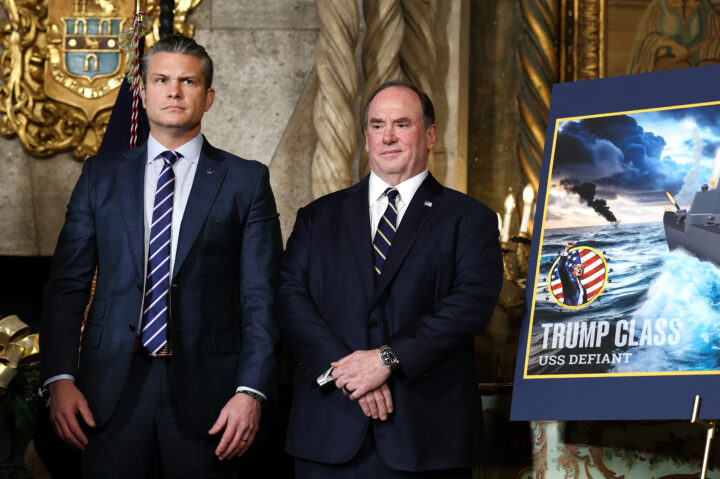
Tasos Katopodis/Getty Images
Secretary of War Pete Hegseth and Secretary of the Navy John Phelan stand together as U.S. President Donald Trump announced the creation of the “Trump-class” battleship during a statement to the media at Trump’s Mar-a-Lago estate on December 22, 2025 in Palm Beach, Florida.


 Add JewishInsider on Google
Defense Secretary Pete Hegseth did not give advance notice to senior Republican senators before announcing on Wednesday that he was firing Navy Secretary John Phelan and had already tapped his replacement, causing surprise and confusion on Capitol Hill.
“I found out about it the way everybody else did,” Senate Majority Leader John Thune (R-SD) told Jewish Insider of the Pentagon’s announcement on social media of Phelan’s dismissal.
Reached for comment, the Pentagon referred JI to Pentagon spokesperson Sean Parnell’s statement on X — the first public announcement of the news.
“Secretary of the Navy John C. Phelan is departing the administration, effective immediately. On behalf of the Secretary of War and Deputy Secretary of War, we are grateful to Secretary Phelan for his service to the Department and the United States Navy,” Parnell said on X. “We wish him well in his future endeavors.”
After taking part in White House meetings earlier Wednesday, Phelan was on Capitol Hill in the afternoon for a pair of pre-scheduled meetings, the first with Sen. Roger Wicker (R-MS), the chairman of the Senate Armed Services Committee, and the second immediately after with Sen. Jack Reed (D-RI), the committee’s ranking member. Phelan’s departure was posted to the Pentagon’s social media pages minutes after Phelan walked out of Reed’s office, a source familiar with the matter told JI.
A GOP senator on the committee who spoke to Reed and Wicker after the Pentagon announced Phelan’s immediate dismissal told JI that the topic of Phelan’s future in his role did not come up in either meeting, and that none of the three men was expecting such a move.
“This was a total surprise to Senate Republican leadership, to the two leaders of the Armed Services Committee and, clearly, to the secretary of the Navy himself,” the senator said.
Senators on the committee privately expressed concern to JI over Phelan’s firing, which comes amid as the U.S. is maintaining a naval blockade of Iranian ports and has begun boarding Iranian-linked tankers around the world, with three U.S. aircraft carriers on station or en route to the Middle East.
“I mean, I’m sure there are going to be some questions asked about the reasons, etc.,” Thune told JI. “But hopefully the authorizing committee will get a briefing and be informed about some of these decisions.”
Prior to his role at the Defense Department, Phelan ran an investment firm and was a major fundraiser for President Donald Trump’s presidential campaign. Phelan and other administration officials had reportedly been clashing over how best to grow the U.S. shipbuilding industry, a longtime challenge, though Phelan has heralded his own close relationship with Trump.
Hegseth’s term has also been marked by ongoing friction with other senior officials in the department, including Army Secretary Daniel Driscoll, and the firings of multiple top officials. Hegseth fired Army chief of staff Gen. Randy George earlier in April.
Phelan is being replaced by Under Secretary of the Navy Hung Cao, a former House and Senate candidate in Virginia.
Pentagon spokesperson Sean Parnell told JI: 'Senior Department of Defense officials will no longer be participating at the Aspen Security Forum because their values do not align with the values of the DoD.'
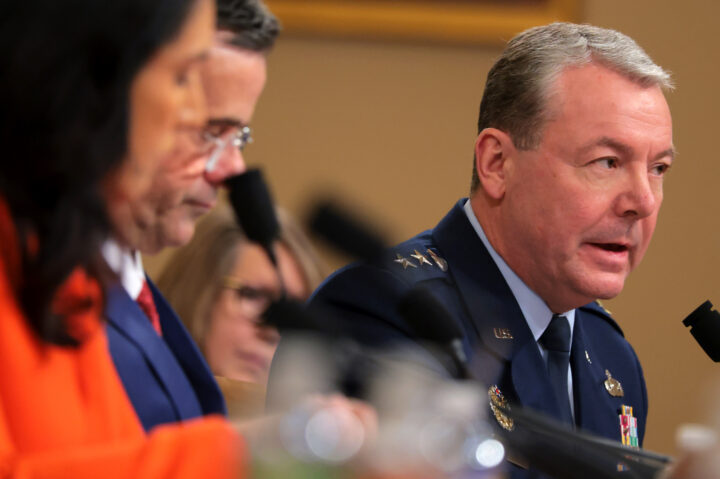
Kayla Bartkowski/Getty Images
Defense Intelligence Agency Director Jeffrey Kruse testifies during an annual worldwide threats assessment hearing at the Longworth House Office Building on March 26, 2025 in Washington, DC.
The 2025 Aspen Security Forum kicks off today and finds itself unexpectedly thrust into the ideological fights gripping the administration.
The Defense Department announced Monday that it would be withdrawing numerous senior military and civilian officials who had been set to speak at the conference.
Pentagon spokesperson Sean Parnell told Jewish Insider: “Senior Department of Defense officials will no longer be participating at the Aspen Security Forum because their values do not align with the values of the DoD. The Department will remain strong in its focus to increase the lethality of our warfighters, revitalize the warrior ethos, and project ‘Peace Through Strength’ on the world stage. It is clear the ASF is not in alignment with these goals.” Spokesperson Kinglsey Wilson offered even more pointed criticism to right-leaning outlet Just the News, saying the conference “promotes the evil of globalism, disdain for our great country, and hatred for the President of the United States.”
It’s tough criticism of a forum that prides itself on bipartisanship and aims to foster cross-partisan dialogue and solution-making, even as those attributes are in short supply in today’s Washington. The forum said in a statement, “we will miss the participation of the Pentagon, but our invitations remain open. … The Aspen Security Forum remains committed to providing a platform for informed, non-partisan debate about the most important security challenges facing the world,” noting that voices across the political spectrum will be speaking this week.
Many had been hoping to hear Defense Intelligence Agency Director Lt. Gen. Jeffrey Kruse, who was originally scheduled for a panel discussing the evolution of warfare, speak about his agency’s leaked report suggesting the strikes on Iran’s nuclear facilities had minimal effects, but Kruse was among the speakers withdrawn by the Pentagon.
Among the administration speakers still scheduled to appear are hostage envoy Adam Boehler, speaking on Thursday, and Tom Barrack, the U.S. ambassador to Turkey and special envoy to Syria. Barrack will be speaking on a Friday panel about the Middle East alongside former CIA Director David Petraeus and former Deputy National Security Advisor Dina Powell McCormick.
Wednesday’s Israel-focused panel will feature former IDF Intelligence Chief Amos Yadlin, former Israeli Ambassador to the U.S. Michael Herzog, former Biden administration official Brett McGurk and author and “Call Me Back” podcast host Dan Senor.
An Iran-focused panel on Thursday will include former U.S. National Security Advisor Stephen Hadley, former CEO of the Bulletin of Atomic Scientists Rachel Bronson and Johns Hopkins professor Vali Nasr.
There’s likely to be plenty of discussion throughout the week about the ways the Trump administration’s strikes on Iran will shape policy in the Middle East — and throughout the world — going forward, and about the ongoing impacts of the war in Gaza.
Former National Security Advisor Jake Sullivan will be speaking on Friday on a panel with former Secretary of State Condoleezza Rice and former Defense Secretary Robert Gates.
Former Defense Secretary Mark Esper and former Homeland Security Secretary Jeh Johnson will also be speaking Friday, on AI and cybersecurity issues, respectively. Former Deputy Treasury Secretary Wally Adeyemo will speak on Thursday about international aid and trade.
Sens. Chris Coons (D-DE), John Cornyn (R-TX) and Mark Warner (D-VA) will lead the conference’s annual “View from the Senate” panel on Friday.
We’ll be keeping an ear out for discussion about the internal debates between hawks and isolationists taking place within the Trump administration over America’s role and engagement in key global arenas — from the Middle East to Ukraine and Asia. We’ll also be tracking proposed efforts to restructure the U.S. intelligence community.
Expect a significant focus throughout the week on the many ways that the Trump administration’s unpredictable foreign policy — from its recommitment to providing Ukraine military aid to the status of tariffs against key countries, along with the recent, sweeping cuts to the State Department and U.S. Agency for International Development — is shaking up global affairs, how the private sector and foreign countries are adapting and how leaders can attempt to maintain bipartisanship on foreign policy.
Please log in if you already have a subscription, or subscribe to access the latest updates.
 Continue with Google

 Continue with Apple