











































































The Treasury Department designated over 60 entities, individuals and vessels that enable Iran ‘to procure illicit nuclear and missile technology, conduct cyber operations and generate oil revenue,’ Bessent said
Chip Somodevilla/Getty Images
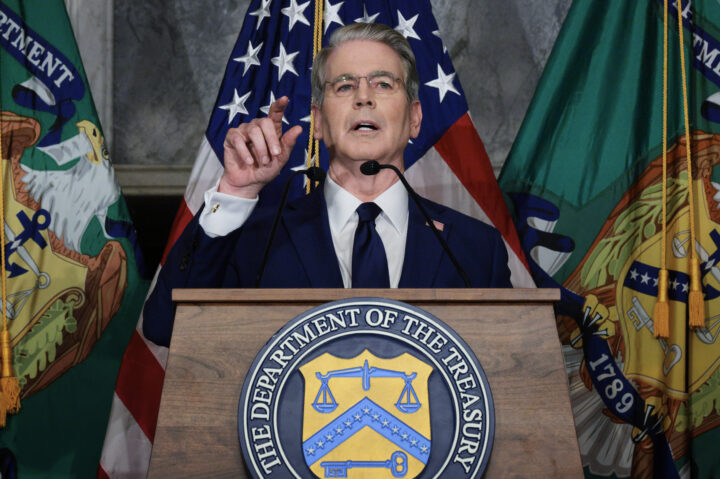
U.S. Treasury Secretary Scott Bessent announces a new set of sanctions against Iran, describing them as "an economic D-Day", in the Cash Room at the Treasury Department on Aug. 24, 2026 in Washington, DC.


 Add JewishInsider on Google
Treasury Secretary Scott Bessent announced on Monday that the Trump administration is launching “Operation Economic Outcast” against Iran, outlining a targeted effort aimed at severing Tehran’s global economic ties in order to “collapse every last option” for Tehran.
“Today, we are launching Operation Economic Outcast … Treasury has mapped every node, every facilitator, and every network that Iran has used to smuggle oil and evade sanctions,” Bessent said at a press conference at the Treasury Department. “Beginning today, the actions of Treasury and other agencies will tighten the noose and block every potential source of revenue that funds the [Islamic Revolutionary Guard Corps] and the evil Iranian regime. We are enforcing a zero leakage approach.”
The directive targets five economic sectors: digital assets, technology, gold, aviation and shipping. At Bessent’s direction, the department’s Office of Foreign Assets Control on Monday designated over 60 entities, individuals and vessels worldwide “that enable the Iranian regime to procure illicit nuclear and missile technology, conduct cyber operations and generate oil revenue.”
“America is no longer managing the Iranian threat, we are ending it,” Bessent asserted. “Iran now faces a very clear choice, with only two paths before them: complete global isolation and a subsistence economy, or a path back to normalcy with an opportunity to rejoin the global economy.”
Bessent explained that Washington is pushing allied countries to comply with the isolation regime and said the U.S. would no longer tolerate diplomatic or commercial neutrality in other countries’ relationships with Tehran.
“The president is making phone calls to world leaders with specific requests to cease their interactions with the regime. We are already seeing results,” Bessent said. “Teams from Treasury, State [Department] and the U.S. military are now meeting with their global counterparts to tell them that the United States expects action. Every country has a defined timeline to shut down activities we have identified. If they do not take action, we will do so unilaterally through Treasury authorities.”
“Those who stand with the United States will reap the rewards of our partnership,” he continued. “Those who tether themselves to the Iranian regime should expect to share in the isolation of a withering regime.”
While Bessent declined to provide a timeline for countries to comply, he emphasized that U.S. patience is not infinite, stating that Washington would aggressively pursue secondary sanctions against any country or entity that continues trade with Tehran.
“No nation should expect to enjoy the rewards of our system while helping those who seek to destroy it,” Bessent said. “The campaign we begin today will gather force with every day that follows, and it will not end until this regime stands alone.”
The sanctions could further pressure Iran’s economy, which is already in distress. Strained by existing U.S. sanctions and a monthslong naval blockade, Iran is wrestling with a collapsing currency, as well as hyperinflation.
Loeb had backed Bessent in 2024 as Bessent and now-Commerce Secretary Howard Lutnick jockeyed to be named to the Treasury Department’s top position
Tom Williams/CQ-Roll Call, Inc via Getty Images
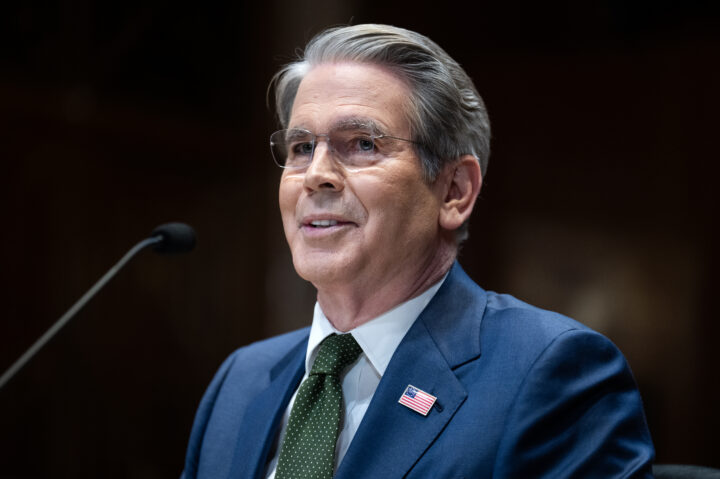
Treasury Secretary Scott Bessent testifies at the Senate Appropriations Financial Services and General Government Subcommittee on April 22, 2026.
Third Point founder Dan Loeb hosted Treasury Secretary Scott Bessent on Monday at his hedge fund’s Manhattan office, according to a photo posted on Loeb’s Instagram account.
Loeb had backed Bessent, who founded the hedge fund Key Square Group in 2015, in 2024 as Bessent and now-Commerce Secretary Howard Lutnick jockeyed to be named to the Treasury Department’s top position. The two also held a meeting at the Treasury Department in Washington in February 2025.
The treasury secretary is examining whether such funds could be used to compensate allies for past and future damage caused by Iranian attacks
Tom Williams/CQ-Roll Call, Inc via Getty Images
Treasury Secretary Scott Bessent testifies at the Senate Appropriations Financial Services and General Government Subcommittee on April 22, 2026.
Treasury Secretary Scott Bessent is examining pathways to repurpose Iranian assets to compensate the U.S.’ Gulf allies for damage inflicted by Iranian attacks during the war, and potential future damages, a source familiar with Bessent’s thinking told Jewish Insider.
“Treasury will utilize all tools available to allow Iranian assets to be made available to our Gulf allies to support rebuilding and repairs for any future damage caused by Iran,” the source said.
“The Secretary has also directed his team to assess conditions amongst our Gulf allies and request comprehensive estimates of the costs associated with repairing damage Iran has inflicted since the start of the conflict,” the source continued. “Treasury will further consider whether Iranian assets could be used to support repairs for past damages.”
U.S. lawmakers have similarly sought to repurpose seized Russian assets to support Ukraine’s defense during its own ongoing war.
Bessent’s comments came the same day that the Treasury Department’s Office of Foreign Assets Control sanctioned four individuals associated with a pro-Hamas flotilla
Tom Williams/CQ-Roll Call, Inc via Getty Images
Treasury Secretary Scott Bessent testifies at the Senate Appropriations Financial Services and General Government Subcommittee on April 22, 2026.
Treasury Secretary Scott Bessent called on U.S. allies on Tuesday to “step up” and join Washington in taking aggressive economic action against Iran and its broader terrorism financing networks.
Speaking at the No Money for Terror Conference in Paris, Bessent said that while the U.S. is “hardly alone in facing the scourge of terrorism,” international partners have failed to do enough to target the covert financial architectures that sustain Iran, transnational criminal organizations and regional proxies.
“Too often, we seem to be alone in our resolve to thwart it,” Bessent said, calling on gathered G7 nations to “join us in rooting out the financing that sustains it — from shell companies that are embedded within Europe, to shadow banking networks that lurk across the Middle East and drug cartels across the Western Hemisphere.”
Specifically, the treasury secretary pressed European nations to directly target Iranian financial infrastructure by “designating its financiers, unmasking its shell and front companies, shuttering its bank branches and dismantling its proxies.”
“It will require those of you in the Middle East and Asia to root out Iran’s shadow banking networks,” he added. “And it will require our partners around the globe to respond with force to the array of terrorists that we face — from Hezbollah to the Sinaloa Cartel. As threats move across boundaries, our unity of purpose must transcend every border.”
The remarks underscore the Trump administration’s continued use of sanctions and secondary financial tools to pressure Tehran amid the Iran war.
“For our part, no adversary has felt the force of America’s economic statecraft more ruinously than Iran,” Bessent said.
The administration has disrupted “tens of billions” in projected Iranian oil revenue, frozen nearly half a billion dollars in regime-linked cryptocurrency,and significantly intensified its crackdowns on Tehran’s illicit shadow banking systems, he said.
“As the regime confronts the wreckage of its military, Treasury will remain relentless in our pursuit to constrict the network of vessels, intermediaries and buyers through which Iran exports both its oil and malevolence,” Bessent said.
Bessent’s comments in Paris came the same day that the Treasury Department’s Office of Foreign Assets Control announced sanctions against four individuals associated with the Global Samud Flotilla, which the department said has been organized by the U.S.-designated Popular Conference for Palestinians Abroad, alongside several other actors operating inside Hamas-aligned Muslim Brotherhood networks.
“The pro-terror flotilla attempting to reach Gaza is a ludicrous attempt to undermine President Trump’s successful progress toward lasting peace in the region,” Bessent said in a concurrent statement released by the department. “Treasury will continue to sever Hamas’ global financial support networks, no matter where in the world they are.”
The lawmakers say the group has, ‘under the guise of a civilian organization,’ worked to advance Hamas’ ‘global agenda of eliminating the State of Israel and the Jewish people’
Tom Williams/CQ-Roll Call, Inc via Getty Images
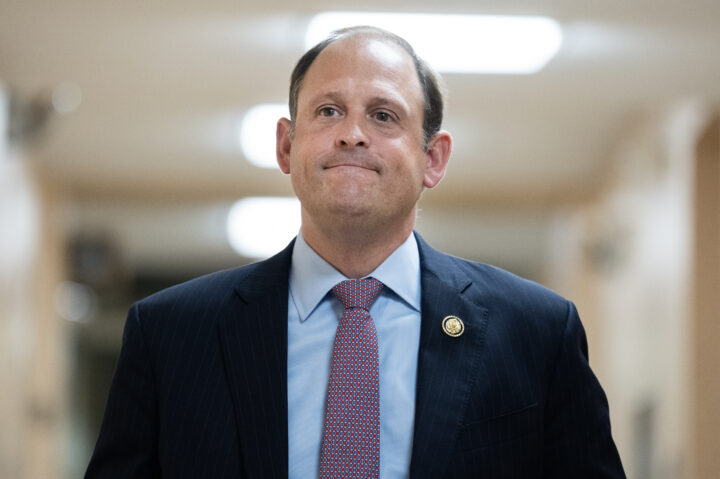
Rep. Andy Barr, R-Ky., arrives for a meeting of the House Republican Conference in the U.S. Capitol on Wednesday, September 3, 2025.
In a letter to Treasury Secretary Scott Bessent sent on Monday, Reps. Andy Barr (R-KY) and Jefferson Shreve (R-IN) called for the U.S. government to designate the Palestinian Conference for Palestinians Abroad (PCPA), also known as the Popular Conference for Palestinians Abroad, as an affiliate of Hamas and a Specially Designated Terrorist group.
Israel, which describes the PCPA as the foreign representative body of Hamas, designated the PCPA as a terrorist organization in 2021. The Israeli government released documentation recovered from Hamas in Gaza allegedly showing links between the PCPA and the high-profile flotilla that last month attempted to break the Israeli blockade of Gaza, as well as anti-Israel demonstrations and other anti-Israel activity abroad.
“Under the guise of a civilian organization, it orchestrates violent demonstrations, anti-Israel flotillas, and other provocations aimed at destabilizing the region and advancing Hamas’s global agenda of eliminating the State of Israel and the Jewish people,” Barr and Shreve wrote in their letter to Bessent. “Ultimately, the PCPA is not a benign advocacy group, but a coordinated network engaged in propaganda, logistical support, and international mobilizations on Hamas’s behalf.”
The letter cites the documentation released by the Israeli government showing direct connections between the PCPA and former Hamas leader Ismail Haniyeh. It also highlights the links between the PCPA and the flotilla.
“At a time when the United States and its allies are working to promote peace and stability in the Middle East, we must confront organizations whose actions are the antithesis of those goals,” the letter continues. “The PCPA’s alignment with Hamas and its incitement of violence represent an acute challenge to regional and international security.”
The pair of Republicans urged Bessent to “swiftly” designate the PCPA and its affiliates as terrorists and impose sanctions in order to “disrupt the group’s capacity to bolster Hamas operations, prolong the war, obstruct the return of hostages, and perpetuate a cycle of violence in the region.”
Barr is a candidate for Senate in Kentucky, running for the seat of retiring Sen. Mitch McConnell (R-KY). Both Barr and Shreve are members of the House Foreign Affairs Committee.
The Jordanian king is a rare foreign head of state who regularly attends the annual Allen & Co. summer gathering
Royal Hashemite Court/X
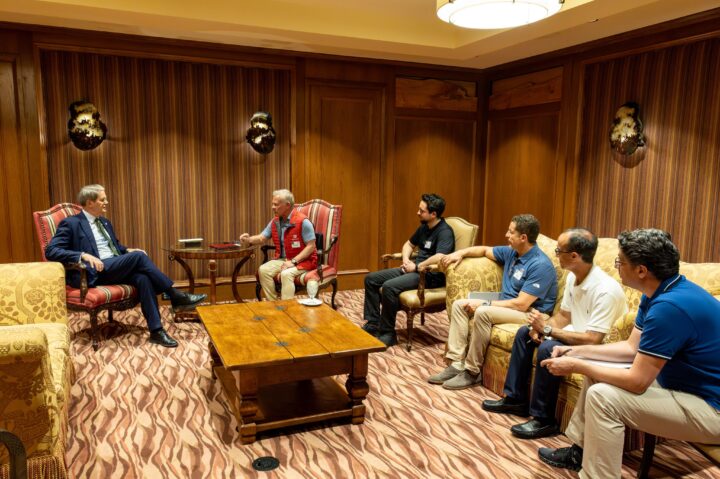
Jordanian King Abdullah II met with Treasury Secretary Scott Bessent on the sidelines of the Sun Valley Conference, July 2025
On the sidelines of the Sun Valley Conference this week, Jordanian King Abdullah II met with Treasury Secretary Scott Bessent. The Royal Hashemite Court said the two “discussed the positive economic relationship between the United States and Jordan.”
The Jordan Times, an English-language newspaper in the Hashemite Kingdom, wrote that in his meetings, the king “noted the importance of Jordan’s economic and administrative modernisation process in enhancing the Kingdom’s competitiveness and ability to attract investments, highlighting opportunities for building and strengthening economic partnerships.”
The Jordanian king is a rare foreign head of state who attends the annual confab hosted by Allen & Co. The gathering brings together thought leaders, tech and media titans and current and former government officials every summer in Sun Valley, Idaho. Last year, King Abdullah met with Jeff Bezos and other business leaders on the sidelines of the conference. Jordan’s Queen Rania and Crown Prince Hussein bin Abdullah were among the guests at the wedding of Bezos and Lauren Sánchez last month.
Other attendees at this year’s conference include Mark Zuckerberg, Andy Jassy, Sam Altman, Barry Diller, Alex Karp, Jared Kushner, Evan Spiegel, Ynon Kreiz, Charles Rivkin, David Zaslav, Brian Grazer, Bob Iger, David Ignatius, Bari Weiss, Senate Minority Leader Chuck Schumer (D-NY), Mike Bloomberg, Govs. Wes Moore and Glenn Youngkin, Jeffrey Katzenberg and Casey Wasserman.
The Foreign Relations Committee leaders called on the admin to ‘remove barriers to expanded engagement with the Syrian interim government’

Al Drago-Pool/Getty Images
Ranking member of the Senate Foreign Relations Committee U.S. Sen. Jim Risch (R-ID) speaks during a Senate Foreign Relations Committee hearing on April 26, 2022 in Washington, DC.
Sens. Jim Risch (R-ID) and Jeanne Shaheen (D-NH), the chair and ranking member of the Senate Foreign Relations Committee, this week urged the Trump administration in a letter to consider expanded sanctions relief for Syria.
Their letter, addressed to Secretary of State Marco Rubio and Treasury Secretary Scott Bessent, marked a notable new push from two of Congress’ most senior foreign policy leaders for targeted and conditional sanctions relief for the new Syrian government, an effort that has seen broad bipartisan support in Washington, but which is opposed by the Israeli government.
Risch and Shaheen urged the administration to “remove barriers to expanded engagement with the Syrian interim government,” with an aim of balancing “opportunity and risk” and providing opportunities for U.S. partners to engage in Syria even if the U.S. takes a more cautious approach.
“We recommend a thorough review of existing U.S. regulations on Syria, to include the extension and expansion of existing general licenses and limited or short-term sanctions relief in the near term,” the lawmakers said.
They urged the Cabinet officials to offer sanctions relief for a wide range of critical fields including agriculture, energy and energy infrastructure, finance, telecommunications and education.
The two said the U.S. should expand general license provisions to allow “more time and geographic flexibility to those on the ground” and consider “short-term sanctions relief” to increase liquidity and prevent instability, goals they believed are “essential to achieving the conditions to advance U.S. interests.”
Risch and Shaheen said that the U.S. should also work to push the new government to intensify efforts to crack down on terrorism, prevent Iranian and Russian entrenchment, destroy remaining chemical weapons, eliminate narcotics and find missing U.S. citizens.
The senators argued that the administration should reward “irreversible” progress on these issues with “fulsome sanctions relief,” and pursue “deeper economic and diplomatic isolation” if such progress does not materialize.
They warned that some recent reports out of Syria “raise serious concerns” about backsliding on some of these issues.
Risch and Shaheen further noted the “growing competition between Israel and Türkiye over Syria’s trajectory that may threaten American interests,” urging the administration “to move quickly to mediate between our allies.”
Please log in if you already have a subscription, or subscribe to access the latest updates.
 Continue with Google

 Continue with Apple