



















































Prince Khalid bin Salman said increasing antisemitic and anti-Israel rhetoric out of the kingdom are not reflective of the monarchy’s position
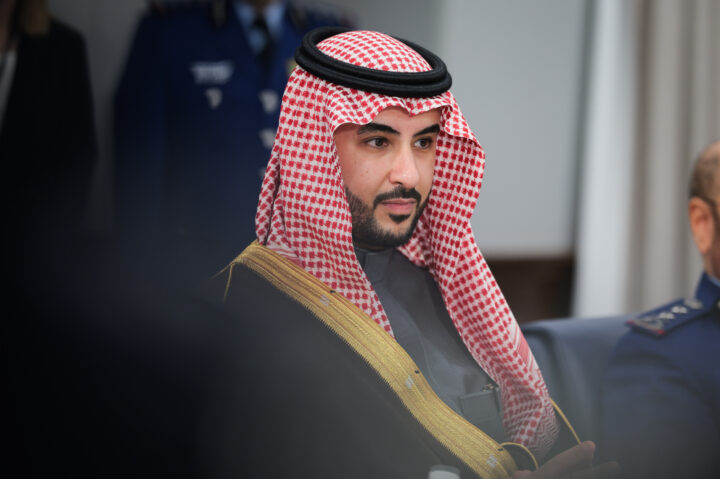
Kayla Bartkowski/Getty Images
Saudi Minister of Defense Khalid bin Salman attends a meeting with U.S. Secretary of Defense Pete Hegseth at the Pentagon on February 24, 2025 in Arlington, Virginia.


 Add JewishInsider on Google
Several Jewish and pro-Israel leaders met privately with Saudi Arabia’s defense minister in Washington on Friday afternoon, as Riyadh draws scrutiny for its increasingly hostile posture toward Israel and promotion of antisemitic messaging.
According to several sources familiar with the discussion, Prince Khalid bin Salman Al Saud denied to attendees that increasing antisemitic and anti-Israel rhetoric out of the kingdom was reflective of the monarchy’s position and emphasized that Riyadh and Jerusalem have mutual understanding and ongoing military, security and intelligence cooperation. He praised Israel’s actions against Hezbollah in Lebanon but said he doesn’t agree with Jerusalem’s recent decision to recognize Somaliland’s independence.
The same day of the meeting, a Muslim cleric in Medina gave a sermon calling for “victory” over the “Zionist aggressors,” while an imam in Mecca preached, “O God support them in Palestine and substitute their weakness with strength.” Hussain Abdul-Hussain, a research fellow at the Foundation for Defense of Democracies, noted that the Saudi government selects speakers to deliver Friday sermons.
On Saudi Arabia’s seeming decline in relations with the UAE, the prince acknowledged the two countries have clashed recently in Yemen but denied any broader pivot in Saudi foreign policy or increasing acceptance of the Muslim Brotherhood in the kingdom, which experts have alleged.
He also spoke to Turkey’s importance in the region, as Saudi Arabia’s growing alliance with Ankara, in addition to countries including Qatar and Pakistan, has raised concerns about the country’s increasing alignment with Islamist actors.
One source confirmed reporting by Axios that Prince Khalid told the group that if President Donald Trump does not follow through on his pledge to take military action against Iran, “it will only embolden the regime.”
Among the attendees, according to two sources with knowledge of the meeting, were Anti-Defamation League CEO Jonathan Greenblatt, American Jewish Committee CEO Ted Deutch, Conference of Presidents of Major American Jewish Organizations CEO William Daroff, B’nai B’rith International CEO Daniel Mariaschin and Rabbi Levi Shemtov of American Friends of Lubavitch (Chabad).
An AJC spokesperson confirmed Deutch’s participation at the meeting. “AJC is in regular, ongoing dialogue with our partners across the Gulf and in Israel to strengthen regional security and advance cooperation and integration,” the spokesperson told JI. “Today was another example of that work. We carry out these efforts continuously from Washington, Jerusalem and Abu Dhabi.”
Daroff also confirmed his attendance to JI, saying the group “had a constructive, off-the-record conversation as part of an ongoing dialogue with Saudi Arabia on regional and geostrategic issues, and appreciated the opportunity to speak frankly.”
Shemtov similarly confirmed his participation and said the prince’s demeanor was “friendly and engaging.” Shemtov said he left the meeting “somewhat encouraged, even if not yet completely convinced” but declined to provide details on what was discussed as the meeting was off the record. Mariaschin confirmed his attendance as well.
The nearly two-hour meeting was also attended by 15 representatives of Washington-area think tanks, including Daniel Shapiro, a former U.S. ambassador to Israel now at the Atlantic Council; Dennis Ross, a veteran Middle East peace negotiator now at The Washington Institute for Near East Policy; Barbara Leaf, former assistant secretary of state for Near Eastern affairs who is now a distinguished diplomatic fellow at the Middle East Institute; Douglas Silliman, former U.S. ambassador to Iraq who is now the president of the Arab Gulf States Institute; Rev. Johnnie Moore, the former executive chairman of the Gaza Humanitarian Foundation; Karim Sadjadpour, a senior fellow at the Carnegie Endowment for International Peace; and former diplomat Daniel Fried, now a distinguished fellow at the Atlantic Council, the sources told JI.
In a separate meeting earlier Friday that ran for almost an hour and a half, Prince Khalid met with a smaller group of pro-Israel national security experts, including Mark Dubowitz of the Foundation for Defense of Democracies and Michael Makovsky of the Jewish Institute for National Security of America. Both confirmed to JI they had attended but declined to share details about the discussion.
‘If this is a real pivot, and not just a momentary detour, it'll be very disappointing,’ the former antisemitism envoy said

Noam Galai/Getty Images
Ambassador Deborah Lipstadt, U.S. special envoy to monitor and combat antisemitism, speaks during 'March For Israel' at the National Mall on November 14, 2023 in Washington, D.C.
Ambassador Deborah Lipstadt, the former U.S. envoy to monitor and combat antisemitism, told Jewish Insider on Tuesday that she’s concerned by the increased pace of antisemitic rhetoric coming from Saudi Arabia, and warned that an extended change of course by Riyadh could have implications on the spread of antisemitism globally.
Lipstadt, who began in the role in May 2022, said that she saw the Saudi government initially very open to addressing antisemitism, but less willing to work with her toward the end of her term, which finished in January 2025. She said that the situation has appeared to deteriorate further since then.
“If this is a real pivot, and not just a momentary detour, it’ll be very disappointing,” Lipstadt said. If that’s the case, “then it’s very disturbing because there was a chance for a change in the culture and in the atmosphere of the Middle East.”
She said she sees antisemitic and extremist sermons recently delivered at Saudi holy sites and around the kingdom as particularly significant — noting the Saudi government also funds imams who preach around the globe. This support gives Riyadh a significant lever to “limit the amount of Jew hatred that is expressed in Muslim communities throughout the world.”
“This is more than just a geopolitical shift,” Lipstadt continued. “It’s that — and it’s certainly an important geopolitical shift — but it also has implications for the spread of hatred, Jew hate.”
The former U.S. ambassador said that she’s also seen a distinct shift in the tenor of translated articles from the Saudi press.
“It’s completely different from what I saw when I was there in July of 2022, and very different from the numerous conversations and interactions I had with Princess Reema, the Saudi ambassador to the United States,” Lipstadt said. “She could not have been more gracious and forthcoming, publicly so.”
The former envoy said that the timing of the Saudi shift is also troubling, noting that it comes as tensions in the region are otherwise easing, as the war in Gaza winds down and progress is made toward a longer-term ceasefire. The Saudi government, she noted, was subject to pressure from its public, which was upset over the war.
“It’s happening now, when things are quieting down — that’s worrisome,” Lipstadt explained. “I hope it can be turned around because it has very, very big implications. … At a time that we’re seeing the impact of radical Islamism, it’s even more troublesome.”
Lipstadt’s first trip abroad in her role in the Biden administration was to Saudi Arabia in June 2022, where she conveyed the “message that I saw real possibilities there.” She said that she came to believe that the Saudis were on a path to joining the Abraham Accords, and that she received “a very warm welcome,” including meetings with the minister of Islamic affairs, who is in charge of the country’s holy sites, and the Saudi deputy foreign minister.
“One high-ranking official, when I walked into his office, introduced himself to me. He said, ‘Hello, welcome. I come from a city of Jews,’ and he meant Medina,” Lipstadt recounted. “Mecca and Medina, where the prophet was, and grew up — that’s a pretty significant way of identifying yourself.”
Her second visit to the kingdom, toward the end of her term in office, “was less promising, less forthcoming on the part of the officials.”
She said it was difficult to gauge at the time whether that was due to a lack of interest in engaging with an outgoing administration or because of pressure from popular opinion in Saudi Arabia against the war in Gaza.
But she said she believes the situation has continued to worsen since she left office. And, she noted, Saudi Arabia has made no further public strides toward joining the Abraham Accords, which some expected the kingdom to do once President Donald Trump returned to office.
Please log in if you already have a subscription, or subscribe to access the latest updates.
 Continue with Google

 Continue with Apple