














































































A letter sent by House Democrats requested that Trump, Donald Trump Jr. and Ambassador Tom Barrack preserve records relating to their relationship with the Turkish president, previewing a potential investigation
Andrew Harnik/Getty Images
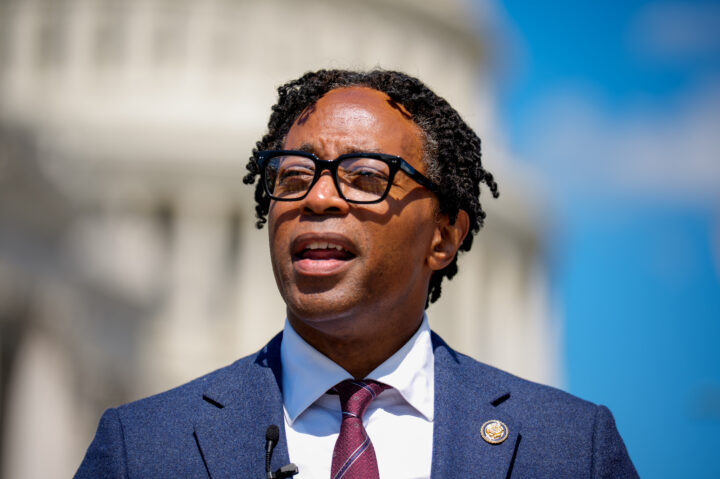
Rep. Wesley Bell (D-MO) speaks during a news conference outside the U.S. Capitol on September 9, 2025 in Washington.


 Add JewishInsider on Google
A group of House Democrats wrote to President Donald Trump on Friday to express “strong opposition” to the administration’s plans to lift sanctions on Turkey and sell the country F-35 fighter jets, and suggested that the decisions may be driven by Trump’s or his family members’ financial interests.
The letter requests that Trump, U.S. Ambassador to Turkey Tom Barrack and Trump’s son Donald Trump Jr. preserve records relating to their relationships with Turkish President Recep Tayyip Erdoğan and the Turkish government, stating that, “In the coming months and years, Congress will continue to exercise our constitutional oversight authorities and thoroughly scrutinize this matter to ensure the interests of the American people and their security is protected” — suggesting a potential House investigation if Democrats retake the chamber in November.
The letter was led by Reps. Wesley Bell (D-MO), Dan Goldman (D-NY) and Dina Titus (D-NV), joined by Reps. Debbie Wasserman Schultz (D-FL), Brad Schneider (D-IL), Gabe Amo (D-RI), Jim Costa (D-CA), Jared Moskowitz (D-FL), Brad Sherman (D-CA) and Rob Menendez (D-NJ).
“Besides the legal limitations on your authority on this issue, we are perplexed by what you believe justifies this potential action,” the lawmakers said of the sanctions relief.
They emphasized that Turkey has only continued to “provoke our democratic allies, undermine regional stability, and support U.S. adversaries and their proxies — including Foreign Terrorist Organizations” since the sanctions were first imposed by Congress during Trump’s first term, and has still not resolved the issue that prompted the sanctions initially — namely, purchasing a Russian S-400 missile-defense system. This issue may be resolved on Friday, as Turkey is expected to announce that it will sell its S-400 batteries to the United Arab Emirates.
The lawmakers said that given the lack of “any reasonable explanation” for the change in policy, the decision “raises serious questions about your Administration’s personal dealings with the Turkish government.”
“There exists no indication of Erdogan’s willingness to reform his rogue, authoritarian behavior — in fact, quite the opposite,” the letter states. “This lack of clear benefit to American interests leads us to the inevitable conclusion that you and those around you may be personally benefiting from this absurd arrangement.”
They highlighted a reported private meeting between Trump Jr. and Erdoğan in 2025 as reason for further investigation and alleged that Barrack “has a history of acting in his own self interests,” pointing to his past indictment for acting as an unregistered foreign agent on behalf of the United Arab Emirates.
Other critics have also alleged that Barrack’s actions on policy and statements have suggested an excessive closeness with Erdoğan or even service to Turkey’s interests and priorities over those of the U.S.
The lawmakers demanded the administration answer questions about Trump Jr.’s visit to Turkey, the Trump and Barrack families’ business interests in Turkey, the administration’s plans regarding a potential F-35 sale, Turkey’s support for Hamas and the administration’s decision to drop an Iran sanctions evasion case against the Erdoğan-linked Halkbank.
The lawmakers argued that Turkey has not, as Trump has claimed, been a strong ally, but rather maintained ties with Russia and threatened and violated the territorial integrity of U.S. allies and risked U.S. security by maintaining the Russian missile-defense system.
“Erdoğan has made no attempt to hide his cozy relationship with our adversaries, including Iran and Russia. Despite sanctions on those countries, Turkey maintains significant economic and energy ties to both,” the lawmakers wrote.
The White House referred Jewish Insider to comments Trump had made during a press conference with Erdoğan this week and Trump Jr. did not respond to a request for comment.
Bell said in a statement to JI that Erdoğan has “made it perfectly clear that he advocates for our adversaries and their terrorist proxies in the Middle East,” but asserted that Trump’s actions are being driven by personal ties.
“Because of President Trump and his family’s ties to Erdogan’s regime, he is reopening a Pandora’s box that can only lead to more chaos in the region,” Bell continued. “President Trump ran on a platform of getting our nation out of continued conflicts in the Middle East. Instead, he has further destabilized the region — costing American service members their lives, wreaking havoc for our allies abroad, and eroding our global leadership. And this latest action only continues to advance his dangerous agenda.”
A U.S. official called Iran's actions ‘wholly unacceptable’ but said negotiators continue to work ‘in good faith’ toward a final deal
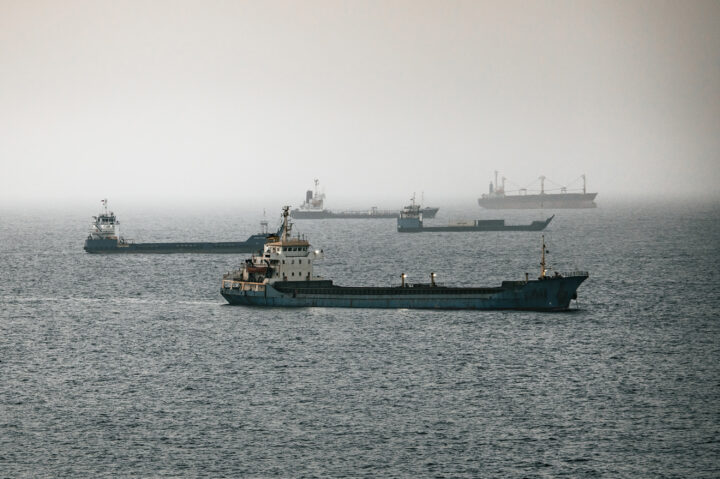
Photo by Elke Scholiers/Getty Images
Crude oil tankers, bulk carriers and vessels sit anchored around Qaboos Port on June 22, 2026 in Muscat, Oman.
A brief window of U.S. sanctions relief for Tehran closed on Tuesday as the Trump administration revoked a waiver that allowed the sale of Iranian oil in response to continued Iranian attacks on shipping vessels in the Strait of Hormuz.
Last month, the Treasury Department lifted sanctions on Iranian oil sales by issuing a 60-day license, a decision experts told Jewish Insider risked providing Tehran with significant revenue for malign activity. Treasury Secretary Scott Bessent had said the temporary license was issued due to Iran’s commitments under the memorandum of understanding, including guaranteeing safe passage through the Strait of Hormuz and inviting international nuclear inspectors back into the country — a claim that Iran swiftly denied. The license allowed Iran to produce, deliver and sell oil, including to U.S. importers, through Aug. 21.
But since the agreement was signed, Iran has since continued its attacks on commercial vessels navigating the Strait of Hormuz, including strikes on three commercial tankers since the beginning of the week, which a U.S. official called “wholly unacceptable.”
“As President [Donald] Trump and the administration have repeatedly affirmed, the MOU in effect with Iran is entirely performance-based. Iran will only reap benefits if they exhibit good behavior,” the official told JI. “Iran’s actions in the Strait were wholly unacceptable to the United States and will be met with consequences. Our negotiators continue to work in good faith towards a final deal.”
An Iranian Foreign Ministry spokesperson had warned that commercial vessels using routes outside of Iranian control could face consequences and said that Iran was “diligently fulfilling its commitments” within the MOU to manage the strait, according to Axios.
‘Why do we just get promises while they get billions?’ former Trump Iran envoy Elliott Abrams said
Jonathan Raa/NurPhoto via Getty Images
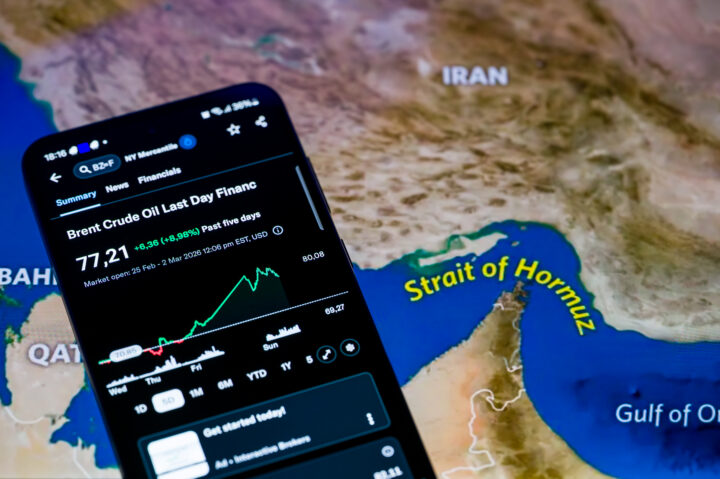
The Brent crude oil price chart is displayed on a mobile screen on March 2, 2026.
Former White House officials and Middle East experts are expressing concern over the Trump administration’s move to lift sanctions on Iranian oil sales through August, warning that Tehran will gain significant revenue it could use for malign activities before it demonstrates concrete progress on its diplomatic commitments.
On Monday, the U.S. Treasury Department issued a temporary 60-day license authorizing the production, delivery and sale of Iranian oil, lifting decades-old sanctions. The move was made in response to Tehran’s agreement to open the Strait of Hormuz and allow international nuclear inspectors into the country following weekend talks in Switzerland, according to Treasury Secretary Scott Bessent, a claim which Iranian officials have denied.
Under the memorandum of understanding signed last week between Washington and Tehran, the U.S. agreed to authorize waivers allowing the export of Iranian crude oil, petroleum products and related derivatives, as well as associated services such as banking transactions, insurance and transportation.
The temporary license is set to expire on Aug. 21 and represents a historic pivot in U.S. policy. It marks the first time since Washington imposed strict energy sanctions on Iran in the wake of the 1979 Islamic Revolution that Iranian oil can be legally imported into the U.S. and purchased using U.S. dollars. The 2015 Joint Comprehensive Plan of Action suspended certain secondary sanctions, allowing foreign companies to purchase Iranian oil, but it did not authorize imports of Iranian oil into the U.S.
Tehran has previously relied on a “shadow fleet” of aging oil tankers to move its crude abroad, funneling most of it to Chinese refineries. Under the new license, the Treasury Department said Iran may now lawfully sell oil from these previously sanctioned vessels, temporarily legitimizing that clandestine network. The waiver also shields Iranian entities, including the Central Bank of Iran, from nonnuclear sanctions tied to terrorist activity.
When asked whether the Iranians could use the profits from oil sales for malign activity, President Donald Trump said “they’re not supposed to be doing that,” and that Tehran is meant to use the income to purchase agricultural goods from the U.S.
“We’ll see, but they’re supposed to use the money to buy food for their people,” Trump told reporters in the Oval Office on Monday. “They’re buying it exclusively from us … all that money is coming back [to the U.S.] in the form of purchase of food … largely to our farmers.”
Meanwhile, foreign policy experts told Jewish Insider that Iran could use the money for malign activity, also expressing concern that Tehran is receiving revenue before proving it will fulfill its long-term obligations under the deal.
“It doesn’t take a lot of imagination to guess what this oil revenue will be used for,” Dan Shapiro, a former U.S. ambassador to Israel under President Barack Obama, told JI. “It won’t be used to benefit the Iranian people. This early concession is just further evidence of how badly the United States conceded leverage to Iran in Trump’s misguided war. We are paying dearly now just to get the Strait of Hormuz reopened.”
Elliott Abrams, who served as special envoy for Iran during the first Trump administration, similarly indicated that the regime would likely use the funds in ways contrary to U.S. interests.
“Why give them the money to stabilize the regime and start rebuilding their military before they have done anything at all on their nuclear program?” Abrams asked. “Why do we just get promises while they get billions?”
Miad Maleki, a former senior Treasury official, said that the sanctions relief “could be an economic lifeline for the Islamic Republic,” in a post on X on Monday. Maleki said the move “theoretically unlocks” around 67 million barrels of oil that are stranded in the Gulf, which he estimated would be worth roughly $8-9 billion, as well as another $10-15 billion in potential relief through the sale of petrochemical tons.
“The license explicitly allows buyers to pay Iran — including the Iranian government and blacklisted Iranian entities — directly for the oil. This isn’t just permission to sell. It’s permission to get paid,” Maleki wrote. “And the payments can be made in U.S. dollars. The dollar is the backbone of global finance, and Iran has been largely locked out of it for years. Handing the regime dollar revenue restores access that sanctions were specifically designed to deny.”
He also noted that the Treasury Department’s authorization will allow Tehran’s “shadow market” to operate “cheaper, faster, and [be] dollar-denominated.”
“While major Western and new-market buyers won’t be rushing to do business with Iran, the license authorizes far more than Iran can currently produce, and there are more than enough willing buyers in China and across Asia to absorb every barrel and petrochemical ton Iran can move,” he wrote.
Abrams also took issue with Iran appearing to gain notable benefits without yet complying with all the U.S. demands.
“The benefits for Iran in the MOU seem to be frontloaded,” Abrams said. “That’s a mistake because to the extent that they benefit now, they have less and less incentive to comply with what we want.”
Abrams maintained that U.S. sanctions should continue even after the lifting of the U.S. naval blockade and the reopening of the Strait of Hormuz.
Shapiro told JI he held similar concerns, particularly regarding how Iran is securing immediate relief without any concessions on its nuclear program and noted that the agreement “doesn’t even mention Iran’s ballistic missile program or support for terrorist proxies.”
Jonathan Ruhe, a fellow at the Jewish Institute for National Security of America, argued that the move provides Iran “upfront sanctions relief,” while simultaneously requiring “fewer concessions” than the JCPOA signed in 2015 under Obama.
AIPAC similarly compared the agreement to the JCPOA, which the group spearheaded efforts to oppose when it was signed.“This license is broader than the terms detailed in the MOU or what was included in the JCPOA,” AIPAC wrote on X on Monday. “Waiving sanctions on production will allow Iran to increase its output and gain increased revenues under the terms of the MOU.”
Ruhe noted that such a move sidesteps mandatory congressional oversight by granting immediate waivers before lawmakers have had a chance to formally review or vote on the arrangement.
“It also runs afoul of the Iran Nuclear Agreement Review Act (INARA), which prohibits any sanctions relief until Congress can review the deal,” Ruhe said. “Iran’s regime should get sanctions relief only in exchange for meaningful concessions on its nuclear program, which it has not made, and congressional review of the deal, which has not happened.”
The secretary of state acknowledged that granting Iran access to additional funds would risk Tehran using the money for malign activity in the region
Daniel Heuer/Bloomberg via Getty Images
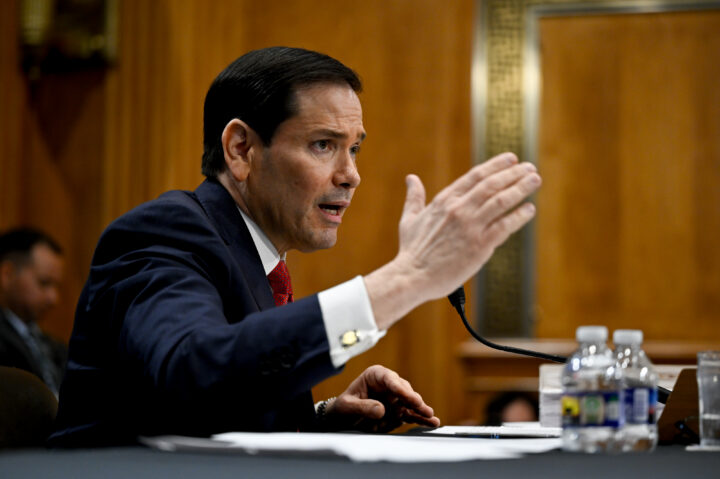
Secretary of State Marco Rubio during a Senate Foreign Relations Committee hearing in Washington, DC, on Tuesday, June 2, 2026.
Secretary of State Marco Rubio said in testimony to the Senate Foreign Relations Committee on Tuesday that the U.S. is not offering Iran any sanctions relief in exchange for reopening the Strait of Hormuz, and that sanctions relief would only be on the table if the Islamic Republic made concessions related to its nuclear program.
The secretary of state described the diplomatic talks as two-phased: The current phase is focused on getting Iran to agree to reopen the strait and to commit to enter further negotiations on disposing its highly enriched uranium and on “severe and long-term limitations and/or cancelation of enrichment.” In exchange, the U.S. would lift its blockade of Iranian ports.
“For example, they have to commit to say, ‘We will dispose of the enriched uranium.’ And the question now is what are the mechanisms by which we can dispose of it,” Rubio said.
The second phase would entail technical discussions on Iran’s nuclear program and fissile material, in exchange for potential U.S. sanctions relief, and could take months to work through.
“Any sanctions relief is condition-based, which means it has to be in return for the reason why the sanctions are put in place in the first place, which is their nuclear program,” Rubio said. “If they agree to give up [nuclear activities], there will be sanctions relief associated with their commitment and their compliance.”
He said that if Iran complies with U.S. demands including giving up nuclear enrichment and disposing of its enriched uranium, “that’s the place where the frozen assets could be discussed. The more they give, the more they would get.”
But he acknowledged that granting Iran access to additional funds would raise other challenges, including using such funding to support terrorist activities.
Rubio said later during a Tuesday afternoon hearing with the House Appropriations Committee that “if money is going to fund the proxies, it won’t be returned to them,” emphasizing that “there are specific sanctions that are in place related directly to the nuclear program” that could be removed as part of talks.
Republicans cried foul when the Biden administration made similar arguments during its own negotiations with Iran, arguing that any sanctions relief for Iran — even if funds were limited to certain specific humanitarian purposes — would ultimately allow the regime more room in its budget to fund proxy terrorism and other malign activities.
Rep. Lois Frankel (D-FL), who questioned Rubio on the issue, urged him “not to give money to Iran to continue the work of their proxies.”
Sen. Lindsey Graham (R-SC) urged the administration in a Tuesday morning X post to ensure that any deal with Iran forecloses support for terrorism going forward.
“ANY DEAL WITH IRAN MUST CLEARLY STATE THAT IF IRAN PROVIDES FUTURE SUPPORT TO TERRORIST ORGANIZATIONS LIKE HEZBOLLAH, IT WILL RESULT IN CRIPPLING SANCTIONS AND OTHER PUNITIVE MEASURES,” Graham wrote.
Rubio said during the Senate hearing that if Iran refuses to reopen the Strait of Hormuz voluntarily, “then we have other options available to us.”
He added that if the U.S. had refrained from action against Iran because of fears it could close the strait, it would have given Iran effective veto power over U.S. action and acceded to Iran the ability to develop nuclear weapons. “That’s an untenable situation.”
Rubio argued that the U.S. is in the strongest position diplomatically in his memory.
“They have agreed to negotiate aspects of the nuclear program that just a month ago, just a year ago, they were refusing to even mention, much less enter into discussion about,” he said. “That is not a guarantee that it will lead to a deal that is acceptable to the Senate or acceptable to the American people, but we were able to engage them in a process that truly tests the proposition of how far they’re willing to go.”
He insisted that any deal would be stronger than the 2015 Joint Comprehensive Plan of Action agreed to by the Obama administration.
Sen. John Cornyn (R-TX) — who recently lost his primary election to a Trump-backed challenger and may now have more leeway to oppose President Donald Trump’s initiatives for the remainder of his term — suggested he was skeptical of any diplomatic agreement with Iran. Under the Iran Nuclear Agreement Review Act, the administration would be obligated to submit any nuclear deal with Iran for congressional review.
“I do applaud the president’s attempt to try to use some diplomacy here in order to deny them access to the enriched uranium and other weapons that they use against Israel and the West, but tell me, why do you think anything that the Iranian regime agrees to that they will comply with?” Cornyn asked. “What evidence is there that they will agree to anything that they ultimately will stick with?”
Rubio said that any deal will require verifiable steps, and that sanctions relief would come after “they actually do certain things,” not simply in exchange for Iran’s agreement in principle.
He also repeatedly said that issues inside Iran that predate the war, such as the growing economic crisis, have only further accelerated during the war.
He added that diplomatic talks have been slowed by Iran’s internal system and by communications issues inside the country, including divisions between elements of Iran’s government and leadership structure.
The “political class,” Rubio said, would “probably make a deal tomorrow,” but Supreme Leader Mojtaba Khamenei — who was believed to have been injured in the Feb. 28 Israeli strike that killed his father and predecessor, Ayatollah Ali Khamenei — and the Islamic Revolutionary Guard Corps are more insulated from economic and political pressure.
Rubio said that the U.S. has not seen or heard directly from Khamenei, but that there are indications that he is alive and increasingly engaging in governing matters.
Despite urging from Sen. Ted Cruz (R-TX), Rubio said that he is not aware of any U.S. program or plans to arm Iranian protesters against the government.
Rubio also described Operation Epic Fury as “highly successful” in shutting down Iran’s defense industrial base and navy, though he acknowledged that “they still have a lot of drones,” framing that as a challenge that is not unique to Iran.
“There is no Iranian navy. … There’s a bunch of Boston whalers with machine guns on them, but there is no navy,” he said.
Cornyn said that it would be “ludicrous” to suggest that, before the war, Iran’s nuclear program did not pose an imminent threat to the United States. Rubio agreed, adding that if Iran were to develop a nuclear weapon, it “could very well use it,” and even if it did not, having such capability would allow it to hold the world hostage and “hyper-scale” its support for terrorism.
Rubio said that Iran is attempting to drag out the conflict in Lebanon between Israel and Hezbollah by continuing to prop up the terror group. He said the U.S. aims to keep talks over Lebanon separate from negotiations with Iran, while Iran is attempting to merge the two issues.
“The Lebanese government and the Israeli government, they could do a peace deal tomorrow. Israel has no territorial claims in Lebanon, and Hezbollah … has called for the overthrow of the current Lebanese government. The impediment in Lebanon is the fact that Hezbollah has embedded itself in that country and is the reason for all the suffering that’s happening there right now.”
Lebanese and Israeli officials are meeting at the State Department for negotiations on Tuesday.
He said that there are continued difficulties in demilitarizing and defanging Hezbollah, explaining that the Lebanese Armed Forces’ capabilities “are not where they need to be” and that certain elements of the LAF have cooperated with Hezbollah, though he said that there has been progress by the Lebanese government.
Rubio praised the United Arab Emirates as having been “very aggressively cooperative” in the U.S. campaign against Iran and said Kuwait has been “fantastic.” He added that while other U.S. partners have been displeased with Iranian strikes on their energy infrastructure, he called those strikes a “reminder” of the threat they all face from Iran.
Asked about the Board of Peace, Rubio said that the group, which he said is now being structured as an international nongovernmental organization, has just begun to hire staff in the past few weeks. He said the organization aims to remain lean, with just five full-time staff now and a goal of growing to 15 to 20.
He also said that the U.S. has not provided any of the funding it pledged to the Board of Peace and has, for now, walked back the commitment of $50 million that Trump initially offered for the body.
Rubio also flatly denied reports that the U.S. was coordinating with Israel to remove Jordanian custodianship of the Al-Aqsa Mosque complex on the Temple Mount.
Speaking at a House Foreign Affairs Committee hearing, Republican and Democratic lawmakers highlighted ongoing abuses by the Syrian government

Samuel Corum/Getty Images
Rep. Brian Mast (R-FL) speaks during a House Committee on Foreign Affairs hearing on Capitol Hill on January 11, 2024 in Washington, DC.
House members on both sides of the aisle raised concerns about the new Syrian government’s recent moves against minority groups, particularly the Kurdish-led Syrian Democratic Forces, in some cases questioning whether Damascus is complying with lawmakers’ expectations after the Caesar Act sanctions on Syria were lifted.
Speaking at a House Foreign Affairs Committee hearing, Republican and Democratic lawmakers highlighted ongoing abuses by the Syrian government, with some appearing to argue that there might be cause to revisit the imposition of U.S. sanctions on Syria. Some, particularly Republicans, had been hesitant to back full sanctions repeal, but did so under pressure from the Trump administration.
Rep. Brian Mast (R-FL), the committee chair, said that no one expected the transition away from the Assad regime to be seamless, “but we’ve already seen too many incidents, in my opinion, too many incidents of sectarian violence against religious and ethnic minorities.”
He called the Syrian government’s advances against U.S. allies in the SDF “unacceptable” and criticized Russia’s ongoing presence in Syria. He said the recent ceasefire agreement between the government and the SDF is a positive step but emphasized that several such agreements have been signed and not enforced in the past.
Mast said the country is “nowhere near where it needs to be today” and he is “not satisfied with the progress that [Syrian President Ahmad al-Sharaa] has made yet” and sees “many of his actions as steps backward.”
Mast, who was one of the final obstacles to full repeal of the Caesar Act sanctions, said that al-Sharaa “does not have a blank check from the United States of America” and that the repeal came with an expectation — albeit not formally binding — that Syria would meet various conditions, including protecting minorities.
Rep. Greg Meeks (D-NY), the ranking member of the committee, said he is “optimistic in support of the Syrian people working toward the future,” but also “deeply concerned” by the ongoing sectarian violence and the Syrian government’s attacks against the SDF. He said al-Sharaa needs to show a commitment to implementing the January deal with the Kurds and to stop abuses by elements of his government.
“While I stand for Syrian people and turning the page toward a new future, we must see President al-Sharaa keep to his word of being a president for all Syrians and ensure Syria’s ethnic and religious minorities are safe and fully represented,” Meeks said.
Rep. Michael McCaul (R-TX), the former committee chair, said that, while he wanted to see al-Sharaa succeed, the Syrian government has not complied with the conditions attached to the repeal of the Caesar sanctions. He said that the images emerging from the Syrian government-aligned forces’ attacks on the Druze echoed those of ISIS-controlled areas of Syria a decade ago.
McCaul said he was particularly concerned that the Syrian government offensive led to ISIS prisoners being released from SDF-guarded prison camps in eastern Syria, some of whom remain unaccounted for. “That is a nightmare scenario, from a national security perspective,” McCaul, who also previously chaired the Homeland Security Committee, said.
Rep. Mike Lawler (R-NY), who had pushed for specific binding conditions on sanctions relief, said in a statement following the hearing, “The United States lifted sanctions on Syria to give al-Sharaa a chance to prove where he stands, despite his terrorist ties,” adding that the non-binding provisions in the final sanctions repeal bill, “were not met, and the trajectory of Syria under al-Sharaa is deeply concerning.”
Following the hearing, Rep. Tim Burchett (R-TN) also said he’s not prepared to normalize relations with Syria and is open to leveraging U.S. economic pressure.
Rep. Brad Schneider (D-IL) praised Mast for pushing to include reporting measures and non-binding conditions in the final repeal legislation, criticizing the administration for its push for unconditional sanctions relief.
“When the White House and Senate leadership pushed a hand to Damascus a clean, unconditional sanctions lift, you pushed back and insisted the repeal come with at least some benchmarks and reporting requirements, and at least a skeleton accountability, which I think is critical,” Schneider said. “I want the record to reflect that this committee, on a bipartisan basis, rejected the administration’s reckless instinct to give away our leverage for nothing in return.”
Rep. Bill Keating (D-MA) highlighted a recent op-ed by former Secretary of State Mike Pompeo that criticized the U.S. for tacitly allowing the Syrian offensive against the SDF, described Trump as overly optimistic about al-Sharaa and criticized the administration’s push to remove sanctions.
“It seems to me that there’s just such a rush to somehow having another peace agreement there that [Trump] is overlooking what the former secretary said, quite strongly, was it’s overly optimistic. And, to take all the sanctions, not using the sanctions as leverage going forward is a mistake,” Keating said.
Rep. Dina Titus (D-NV) said she was also “not in such a big hurry to take away some of the sanctions and the [terrorist] status of the president when he transitioned from so-called terrorist to so-called leader of all the Syrians.”
Rep. Johnny Olszewski (D-MD) highlighted concerns about changes to the Syrian education system, which has “removed references to women, to love, to pre Islamic culture and to even human evolution, sending a chill message to religious and ethnic minorities,” adding that Syria “can’t replace one form of intolerance with another.”
Multiple Republicans also cast doubt on whether al-Sharaa had actually reformed, characterizing him as still being a committed Islamist terrorist, who is now pretending to be a moderate reformer for Western audiences.
“I think I’m hopeful that something great can happen with Syria in the United States ought to be part of that, but giving all our leverage in advance, to me, doesn’t seem a good idea and a good way to make sure that happens,” Rep. Scott Perry (R-PA) said.
“I generally believe that once a Muslim terrorist, always a Muslim terrorist,” Rep. Randy Fine (R-FL) added.
Several lawmakers raised particular concerns about Turkey’s influence in Syria. Some linked the Syrian government’s offensive against the SDF to Turkey’s longtime enmity toward the Kurds, and others said that they see Syria as the first step in an attempt by Turkish President Recep Tayyip Erdoğan to build a regional empire.
“Right now in Turkey, they are increasingly an Islamic dictatorship. The chief opponent to Erdoğan is in jail. He will not get out prior to the elections, I don’t believe,” Rep. Keith Self (R-TX) said. “Erdoğan is overturning the secular state that Atatürk set up, and I think that that is going to set up, between Turkey and Israel, a future conflict.”
Self said he thinks Turkey aims to replace Iran as a regional power in the Middle East.
Rep. Josh Brecheen (R-OK) highlighted that Erdoğan publicly aspires to restore the Ottoman Empire, which, he noted, requires “driving all the way to Jerusalem,” and said that al-Sharaa has not appeared to cross Turkey at any point.
“My real belief is that Erdoğan’s desire to have a re-establishment of the Ottoman Empire, that al-Sharaa is not being fully truthful to what his real goal is,” Brecheen said. “My great concern is that we are enabling the prosperity of Turkey, we are enabling the prosperity of Russia, and al-Sharaa is not being truthful to us. And that years down the road, if prosperity comes — it’s not going to change the jihadist mentality.”
He suggested that he does not believe that Amb. Tom Barrack, who serves as the U.S. ambassador to Turkey, should be serving simultaneously as the U.S. envoy to Syria, to ensure that the U.S. can “play hardball in Syria” while Barrack maintains good relations with Turkey.
Nadine Maenza, the former chair of the U.S. Commission on International Religious Freedom, said that she does not believe that Barrack’s dual role is serving the U.S. well and emphasized that the State Department appears to be deferring to Barrack on Syria policy. She also said the U.S., and Barrack, should not “reward” the Syrian government with economic deals after atrocities by government-aligned forces.
Witnesses who testified before the committee were divided, with some witnesses urging pressure on the Syrian government to ensure it implements and sustains protections for the Kurds and other minorities and suggesting the U.S. continue to align most closely with its longtime partners in the SDF, while others defended al-Sharaa as an imperfect but reliable partner who had covertly worked with the United States for years.
Please log in if you already have a subscription, or subscribe to access the latest updates.
 Continue with Google

 Continue with Apple