














































































The lawmakers warned of a lack of safeguards in the deal to prevent Riyadh from obtaining a nuclear weapon

Tom Williams/CQ-Roll Call, Inc via Getty Images
Rep. Gregory Meeks (D-NY)


 Add JewishInsider on Google
A group of House Democrats introduced a resolution on Thursday to block the U.S. nuclear agreement with Saudi Arabia, citing the lack of safeguards in the deal applied in previous agreements with other U.S. allies and arguing that the deal paves the path toward a Saudi nuclear weapon.
Under procedural rules, the Democrats should be able to force votes on the resolution, which seems likely to pick up support from most Democrats and potentially a handful of Republicans.
Given the tight margins in each chamber, the resolution could — but is far from guaranteed to — pass, but is unlikely to meet the two-thirds majority needed to override a presidential veto, should the administration push ahead anyway.
“This U.S.-Saudi nuclear agreement dangerously departs from decades of nonproliferation standards and presents considerable risks,” Reps. Greg Meeks (D-NY), Brad Sherman (D-CA), John Garamendi (D-CA) and Don Beyer (D-VA) said in a joint statement. The four lawmakers are leading the resolution against the nuclear deal. Meeks is the ranking member of the House Foreign Affairs Committee.
They emphasized that the deal does not require Saudi Arabia to commit not to enrich or reprocess energy or to agree to enhanced International Atomic Energy Agency inspections under the Additional Protocol.
The deal specifically arranges for a mechanism for potential nuclear enrichment inside Saudi Arabia, in a U.S.-managed facility, while also not ruling out independent Saudi enrichment activity.
“A region already gripped by conflict and escalation does not need another nuclear power,” the lawmakers continued, highlighting that Crown Prince Mohammed Bin Salman has been clear that Saudi Arabia would seek a nuclear weapon if Iran obtains one and that Riyadh has been expanding its ballistic missile capacity.
“Handing Saudi Arabia enrichment capacity under these conditions — even with the stipulations included in the agreement the administration has shared with Congress — isn’t just reckless nonproliferation policy, it’s an invitation to a nuclear arms race in the Middle East,” the lawmakers said.
‘Fortnite’ was rated the best at implementing safeguards to combat antisemitism, with ‘Grand Theft Auto Online,’ ‘Call of Duty’ and ‘Minecraft’ following closely behind

Thomas Fuller/NurPhoto via Getty Images
The Fortnite logo is displayed on a smartphone screen in the Apple app store on March 6, 2026.
A first-of-its kind leaderboard evaluating how major video game companies address antisemitism and extremism in online games was released on Wednesday by the Anti-Defamation League, Jewish Insider has learned.
The leaderboard assessed 10 of the most popular games and their respective companies on their policies and in-game safety features. “Fortnite” was rated the best at implementing safeguards to combat antisemitism, with “Grand Theft Auto Online,” “Call of Duty” and “Minecraft” following closely behind. Other major games evaluated included “Roblox,” “Valorant,” “Clash Royale,” “Counter-Strike 2” and “PUBG: Battlegrounds.”
ADL evaluated the product features of each individual game and the relevant policies that govern that game — for some games, the policies that govern them were specific to the game, while for some it was the company policies that apply to all of their games.
The leaderboard, created by the ADL Center for Technology and Society in partnership with the ADL Ratings and Assessment Institute, builds on the annual survey work that CTS did in partnership with gaming analytics firm NewZoo, from 2019-2023.
Games received labels of advanced, moderate or limited protections based on criteria including: antisemitism and hate policy; extremism/terrorism policy; in-game display of code of conduct; documentation of escalation to law enforcement; and in-game tooling.
The latter criteria, which accounts for 60% of a game’s overall score, includes players’ ability to block and/or mute other players; players’ ability to report players for voice, text, usernames and user-generated content; and the game’s prevention of antisemitic and hateful extremist usernames.
Bonus points were awarded for clear appeals processes and engagement with ADL, and points were deducted for harmful content on public-facing game stores. The antisemitism watchdog shared detailed findings with each gaming company and invited them to discuss the assessment before the leaderboard’s release, to which Epic Games, Supercell and Minecraft responded.
Popular online games boast hundreds of thousands of players, with 85% of U.S. teens reporting playing video games in 2024, according to the Pew Research Center. The Pew study found that 80% of all teens think harassment over video games is a problem for people their age, and 41% of those who play them say they’ve been called an offensive name while playing.
The leaderboard comes one year after ADL conducted a study where it asked 15 participants (university students, recent graduates and young adults) to play four leading online games (“Valorant,” “Counterstrike 2,” “Overwatch 2” and “Fortnite”) in one-hour increments with different identities (Jewish and Muslim religious and ethnic identities, as well as in national identities such as Chinese, Mexican and Israeli). It found that almost half of game play experiences included some form of harassment, such as slurs, trash-talking or disrupted play, and one-third included identity-based harassment, such as “gas the Jews” or calling people the “N-word.”
The ADL said it plans to feature the results in an online Gaming Leaderboard, designed to be a resource that will track how gaming companies manage their online multiplayer ecosystems over time to guide parents, gamers, policymakers and the gaming industry itself.
“When a parent wants to know if an online game is safe for their child, there has been no one-stop shop to understand how a particular game approaches online safety,” Daniel Kelley, senior director of the ADL Center for Technology and Society, said in a statement. “This leaderboard addresses that critical gap by offering the most comprehensive evaluation of safety measures in online multiplayer games to date, with a focus on how companies manage antisemitism and extremism.”
Senior Democrats urged caution in any deal that would allow the Gulf kingdom to enrich uranium

Jemal Countess/Getty Images for Fair Share America
Sen. Richard Blumenthal speaks at a rally at the Capitol on April 10, 2025 in Washington, DC.
Democratic lawmakers are expressing concerns about the administration’s apparent moves toward a nuclear deal with Saudi Arabia that would allow the kingdom to enrich uranium, lacking the safeguards that were included in a similar nuclear cooperation deal with the United Arab Emirates.
There had previously been bipartisan support in Congress for including such safeguards, including intrusive International Atomic Energy Agency inspections, under an “additional protocol” of the Nuclear Nonproliferation Treaty, and the “gold standard” commitment of renouncing nuclear enrichment and reprocessing included in the UAE deal. Even Energy Secretary Chris Wright last year denied that the U.S. would allow Saudi enrichment.
Asked about the situation this week, Democrats — across a broad ideological spectrum — expressed concerns, while Republicans generally avoided commenting, saying they weren’t familiar with the administration’s apparent plans.
“I think we should be extremely cautious and scrutinize — very exactingly — any deal with Saudi Arabia that provides nuclear know-how or fuel, and certainly it has to be a part of a broader agreement for normalizing relations with Israel that expands the Abraham Accords,” said Sen. Richard Blumenthal (D-CT).
“It can’t be a separate action, apart [from] everything else that’s going on, where we need Saudi cooperation,” Blumenthal continued.
Sen. Mark Kelly (D-AZ) told JI he wasn’t aware of the terms of the proposed deal, but said that there is a “whole range” of what enrichment can entail.
“You see this with Iran,” he said. “We gave them, in the 1970s, the ability to do medical-grade enrichment. [There is a] big difference with that and enriching uranium up to 90% have the ability to then make a weapon. I haven’t looked at the proposal. I think we’ve got to be generally very careful about how we transfer this technology.”
Sen. Ed Markey (D-MA) last week accused the administration in a statement of “caving to Saudi demands and … writing a recipe for disaster with its plan to give nuclear-weapon-wannabe Saudi Arabia nuclear technology without the strongest safeguards.” He said Congress should block the deal in order to prevent a nuclear arms race in the Middle East.
Rep. Brad Sherman (D-CA), a vocal critic of efforts to allow Saudi Arabia to enrich, re-introduced legislation on Tuesday requiring a congressional vote of support for an agreement with Saudi Arabia, saying in a statement, “Any nuclear agreement with Saudi Arabia must include ironclad nonproliferation protections. … Without the strongest safeguards, we risk fueling nuclear proliferation in one of the world’s most volatile regions.”
He has previously warned that a Saudi nuclear program could ultimately be turned to target Israel should the kingdom’s stance change or the ruling family fall from power.
Previously, lawmakers on both sides of the aisle have demanded the same “gold standard” commitments from Saudi Arabia that the U.S. received from the UAE, with both the chair and ranking member of the Senate Foreign Relations Committee affirming that stance last year.
Sen. Jim Risch (R-ID), the committee chair, said last year that any nuclear deal with Saudi Arabia “has to” include the “gold standard.” He did not provide a comment this week.
Asked by JI about the latest developments, several Senate Republicans said they had not been following the situation and largely declined to comment.
A group of nine Jewish House Democrats last year also raised concerns about efforts to move toward a nuclear deal with Saudi Arabia unless “explicitly … tied to the Kingdom’s recognition of Israel and normalization of relations between the two countries.”
Andrea Stricker, a research fellow and deputy director of the nonproliferation program at the Foundation for Defense of Democracies, told JI that Israel should be “worried” about a potential nuclear deal between the U.S. and Saudi Arabia, describing it as a “stunning reversal” of longstanding U.S. policy.
She noted that the decision to disregard typical safeguards is cause for concern, warning that completing such a deal can have unpredictable consequences down the line.
“We can’t control how the Saudis will use enrichment and reprocessing in the future, even if they are a partner today,” said Stricker. “With weak safeguards in place, Riyadh could duplicate the technology and set up covert fuel-making plants for nuclear weapons.”
Jonathan Ruhe, a fellow at the Jewish Institute for National Security of America, said that Saudi Arabia cannot be trusted with a nuclear deal, adding that it is “bad politics” for the U.S. to “demand that Iran end enrichment while possibly partnering up with its rival’s enrichment program.”
“It also sends the wrong message to partners like the UAE that signed up for the gold standard deal with the United States, which rightly prohibits such activities,” Ruhe added. He warned that such a deal could “set off a regional proliferation cascade,” from actors such as Iran, Turkey and Egypt.
Simon Henderson, a senior fellow at The Washington Institute for Near East Policy, said the United States faces a delicate balancing act: pursuing a deal that could carry long-term proliferation risks while also trying to prevent Saudi Arabia from turning to rival powers for nuclear cooperation.
“The United States is trying to do what is arguably impossible: allow Saudi Arabia to acquire American civil nuclear technology while hoping that it isn’t used as a cover for being able to make an atomic bomb,” Henderson said.
Henderson downplayed concerns that the prospective deal is not explicitly tied to Saudi-Israel normalization, telling JI that normalization is “delayed rather than dead.” He also dismissed the notion that a civil nuclear agreement with Riyadh would pose a threat to Israel.
“Iran is the threat to Israel, not Saudi Arabia,” Henderson said. “Even without formal relations, Riyadh and Jerusalem are on the same page on many issues.”
Rep. Sara Jacobs told JI that the resolution is a ‘first step’ to highlight bipartisan consensus on the issue
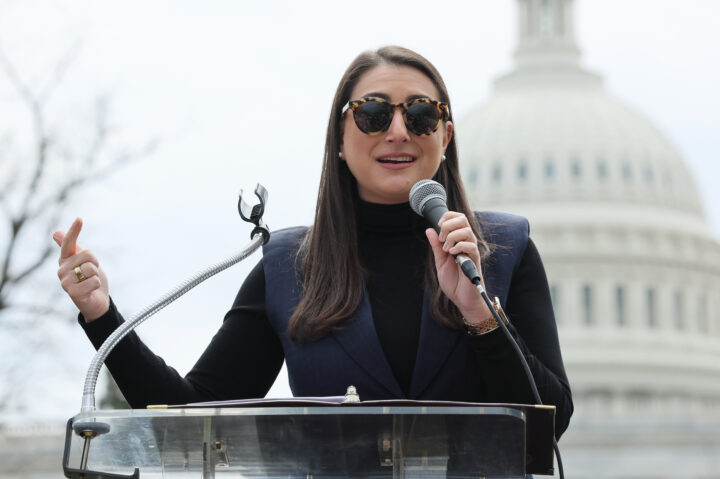
Jemal Countess/Getty Images for Fair Share America
Rep Sara Jacobs (D-CA) speaks at the rally to Say NO to Tax Breaks for Billionaires & Corporations at US Capitol on April 10, 2025, in Washington, DC.
A bipartisan group of House members is introducing a resolution that sets out recommendations for tackling the spread of antisemitism through artificial intelligence models and highlights the ways those programs have been used to spread a variety of forms of anti-Jewish hate.
The resolution, led by Reps. Sara Jacobs (D-CA), Don Bacon (R-NE), Juan Ciscomani (R-AZ) and Laura Friedman (D-CA), highlights that AI models can “generate, amplify, or normalize antisemitic content, deepfakes, synthetic media, and deeply anti-Jewish bias, and can be weaponized to target Jewish individuals and institutions, as well as American institutions, normalizing antisemitism and anti-Jewish bias en masse.” It also notes that there is an extensive history of AI models espousing antisemitic attitudes, dating back to at least 2016.
The resolution states that combating antisemitism is a national priority and that technology companies have a “responsibility to implement robust safeguards,” including transparency measures, working with antisemitism experts and taking steps to prevent the spread of antisemitism or violent content targeting Jewish people.
Jacobs told Jewish Insider this week that AI is accelerating conditions of rising antisemitism and danger for the Jewish people “with the rapid creation, spread and amplification of antisemitic content that makes us actively less safe.”
She emphasized that the public is increasingly turning to AI as an information tool with “no checks” to the antisemitic content AI is spreading.
The resolution encourages tech companies to implement standards to prevent antisemitism including “supporting enforcement technology, red teaming methodologies, and datasets to guide risk identification, measurement, mitigation, and governance of AI systems,” as well as expanded data data sharing and access for researchers to study antisemitic content and assess potential responses.
It additionally recommends periodic public reporting by technology companies on antisemitic content on AI platforms and how the platforms are responding.
It urges governments, civil society, academia and the business community to develop “effective interventions” against antisemitic content and harassment, including plans for responding to threats of violence.
The legislation also calls for efforts to improve education and digital literacy among young people to recognize and resist antisemitic narratives and AI-generated hatred.
“Corporations need to step up and maintain standards and safeguards for AI systems that protect human rights and the safety of all people, including the Jewish community,” Jacobs said. “I think there’s a lot more they could be doing, and that’s why we need a whole of society approach to antisemitism, which is what we call for in this resolution.”
Jacobs said that the resolution is a “first step” to highlight bipartisan consensus on the issue, and noted that while it’s nonbinding, it does set out specific standards and recommendations for the industry.
Please log in if you already have a subscription, or subscribe to access the latest updates.
 Continue with Google

 Continue with Apple