














































































If Darline Graham falls short on Tuesday, it could be an indication that a Trump endorsement is no longer the automatic ticket to victory
SAUL LOEB / AFP via Getty Images
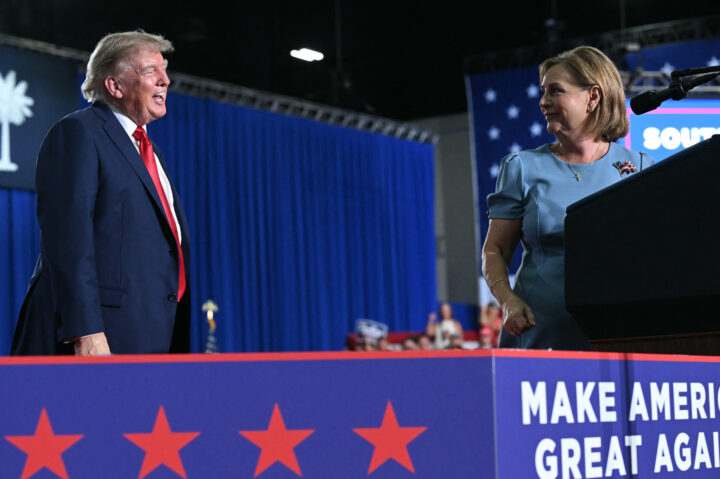
President Donald Trump congratulates Sen. Darline Graham after she spoke during a campaign rally at Myrtle Beach Convention Center in Myrtle Beach, South Carolina on August 21, 2026.


 Add JewishInsider on Google
Today’s special election GOP runoff for Senate in South Carolina between appointed Sen. Darline Graham and five-term Rep. Ralph Norman (R-SC) will be a clear test over just how much juice President Donald Trump’s endorsement carries within the Republican Party, at a time when his overall political standing has been on the decline.
Graham has struggled through the shortened campaign to fill the seat of her late brother, dodging the media spotlight (unlike her brother) and sticking to generic talking points in talking about the issues. She faced blowback after admitting she didn’t know enough about foreign policy to answer a debate question about Taiwan — underscoring how much of a novice she is on an issue that defined Lindsey Graham’s legacy.
But Trump has been a loyal backer, holding a rally last Friday for her campaign, which featured appearances from the state’s Republican leadership, including Gov. Henry McMaster and Sen. Tim Scott (R-SC), who is also the chairman of the National Republican Senatorial Committee.
Norman also hardly fits the profile of the up-and-coming challenger. He’s 73 and would be one of the oldest freshman senators in recent memory. And for more-moderate Republicans, his record of antagonism towards House Republican leadership and support for declaring martial law in the days leading up to President Joe Biden’s 2021 inauguration make him a deeply flawed choice.
For national security hawks, Norman’s votes against several Israel aid packages and opposition to Ukraine assistance are also some notable red flags that make Darline Graham the candidate more aligned with her brother’s worldview.
Trump’s endorsement record has been mixed this year, initially backing the losing gubernatorial candidate (Lt. Gov. Pamela Evette) in South Carolina — while endorsing unsuccessful candidates for governor in Georgia, Iowa, Minnesota and Wyoming. All told, he’s backed 10 unsuccessful candidates in primaries this cycle. But the president’s record in Senate races this year is still perfect, having successfully backed insurgent challengers to Sens. Bill Cassidy (R-LA) and John Cornyn (R-TX).
In fact, only three of Trump’s Senate endorsees throughout his political career have lost in primaries (Alabama GOP Sen. Luther Strange in 2017; West Virginia Senate candidate Evan Jenkins in 2018; Utah Senate candidate Trent Staggs in 2024).
Graham is hoping to avoid joining that club, and despite her flubs, she’s still got a strong chance of prevailing. She won the first round of balloting with 33% of the vote — eight points ahead of Norman — and finished a respectable second place in the northeastern corner of the state that makes up Rep. Russell Fry’s (R-SC) home base. (Fry endorsed Graham’s candidacy after finishing in third place in the primary.)
But if Graham falls short, it would not just be a sign that South Carolina voters were wary of her policy inexperience. It would be an indication that the Trump endorsement, while still valuable in Republican primaries, isn’t the automatic ticket to victory that it was for so long.
GOP campaign veteran Colin Reed called Graham’s debate performance a ‘seismic moment in an otherwise sleepy race’

Peter Zay/Anadolu via Getty Images
Sen. Darline Graham (R-SC) and Rep. Ralph Norman (R-SC) participate in a televised debate ahead of the Republican primary runoff in Newberry S.C., on August 18, 2026.
Sen. Darline Graham’s (R-SC) stumbling performance at the final GOP primary debate on Tuesday has prompted questions among Republicans in Washington about her prospects in next week’s runoff against Rep. Ralph Norman (R-SC).
Graham’s debate performance has been widely panned for her response to a question about Taiwan and the South China Sea, during which she admitted that she is “not that informed on national security.” The moment prompted national Republican operatives to question her qualifications to replace her late brother, Sen. Lindsey Graham (R-SC), and led to an avalanche of attacks from critics about her lack of policy experience.
Senior Republicans who have been involved in the race privately described Graham’s foreign policy flub as a pivotal moment that could cost her the nomination.
“It was always going to be a lot harder than she was told when she got into this, but I thought she could win before the debate. Now, I think she’s done for,” a senior GOP campaign official involved with the race told JI. “This loss is going to be an unfortunate embarrassment, and the way this played out could be somewhat of a stain on Lindsey’s legacy even though he had nothing to do with it.”
A spokesperson for Graham’s campaign declined to comment about her debate performance. Graham defended her answer while speaking to reporters in the spin room following the debate, arguing that, “The people of South Carolina, they’re worried about their pocketbooks more than they’re worried about the South China Sea, quite honestly.”
Veteran Republican strategists who have been involved in high-profile Senate races called Graham’s performance one of those rare moments that could change the trajectory of the race.
“The debate seems fairly consequential for a number of reasons,” Colin Reed, a founding partner of South & Hill Strategies and a GOP campaign veteran, told Jewish Insider. “To me, it seems like a fairly seismic moment in an otherwise sleepy race.”
Reed predicted that Graham’s inability to sound articulate on foreign policy — all but taking a pass on a consequential national security question — was likely to have an impact on the outcome of the race because of the importance of national security issues to South Carolina’s “heavy military presence and large veteran community.”
He added that her comments are already drawing comparisons to “the towering figure her brother was on the matter of foreign affairs” and the fact that the U.S. “happens to be engaged in multiple conflicts, or at least one conflict overseas with Iran, right now.”
“This is a late-summer primary and runoff, and only the most engaged audiences turn out,” Reed said. “Those types of audiences are the ones who were likely paying attention or discussing the debate.”
He argued that Graham’s lack of political experience makes her a “blank canvas” to voters and that, combined with the special election to replace her late brother on the ballot as the GOP nominee being truncated despite Republican primary voters being “wary of coronations,” the South Carolina senator had already been in a vulnerable political position prior to the debate.
Should Graham lose to Norman, it would mark the first time this cycle that a GOP candidate endorsed by President Donald Trump in a Senate race has lost their primary contest.
The president will hold a campaign rally for Graham in Myrtle Beach on Friday, even as he has scaled back his campaign appearances in recent months. Republicans in Washington expressed skepticism that the rally would significantly alter the outcome of this race, with two sources predicting that most of the attendees were only going to see the president speak. (For his part, Lindsey Graham was frequently booed and heckled when appearing at Trump rallies through the years.)
Norman said in a statement following the debate that South Carolina deserves to have a senator with “know-how” on foreign policy matters.
“Whether it’s spy balloons flying overhead or buying up land near South Carolina military bases, China continues to prove that it is a threat to the United States,” the House lawmaker told Politico.
Republican senators were told that Graham was not interested in seeking a full term when she agreed to the appointment in the immediate aftermath of her brother’s unexpected death last month. Graham said in a pre-debate interview on Monday that she “didn’t even realize I’d be asked to fill the seat temporarily” and did not accept the appointment last month with the idea of running for a full term. She instead credited the president with convincing her to run during an Oval Office meeting in her first week as senator.
Graham’s surprise decision to run, which two sources told JI came at the urging of Trump and several of Lindsey Graham’s campaign consultants, was met with apprehension in Washington. GOP circles. After Graham launched her campaign, Republican senators and strategists skeptical of her chances of winning began quietly voicing concern to one another about her lack of voting record or political background, the fact that she lacked a policy platform and the optics of sending a grieving sister out on the campaign trail. They also took note of how competitively Norman, Graham’s opponent in next week’s runoff election, was polling in the race.
One senior Senate GOP operative put it bluntly: “If we’re going to do a coronation, we need to be able to do a coronation. If we can’t get our s**t together, then we shouldn’t keep trying.”
Graham was cautioned by several Republicans, including two senators, that she would be setting herself up for a contentious election fight if she got in the race, according to two sources familiar with the matter. She was told by several of her brother’s campaign consultants, however, that while the contest would be challenging, she was likely to win with the president’s endorsement.
Graham prevailed in the first round of the primary election earlier this month, but only tallied 33% of the vote, far short of the majority necessary to avoid a runoff. She got a campaign boost after winning the endorsement of one leading rival, Rep. Russell Fry (R-SC), but her debate stumble only underscored her biggest vulnerability: lack of experience.
“The debate was challenging to watch. Her performance was very bad. We all empathize with her because of the circumstances she’s under, but that makes it all the more disturbing that folks who claim to love Lindsey would get in her ear and tell her she should run,” the Senate Republican campaign source said.
The winner of the Republican runoff next Tuesday will face Democrat Annie Andrews in the November election. Andrews, a pediatrician, is a decided underdog running in a solidly Republican state, but has been a strong fundraiser, bringing in over $10 million during the campaign cycle.
Collins led Dooley 41-30 in the May 19 Republican primary, with Rep. Buddy Carter (R-GA) coming in at 25%
Miguel Martinez/Atlanta Journal-Constitution via AP
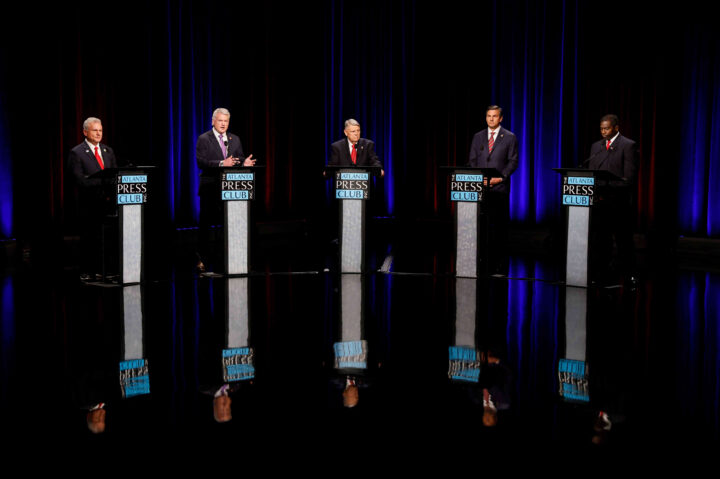
U.S. Rep. Mike Collins, R-Jackson, second left, speaks at the Atlanta Press Club Loudermilk-Young primary election debate for the U.S. Senate at Georgia Public Broadcasting, Sunday, April 26, 2026, in Midtown Atlanta.
Rep. Mike Collins (R-GA), who has repeatedly faced controversy during his time in the House, appears favored to win the Republican Senate primary runoff in Georgia against Derek Dooley, a former college football coach backed by popular moderate GOP Gov. Brian Kemp.
Collins led Dooley 41-30 in the May 19 Republican primary, with Rep. Buddy Carter (R-GA) coming in at 25%. The runoff will take place on Tuesday, with the winner to face Sen. Jon Ossoff (D-GA) in November.
Polling shows Collins maintaining a sizable lead. Two late May post-primary polls, by JMC Enterprises and CivicLens Research, showed Collins ahead. Collins led by 16 percentage points in a JMC poll, 55-39, with 7% undecided, and by 10 points in a CivicLens poll, 50-40, with 10% undecided.
President Donald Trump endorsed Collins — generally seen as the more MAGA-aligned candidate — late on Saturday, while Kemp — who national Republicans initially sought to recruit for the race — has been aggressively campaigning around the Peach State in support of Dooley.
Trump described Collins as a “a true Friend, Fighter, and WARRIOR, who has been with us from the very beginning,” while dismissing Dooley as an unknown figure who lived outside of the state “for most of his life,” didn’t vote in 2020 or 2016 and said that Trump lost Georgia in the 2020 election, which Trump continues to deny.
Charles Bullock, a professor of political science at the University of Georgia, said that the state’s election history has shown that candidates who finish with such a commanding lead in the primary generally win the runoff, and that the little publicly available polling has largely reflected that Collins is maintaining his 10-point lead.
Dooley’s major asset, Bullock continued, remains the support he has received from Kemp. But Collins entered the race with name recognition in the Atlanta area, particularly from his work leading the Laken Riley Act, multiple previous runs for Congress and his father’s own service as a member of Congress.
Dooley, by contrast, entered the race as a largely unknown candidate. Collins’ advantages carried him despite the fact that he spent the least money of any of the GOP candidates in the race.
Bullock said that Dooely’s best chance of victory on Tuesday will be if there is strong turnout in the Atlanta area, rather than the more rural areas that have been Collins’ bases of support.
Collins and his campaign have repeatedly faced controversies relating to antisemitism and affiliations with extremist figures.
A recent report by Slate showed that Collins’ current congressional chief of staff, Kip Talley, was involved in a group chat that also included prominent white nationalists and Holocaust deniers, in which Talley pledged that he would “try and use the levers of the legislative branch” to defend and attempt to free from prison the far-right activist and Holocaust denier Charles Johnson.
Talley also said in the group chat that he contacted federal officials in an effort to “to get [Johnson] out” of prison.
In a statement to Slate, Talley denied acting at Collins’ direction or using official resources on behalf of Johnson, whom Talley described as “an acquaintance I have known for years.”
Collins himself faced criticism for endorsing an X post by an antisemitic, racist account attacking a reporter for being Jewish in 2024. Collins continued to deny that the original post for which he offered support was antisemitic and refused to apologize.
He also voted against the Antisemitism Awareness Act, though he has otherwise maintained a generally strong record on measures related to antisemitism and Israel policy in the House.
“Mike Collins has condemned the hate speech seen on college campuses and around the globe, and has been an ardent supporter of Israel in Congress. While [Georgia Sen.] Jon Ossoff capitulated to woke activists and voted to cut aid to Israel, Mike Collins has stood strong and protected its right to exist,” a Collins campaign spokesperson told JI last year, when asked about his online history and vote on the antisemitism bill.
Talley isn’t the only Collins aide who has caused controversy.
William Paul, a former Collins staffer and son of Sen. Rand Paul (R-KY), recently accosted Rep. Mike Lawler (R-NY) at a bar in Washington with an antisemitic rant, though Paul was no longer working in Collins’ office at the time of the incident.
In the final weeks of the runoff, a Collins campaign account on X made a crude post mocking a pro-Dooley GOP strategist over accusations of sexual assault made by the strategist’s wife against former news anchor Matt Lauer. Collins apologized and fired his former chief of staff, Brandon Phillips, who has long been dogged by scandal and is under House Ethics Committee investigation.
Dooley and his allies argued that the incident highlighted concerns about Collins’ electability against Ossoff.
Dooley has enjoyed support from conservative members of Georgia’s Jewish community since he entered the race. Emanuel Fialkow, a prominent member of the community, hosted a meet-and-greet with prominent Jewish leaders ahead of his campaign launch. He described Dooley as “very receptive” to their feedback and as a “staunch supporter of the Jewish people, and all religions, and of Israel” in an interview with Jewish Insider last week.
“Derek Dooley is our best chance to get rid of Ossoff, and I think that Derek Dooley will be true and unwavering in his support for Georgia, Israel and religious freedom, period, including Jewish people,” Fialkow said.
Fialkow did not comment on Collins beyond saying that Phillips’ activity was “awful and [Collins] should have fired him sooner.”
Though he predicted that Collins would win the primary, the University of Georgia’s Bullock said that Dooley would likely be the more electable candidate in November, which he said has been the factor driving Kemp’s support for the former football coach. “If he were to be chosen, Derek would probably be a stronger candidate in November,” Bullock said — though Ossoff would likely be the favorite against either man.
The swing voter population in the state, according to Bullock, consists of white, college-educated voters identifying as Republicans. If a Democrat can increase his share among those voters, he will likely win, and Ossoff is well-positioned to do so in November.
Campaign consultants, Bullock said, are “increasingly acknowledging” that it will be difficult to beat Ossoff, and are looking to direct money toward other Senate battlegrounds.
Bexar County sheriff’s deputy Johnny Garcia is facing off against Maureen Galindo, who has made antisemitic conspiracy theories a key feature in her campaign

Courtesy
Bexar County sheriff’s deputy Johnny Garcia
An upcoming Democratic runoff for a red-leaning open House seat in Texas that could be competitive in November is now emerging as a stark example of the growing tensions between moderate candidates and their fringe opponents on the extreme left over how to approach Israel and the rise of antisemitism.
The May 26 election in Texas’ recently redrawn 35th Congressional District, which was created to favor Republicans and extends from San Antonio to Austin, pits Johnny Garcia, a Bexar County sheriff’s deputy who is backed by pro-Israel Democrats and establishment officials, against Maureen Galindo, a local activist who has used her growing social media presence to promote a range of conspiracy theories, including specious claims about Israel and its ties to the United States.
Despite spending only around $4,000 on her insurgent bid and raising no money, Galindo, 38, narrowly finished first in the crowded primary earlier this month, clinching just over 29% of the vote — two points ahead of Garcia, who placed second. The other two Democratic primary candidates, John Lira and Whitney Masterson-Moyes, each won about 20%. Both have since endorsed Galindo in the runoff.
The unexpected result has raised serious doubts among mainstream Democrats and nonpartisan election observers over whether the party can win the seat if it nominates Galindo, who last year ran unsuccessfully for San Antonio City Council — and whose unhinged rhetoric is likely to alienate voters in the general election.
Her upset also underscores how, on both sides of the aisle, fringe candidates prone to conspiracism that increasingly focuses on Israel are managing to gain some traction — amid an uptick in antisemitic violence linked to the war in Gaza and now in Iran.
In an interview with Jewish Insider last Friday, however, Garcia, 39, said he had anticipated the possibility of a runoff, projecting confidence about his ability to claim the nomination for a seat he and national Democratic leaders believe he is best suited to win this fall.
He said he had already expanded his coalition in the days after the primary, earning new endorsements from both current and former elected officials who had previously remained neutral, while otherwise drawing contrasts with an opponent whose unstable messaging, he argued, shows a lack of connection to voters’ everyday concerns in the heavily Latino district.
“Although the desired outcome would have been making sure that we powered through the primary without a runoff, here we are in a situation to make sure that we are educating the voters about who the two candidates are,” he said, claiming that only “one aligns with” a district that he described as “very blue-collar.”
He characterized Galindo, by comparison, as a polarizing figure whose penchant for incendiary rhetoric threatens to stoke intraparty divisions in the House and inflame tensions nationally, accusing her of fomenting antisemitism in her commentaries on social media.
“Antisemitism is dangerous, and this country has enough divide as it is with what we’re seeing at the top by those in power,” he told JI. “We don’t need more of that, in a time where division is so strong and hate is driven by antisemitism. We don’t need more of that, especially coming from a Democratic candidate running for Congress.”
During a moment of increased political tensions fueled in part by “wars in the Middle East” raising security concerns in the Jewish community, Garcia argued, “we don’t need somebody like that making antisemitic remarks, and conspiracy theories, that could potentially drive what we just saw yesterday in Michigan,” referring to the foiled terrorist attack that targeted a synagogue in suburban Detroit last Thursday.
Citing his career in law enforcement, Garcia, who said he had worked in construction and plumbing before serving as a corrections officer and later as a hostage negotiator on an elite SWAT team, broadly emphasized his appreciation for nonprofit security grants that help protect religious institutions from terror attacks. New federal funding is currently tied up in Congress amid a partial shutdown at the Department of Homeland Security.
“I support security grants for synagogues and Jewish schools, with the ability to also monitor hateful rhetoric and antisemitism online and to streamline the response across law enforcement agencies,” Garcia told JI. “Here in San Antonio, we understand that, when we have an attack anywhere in the nation, it is our direct response to make sure that the fates that are being directly impacted are remaining safe, and ensuring those who practice a particular faith, such those who attend synagogues, will be safe. That is a priority.”
In her own campaign, meanwhile, Galindo has demonstrated an unusual fixation on Israel, while using messaging that invokes antisemitic tropes. “We need Congress members that put America before Israel, I can’t even believe I’m having to say this!!” she wrote in one representative online post. “If it’s not clear, I DO NOT SUPPORT AMERICAN TAX DOLLARS GOING TO ISRAEL AND WILL NEVERRRR ACCEPT THEIR BLOOD MONEY.”
She has devoted much of her attention to what she suggests are pernicious links between San Antonio and Israel, while baselessly insinuating that “there may be Israeli soldiers” secretly embedded in U.S. federal immigration operations. She has frequently claimed that the Department of Homeland Security is based out of Tel Aviv, citing as evidence a screenshot purporting to show the agency had created its X account in the Israeli city — which X’s head of product has dismissed as “fake news” and a “hoax.”
Meanwhile, the first section in the issues page featured on Galindo’s campaign website refers to “genocide,” only mentioning Israel. “We must stop funding Israel with billions of American workers’ tax dollars every year,” she says. “Instead we can invest that money in a STRONGER AMERICA.”
In an email to JI last week, Galindo, who declined to be interviewed, did not answer questions asking if she was aware that her language on Israel echoes antisemitic conspiracy theories.
“Jewish-Americans are saying that Israeli government actions are escalating antisemitism which of course makes me fear how Israeli and American aggressions are harming Jewish people around the world!” she wrote in response.
She also refused to acknowledge that her repeated claims regarding DHS had been discredited. “It would be sus if the DHS in Tel Aviv post was debunked because I saw it with my own eyes that day!” Galindo said. “I hope X leadership isn’t compromised. You should look into that for the safety of all Jewish people — we must stop harm to Semites and end genocide!”
For his part, Garcia expressed strong support for Israel and its relationship with the United States last week. “I firmly believe the actors of Hamas are a terrorist organization,” he said. “We need to make sure our closest ally in the Middle East remains safe and has the ability to protect itself.”
“Making sure the region remains safe and remains stable is a priority,” he explained to JI. “We need to ensure the area does not destabilize and allow for other terrorist organizations to sprout and spring up, especially at a time where we are now in a new war with Iran.”
While he acknowledged Iran “has been a leading sponsor of terrorism for years and everyone agrees unilaterally that Iran cannot be allowed to obtain a nuclear weapon,” Garcia disagreed with the manner in which the Trump administration has prosecuted the war, saying it has endangered American soldiers and resulted in escalating gas prices back home, at a moment when voters are more concerned with basic affordability issues such as rising grocery and health care costs.
“This war is careless and it’s reckless,” he told JI, adding that military “families here in San Antonio are fearful their children will be going and fighting in this endless war.”
His centrist approach to foreign policy and other topics has earned Garcia endorsements from the moderate Blue Dog PAC and Democratic Majority for Israel, which recently included him on its first slate of non-incumbent House candidates for the midterms.
“Let’s be clear, there is only one Democrat who can win this race and it’s Johnny Garcia,” Brian Romick, DMFI’s president and chair of its political arm, said in a statement to JI. “DMFI PAC is proud to support him because if Democrats are going to win back the House, we need to support candidates like Johnny who can actually win in November.”
Even as the nonpartisan Cook Political Report has ranked the race “likely Republican” in its election forecast, the Democratic Congressional Campaign Committee has indicated it is optimistic it can win the seat, adding it to a list of “districts in play” late last year.
“Knowing their record of broken promises has turned voters against them, Republicans are attempting to save their microscopic majority by trying to diminish the power of voters of color in Texas,” Rep. Suzan DelBene (D-WA), who chairs the DCCC, said in December. “Democrats will not let their cynical power play go down without a fight. The DCCC will work to ensure the people of Texas’ 35th District have the representation they deserve.”
Local political experts agreed the race could be in reach for Democrats this November, depending on the outcome of the runoff — where Republicans also are fielding two candidates after a primary where no candidate came close to securing more than 50% of the vote required to win the nomination outright.
“I wouldn’t consider any runoff in which neither candidate broke 30% in the first round to be a sure thing,” David Crockett, a political scientist at Trinity University in San Antonio, warned last week about the Democratic runoff. “This will hinge on turnout and organization, and where the voters for the third and fourth place finishers go.”
Jon Taylor, a professor of political science at the University of Texas at San Antonio, shared a more sanguine assessment, suggesting Galindo “may have benefitted from a low name identification primary.”
“But based on the also-rans from the primary and Garcia’s fundraising and organizational advantage,” Taylor told JI, he suspects that Garcia will win the May contest. “Lira and Whitney Masterson-Moyes’ voters are more likely to gravitate toward the more moderate Garcia.”
Looking to the fall, “Garcia provides national Democrats with better material to work with in November and none of the liabilities of the more extreme and at times unbalanced Galindo,” noted Mark P. Jones, a political scientist at Houston’s Rice University.
Though the GOP had drawn the new seat to help give the party an edge — the product of mid-decade redistricting that transformed a solidly blue enclave held by progressive Rep. Greg Casar (D-TX), who is now running for a different seat — experts said that a difficult national political environment now facing Republicans could shape their chances for a pick-up in the general election.
The Democratic nominee will face off against either John Lujan, a state lawmaker backed by Republican Gov. Greg Abbott who flipped a blue San Antonio seat in 2021, or Carlos De La Cruz, a U.S. Air Force veteran who won a late endorsement from President Donald Trump that complicated the primary’s closing stage. Lujan, who placed first with 33% of the vote, bested De La Cruz, whose sister is Rep. Monica De La Cruz (R-TX), by six points, hardly a strong total for either candidate.
“Democrats across the country and in Texas over the last year and more have run well ahead of their historic vote shares,” said Cal Jillson, a professor of political science at Southern Methodist University in Dallas. “It looks like 2026 is shaping up to be a good Democrat year nationally and in Texas.”
Unless the political landscape changes “in the Republicans’ favor between now and Election Day,” he told JI, “I would think any district that is less than” heavily favorable for the GOP “might be available to a good Democrat candidate running a good race.”
In the meantime, though, Garcia said that he is focusing on shoring up support in advance of the runoff, as he works to prevent his extremist rival from another upset. “Now more than ever,” he said, “we need to be united — not just as Democrats, but as a nation. We can’t allow hateful vitriol or further divides to fuel tensions and create an environment for attacks” targeting the Jewish community.
“My title in law enforcement, in the state statute, is peace officer,” Garcia explained to JI. “That’s what we are, first and foremost. We’re not deputies, we’re not policemen. We are peace officers. And I believe strongly in peace and diplomacy.”
“That is what I starkly bring to this race” and what “we’re ultimately fighting to restore in Congress as well,” he said.
Greene has stayed on the sidelines in the race to replace her, not endorsing or rallying for any of the candidates, as she continues to air her disappointment with Trump and the GOP leadership
Chip Somodevilla/Getty Images
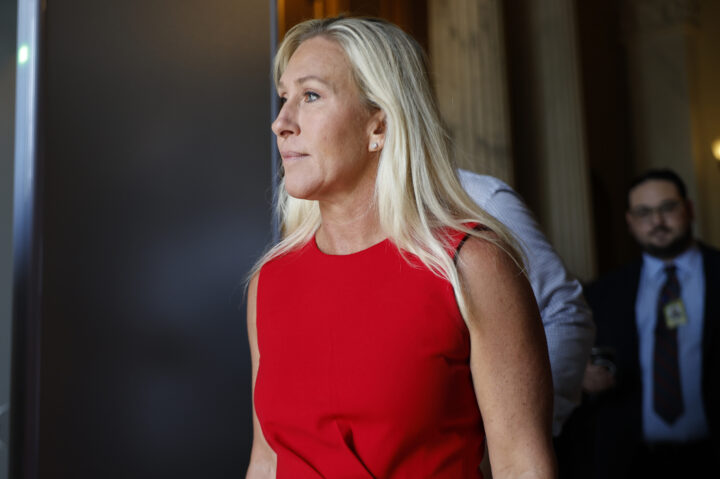
Rep. Marjorie Taylor Greene (R-GA) leaves the House Chamber following the last vote of the week at the U.S. Capitol on September 12, 2024 in Washington, DC.
Voters are casting ballots today in the special election for the ruby-red House seat previously held by Rep. Marjorie Taylor Greene (R-GA), but the final outcome will likely remain uncertain for another month.
With 17 candidates on the all-party ballot, the race is expected to go to a runoff — unless any candidate receives 50% or more of the vote, making today’s race effectively a competition over which two candidates are likely to finish with the most support.
On the GOP side, the race is dominated by two candidates. The first is Clay Fuller, a local district attorney, veteran and former White House fellow who is backed by President Donald Trump.
The second, former state Sen. Colton Moore, a hard-line conservative rabble-rouser often at odds with his own party’s leadership, is running as the anti-establishment populist — a profile that more closely matches Greene’s.
The district is one of the most Republican in the country: Trump carried the district by 37 percentage points in 2024, and paid a visit to the district in late February to throw his support behind Fuller.
A third Republican candidate, Brian Stover, a local businessman, has raised a significant amount of campaign cash and is a wild card.
On the Democratic side, the likely leader is Army veteran Shawn Harris, who lost to Greene in 2024 by nearly 30 points. He’s pulled in $4.2 million from Democrats outraged by Greene and who’ve been attracted by a far-fetched pitch that he can flip the seat. But he’s likely to secure a runoff spot, given how many Republican candidates are on the ballot.
Fuller’s campaign has been touting Trump’s endorsement, and his own military service. Fuller’s Air Force career included work on counterterrorism operations, and he was deployed in 2024 to the Al Udeid airbase in Qatar supporting U.S. Central Command operations. He also has the support of the conservative Club for Growth.
He has backed the U.S.-Israeli offensive against Iran, and expressed support for Israel. “President Trump tried the peace route with Iran not once, not twice, but THREE separate times—and they refused. He’s the peace President, but you can’t negotiate with a death cult,” Fuller said, emphasizing he had supported operations against Iran and that the regime and its proxies had killed many Americans.
Despite not receiving Trump’s support, Moore is also trying to tie himself closely to the president, describing himself on his campaign website as “Trump’s #1 Defender” and “a Proven Warrior for President Trump” — pointing to his vocal efforts to contest the results of the 2020 election and opposition to subsequent investigations of Trump and his allies — and using the campaign slogan, “God. Guns. Trump.”
Moore has repeatedly found himself at odds with Georgia’s GOP establishment, having been expelled from the Republican caucus, banned from the Statehouse floor and arrested when he tried to enter the 2025 State of the State address.
Moore doesn’t appear to have addressed the war in Iran, but said, days after the Oct. 7, 2023, Hamas attacks, “The Jewish people are the indigenous people of Israel.” And according to a candidate questionnaire from 2022, he is a longtime supporter of Israel, having attended AIPAC conferences and, as a college student, having served as co-chair of the University of Georgia AIPAC chapter. “There is no Palestinian land, it is all the land of Israel,” he said in the questionnaire.
So despite his MAGA bona fides, his record appears decidedly more supportive of Israel than Greene, who has advanced antisemitic conspiracy theories and became one of the few anti-Israel Republicans in Congress.
However, Moore was also the only Republican member of the state Senate to vote against a bill in 2024 codifying the International Holocaust Remembrance Alliance’s working definition of antisemitism — echoing Greene’s stance on the Antisemitism Awareness Act in the same year.
As of Feb. 18, Stover had raised $940,000 (around two-thirds of that was in the form of a personal loan to his campaign), Fuller $787,000 and Moore $342,000.
The normally voluble Greene has stayed on the sidelines in the race to replace her, not endorsing or rallying for any of the candidates, as she continues to air her disappointment with Trump and the GOP leadership.
Please log in if you already have a subscription, or subscribe to access the latest updates.
 Continue with Google

 Continue with Apple