












































































Armed Services Committee chair Roger Wicker broke his silence on Thursday, warning the deal would make Iran’s Obama-era payoff ‘look like a pittance’

Tom Williams/CQ-Roll Call, Inc via Getty Images
Senate Armed Services Committee Chairman Roger Wicker (R-MS) arrives for a confirmation hearing in Dirksen building on Tuesday, May 13, 2025.


 Add JewishInsider on Google
Senate Republicans continued on Thursday to air concerns about the U.S. memorandum of understanding with Iran, in some cases fueled further by Vice President JD Vance’s comments dismissing the effectiveness of U.S. sanctions and lambasting Israeli government officials who have objected to the deal.
Sen. Roger Wicker (R-MS) — the chairman of the Senate Committee on Armed Services — issued a statement ripping into the agreement, saying he’s “concerned [it] negotiates away the victories of Operation Epic Fury in ways that are completely out of step with the president’s goals.” Wicker had for days told reporters he was “withholding comment” on the MOU.
He said that, even though the $300 billion reconstruction fund outlined in the deal is not coming from U.S. taxpayer money, it “would make Iran’s payoff under President [Barack] Obama’s 2015 deal look like a pittance by comparison” and that it “would be an error to force Israel to stand down against Hezbollah.”
He said he also opposes any sanctions relief or unfreezing of funds for Iran “in exchange for Iran’s mere agreement to negotiate for another 60 days. The Iranian regime has not renounced its ultimate goal — ‘Death to America, Death to Israel.’ The regime will invest every penny it receives to further that aim.”
But Wicker pointed ultimate blame for the final shape of the deal at the “intermediaries,” rather than Trump himself.
Wicker told reporters he expects to hear from Vance about the deal but that no briefings have yet been arranged or scheduled.
Reiterating a stance he expressed a day prior, Sen. Ted Cruz (R-TX) said, “History demonstrates giving billions of dollars to theocratic lunatics who want to kill you is an exceptionally bad idea. So I hope we don’t do that.”
Asked about the comments by Vance — a potential candidate in the 2028 GOP presidential primary — Cruz, who mounted his own presidential bid a decade ago and is rumored to be considering a 2028 run, said, “I think the vice president can speak for himself.”
Sen. Thom Tillis (R-NC) said that he plans to go through the agreement in detail to compare it to the 2015 Joint Comprehensive Plan of Action because “what we don’t want to do is repeat that mistake.”
Tillis rejected Vance’s comments that sanctions have not been effective. “You’ve seen all kinds of their behavior changes in reaction to sanctions,” Tillis told Jewish Insider. “To suggest it’s not working would suggest that broadly sanctions don’t work, and we all know that that’s just factually incorrect.”
He told JI that “clearly any sanctions that are subject to congressional approval, he needs to come to Congress. Pretty straightforward. They covered that on ‘Schoolhouse Rock.’”
Tillis, who is retiring, also called the deal a “very important moment” for Vance. “It’s definitely a two-edged sword. Coming up short’s probably not good for him, but it could be a great achievement for him.”
Sen. Mike Rounds (R-SD) told JI he hadn’t heard Vance’s comments on sanctions, but he said that “it seems to me that there are billions of dollars that have been held from Iran, which has not gone to terrorist activities, and I think that is a good thing. So, with regard to that, it clearly had an effect. Whether or not it was completely effective is debatable.”
Rounds said he was concerned that Israel was not a party to the negotiations but “there’s an expectation somehow that there would be a limitation on activity going on in Lebanon that we’re not involved with at all, but that Israel is.”
He emphasized that “the Israeli government has a right to defend its people” from the yearslong ongoing attacks from Hezbollah, “and I don’t see that necessarily correctly addressed within this original memorandum. Perhaps there’ll be more meat on it in an actual agreement.”
The senator said he’s unsure whether the Iran Nuclear Agreement Review Act, which blocks the lifting of sanctions or unfreezing of funds for a congressional review period on any deal pertaining to Iran’s nuclear program, would be applicable, or what legislative steps would be involved if it were.
“We need to learn more about what [Trump’s] intent is and how permanent the two parties expect this to be,” Rounds said. “There’s a lot of questions we don’t have answers to yet, but it’s early in the process.”
He raised concerns about how the agreement would be enforced “particularly if you release all of their funds immediately, they’re allowed to do with it whatever they want. In the past, they’ve used that to fund terrorist activities. The first one that comes to mind is Hezbollah, which sits in Lebanon right now and has been attacking Israel relentlessly for years.”
Sen. John Cornyn (R-TX) said that “everything I’ve heard about it causes me concern” and he believes the president agreed to the deal because he was “concerned about the midterm elections and gas prices and blockage of the Strait of Hormuz.”
“This gets that open, but I think he’s had to pay a very deal price to get that done, and I think we should be clear-eyed and realistic that this isn’t going to persuade the Iranian regime to go in peace,” Cornyn, who is retiring after being defeated by a Trump-backed primary challenger, said.
He said that the steps taken by U.S. military operations to degrade Iran’s ballistic missile program and military-industrial base and delay its nuclear program were positive, but “I think we ought to be realistic about where we are. It’s temporary. It’s certainly not a permanent solution.”
Cornyn said he does not believe that Trump was joking when he said on Wednesday that he would blame Vance if the deal goes awry, and that the outcome of the deal might affect Vance’s prospects in the 2028 presidential race.
Cornyn said he expects that Congress, in its oversight role, will be examining the release of sanctions and whether the administration has the ability to lift those sanctions unilaterally.
Sen. Tom Cotton (R-AR), the Senate Intelligence Committee chair who also had not yet commented on the deal, said on Thursday that he has “concerns” over the MOU, warning that “certain aspects of this deal are a step in the wrong direction.”
The Arkansas senator told Fox News’ “The Story with Martha MacCallum” that Trump “deserves enormous credit for making Iran weaker than it’s been in decades, and we need to make sure that we don’t squander the leverage that we’ve built.” Cotton said he wished that the president “had continued with Project Freedom when it was announced a couple months ago.”
He also called on Trump to “use our military to force the Strait open and to keep it open, in addition to reimposing the blockade in the event that “Iran doesn’t keep its end of the bargain.”
Cotton pointed to the immediate lifting of sanctions on Iran’s oil exports, suggesting the funding would go toward malign activities, and raised concerns about the long-term control of the Strait of Hormuz.
“There’s certain parts of this memorandum that are a bit vaguer about Iran’s ability to access up to $100 billion of frozen funds or whether Iran can impose tolls on the Strait of Hormuz after two months,” Cotton said. “We’ll need more explanation there. I hope President Trump won’t allow those things to happen.”
Sen. Joni Ernst (R-IA) said that lawmakers had “very serious problems” with the JCPOA and the administration will need to come explain the deal because “I don’t want to see JCPOA 2.0.”
Sen. Lisa Murkowski (R-AK) told JI that she expects to find out “a lot more about the real details and particulars in these next 30 days.”
The Alaska senator said Congress needs “to make sure that the way that the president and the United States are interpreting this is in sync with how Iran is interpreting this, and I’m not certain yet that we’re at that place.”
Murkowski said “they can’t tell me” how the sanctions relief and reconstruction funding will work “so I certainly have a lot of questions that have yet to be resolved, but I also appreciate that the agreement allows for this next 30 days to work through reaching it.”
Asked about Trump’s suggestion on Wednesday that he wasn’t opposed to Iran possessing ballistic missiles, Murkowski replied, “That wasn’t helpful.”
Murkowski responded affirmatively when pressed on if those types of comments from the president and senior administration officials gave her pause about what the final agreement could look like.
Sen. Jim Justice (R-WV) said that “if we don’t have absolute assurances” that Iran can never obtain a nuclear weapon “then we lose,” though he said that “there’s still work to be done” in further negotiations.
“If it were to come to pass that we still have all kinds of concerns and no assurances and everything else, then it’s not good at all,” Justice said. “We have to have control one way or another” of Iran’s nuclear materials.
He said he couldn’t address disputes with Israel about the deal directly but said “the Israelis have been wonderful allies, and we’re going to stay arm-in-arm with them, period.”
Democrats, meanwhile, continued to lambast the agreement.
Sen. Richard Blumenthal (D-CT) told JI the administration is “desperate” and “flailing” and criticized the exclusion of Israel from the negotiations given that it continues to face attacks from Hezbollah, from which he said it must defend itself.
He said the agreement’s reliance on the U.N. as an enforcement and verification mechanism also hurts Israel.
“How can Israel trust the U.N.? Working with Israel is simply not in their toolkit. With the hundreds of billions of dollars provided, the unfreezing of sanctions immediately, the lifting of the freeze on assets, I don’t know how Republicans who attacked us with the JCPOA are going to handle that,” Blumenthal said. “This is a regime that continues to call the United States ‘the Great Satan.’ I don’t know what they’re thinking.”
And, he argued, the agreement effectively requires nothing of Iran: “I know the vice president’s line has been, ‘They only get the benefit of the bargain if they keep their side of it,’ but there is no side of it for them. They’re under no obligations here. It keeps the status quo for nuclear arms, lifting sanctions, lifting the freeze on assets, the $300 billion dollars.”
Sen. Chris Coons (D-DE) called the deal “appalling, flawed, pathetic failure” but “the inevitable conclusion of a combination of never making the case to the American people, flawed strategic provision, lack of grasp of the regional dynamics. How many ways can I say bad, bad, bad.”
On the issue of sanctions, Coons told JI, “President Trump cut a horrible deal where he is giving to Iran an enormous amount of released assets that have been frozen, sanctions relief that will generate tens of billions, if not hundreds of billions, and this reconstruction fund In combination, this is a massive infusion of cash to the mullahs and the IRGC. History shows the mullahs will not primarily use this money to build health clinics and schools.”
He said that Vance’s criticisms of Israeli officials are part and parcel of his efforts to sell an unsatisfactory agreement.
“I think JD Vance has been tasked with trying to sell a really bad deal and he is being as aggressive as he possibly can in knocking down one of the more obvious critics — a country that has a lot to lose,” he added. “If their opposition to the JCPOA was in any way principled, then they have to criticize a deal that’s worse than the JCPOA.”
Coons pointed responsibility for countering the deal toward Republicans, emphasizing that Iran will use the funding it receives under the deal for malign purposes. The Delaware senator said that there are “some things” Congress can do including conduct oversight of the congressional sanctions that the deal seeks to lift.
Sen. Cory Booker (D-NJ) echoed colleagues in describing the agreement as an “unconditional surrender” by the U.S. ‘because we get nothing from this deal.”
“All the specific benefits go to Iran. We get vague promises for potentially in the future hundreds of billions of dollars,” Booker said. “We’re allowing an extreme, terrorist supporting regime, that’s more extreme than when we began this, that chant ‘Death to America,’ to have more resources to do more things. So this is perhaps one of the biggest presidential blunders and failures in the last 20 years.”
He said that whether Senate Republicans stand firm and refuse to allow the administration to lift sanctions requiring congressional approval “is going to be the big test.”
“Will they just roll over and lay down for him, or will they stand up and provide the kind of checks, balances, oversight, and accountability when it comes to Iran, that they should be doing?” Booker asked. “They have a lot of levers to pull on the Republican side, where they right now control the Senate and control the House.”
He did not address what Democrats plans’ or role might be.
In the House, pro-Israel Democrats are also outraged by the deal and vowed not to support when it comes before Congress, which they said it must under INARA.
Rep. Josh Gottheimer said he is “totally dumbfounded by this agreement, and, like many, in a state of disbelief,” adding that the U.S. “got nothing” and “not one core objective was meaningfully met.”
He predicted that the next phase of the deal will never come about, and said the U.S. is “selling out Israel” and “kowtowing to Hezbollah terrorists, by tying Israel’s hands in Lebanon.”
Rep. Brad Schneider (D-IL) called it a “surrender agreement” and an “unacceptable capitulation without achieving any of our objectives” that will “facilitate the rebuilding” of Iran’s military and support for proxy groups.
“Unless the agreement is changed to actually close and permanently block Iran’s path to nuclear weapons, I will vote against it,” Schneider said.
The proposed restrictions come after top Senate lawmakers publicly expressed frustration in recent months with the LAF’s failure to take concrete steps to fully disarm Hezbollah
MAHMOUD ZAYYAT / AFP via Getty Images
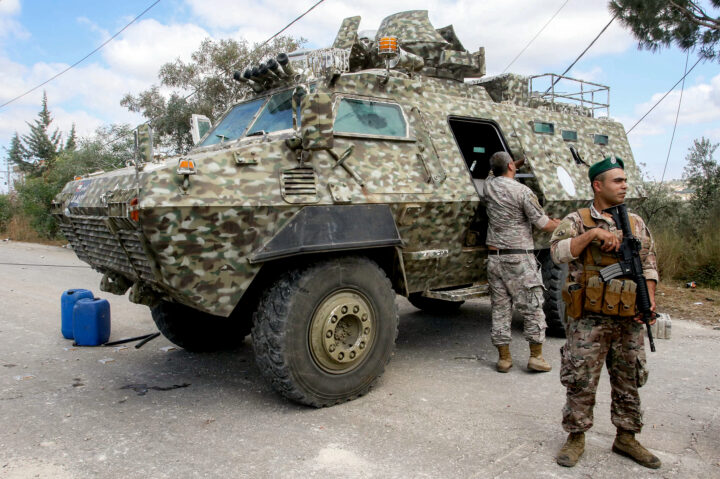
Lebanese army forces set up a checkpoint at the entrance of the village of Ghandourieh in southern Lebanon on June 15, 2026, preventing people from crossing towards villages the Israeli military is believed to have deployed.
The Senate’s version of the 2027 National Defense Authorization Act proposes sweeping new conditions on U.S. support for the Lebanese Armed Forces. The proposed restrictions come after top Senate lawmakers publicly expressed frustration in recent months with the LAF’s failure to take concrete steps to fully disarm Hezbollah, and argued that the U.S. should not provide unconditional funding for the LAF.
Sen. Roger Wicker (R-MS), the chair of the Armed Services Committee, which produces the NDAA, said in late April that “Congress should not support the LAF unless it acts to disarm Hezbollah completely — and immediately.”
Sen. Jim Risch (R-ID), who chairs the Foreign Relations Committee, echoed Wicker, adding that it was “well past time for the LAF to take tangible action to fully disarm Hezbollah and for the Lebanese government to follow through on long-promised economic reform. The era of complacency and unconditional bailouts must come to an end.”
Support for the LAF, which would be limited to no more than $36 million, is conditioned on the LAF’s work to disarm Hezbollah. No more than 5% of that funding can be provided until the administration certifies to Congress that Lebanon has outlawed Hezbollah’s activities and that the LAF is actively working to disarm Hezbollah, prevent the Iranian-backed group’s rearmament and prevent attacks on Lebanon’s neighbors — including Israel.
The administration would then be required to re-certify every 90 days to Congress that the LAF is continuing to act against Hezbollah to the full extent of its capabilities, with a mandatory suspension of aid if it cannot meet that certification.
The quarterly reports would also include specific data on the number of weapons seized from Hezbollah and other metrics regarding the LAF’s efforts to degrade Hezbollah, as well as the makeup and capacities of the LAF forces.
President Donald Trump on Tuesday publicly condemned Israel’s operations against Hezbollah, suggesting — in a move that baffled both lawmakers and experts — that Syria’s military could instead be called upon to deal with the Hezbollah threat.
The NDAA would block U.S. counterterrorism assistance to Syria until the administration can certify the Syrian government is taking action to demobilize, disarm and monitor foreign fighters and jihadists in the country, implement a system to “fairly integrate” the Kurdish-led Syrian Democratic Forces into the Syrian military and prevent attacks on minorities including Kurds and Druze.
The provision comes amid continued scrutiny on Capitol Hill of the Syrian government’s efforts to protect minorities after the U.S. withdrew sanctions on the Syrian government.
As previously reported, the NDAA, which was finalized last week but not released in full until Tuesday, includes a version of the FUTURES Act, which has become a hot-button issue in the context of the House version of the NDAA, seeking to centralize and expand existing defense collaboration efforts between the two partners.
But it also includes a second provision on joint development, requesting the administration provide Congress with a plan to establish a partnership between the U.S. and Israel on defense industrial priorities, with the goal of supporting the defense industrial bases in both countries, providing opportunities for industries in both countries to cooperate and collaborate and supporting defense development and startups in both countries.
The legislation additionally proposes boosting funding for cooperation on subterranean operations — previously billed as counter-tunnelling efforts — from $80 million to $100 million, and counter-drone programs from $70 million to $100 million. The bill also authorizes $1 million for cybersecurity cooperation with Israel.
That funding would still have to be approved separately in the appropriations process later this year.
The NDAA also includes two different provisions to enhance defense cooperation with both Israel and other Middle East allies.
One, the Abraham Accords Defense Cooperation Initiative, would establish a program to expand defense cooperation between the U.S. and the Abraham countries, to address various threats in the region. It encourages each country in the region to provide matching funds for the program.
The other, which pulls language from the OASIS in the Middle East Act, aims to develop a coordinated air- and missile-defense acquisition strategy alongside Israel, Abraham Accords members and other Middle East allies to ensure adequate resources to protect the U.S. and its allies in the event of future conflicts.
The provision further requires the administration to explain its work to replenish interceptor stockpiles that have reportedly been severely degraded in the war, assess the possibility for co-production with various Middle East allies of interceptor systems, consider an creating an air-defense stockpile in the Middle East and improve joint development and acquisition of low-cost interceptor options.
The NDAA, which provides formal congressional authorization for the Civil Military Cooperation Center overseeing the implementation of the ceasefire plan in Gaza, requires the administration to provide Congress with information on plans for and actual deployment of the International Security Force in Gaza and its involvement in disarming Hamas, as well as on granular, specific details on the amount and types of aid moving into Gaza.
Plans for the ISF have largely failed to materialize, and the force has not yet deployed inside Gaza, where efforts to disarm Hamas have stalled in light of the terrorist group’s intransigence.
Roger Wicker, the Senate Armed Services Committee chair, told Jewish Insider that Iran has ‘been stringing us along’ and ‘had no intention of negotiating in good faith’
Tom Williams/CQ-Roll Call, Inc via Getty Images
Senate Armed Services Committee Chairman Roger Wicker (R-MS) arrives for a confirmation hearing in Dirksen building on Tuesday, May 13, 2025.
Sen. Roger Wicker (R-MS), the chairman of the Senate Armed Services Committee, said on Monday that he would support President Donald Trump abandoning diplomatic talks with Iran and resuming military operations.
“It’s becoming clearer and clearer that they’ve been stringing us along and that they had no intention of negotiating in good faith,” Wicker told Jewish Insider of Iran. “I wouldn’t blame the president at all if we resume full-scale war. I don’t think the American people would blame him at all.”
The senator’s remarks follow a sharp weekend escalation, which saw Iran launch a barrage of ballistic missiles at Israel in response to IDF operations in Beirut. Asked at the Capitol on Monday about Trump’s subsequent pressure on Israeli Prime Minister Benjamin Netanyahu to hold back retaliatory strikes, Wicker encouraged a tougher stance on Iran.
Wicker has been skeptical for weeks of U.S. negotiations with Iran, urging a return to combat operations.
While Netanyahu reportedly called off broader strikes on Iran on Monday, he suggested he had pushed back on Trump’s request for Israel not to respond to an Iranian missile attack on Sunday. Netanyahu said he had relayed to the White House that Israel retains its right to self-defense “with appreciation and respect in my good conversations with my friend President Trump.”
Wicker dismissed concerns that Trump and Netanyahu’s relationship had deteriorated over the war in Iran, and emphasized his support for Israel’s actions against Hezbollah in Lebanon.
“I think the president would tell you that our relationship with Israel is as strong as it’s ever been, and that he’s doing well with Netanyahu,” Wicker said. “On the issue of Israel and Hezbollah, Hezbollah exists for no reason other than to destroy Israel and kill Americans. That’s the only reason they exist. They’re not a religion, they’re not a region, they’re not an ethnic group.”
“I absolutely believe that Israel has every right to respond forcefully when attacked by Hezbollah,” he added.
Sen. Ted Budd (R-NC) said that Israel and the U.S. are responsible for making their own decisions, but said that shouldn’t damage the core alliance.
“Israel is a sovereign country. They can make their own decisions. We’re a sovereign country, we can make ours,” Budd said. “We can make recommendations to either, and they’re a great ally. We need to make sure we maintain the status of them being a great ally.”
Sen. Richard Blumenthal (D-CT) argued that what he characterized as the administration’s failures are producing friction with Israel.
Blumenthal said that “Israel has a right to defend itself” from both Iran and Hezbollah and “has a right to strike back at Hezbollah, in Lebanon, where it is strongest, maybe outside Beirut.”
“The fundamental problem here is that Trump is caught in a quagmire of his own making with unrealistic and, in fact, confused goals that have not been achieved,” Blumenthal continued, “He’s struggling for negotiations, while Israel wants to achieve some goals, including securing the enriched uranium, and so there’s bound to be some tension.”
“But at the end of the day, they’ll have to continue working in concert, because that’s the only path toward peace,” Blumenthal said.
‘The rumored 60-day ceasefire — with the belief that Iran will ever engage in good faith — would be a disaster,’ said Senate Armed Services Committee Chairman Roger Wicker

Drew Angerer/Getty Images
Sen. Ted Cruz (R-TX)
Hawkish Senate Republicans expressed outrage on Saturday over the reported terms of a U.S. ceasefire deal with Iran, calling the agreement a defeat for the U.S. filled with major concessions to the Iranian regime.
“I am deeply concerned about what we are hearing about an Iran ‘deal,’ being pushed by some voices in the administration,” Sen. Ted Cruz (R-TX) said on Saturday.
Cruz said that Trump’s decision to strike Iran was correct and “the most consequential decision of his second term, but said that ending the war on the reported terms would be a failure.
“If the result of all that is to be an Iranian regime — still run by Islamists who chant ‘death to America’ — now receiving billions of dollars, being able to enrich uranium & develop nuclear weapons, and having effective control over the Strait of Hormuz, then that outcome would be a disastrous mistake,” Cruz continued.
He said that he is “pray[ing] the early reports are wrong” but said the fact that former Biden administration Iran envoy Rob Malley praised the reports is “not encouraging.”
“President Trump believes in peace through strength, and his strong leadership has already made America much safer,” Cruz said. “He should continue to hold the line, defend America & enforce the red lines he has repeatedly drawn.”
Sen. Lindsey Graham (R-SC) said that ending the war along the proposed terms would be conceding that there is no military solution to defeating Iran.
“If a deal is struck to end the Iranian conflict because it is believed that the Strait of Hormuz cannot be protected from Iranian terrorism and Iran still possesses the capability to destroy major Gulf oil infrastructure, then Iran will be perceived as being a dominate force requiring a diplomatic solution,” Graham said.
He said that such an outcome would shift the balance of power in the region and “be a nightmare for Israel.”
“Also, it makes one wonder why the war started to begin with if these perceptions are accurate. I personally am a skeptic of the idea that Iran cannot be denied the ability to terrorize the Strait and the region cannot protect itself against Iranian military capability,” Graham continued. “It is important we get this right.”
Sen. Tom Cotton (R-AR), who chairs the Senate Intelligence Committee, shared Graham’s post.
Sen. Roger Wicker (R-MS), the chairman of the Senate Armed Services Committee, had urged Trump on Friday to ignore advisors urging an agreement with Iran, and encouraged the administration to return to war so as not to leave behind a legacy of weakness.
“The rumored 60-day ceasefire — with the belief that Iran will ever engage in good faith — would be a disaster,” Wicker said Saturday. “Everything accomplished by Operation Epic Fury would be for naught!”
Meanwhile, other congressional Republicans are expressing support for the administration’s approach.
“President Trump is the ONLY one who could have gotten Iran — the world’s largest state sponsor of terrorism — to the negotiating table,” House Speaker Mike Johnson (R-LA) said. “We are greatly encouraged to learn a PEACE DEAL in Iran is underway — and look forward to learning more about the specifics. Under President Trump’s leadership, our nation is stronger, more respected on the global stage, and safer than ever before.”
Rep. Randy Fine (R-FL) said he’d spoken to the White House about the proposed deal and expressed support for it.
“President Trump will land this deal and end the conflict on his terms,” Fine said. “The Mullahs will never have a nuclear weapon.”
Former Secretary of State Mike Pompeo also lambasted the reported deal’s terms, calling it “straight out of the Wendy Sherman-Robert Malley-Ben Rhodes playbook: Pay the IRGC to build a WMD program and terrorize the world,” referring to the 2015 Iran nuclear deal struck by the Obama administration. He also called for a return to war.
Pompeo’s post faced furious backlash from White House Communications Director Steven Cheung, Trump advisor Alex Brusewitz and Rep. Anna Paulina Luna (R-FL).
The terror group has once again ramped up its attacks on international shipping in the Red Sea two months after reaching a ceasefire with the U.S.
Tom Williams/CQ-Roll Call, Inc via Getty Images
Senate Armed Services Committee Chairman Roger Wicker (R-MS) arrives for a confirmation hearing in Dirksen building on Tuesday, May 13, 2025.
A top Senate lawmaker indicated on Thursday that he’s open to resumed U.S. involvement in the campaign against the Houthis, amid a ramp-up of the group’s attacks on commercial shipping in the Red Sea and Israel that comes two months after the U.S. and the Houthis reached a ceasefire that ended the American bombing campaign against the group.
The Iran-backed Yemeni terrorist group has attacked and sunk two cargo ships passing through the Red Sea this week, killing several members of the ships’ crews and wounding and kidnapping others. The Houthis have also launched new strikes on Israel.
“The Houthis need to be totally eliminated,” Sen. Roger Wicker (R-MS), the chair of the Senate Armed Services Committee, told Jewish Insider. “They have no purpose other than to kill free people.”
Asked if the U.S. should become involved directly against the Houthis again, Wicker said, “I wouldn’t rule that out.”
Sen. Mark Kelly (D-AZ) told JI that if the Houthis continue to block Red Sea shipping, “we’ve got to figure out a path forward on how to respond. It can’t be a long-term thing for ships to go around the Horn of Africa.”
Sen. James Lankford (R-OK) said he wouldn’t, at this point, discuss possible American action, but emphasized that any Houthi activity has Iran’s hand behind it.
“The Houthis have decided the war against Israel is not over, and that doesn’t happen without Iranian support,” Lankford said, noting Iran’s assistance in providing intelligence, training and arms to the Yemeni terror group. “That would tell me Iran’s not done with their acts of terrorism in the region. … We have to decide, and Israel has to make a determination — as they have, of late — to be very, very clear. And Israel has carried out additional strikes on the Houthis to try to make that stop.”
Sen. Mike Rounds (R-SD) said, “I’m not sure what our interests are there right now, but most certainly, we have told them in the past that if they want to have a ceasefire, we’ll support a ceasefire. If they want to get back in the middle of it, I suspect that the administration may very well have a response to that.”
He said that he couldn’t discuss the possibility of a U.S. response without having been briefed on the situation.
Sen. Ted Budd (R-NC) said he would need to think further about what circumstances would require American intervention.
“You’ve seen their main source, of Iran, be taken offline,” Budd told JI. “It remains to be seen what Iran is going to do in connection with the Houthis, but they’re a malevolent force that needs to be dealt with.”
Asked for comment on whether the Houthis’ strikes violated the group’s ceasefire with the U.S. or what might prompt further American action against the terrorist organization, the White House referred JI to a State Department press release condemning the attacks.
“These attacks demonstrate the ongoing threat that Iran-backed Houthi rebels pose to freedom of navigation and to regional economic and maritime security,” State Department spokesperson Tammy Bruce said. “The United States has been clear: we will continue to take necessary action to protect freedom of navigation and commercial shipping from Houthi terrorist attacks, which must be condemned by all members of the international community.”
Please log in if you already have a subscription, or subscribe to access the latest updates.
 Continue with Google

 Continue with Apple