














































































Rasoul will instead remain in the Virginia House of Delegates, where he is chair of the Education Committee
Samuel Corum/Getty Images
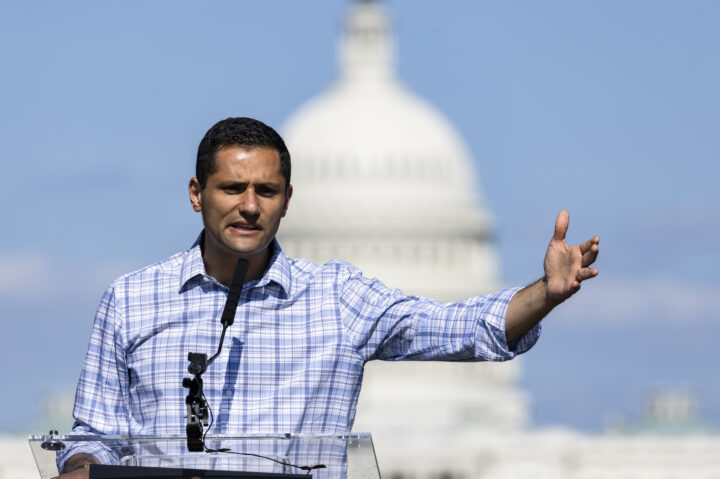
Sam Rasoul of the Virginia House of Delegates speaks during a rally on the National Mall on May 31, 2021 in Washington, DC.


 Add JewishInsider on Google
A Virginia state lawmaker with a history of inflammatory anti-Israel rhetoric who had been exploring a congressional run announced on Friday that he would instead remain in the state’s House of Delegates.
Sam Rasoul, a Roanoke Democrat who is the son of Palestinian immigrants, said he would hold onto his seat in the state Legislature to continue focusing on his work chairing the Education Committee, a role that has garnered concern from the state’s Jewish community due to his heated comments.
The decision comes days after Virginia voters approved a new congressional map that is likely to deliver four additional House seats to Democrats, prompting a reshuffling as politicians in the state opt to run — or not to run — for the newly drawn Democratic-friendly seats.
“Over the past few months, I have been evaluating the best path forward for me to continue serving our communities as we witness the Trump administration use our taxpayer dollars to fund a genocide abroad and wage an illegal and immoral Middle East war, all while our infrastructure and education systems are left crumbling here at home,” Rasoul said in a statement. “After careful consideration, I have decided that I will not be running for Congress this year.”
He urged congressional leaders to “champion Medicare for All, tackle the affordability crisis, and fight for an arms embargo on Israel.”
Rasoul came under fire last year from Jewish leaders in the state after posting a series of anti-Israel messages on social media that critics say veered into antisemitism. “Zionism has proven how evil our society can be,” he wrote on Instagram last summer, in a post that also called Zionism a “supremacist ideology created to destroy and conquer everything and everyone in its way.”
The Jewish Community Relations Councils for the Washington metro area, Richmond, Virginia Beach and Newport News called last August for Rasoul to be removed from his position as chair of the Education Committee, but that push was not successful.
Sen. Lisa Murkowski said she’s concerned Trump will deploy ground troops while the Senate is on recess
Heather Diehl/Getty Images
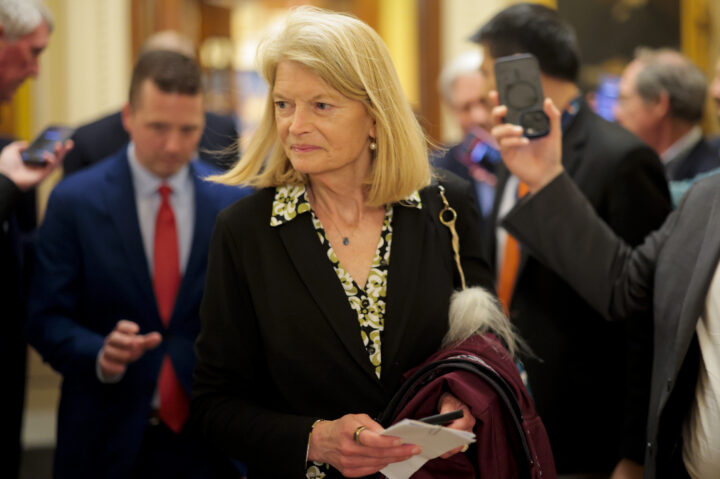
Sen. Lisa Murkowski (R-AK) walks through the Capitol on March 23, 2026 in Washington, DC.
Thursday brought a series of new signals that at least a small number of ideologically varied Republican lawmakers are growing frustrated with the war in Iran and with the administration’s frequently shifting rhetoric about it — including from some otherwise-hawkish lawmakers.
Sen. Lisa Murkowski (R-AK), who previously called for an end to the war, told Bloomberg on Thursday that she’s working on a potential authorization for use of military force in Iran, to limit the scope of the U.S. operation and prevent the deployment of ground troops.
“I don’t know what else to do,” Murkowski told the outlet. “I’m worried we get out of town and the president goes in with ground troops aiming for a full takeover.” The Senate is scheduled to be in recess for the next two weeks.
After Murkowski’s comments, The Wall Street Journal reported that President Donald Trump was considering deploying an additional 10,000 troops to the Middle East.
Rep. Don Bacon (R-NE), who has generally been supportive of the war effort, told NOTUS on Thursday after a House Armed Services Committee briefing the day prior that he was unclear on the U.S.’ plans and goals in the war.
“I don’t know the plan,” Bacon said. “What is the end-state goal? What is the mission? I think clarity there would be helpful.”
Rep. Rob Wittmann (R-VA) also told the outlet that he’s seeking “more granularity, more specificity on what specifically is happening on the ground, and then how is that leading to achieving the military objectives.”
Rep. Mike Rogers (R-AL), the Armed Services Committee chairman, emerged from the briefing Wednesday frustrated with what he said was a lack of information from the administration, warning officials that their reticence could have “consequences.”
Meanwhile, Rep. Nancy Mace (R-SC), who’s been more critical of the war in general, indicated to Axios she’s now inclined to vote for an upcoming war powers resolution to end the war, bringing it closer to the threshold for passage. She added, “War with Iran needs to end. President Trump has won the war, time to exit.”
House Democrats were initially expected to call a vote on that legislation this week, but have delayed their plans until after the congressional recess, saying they still don’t think they have the votes to pass it.
Regardless of whether the resolution passes the House, it remains unlikely to pass the Senate and could be vetoed by Trump. But passage of the resolution in the closely divided House would be a rebuke of Trump and his strategy.
The group’s warning came as Gov. Gavin Newsom said Israel could be considered an apartheid state

Michael Brochstein/SOPA Images/LightRocket via Getty Images
Jonathan Greenblatt, ADL CEO & national director, speaking at the Anti-Defamation League (ADL) National Leadership Summit in Washington, D.C.
The Anti-Defamation League on Thursday urged public figures to refrain from promoting antisemitic rhetoric amid the U.S. and Israel’s operation against Iran, as some leading Democrats have invoked anti-Israel sentiment since the war began last week.
“Since the start of hostilities with the Islamic Republic of Iran last weekend, we are witnessing an alarming pattern of escalating, inflammatory rhetoric from voices across the political and ideological spectrum,” said Jonathan Greenblatt, CEO of the ADL. “This rhetoric distorts reality and fuels dangerous antisemitic narratives.”
The ADL’s statement comes as several Democratic elected officials have condemned the joint U.S.-Israel ongoing strikes in Iran.
Greenblatt expressed concern that “too many voices” have “engaged in this dangerous game,” which he said includes statements calling Israel an “apartheid state” or accusing it of “genocide,” which “inflame hatred.”
California Gov. Gavin Newsom said on Tuesday on the liberal podcast “Pod Save America” that the U.S. should reconsider its military support for Israel. Amid the Iran operation, he told the podcast’s hosts that Israel could “appropriately” be described as an apartheid state.
The comments marked a shift for Newsom — widely considered a 2028 presidential contender — who traveled to Israel less than two weeks after the Oct. 7 terror attacks in 2023 and said in an October 2025 interview that he would not consider eliminating U.S. military aid to Israel.
Additionally, the ADL condemned rhetoric that claims pro-Israel organizations and supporters are “anti-American” for advocating for a U.S.-Israel relationship, as well as rhetoric that blames Israel or frames American policy as manipulated by Jewish influence.
During an address at J Street’s convention in Washington on Sunday, Sen. Chris Van Hollen (D-MD) said the pro-Israel advocacy group “may call itself pro-American. They may call themselves pro-Israel. But they are neither.”
“It is a sad irony that an operation against the world’s largest sponsor of antisemitism has prompted so much antisemitism,” said Greenblatt.
The ADL’s statement, which does not mention Newsom or any other figures by name, is a contrast from one put out by the American Jewish Committee on Wednesday, which directly condemned the governor.
“Governor Newsom’s recent comments about Israel were confusing and problematic at a critical moment, as the United States, Israel, and their regional partners confront significant threats from the Iranian regime,” the AJC said.
“Invoking the term ‘apartheid’ is wrong and inflammatory, does not reflect the complex realities on the ground, and only risks inflaming tensions. Policy disagreements between Israeli and U.S. leaders should not undermine the enduring importance of the U.S.–Israel relationship, grounded in shared values and strategic interests.”
She also doubled down on her condemnation of the slogan ‘globalize the intifada,’ over which she previously criticized mayoral nominee Zohran Mamdani
Drew Angerer/Getty Images
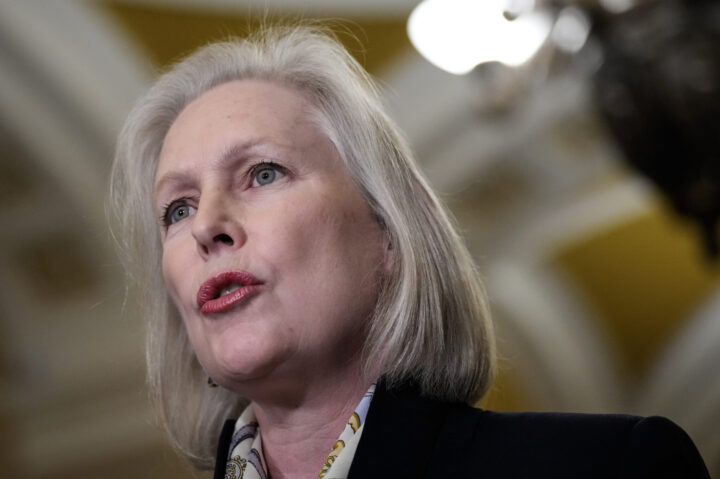
Sen. Kirsten Gillibrand (D-NY) speaks at a news conference following a closed-door lunch meeting with Senate Democrats at the U.S. Capitol on October 31, 2023, in Washington, D.C.
Sen. Kirsten Gillibrand (D-NY) said in comments to Jewish leaders in New York City on Monday that anti-Israel protesters and, in some cases, fellow Democratic lawmakers are fueling antisemitism through the rhetoric and slogans they use, though she said that in many cases it is unintentional.
“Some of the rhetoric that comes out of various protests globally, various protests on college campuses is so damaging. When they say words like ‘river to the sea,’ whey they say words like ‘globalize the intifada,’ it means end Israel. It means destroy Jews,” Gillibrand said in a video from a roundtable with Jewish leaders in Borough Park shared by The Forward. “No matter what words they intend to be saying, that is the meaning of these simple phrases.”
Intifada, she continued, is “not a social movement. It’s terrorism, it’s destruction, it’s death.”
The New York senator has been particularly outspoken about the “intifada” rhetoric in the context of the New York City mayoral race. She previously offered strong condemnation of Democratic mayoral nominee Zohran Mamdani for his refusal to condemn the “globalize the intifada” slogan and said that Jewish constituents were alarmed by his past comments.
Gillibrand also claimed Mamdani had made “references to global jihad,” but later apologized. She has not endorsed Mamdani’s mayoral bid.
The New York senator said she would work with Democratic colleagues “who sometimes, in my opinion, don’t use the right words or aren’t sensitive to the impact of those words” and explain to them how their comments are being received and contributing to antisemitism, and to rally them to support efforts to fight antisemitism.
“Nine times out of 10, they aren’t trying to be antisemitic or even trying to be anti-Israel. They just think they’re fighting for human rights,” Gillibrand continued, “but the words they often choose to use are very hurtful and harmful and are undermining.”
“It is very hurtful and it makes people feel like sometimes the members of our party do not have their back, and I think that’s very disruptive and damaging for our community, for our state, for our brothers and sisters,” Gillibrand said.
Gillibrand added that leaders and individuals have to “understand the impact of their words in all contexts,” including to the Muslim community and other faith and immigrant communities.
She also insisted that “nine out of 10 Democrats are pro-Israel and want peace in the Middle East,” though a majority of the Senate Democratic caucus recently voted in favor of blocking some arms sales to Israel.
Gillibrand argued that many of her colleagues’ concerns are driven by the political leadership in Israel, including Prime Minister Benjamin Netanyahu and far-right members of the Israeli government.
“They don’t know how to articulate political disagreement, and sometimes it comes out as anti-Israel,” she said. “I try very hard to explain that your intentions are one thing, but how you’re received is another, and that’s where we get the disconnect.”
Please log in if you already have a subscription, or subscribe to access the latest updates.
 Continue with Google

 Continue with Apple