











































































Graham’s victory means that Trump holds a near-perfect record with his Senate primary endorsements during his political career, even as some of his gubernatorial and House picks have fallen short this year
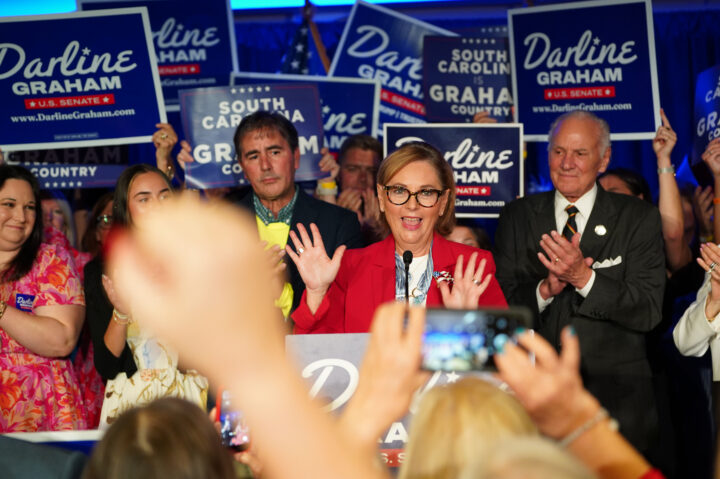
Megan Varner/ Getty Images
Sen. Darline Graham (R-SC) speaks during a campaign event following her win, at the Willoughby, Humphrey & D'Antonio Law Firm on August 25, 2026 in Columbia, South Carolina.


 Add JewishInsider on Google
Boosted by an endorsement from President Donald Trump and a preelection rally from the state’s leading Republican figures, Sen. Darline Graham (R-SC) survived a challenge from Rep. Ralph Norman (R-SC) to win the GOP nomination for her late brother’s Senate seat.
“I continue to miss Lindsey every day, and there is still a big hole in my heart, but I know he’s looking down, very proud,” Graham said in her victory speech Tuesday night.
Graham prevailed narrowly (52%-48%) despite facing serious questions about her experience and readiness for a full term in the Senate during the compressed campaign. She expressed ignorance about foreign policy in the race’s lone debate when asked about her thoughts about Taiwan’s security. She had also said she wouldn’t be as focused on foreign policy as her brother, whose hawkish national security record defined his political legacy.
Norman, a hard-line fiscal conservative, proved to be a lackluster opponent, winning in his home base in northwestern South Carolina but losing across the rest of the state. He alienated Republican leaders by initially opposing Trump’s presidential campaign in 2024 (he was one of Nikki Haley’s leading endorsees) and holding out support of former House Speaker Kevin McCarthy (R-CA) during the 2023 House GOP leadership fight.
Norman wasn’t able to offer a generational contrast, either — at 73, he would have been one of the oldest freshman senators in recent memory. He was badly outspent in the race by Graham and allied groups, including Trump’s well-financed super PAC, which hasn’t gotten involved in many races this cycle.
“His policies are good, I never understood why he got in this race … it is what it is. I’ll accept it,” Norman said in his concession speech of the president’s involvement.
Graham’s victory means that Trump holds a near-perfect record with his Senate primary endorsements during his political career, even as some of his gubernatorial and House picks have fallen short this year. Trump’s decision to spend valuable political capital — both in time and money — clearly played a pivotal role in the competitive runoff.
Graham herself offered a nod to Trump’s influence, saying in her election night speech, “South Carolina is truly Trump country.”
In November, Graham will face pediatrician Annie Andrews, a Democrat who has been a strong fundraiser, especially given the challenges the party faces in winning South Carolina, a solidly conservative state that backed Trump by 18 points in the 2024 presidential election.
GOP campaign veteran Colin Reed called Graham’s debate performance a ‘seismic moment in an otherwise sleepy race’
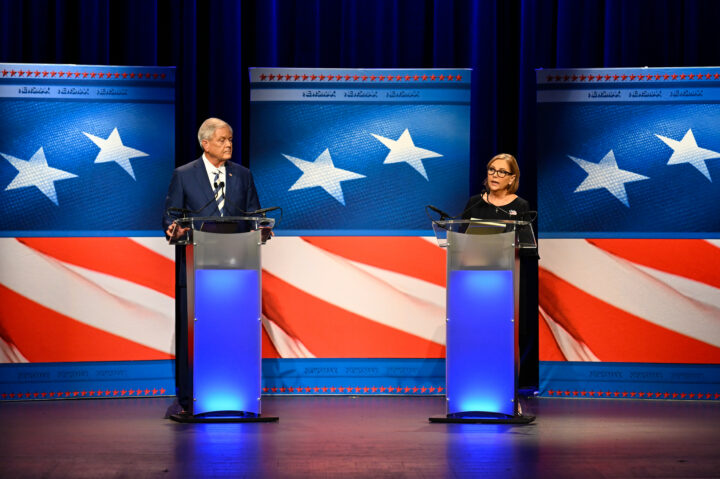
Peter Zay/Anadolu via Getty Images
Sen. Darline Graham (R-SC) and Rep. Ralph Norman (R-SC) participate in a televised debate ahead of the Republican primary runoff in Newberry S.C., on August 18, 2026.
Sen. Darline Graham’s (R-SC) stumbling performance at the final GOP primary debate on Tuesday has prompted questions among Republicans in Washington about her prospects in next week’s runoff against Rep. Ralph Norman (R-SC).
Graham’s debate performance has been widely panned for her response to a question about Taiwan and the South China Sea, during which she admitted that she is “not that informed on national security.” The moment prompted national Republican operatives to question her qualifications to replace her late brother, Sen. Lindsey Graham (R-SC), and led to an avalanche of attacks from critics about her lack of policy experience.
Senior Republicans who have been involved in the race privately described Graham’s foreign policy flub as a pivotal moment that could cost her the nomination.
“It was always going to be a lot harder than she was told when she got into this, but I thought she could win before the debate. Now, I think she’s done for,” a senior GOP campaign official involved with the race told JI. “This loss is going to be an unfortunate embarrassment, and the way this played out could be somewhat of a stain on Lindsey’s legacy even though he had nothing to do with it.”
A spokesperson for Graham’s campaign declined to comment about her debate performance. Graham defended her answer while speaking to reporters in the spin room following the debate, arguing that, “The people of South Carolina, they’re worried about their pocketbooks more than they’re worried about the South China Sea, quite honestly.”
Veteran Republican strategists who have been involved in high-profile Senate races called Graham’s performance one of those rare moments that could change the trajectory of the race.
“The debate seems fairly consequential for a number of reasons,” Colin Reed, a founding partner of South & Hill Strategies and a GOP campaign veteran, told Jewish Insider. “To me, it seems like a fairly seismic moment in an otherwise sleepy race.”
Reed predicted that Graham’s inability to sound articulate on foreign policy — all but taking a pass on a consequential national security question — was likely to have an impact on the outcome of the race because of the importance of national security issues to South Carolina’s “heavy military presence and large veteran community.”
He added that her comments are already drawing comparisons to “the towering figure her brother was on the matter of foreign affairs” and the fact that the U.S. “happens to be engaged in multiple conflicts, or at least one conflict overseas with Iran, right now.”
“This is a late-summer primary and runoff, and only the most engaged audiences turn out,” Reed said. “Those types of audiences are the ones who were likely paying attention or discussing the debate.”
He argued that Graham’s lack of political experience makes her a “blank canvas” to voters and that, combined with the special election to replace her late brother on the ballot as the GOP nominee being truncated despite Republican primary voters being “wary of coronations,” the South Carolina senator had already been in a vulnerable political position prior to the debate.
Should Graham lose to Norman, it would mark the first time this cycle that a GOP candidate endorsed by President Donald Trump in a Senate race has lost their primary contest.
The president will hold a campaign rally for Graham in Myrtle Beach on Friday, even as he has scaled back his campaign appearances in recent months. Republicans in Washington expressed skepticism that the rally would significantly alter the outcome of this race, with two sources predicting that most of the attendees were only going to see the president speak. (For his part, Lindsey Graham was frequently booed and heckled when appearing at Trump rallies through the years.)
Norman said in a statement following the debate that South Carolina deserves to have a senator with “know-how” on foreign policy matters.
“Whether it’s spy balloons flying overhead or buying up land near South Carolina military bases, China continues to prove that it is a threat to the United States,” the House lawmaker told Politico.
Republican senators were told that Graham was not interested in seeking a full term when she agreed to the appointment in the immediate aftermath of her brother’s unexpected death last month. Graham said in a pre-debate interview on Monday that she “didn’t even realize I’d be asked to fill the seat temporarily” and did not accept the appointment last month with the idea of running for a full term. She instead credited the president with convincing her to run during an Oval Office meeting in her first week as senator.
Graham’s surprise decision to run, which two sources told JI came at the urging of Trump and several of Lindsey Graham’s campaign consultants, was met with apprehension in Washington. GOP circles. After Graham launched her campaign, Republican senators and strategists skeptical of her chances of winning began quietly voicing concern to one another about her lack of voting record or political background, the fact that she lacked a policy platform and the optics of sending a grieving sister out on the campaign trail. They also took note of how competitively Norman, Graham’s opponent in next week’s runoff election, was polling in the race.
One senior Senate GOP operative put it bluntly: “If we’re going to do a coronation, we need to be able to do a coronation. If we can’t get our s**t together, then we shouldn’t keep trying.”
Graham was cautioned by several Republicans, including two senators, that she would be setting herself up for a contentious election fight if she got in the race, according to two sources familiar with the matter. She was told by several of her brother’s campaign consultants, however, that while the contest would be challenging, she was likely to win with the president’s endorsement.
Graham prevailed in the first round of the primary election earlier this month, but only tallied 33% of the vote, far short of the majority necessary to avoid a runoff. She got a campaign boost after winning the endorsement of one leading rival, Rep. Russell Fry (R-SC), but her debate stumble only underscored her biggest vulnerability: lack of experience.
“The debate was challenging to watch. Her performance was very bad. We all empathize with her because of the circumstances she’s under, but that makes it all the more disturbing that folks who claim to love Lindsey would get in her ear and tell her she should run,” the Senate Republican campaign source said.
The winner of the Republican runoff next Tuesday will face Democrat Annie Andrews in the November election. Andrews, a pediatrician, is a decided underdog running in a solidly Republican state, but has been a strong fundraiser, bringing in over $10 million during the campaign cycle.
Graham’s stumble comes one week before the special election runoff
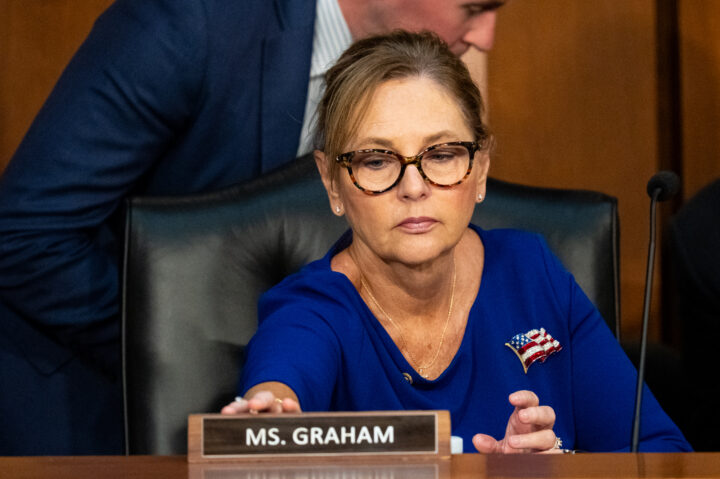
Sen. Darline Graham, R-S.C., arrives for the Senate Judiciary Committee vote to move the nomination of Acting Attorney General Todd Blanche out of committee in the Hart Senate Office Building on Tuesday, Aug 4, 2026. (Bill Clark/CQ-Roll Call, Inc via Getty Images)
Sen. Darline Graham (R-SC) said at the final GOP primary debate to replace the late Sen. Lindsey Graham (R-SC), one of Congress’ most engaged members on foreign policy, that she is “not that informed on national security.”
Graham made the comments after being asked at Tuesday’s debate, which was hosted by Newsmax and South Carolina ETV and Public Radio, if she believed Taiwan and the South China Sea were national security issues for the United States.
“I’m just going to be honest here. I’m not that informed on national security, but I do support the military,” Graham said. “My brother was in the Air Force for 33 years, so I will do everything I can to support the military. My dad was in the army. I’m not a polished politician up here. National security is not my thing, not my area of expertise. But I do support the military.”
Rep. Ralph Norman (R-SC), Graham’s opponent in next week’s special election runoff, responded by describing Taiwan as “a definite ally” of the U.S. and praising President Donald Trump for “enabling Taiwan to defend themselves against China.” Norman has served in Congress for nearly a decade, and has touted his legislative experience as a strength on the campaign trail.
Shortly after the debate concluded, former South Carolina Gov. Nikki Haley, who has endorsed Norman in the runoff, criticized Graham for her answer.
“Lindsey Graham was well informed on the United States’ national security. Darline Graham admits she’s not,” Haley wrote on X. “This is not something you inherit. And it’s critical in the U.S. Senate.”
At the start of the debate, Graham said while responding to a question about the cost of living that she trusted Trump “to get the Strait of Hormuz open.”
Asked if she supports continuing the U.S. war in Iran, Graham said, “I fully trust President Trump when it comes to the war in Iran. Forty-seven years this has been going on. Iran is the weakest they have been in 47 years. The one thing that concerns me is we cannot let them get a nuclear weapon. So I trust President Trump and everything he’s doing, I think he’s got this, and I trust him on it.”
Graham later cautioned, however, that she was not committed to supporting U.S. boots on the ground in Iran, a move that Trump has not indicated he’s considering.
“I think we should stand with Israel. They’re one of our strongest allies, so I definitely support standing with Israel,” Graham said. “I am a little concerned about troops on the ground. I don’t know that that’s necessary just yet. I would like to make sure that we try all economic solutions before we put troops on the ground.”
Norman, meanwhile, said that while he has been supportive of the president taking out the Iranian regime and its nuclear program, he believes the administration needs to justify why it is continuing the war and said that the U.S. should end its operations against Tehran.
“They were a severe threat, and he had the courage to do that. Now, I think that we’ve got to end it. I think that he’s going to have to tell the American people what it’s going to take,” Norman said. “If the Straits of Hormuz are still dominated by a country that’s supposed to be decimated, we’ve got to have some understanding on that because I’m not for endless wars. You win them and you get out.”
The South Carolina senator knocked Norman for voting against the National Defense Authorization Act on several occasions, which Norman responded to by pointing to his concerns about the size of the federal defense budget and the national debt.
While discussing U.S. support for Israel, of which Lindsey Graham was one of the most prominent champions in Congress, Norman described himself as a proponent of a strong U.S.-Israel relationship and vowed to continue being an ally to the Jewish state. He also praised Israel for what he characterized as its willingness to put troops on the ground in Iran to complete its military objectives.
“Israel is the only democracy in the Middle East. If you go there, that’s God’s country, and we have continued to maintain good relations,” Norman said. “The president, I think, has paid many a trip over there. You go over there, it changes you. It just does. … From what we’re hearing in Congress, they are ready, and willing and able to take out Iran if it means putting troops on the ground. They’re trained soldiers and they are true patriots. Yes, they are a friend, and we have to remain a friend.”
The South Carolina runoff between Graham and Norman is being held next Tuesday, August 25. Trump is headlining a campaign rally for Graham on Friday in Myrtle Beach.
Rep. Ralph Norman has backed Israel rhetorically but voted against two aid packages; Sen. Darline Graham has a short legislative record but has cosponsored Israel and Iran-related bills

Bill Clark/CQ-Roll Call, Inc via Getty Images
Rep. Ralph Norman (R-SC) candidate for U.S. Senate, speaks during the GOP stump event held for Republican candidates for Senate at the Charleston Rifle Club in Charleston, S.C., on Aug. 6, 2026.
Rep. Ralph Norman (R-SC), facing a runoff special election to succeed the late Sen. Lindsey Graham (R-SC), has walked a fine line on supporting Israel during his nearly decade in Congress — maintaining strong rhetorical support for the Jewish state while voting against major aid packages and some antisemitism legislation.
Sources with Norman’s campaign and with the campaign of his opponent, Sen. Darline Graham (R-SC), told Jewish Insider that both camps are seeking the pro-Israel vote in the Aug. 25 runoff. Still, the two candidates have taken different approaches to the issue, which are now under the microscope as the race enters its final leg.
A member of the right-wing House Freedom Caucus, Norman has developed a reputation on Capitol Hill as a committed fiscal hawk known for frequently opposing must-pass items like the debt ceiling increase or government spending packages because they did not address the national debt or include provisions to offset the spending.
Norman has generally maintained a pro-Israel record since being elected to Congress in 2017. In the wake of Hamas’ Oct. 7, 2023, attacks on Israel, Norman signed on to several resolutions and letters condemning the attacks and the subsequent anti-Israel protests on university campuses nationwide.
But Norman also voted against two Israel aid packages in 2024 — he opposed the first bill in February for not containing offsets to cover the financial costs and another bill in April for being tied to Ukraine assistance, which he opposes.
Norman defended both votes, arguing that neither were indicative of his commitment to the Jewish state and pointing to his support for the Israel aid package that the House passed in November 2023, which included offsets. (That bill stalled in the Senate.)
“There’s NO DISCUSSION about any spending reductions to pay for any of this, so we’re just supposed to borrow more and more money to pay for this aid?” Norman wrote in a blog post of his opposition to the Israel aid package without offsets. “It’s borderline criminal what we’re doing, and it’s sad that the United States is no longer able to help a critical ally because of our own abhorrent financial recklessness.”
Norman repeatedly criticized then-President Joe Biden for his waning support for Israel as the 2024 presidential election drew near, and urged the Trump administration to stand with the Jewish state in its campaign to eliminate Hamas from Gaza.
Norman called the White House’s Gaza peace plan, announced in October, “a step in the right direction and long overdue.”
“We must continue to stand with Israel, ensure Hamas is fully dismantled, and never forget who the terrorists are in this conflict. This is a win for peace, for strength, and for our greatest ally in the Middle East,” he said.
He voted against the long-stalled Antisemitism Awareness Act (AAA) when it passed the House in May of 2024 and voiced his opposition to any new legislation on the issue of antisemitism the following spring. “We shouldn’t do anything further with antisemitism. I don’t know how you define it. It’s subjective,” Norman told Punchbowl News.
While Norman was one of just five lawmakers to vote against the Never Again Education Act — a bill to further Holocaust-related programming and educational materials in middle and high schools — when it was passed by the House in 2020, he supported legislation in 2023 reauthorizing the law and extending the program through 2030.
Representatives for Norman did not respond to JI’s request for comment on his opposition to those bills.
During the GOP debate in the special election primary, Norman pointed to his record of calling out the Iranian regime as a threat to the U.S. The House lawmaker praised the president’s decision to strike Iran, though he argued that the ongoing war “has gone on longer” than expected and said he would not vote to support U.S. troops on the ground.
“There are military generals now that are saying that if we’re going to really eliminate them, they’re gonna have to put boots on the ground. I don’t think the country wants that right now,” he said. “[Trump] will eventually, sooner rather than later, use whatever power from the air to take them out, and I think that’s the right course to take.”
Norman has been endorsed in the runoff by Sen. Rick Scott (R-FL), a pro-Israel champion in Congress. Graham, meanwhile, has the support of Trump and the Republican Jewish Coalition. Rep. Russell Fry (R-SC), who came in third in the special primary election, endorsed Graham in the runoff on Friday.
Graham’s tenure in public office only began in mid-July, when her late brother’s sudden passing led to her appointment to serve out the rest of his term. The incumbent senator has begun cosponsoring legislation, including on supporting Israel and targeting Iran, in recent weeks in a continuation of her brother’s policy on the issues.
Graham announced on Thursday that she was cosponsoring an additional four bills, all of which “strengthen the U.S.-Israel partnership, target the Iranian regime and confront antisemitism,” according to a readout from her office.
All four bills are also bipartisan and bicameral: the U.S.-Israel FUTURES Act, establishing a cooperative initiative focused on defense technology R&D; the Iran Human Rights, Internet Freedom, and Accountability Act, aimed at disrupting the finances of the Iranian regime and its allies and expand internet access in Iran; the Enhanced Iran Sanctions Act, a bill targeting Iran’s oil exports to China and other countries; and the Jewish American Security Act, a proposal to address antisemitism across multiple sectors of American society being championed by the mainstream Jewish community.
“I truly believe we have a moral and religious duty to stand with the Jewish people and the nation of Israel to guard against those who seek to destroy them,” Darline Graham told JI in a statement. “In dangerous times, it is crucial we strengthen ties with a friend and ally like Israel, not walk away from them.”
At the primary debate, Graham also voiced strong support for the Iran war.
“I completely agree with President Trump on standing with Israel. They are an extremely important ally of the United States,” Graham said. “We cannot allow terrorists to build nuclear missiles because they’re going to want to kill Americans, that is just the sad truth. If they build the nuclear missiles, their goal is to come here and kill us, so the more we can fight them over there and prevent it over there, the better for the United States. I am all for peace through strength.”
The president called Fry, who defeated a Republican backing his impeachment in 2021, a ‘very, very talented person’ in an interview this week
Bill Clark/CQ-Roll Call, Inc via Getty Images
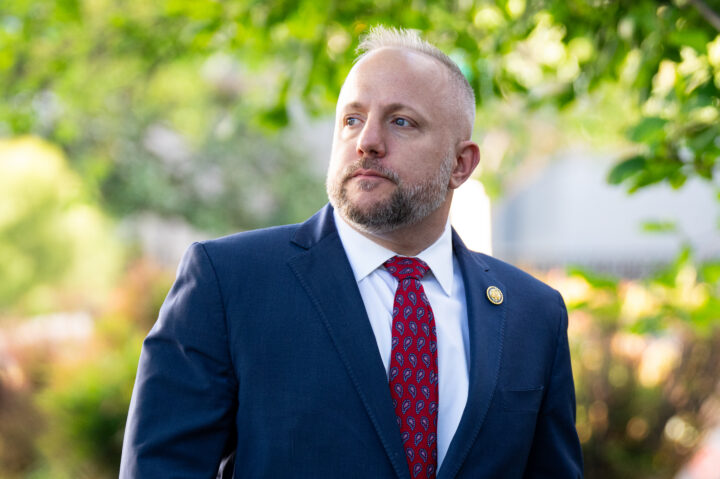
Rep. Russell Fry (R-SC) arrives for the House Republican Conference caucus meeting at the Capitol Hill Club in Washington on Wednesday, May 13, 2026.
The late Sen. Lindsey Graham (R-SC) understood the value of staying in President Donald Trump’s good graces — both to advance his top legislative priorities and to shield himself from challenges on his right flank.
In the wake of Graham’s sudden death, the candidates vying to succeed him have absorbed a central lesson of his career: the most decisive factor in the Republican primary will almost certainly be who wins Trump’s endorsement.
Rep. Russell Fry (R-SC), who ousted a sitting GOP lawmaker with Trump’s endorsement in 2022, is emerging as one of the leading contenders and someone who has an inside track to receive the president’s blessing. Fry’s defeat of former Rep. Tom Rice (R-SC), who was one of the few Republicans to vote for Trump’s impeachment in 2021, allowed him to build early relationships with Trump’s political circle.
Fry has been making calls to White House officials about a possible run this week, a source familiar with the matter told Jewish Insider.
Asked on Monday evening about the possibility of endorsing Fry if he launched a bid for a full term in Graham’s seat, Trump told Newsmax that Fry is “somebody you can watch out for” as a rising Republican star and did not deny he was considering backing the House lawmaker if he enters the race.
Fry, who became an ally of Graham’s while they served in Congress together, was one of the Republicans who had reached out to the White House about a possible interim appointment to the seat. South Carolina Gov. Henry McMaster ultimately announced on Monday that he was appointing Sen. Darline Graham Nordone (R-SC), Graham’s younger sister, to serve out the remainder of her older brother’s Senate term, which expires next January.
“Russell Fry, a young congressman, is outstanding. That could happen. I could see that happening,” Trump said of an endorsement. “I think he’s a very, very talented person. … I mean, he’s doing much better than the person that preceded him. He’s been very popular in the state.”
Reached for comment, a White House official told JI about the president potentially endorsing Fry that, “Until the president makes an announcement, any speculation is just speculation.”
Fry has been a reliably conservative and party-line vote in the House since elected, and also holds a solidly pro-Israel voting record. AIPAC congratulated him on his primary victory in 2024.
Graham’s GOP replacement on the November ballot will be chosen in a special election scheduled for Aug. 11. Candidates can file to run for the seat starting on July 21, in accordance with the timeline required by state law, and several others are also looking to throw their hats in the ring.
Among the other Republicans who have reportedly been lobbying the White House and considering jumping into the race are Rep. Ralph Norman (R-SC); Rep. Nancy Mace (R-SC); former Rep. Trey Gowdy (R-SC), a Fox News host and close ally of National Republican Senatorial Committee chairman Sen. Tim Scott; and Lt. Gov. Pamela Evette, who lost to the state’s Attorney General Alan Wilson in a runoff of South Carolina’s Republican gubernatorial primary in June.
Mark Lynch, who lost to Graham in last month’s primary by 30 points, said on Monday that he would enter the special election and committed $5 million to his campaign. During the campaign, Trump called him a “lunatic” who “would be a DISASTER for the Republican Party,” which came in response to Lynch blaming the U.S. war in Iran on Graham by arguing that the senator had convinced the president to start the conflict. Graham had criticized Lynch, a South Carolina businessman, for employing staffers with records of making antisemitic statements,
Rep. Joe Wilson (R-SC), who was also floated for a possible interim appointment, said on Sunday that he was committed to staying in the House to protect Republicans’ slim majority in the lower chamber. He has not divulged if he is considering entering the special election.
Rep. William Timmons (R-SC) said late Tuesday that he would not enter the race to replace Graham, adding in the announcement that he would not support Noman or Mace’s candidacies.
Regardless of who the nominee is, Republicans are confident that they will hold the Senate seat in November. Trump carried South Carolina in the 2024 presidential election by 18 points, 58-40%.
The Democratic nominee in the race is Dr. Annie Andrews, a pediatrician who handily won her primary. A political outsider who challenged Mace unsuccessfully in 2022, Andrews has drawn attention for her effective fundraising against Graham, outraising the incumbent in the last two quarters. National Democrats, however, have so far declined to prioritize the race, citing the need to use those resources in battleground states.
The Cook Political Report grades the race as solid Republican.
A national Democratic campaign source told JI that this is not expected to change unless Republicans were to nominate a weak candidate with a record of extremism or concerning accusations about their personal background, such as accusations of criminal activity or assault.
“If you remember back to [former Democratic National Committee Chair] Jaime Harrison’s campaign [in 2020], he was the head of the South Carolina Democratic Party and raised over $100 million and still got blown out,” Dr. Gibbs Knotts, a professor of political science at Coastal Carolina University, told JI. “South Carolina has not dipped its toe into that purple state category for two to three decades.”
“Whoever gets this [Republican] nomination, to state the obvious, is very likely to be the next senator.”
Please log in if you already have a subscription, or subscribe to access the latest updates.
 Continue with Google

 Continue with Apple