





































































In an interview with JI, Suozzi recounted the story of a six-day silent retreat in Louisiana after losing the New York gubernatorial primary, which he said hardened his resolve to stick by his values
Heather Diehl/Getty Images
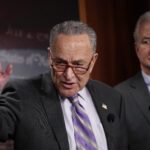
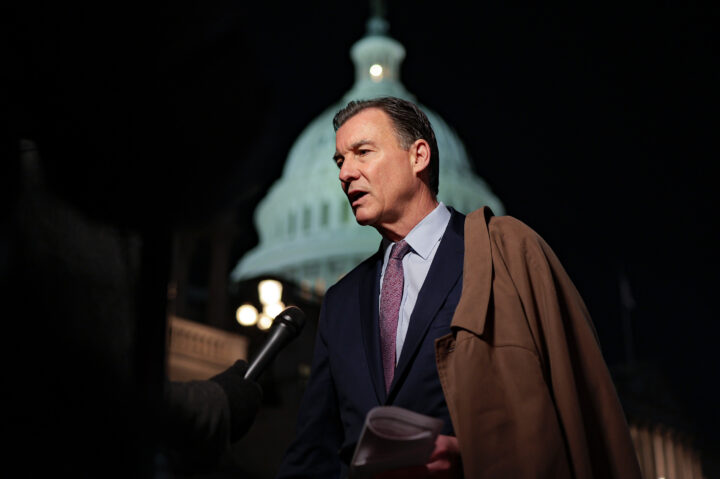
Rep. Tom Suozzi (D-NY) speaks with members of the media outside the U.S. Capitol on December 17, 2025 in Washington, DC.


 Add JewishInsider on Google
At a time of rising anti-Israel and, in some cases, antisemitic sentiment in segments of the Democratic Party, Rep. Tom Suozzi (D-NY) said in an interview with Jewish Insider this week that he is not fazed by the pressure, to which some Democratic colleagues have caved.
Suozzi, a moderate pro-Israel Democrat from Long Island, has long been a vocal champion of the U.S.-Israel relationship and the Jewish community in the House, and represents a heavily Jewish district.
The New York congressman is also the lead Democrat in the House on a bill to establish 100-foot buffer zones outside of houses of worship. He had introduced legislation of his own on the subject earlier this year, but subsequently teamed with Rep. Brad Knott (R-NC), Sen. Ted Cruz (R-TX), Sen. Elissa Slotkin (D-MI) and outside advocates on a bipartisan consensus bill, the Right to Worship Act, which Suozzi had a significant role in negotiating.
A slew of outside groups supporting that bill, many of which also backed Suozzi’s original legislation, are set to rally outside the Capitol on Wednesday in support of the legislation.
Suozzi said he “decided years ago that I would be a supporter of Israel through thick and thin, based upon my travel there and different experiences I’ve had in my life.” He said he feels only more emboldened to stick to his guns on the issue in his political second act — Suozzi was a member of Congress from 2017 to 2023, before losing a bid for governor of New York.
In a 2024 special election, he won back his old seat after disgraced former Rep. George Santos (R-NY) was expelled from Congress.
After his gubernatorial loss, Suozzi spent time traveling around the country, culminating in a six-day silent Jesuit retreat in Louisiana, where Suozzi said he “surrendered to the fact that I don’t control things, and things happen the way they’re supposed to happen.”
“You would say things are either beshert or they’re not,” Suozzi said, using the Yiddish word for destined. “So I’ve decided that I’m just going to stick to my values and work as hard as I can, and whatever happens, happens. And so I’ve decided on this issue that I’m going to do the right [thing]. I’m a little bit more fearless than I was last time around. I’m going to do what I think is right and let the chips fall where they may.”
At this point, he said he’s “used to” the pressure and that he takes the “good with the bad.”
“There are some people there are some people that are really happy with my position, and there are others and there are other people that are very unhappy with my position, and that’s that’s the life I live — I guess we all do,” Suozzi said.
A co-chair of the House Problem Solvers Caucus, Suozzi argues that lawmakers need to communicate more and find areas where they can come together and work together.
“Everybody’s going off into their respective camps on a regular basis, and you know there’s not enough conversation taking place,” he said. “We’re facing a lot of very serious issues in our country right now, and it’s not good enough to just do a video onto your phone and say how bad the other side is. We have to do the difficult work of actually trying to find common ground.”
He points to the buffer zone bill as one example of such work.
As Knott told the story in a recent appearance on Fox News, Suozzi called Knott and approached him on the House floor when he heard that Knott was working on his own buffer zone bill. “He put down his bill, he joined this one, he contributed unbelievably productively to this bill’s formation and now he’s gone and helped secure Sen. Slotkin, Sen. Cruz, so it’s a hats off to Rep. Suozzi in this effort,” Knott said during the interview.
Suozzi has said in multiple interviews about the bill that the goal is to ensure that people feel safe going to religious services, and that showing up to practice one’s religion shouldn’t require facing down danger.
“The objective here was to successfully respect the constitutional protections for the right to free speech and the equally important right to worship, which are both in the First Amendment,” Suozzi told JI. “The big thing in my head was that a person shouldn’t have to show particular courage just to attend a religious service.”
He said he hopes that the Senate will take up the bill during the remaining weeks it is in session before the midterm elections, so that the House can take the bill up during the lame duck session.
“The tough lift, the heavy lift here, is to show that we’re trying to responsibly balance First Amendment freedom of speech and right to worship rights,” he said.
Asked about his conversations with colleagues on the bill, Suozzi said that the fact that such a wide range of groups, including ones representing a range of religions and religious communities, “makes people feel more comfortable that we’re taking into account those type of concerns” and that no community has expressed serious concerns.
“It’s just a matter of getting people’s attention in the midst of all the different noise that’s going on here in Washington, D.C. these days,” he said.
The coalition of support for the bill is broad, including a range of Jewish groups including the reform, conservative and Orthodox movements, various Christian and Catholic groups, Hindus, Sikhs, Seventh-Day Adventists, Mormons and Muslims — even including a Muslim group that has faced scrutiny for featuring extremist speakers at a recent conference and which was accused of ties to the Muslim Brotherhood at a hearing Cruz chaired.
Suozzi said he’s found Knott to be “very, very thoughtful, certainly very intelligent” and that he’s brought experience as a prosecutor to the issue. A co-chair of the bipartisan House Problem Solvers Caucus, Suozzi said that he thinks that members of Congress need to cross the aisle to talk to each other more on both this and other issues.
“Tom Suozzi has been an outstanding leader in fighting antisemitism, supporting Israel, and standing with American Jewry,” Nathan Diament, the executive director of the Orthodox Union Advocacy Center said in a statement, of Suozzi’s work. “His work with Congressman Knott to protect our right to worship is exactly the kind of bipartisan leadership we need. There is no greater friend to the Jewish community than Tom Suozzi.”
Rep. Brad Knott said he’s seen the rise in incidents targeting houses of worship accompanied by a ‘partisan application of laws from the prosecutor’s office’

Tom Williams/CQ-Roll Call, Inc via Getty Images
Rep. Brad Knott (R-NC) during a House Judiciary Committee hearing on Jan. 22, 2026.
Rep. Brad Knott (R-NC), the lead House Republican sponsor of the Right to Worship Act, a federal buffer zone bill to protect religious institutions from disruptive and threatening protests, said on Wednesday that the bill aims to give targeted worshipers a recourse particularly where prosecutors fail to step in or take action.
Knott, a former federal prosecutor, said in an interview with Jewish Insider that he got involved with the effort because of a spate of incidents targeting houses of worship of various religions around the country. “There’s really no secret that places of worship, especially traditional faith, have come under attack,” Knott said, pointing to incidents targeting Catholic, Christian and Jewish institutions.
He made repeated reference to demonstrations that have disrupted religious services at synagogues across the country, as well as to an incident in Minnesota where a group of anti-Immigration and Customs Enforcement demonstrators disrupted a church service, accompanied by journalist Don Lemon, who has been federally charged in the incident.
The North Carolina congressman said that he’s seen the rise in incidents targeting houses of worship accompanied by a “partisan application of laws from the prosecutor’s office” — leaving those targeted with little recourse if local and federal prosecutors declined to press charges.
The new bill would provide victims a recourse to sue those who disrupted their services in civil court, as well as provide prosecutors the option to file suit.
“When you look at the needs of the country, and the increasing partisanship of local prosecutors, this bill is needed for people who want to worship as they have for years and years and years in this country,” Knott said.
He offered the example of the Minnesota church case, where state officials declined to file charges, “strictly for political and partisan reasons. I don’t care if they’re on the right. I don’t care if they’re on the left. That is fully, fully inappropriate.”
He described such disruptions as a problem on both sides of the aisle, but also said that he sees more active and aggressive demonstrators from the anti-Israel and Black Lives Matter movement willing to disrupt sacred spaces.
The North Carolina congressman said he got involved with the issue to help protect both the rights to free speech and freedom of religion.
“If we lose those rights, if people become apathetic, if we allow the people who are disruptive to intimidate folks away from churches, away from cathedrals, away from synagogues, that’s a real problem and we start to lose the fabric of who we are as Americans,” Knott said. “Why else would I be in Congress but for trying to protect innocent people, trying to ensure that the constitutional standards and privileges we have are protected and maintained and to ensure that people who are bad actors are dealt with appropriately.”
Time is short to pass the bill before the end of the congressional session, particularly with many big-ticket items on the House’s agenda and almost no time remaining in session before the election. But Knott expressed optimism that the bill can rally strong support and pass this year, particularly as it is moving through the House and Senate in parallel.
Knott acknowledged that colleagues have approached the legislation with skepticism and concerns about potentially infringing upon the First Amendment but said that once it has fully been explained to them, each of the colleagues with whom he’s discussed the bill, particularly those with backgrounds in the law, have been onboard.
“If we have time to deliberate and explain it, I believe this bill could be very, very bipartisan and, if not unanimous, close to unanimous passage in both houses,” he said. “Every conversation I have had, people have gotten it. They’ve agreed … that makes sense.”
He emphasized that the bill contains robust protections for the First Amendment, specifically allows for peaceful protest within the buffer zone, does not address any specific content or faith, only addresses conduct that isn’t already covered by the First Amendment and involves civil penalties and requires proof of a “substantial disruption” with “specific intent” in order to win damages from a jury.
There are no immediate plans to move the bill forward in the House Judiciary Committee — although the Senate could also take the bill up first — but Knott said that House Speaker Mike Johnson (R-LA) is strongly supportive of the bill, and that he has discussed it with other members of GOP leadership, who have also been supportive and in some cases interested in joining as cosponsors.
“Whenever it’s explained, it gets momentum as a bill that meets the need of the day. And whenever that sentiment accrues, it should pass,” Knott said. “We’re working on it, and as soon as there’s an opening, again, whether it’s through suspension or the traditional committee markup, I think that we’ll do it.”
Knott was the initial House sponsor of the bill, and, in collaboration with outside advocates, came together with Rep. Tom Suozzi (D-NY), who was working on a separate buffer zone bill. In a recent Fox News interview, Knott praised Suozzi’s work on and contributions to the bill, as well as his help in securing Senate cosponsors, Sens. Ted Cruz (R-TX) and Elissa Slotkin (D-MI).
The bill has been spearheaded by Sen. Ted Cruz and Rep. Brad Knott; Cruz’s staff reached a compromise on Sunday with Rep. Tom Suozzi to secure his support.
Jewish Federations of North America
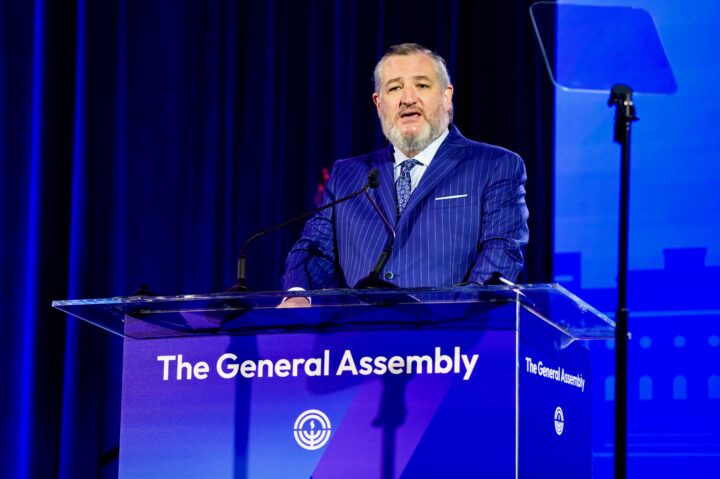
Sen. Ted Cruz (R-TX) speaks at the Jewish Federations of North America's General Assembly on Nov. 18, 2025.
Sen. Ted Cruz (R-TX), Rep. Brad Knott (R-NC) and Rep. Tom Suozzi (D-NY) are preparing to introduce federal legislation that would establish a 100-foot buffer zone around religious institutions, within which conduct that disrupts religious services or interrupts access to the place of worship would be banned during religious services.
The Right to Worship Act aims to address demonstrations around synagogues and other houses of worship that have become a growing concern for the Jewish community following anti-Israel and antisemitic protests outside synagogues that have turned violent. Several states have pursued similar legislation.
Cruz and Knott have been working on the bill for some time, and two sources familiar with the situation said that “intense negotiations” had been ongoing between Cruz and Suozzi’s teams to reach a bipartisan compromise balancing the desire to protect religious worship and free speech rights. A source said a deal was reached on Sunday evening.
“The First Amendment guarantees every American the right to freely exercise their faith, and Congress has a duty to ensure that guarantee is met,” Cruz said in a statement to Jewish Insider. “In recent years, we have seen organized acts of hate meant to disrupt and deny that right, which have been untenably defended as speech. That is why I am introducing the Right to Worship Act, and I urge my colleagues to support it.”
According to draft bill text viewed by JI, the buffer provision would impose fines for such activity, and impacted individuals, the Department of Justice or state attorneys general would be able to bring suits under the statute. It also includes language protecting non-disruptive First Amendment activity.
Knott did not respond to requests for comment and Suozzi did not comment for this article.
Sander Gerber, the CEO of Hudson Bay Capital and a lead architect of the Taylor Force Act, helped craft the new legislation, inspired in part by the decades-long weekly antisemitic protests outside his father’s synagogue in Ann Arbor, Mich. — an issue Gerber’s father previously sought to appeal to the Supreme Court.
Gerber said that officials at various levels, including the Department of Justice under the Trump administration have said that they’re unable to step in under the existing FACE Act because the conduct at the Ann Arbor synagogue is not physically threatening or obstructive. The FACE Act, invoked on multiple occasions by the current Justice Department, bars the use of force, threats or obstruction to block access to reproductive health services or to obstruct the right to worship.
“The Ann Arbor City Council passed a resolution saying these protesters are antisemitic. The mayor said he can’t move them away because his legal team won’t let them. Leo Terrell at DOJ said there’s nothing he can do because they’re not threatening,” Gerber told JI. “So it’s a gap in the FACE Act. Here you have intentional disruption [and] harassment, so how do you navigate free speech within that?”
Moshe Davis, who led former New York City Mayor Eric Adams’ office to combat antisemitism, has also been involved in crafting the bill, which he said aims to fill gaps in existing law and in some of the state and local buffer zone bills like the one in New York City, which he described to JI earlier this year as “watered down.”
He said he began working with Gerber on the legislation after being pushed out of the New York City government by Mayor Zohran Mamdani, and the pair got in touch with House Speaker Mike Johnson (R-LA) — who has been strongly supportive — about the effort after a spate of incidents at houses of worship, as well as communicated with the Department of Justice to work through any potential First Amendment Issues. He also praised Cruz and his staff’s work on the bill.
“I started this work in New York City, responding to the mobs targeting synagogues,” Davis told JI. “What we have seen since is a national problem that reaches every faith and requires a federal answer. No American should be afraid to walk into their house of worship.”
Johnson did not respond to requests for comment.
Nathan Diament, the executive director of the Orthodox Union Advocacy Center, which has also been working to support the bill, said, “The need for this legislation in the face of recent actions taken against shuls, as well as other houses of worship, is clear. And — it’s realistic for Congress to pass this bill in September.”
Suozzi previously introduced the SACRED Act, an alternative buffer zone bill, earlier this year, with the backing of several major Jewish community groups. Suozzi’s bill, cosponsored by Max Miller (R-OH), is different from the new one in that it allows greater leeway for demonstrations inside the buffer zone as long as they are nonviolent and nonthreatening.
Suozzi’s bill was also backed by the Anti-Defamation League, American Jewish Committee, Orthodox Union, Hadassah, Hindu American Foundation, Islamic Society of North America, Jewish Federations of North America, UJA-Federation of New York, the Holocaust Memorial and Tolerance Center and Agudath Israel of America. Leaders of communities impacted by antisemitic violence have been lobbying in support of Suozzi’s bill.
“No one should have to fight their way through harassment and intimidation to simply pray in peace. That’s why ADL is grateful members like Senator Cruz and Representatives Suozzi and Knott have recognized the urgency of this growing problem and made a clear commitment to protecting safe access to houses of worship,” Lauren Wolman, the senior director of government relations and strategy for ADL said in a statement.
“ADL has always championed the core principle at the heart of this issue: everyone, regardless of their faith, should be able to worship freely and safely,” Wolman continued. “We look forward to continuing to work with Congress to build consensus around the long-overdue critical protections needed to help safeguard the First Amendment right to religious worship.”
In the Senate, Sen. Bernie Moreno (R-OH) previously expressed interest in attempting to advance the SACRED Act by unanimous consent.
Davis said that advocates have also been in communication with groups representing other religions to secure their support as well. NORPAC, the grassroots pro-Israel group, lobbied in favor of the bill in advance of its formal introduction during its Capitol Hill advocacy day in May, and the Combat Antisemitism Movement has worked to support the legislation as it has taken shape.
The Family Research Council, a Christian group, is also among the organizations supporting the bill.
Proponents have already launched an advocacy website, ProtectingWorship.org to rally support for the bill in advance of its introduction. The site highlights incidents targeting both the Jewish and Christian communities, and defends the constitutionality of the legislation.
“Outside synagogues, churches, mosques, and temples, organized groups have learned to exploit a gap in federal law — surrounding houses of worship with amplified noise, blocking entrances, and creating an atmosphere of intimidation designed to make worshippers turn around and go home,” the website states. “They stop just short of physical violence, because they know the law stops there too.”
The website emphasizes the bill is narrowly tailored, of significant government interest, that there are many other channels for protest and that it’s neutral to the content of the protests. It also provides legal memoranda from two different law firms supporting the draft legislation.
Please log in if you already have a subscription, or subscribe to access the latest updates.
 Continue with Google

 Continue with Apple