













































































Muslim, Sikh, Hindu and evangelical groups also turned out in support of the federal buffer zone legislation that would protect against harassment outside of places of worship
Marc Rod
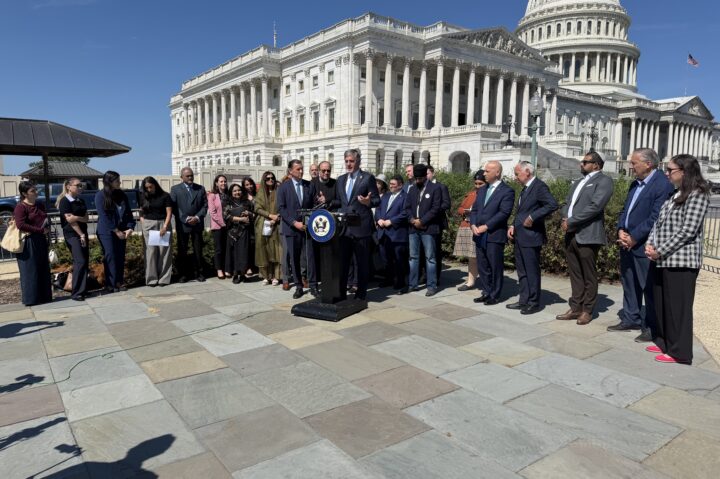
Reps. Tom Suozzi (D-NY) and Brad Knott (R-NC) rally with religious groups in favor of the Right to Worship Act on Sept. 16, 2026.


 Add JewishInsider on Google
Reps. Brad Knott (R-NC) and Tom Suozzi (D-NY) rallied outside the Capitol on Wednesday alongside more than two dozen representatives of religious community organizations in support of the Right to Worship Act, their federal bill establishing buffer zones outside of religious institutions to protect them from disruptions.
House Speaker Mike Johnson (R-LA), who has been involved in supporting the bill behind the scenes, also expressed his support for it in a statement to Jewish Insider.
“Religious liberty is regarded as our ‘First Freedom.’ Our Founders listed it first in the Bill of Rights because they understood how essential it was to the foundation of our Republic. But that right rings hollow if worshippers must brave harassment or worry for their safety as they exercise their religion,” Johnson said.
“Americans of all religious affiliations deserve the right to do so without fear and the Right to Worship Act ensures they can, while also maintaining the First Amendment right to peaceful protest,” he continued. “I commend Rep. Knott for his leadership on this legislation and his steadfast defense of our fundamental freedoms.”
Knott and Suozzi’s press conference included representatives from various nondenominational Jewish groups and the Orthodox movement, as well as leaders from the evangelical, Sikh, Hindu, Muslim and even Scientology communities. The Reform and Conservative movements are also supporting the bill.
Knott and Suozzi praised each others’ work on the bill and ability to compromise to put out this consensus bill.
“I commend Rep. Suozzi again for his monumental effort in assembling this team behind us, this team around the country, that was so valuable in crafting this legislation,” Knott said.
“It’s a very rare hallmark in this town when you have a senior legislator like Rep. Suozzi come to a freshman legislator on the House floor and say, ‘Look, we’re trying to do the same thing. I will lay down my bill and join forces with you so long as we can get this thing across the finish line.’ And had he not done that, I don’t know if we’d be here today,” he continued.
Suozzi previously had introduced separate buffer zone legislation that contained a somewhat different formula than the Right to Worship Act.
Knott said he’d been in contact with various colleagues including Rep. Jamie Raskin (D-MD), the ranking member of the Judiciary Committee, which has jurisdiction on the bill, and has seen significant support.
Suozzi likewise praised Knott as “a former prosecutor, new member of Congress from North Carolina, very well respected by his colleagues, and somebody that I personally admire, especially getting to know him over the past couple months, and listening to him speak, and seeing his intellect and his compassion work together to try and get a bill done across party lines.”
At one point in the press conference, a shofar sounded in the distance from somewhere on the Capitol grounds.
Also speaking in support of the bill were Anti-Defamation League CEO Jonathan Greenblatt; Jewish Federations of North America CEO Eric Fingerhut; Jessica Bernton, the American Jewish Committee’s director of congressional affairs; Nathan Diament, executive director of the Orthodox Union Advocacy Center; Rabbi Yossie Charner, Agudath Israel of America’s director of congressional affairs; Elizabeth Cullen, Hadassah’s director of government relations; Hadas Alterman, Stand With Us’ director of legislative strategy; and Combat Antisemitism Movement President of U.S. Affairs Alyza Lewin.
Diament urged that the bill be the first order of business when the House returns in November, after its extended recess that began Wednesday.
They were joined by representatives from the National Association of Evangelicals, American Muslim and Multi-faith Women’s Empowerment Council, Hindu American Foundation, United Sikhs, BAPS Swaminarayan Sanstha (a Hindu group) and the Coalition of Hindus of North America.
Suozzi and Knott acknowledged that the legislation’s applicability to the repeated incidents during which anti-Israel protesters have demonstrated outside of or broken into events at synagogues promoting aliyah to Israel or land sales in Israel and the West Bank would likely have to be litigated in court if the bill passes.
“There’s going to be litigation that will come. That’s why we spent so much time speaking to constitutional experts about this process,” he said. “There’s going to be litigation about that question and about others as well. The bill really focuses heavily on religious services, so that’ll be a real question and a real challenge as to whether or not that will withstand the constitutional challenge.”
He added that he hopes the bill “sends a message that we all have to do better in the process.”
Knott added that the bill requires “a substantial, focused, intentional effort to prevent someone from entering or otherwise worshipping. Within the buffer zone, if you hold a sign that says, ‘Israel, do better,’ that’s perfectly consistent with this law. If I grab a worshipper by the lapel pin and said, ‘You’re committing whatever crime you allege,’ that’s a disruption that’s not sanctioned with this bill.”
He said, “The definition targets the focused, intentional disruption, not the benign peaceful [one],” adding that the bill is intentionally focused on incidents in which “where people use an organized, established house of worship to target specific people.”
During the press conference, Suozzi specifically credited a constituent, Abraham Hamra, with first bringing the buffer zone issue to his attention and prompting him to craft his original bill, the SACRED Act.
Hamra told JI that his family is from Syria and came to the United States to seek religious freedom. He said he felt “we couldn’t stand idly by and just complain” after protesters disrupted an event in Park East Synagogue in nearby Manhattan. He started a petition calling for buffer zone legislation, which gathered 10,000 signatures.
A member of the board of Long Island’s Holocaust Memorial and Tolerance Center brought the petition to Suozzi’s attention and connected him with Hamra.
“This bill is now a reality, and honestly, it is a bill that’s going to protect what’s great about America, because the First Amendment gives us the right to speech and the right to worship,” Hamra said. “If we protect both of those rights, we continue having the America that many refugees flee to, the America that enables so much success, and that’s why I started this petition, hoping that this bill would be introduced.”
Both Suozzi and Knott also credited various leaders from the Jewish and other communities for their work on the bill, including Greenblatt and the ADL and Diament and the OU, as well as Hudson Bay Capital CEO Sander Gerber and Moshe Davis, the former director of the New York City Mayor’s Office to Combat Antisemitism, who have been heavily involved in the effort.
Owens and Kent are set to speak at a far-right Catholic advocacy gala, while one Catholic leader called to ‘reject the conspiracies … against our Jewish brothers and sisters’
Franco Origlia/Getty Images
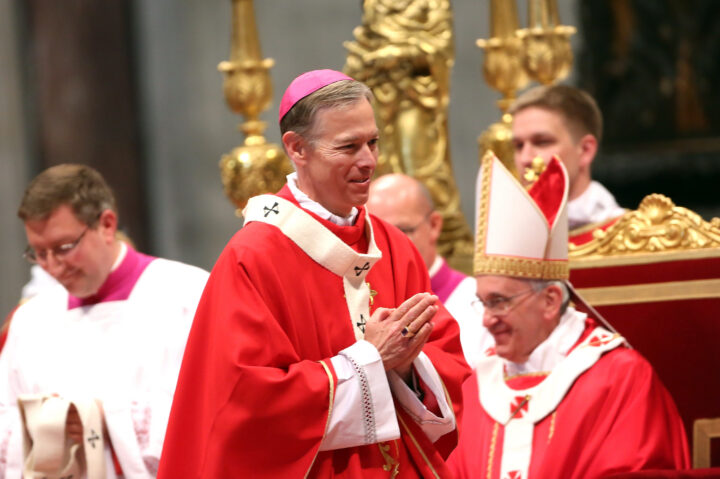
Archbishop of Portland Alexander King Sample receives the Pallium from Pope Francis during the Solemnity of Saint Peter and Paul at Vatican Basilica on June 29, 2013 in Vatican City, Vatican.
In the 24 hours before a fringe Catholic political group planned to host a gala in Washington honoring a number of public figures who have faced accusations of antisemitism, several prominent members of the American Catholic Church stated unequivocally that antisemitism is not a part of their religious doctrine.
“The Jewish community is attacked at a far higher rate than any other religious group in the United States. If we Catholics, in truly living out the Gospel, are to defend religious freedom with integrity, we must clearly speak out against antisemitism,” Archbishop Alexander K. Sample, the archbishop of Portland, Ore., said in a video posted by the U.S. Conference of Catholic Bishops on Wednesday.
Sample is the chairman of the religious liberty commission at the USCCB, the membership organization of current and retired Catholic bishops in the United States. The video was timed with the upcoming Easter holiday, which Sample said has “at times been the occasion for outbursts of hatred and even violence against Jews” by Catholics who collectively hold the Jews responsible for the crucifixion of Jesus.
“As Catholics, we are called to walk in the truth and so to reject the conspiracies and lies that lead to harassment and even violence against our Jewish brothers and sisters,” said Sample.
On Thursday morning, Vince Haley, the director of the White House Domestic Policy Council, delivered greetings from President Donald Trump at the annual National Catholic Prayer Breakfast in Washington. Haley, who is Catholic, wrapped up his own remarks with a call for Catholics to take a stand against antisemitism.
American Catholics have a responsibility, Haley said, “to render assistance to and speak out tirelessly in defense of our beloved Jewish neighbors and fellow citizens in the face of rising attacks and the tidal wave of hatred that is being manufactured against them.”
“Hatred toward Jewish people is ugly, despicable, an affront to the Sacred Heart of Jesus, and surely an occasion of terrible grief for our Jewish mother, Mary,” Haley continued. “And such evil should be condemned loudly and often by all people of goodwill, especially us.”
Neither Haley nor Sample mentioned the Catholic Prayer for America Gala, an event being hosted on Thursday night in Washington by Catholics for Catholics, a far-right political advocacy organization with a mission of targeting Catholic politicians who they deem to be insufficiently supportive of their perspective on church doctrine.
But the gala raised eyebrows across Washington when the organization announced just hours after Joe Kent resigned as director of the National Counterterrorism Center in protest of Trump’s policy toward Iran earlier this week that Kent would speak at the event.
Kent, who has a history of ties to far-right extremists and sought the support of antisemitic influencer Nick Fuentes during a 2022 congressional run, claimed that the U.S. was driven into war by “Israel and its powerful American lobby.”
The event’s lineup already featured a who’s who of right-wing media personalities who have faced accusations of antisemitism.
Carrie Prejean Boller, a former beauty pageant contestant who was fired from the White House Religious Liberty Commission Task Force in February after a disruptive anti-Zionist tirade at a public hearing, will be speaking. She was invited soon after the blow-up at the hearing, and in the weeks since she has doubled down on posting antisemitic content online.
At the Religious Liberty Commission hearing, Prejean Boller came to the defense of the far-right influencer Candace Owens, who since parting with the Daily Wire in 2024 has become a reliably antisemitic voice on social media. Owens will also be speaking at the Catholics for Catholics event, along with Michael Flynn, who served as national security advisor for the first 22 days of Trump’s first term.
Activist Sameerah Munshi was appointed by the White House to the commission’s advisory board; the two women have jointly posted antisemitic content online
Win McNamee/Getty Images
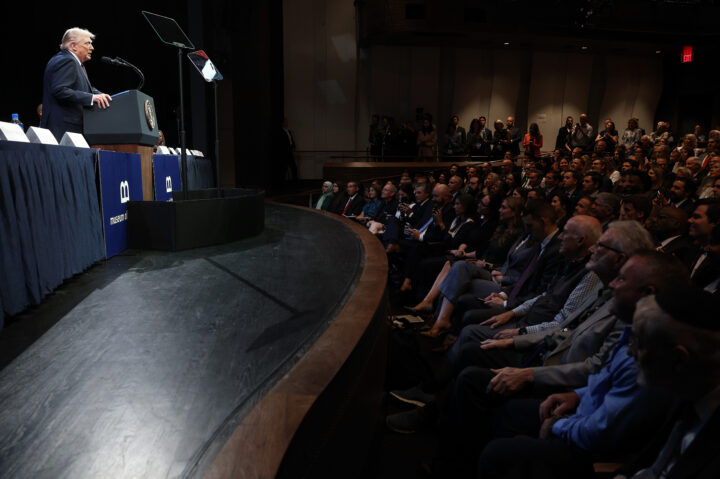
President Donald Trump speaks to the White House Religious Liberty Commission at the Museum of the Bible September 8, 2025 in Washington, DC.
For the first hour and a half of the White House Religious Liberty Commission’s Monday hearing on antisemitism, the Jewish witnesses testifying about their experiences of antisemitism seemed to be in alignment with the commission’s members — all generally conservative and eager to see antisemitism stamped out.
Then Commissioner Carrie Prejean Boller began questioning the witnesses with a sharply anti-Israel bent, in an adversarial tone. Following public backlash, she was removed from the commission two days later by the commission’s chair, Texas Lt. Gov. Dan Patrick. (Prejean Boller insists Patrick does not have the authority to remove her.)
Prejean Boller, who wore a Palestinian flag pin at the hearing, has used the criticism to deepen her line of attack against so-called “Zionist supremacy in America,” doubling down on her opposition to Israel. “I am a free American. Not a slave to a foreign nation,” she wrote on X on Tuesday.
While Prejean Boller may have been removed from the body, she found an ally who has stood by her this week and who remains on the commission’s advisory board: Sameerah Munshi, a Muslim activist who first gained a public profile in the summer of 2023, when she testified at a Montgomery County, Md., school board hearing against the inclusion of LGBTQ-related material in elementary school classes.
That moment thrust Munshi briefly into the national spotlight, where she worked alongside conservative Christians who also opposed the liberal Maryland county’s approach to educating about LGBTQ issues. Prejean Boller, too, first gained national attention for her opposition to gay marriage at a beauty pageant in 2009.
The two women — both of whom were appointed by President Donald Trump — have now joined together as the anti-Israel wing of the commission. Both of them have publicly defended antisemitic commentator Candace Owens, who uses conspiracy-laden language to discuss Jews and Israel. In a shared Instagram post last week, Prejean Boller and Munshi pointed fingers at a shadowy cabal that they blame for both the humanitarian crisis in Gaza and the alleged crimes of Jeffrey Epstein.
“The politicians who refuse to condemn the Israeli government’s starvation and genocide on the Palestinians are the same ones unmoved by the Epstein crime files,” Prejean Boller and Munshi wrote. “Gaza was a precursor to the release of the Epstein files. Their goal: normalize and justify the torture and killing of innocent children … Arrest these monsters. Drain the evil swamp. End Palestinian genocide. Defund Israel.”
Prejean Boller and Munshi said in another post that they had submitted an alternative list of “fair witnesses” to the commission whom they hoped would present at the antisemitism hearing. The list included Norman Finkelstein, a discredited Holocaust scholar who has publicly defended the Oct. 7, 2023, Hamas attacks, as well as Miko Peled and Yaakov Shapiro, two anti-Zionist Jewish activists.
“Antisemitism should never be conflated with anti-Zionism or pro-Palestinian advocacy,” the two women wrote.
When former UCLA law student Yitzy Frankel spoke at the hearing about his experience of antisemitism on campus after Oct. 7, and described a statement he wrote condemning Hamas’ “rape, beheading of children and taking of hostages,” Munshi muttered under her breath that Hamas had not beheaded anyone, a member of the audience who was seated near her told Jewish Insider.
What remains unclear is who at the White House appointed Prejean Boller and Munshi to their roles on the commission and its advisory board, of which Munshi serves as a lay leader. Several members of the advisory board who spoke to JI said they did not know how they had been selected. A White House spokesperson declined to comment. Munshi did not respond to a request for comment.
Neither Munshi nor Prejean Boller had a history of posting anti-Israel content online prior to late last year.
Prejean Boller’s X account was used only infrequently, mostly to share content about Trump, illegal immigration, Christianity and gender issues. In early 2024, Prejean Boller began to come to Owens’ defense when Owens left The Daily Wire amid concerns about her antisemitic views. Munshi was also an infrequent user of X, and very occasionally posted pro-Palestinian messages over the last two years. Following Monday’s hearing, both women have taken to posting often and highlighting their opposition to Zionism.
“We condemn Zionist supremacy and the demanding we deny our individual faith for the fear of being called an antisemite. Religious freedom lives on,” Prejean Boller posted on Tuesday alongside a photo of the two women.
Please log in if you already have a subscription, or subscribe to access the latest updates.
 Continue with Google

 Continue with Apple