





























































After 104 members of the House voted last week in favor of an amendment to eliminate military aid to Israel, pro-Israel activists who have spent years building ties with lawmakers are now wondering how to approach those relationships
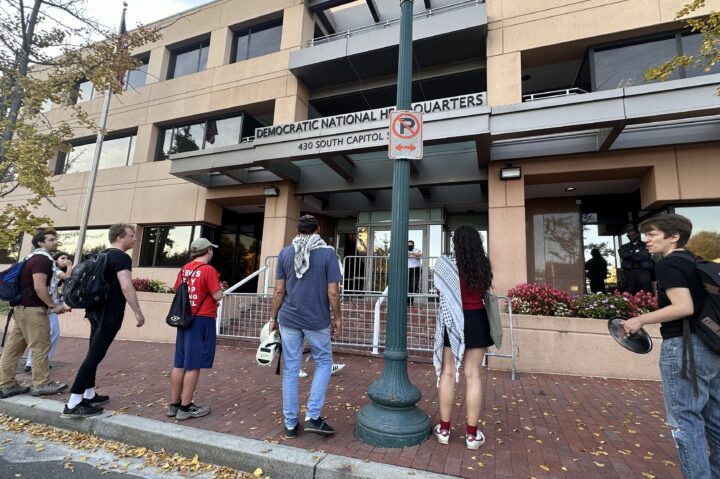
(Yasin Ozturk/Anadolu via Getty Images)
A group of demonstrators hold a noise protest outside the Democratic National Committee Headquarters in Washington D.C., United States on October 31, 2024.


 Add JewishInsider on Google
Before AIPAC began spending tens of millions of dollars per election cycle on campaigns, back when it was purely an advocacy organization that touted its relationships with many of the 535 members of Congress, the pro-Israel group used to describe its approach to Capitol Hill with a cheeky, upbeat motto: “You have friends, and you have potential friends.”
But when former Bay Area AIPAC leader Naomi Lauter used to invoke the slogan, she added a third category: “Friends who have a little less potential than others.” Lauter died in 2017, but the saying still resonates with her son, Sam, who is a major Democratic donor and pro-Israel activist in his own right — and who is now wondering whether that third category might be growing even larger.
After 104 members of the House voted last week in favor of an amendment to eliminate all $3.3 billion in annual military aid to Israel, pro-Israel activists across the country who have spent years building ties with lawmakers are now wondering how to approach those relationships following a vote that some see as a betrayal. Even many longtime Israel supporters — including Reps. Jack Auchincloss (D-MA), Glenn Ivey (D-MD), Laura Friedman (D-CA), Nancy Pelosi (D-CA) and Pat Ryan (D-NY) — voted for the amendment, which did not pass. Pro-Israel activists who spent years building trust and gaining access to these lawmakers are now grappling with whether whether those relationships are still worth their continued investment.
To borrow from AIPAC’s old slogan: Are the lawmakers who voted for the amendment still considered friends — or potential friends — of the U.S.-Israel relationship? Or was their vote against the annual aid package to Israel, and against a bill that was opposed by a wide swath of nonpartisan and Democratic Jewish groups, a crossing-the-Rubicon moment that cannot be undone?
Friends and backers of the members of Congress who voted for the amendment are struggling to answer those questions. Several who spoke to Jewish Insider said that a single vote on a measure that was sure to fail should not spell the end of years of friendship. But even as they acknowledged the seismic reverberations of the vote, many also spoke of the need to tread carefully at a politically uncertain moment.
“Our issues are too important to not hold onto the ability to have a conversation with the person, because the votes are not going to end. It’s not going to all of a sudden stop,” Sam Lauter said. He talked to several members of Congress in the days before the vote, including Pelosi, urging them to vote no.
“It’s not a good trend line, but also this idea that we’ve lost the Democrats — let’s not create self-fulfilling prophecies here. There’s an opportunity for us to turn some of this around,” Tyler Gregory, CEO of the Bay Area Jewish Community Relations Council, said. “I am optimistic that several of them could be flipped if the vote had actual consequences, and I think that’s the job ahead of us.”
“Now, if someone said to me, ‘You know what, I voted yes, and my reasoning was because actually I don’t think we should be allies with Israel anymore, and I have no interest in the friendship with the community or the country, I’m done.’ Well, OK, that friendship’s done,” said Lauter.
This vote was destined to fail, but Tyler Gregory, CEO of the Bay Area Jewish Community Relations Council, called it “a dress rehearsal.” It will not be the last time U.S. aid to Israel comes up for a vote, and Gregory said he will need to lean on those lawmaker relationships in the future when the vote is more consequential.
“It’s not a good trend line, but also this idea that we’ve lost the Democrats — let’s not create self-fulfilling prophecies here. There’s an opportunity for us to turn some of this around,” Gregory said. “I am optimistic that several of them could be flipped if the vote had actual consequences, and I think that’s the job ahead of us.”
Halie Soifer, who served as an advisor to then-Sen. Kamala Harris (D-CA), now leads the Jewish Democratic Council of America, which urged members to vote against the amendment — as did Democratic Majority for Israel and the more liberal J Street. She called the vote “an inflection point,” but said the group is not considering removing its endorsements of lawmakers who supported the amendment.
“We’ve maintained a very consistent, principled position with regard to aid for Israel, and it’s not us that shifted,” Soifer said. “There is clearly a fast-moving shift within the Democratic Party itself, and we’re considering what that means.”
When asked whether she had ever seen so many candidates shift their positions on an issue within a single two-year election cycle, Soifer answered directly: “Absolutely not.”
AIPAC responded to the vote by no longer allowing donations, through its political action committee, to the 18 lawmakers it endorsed who voted for the measure.
“AIPAC members across the country watched this vote closely and are making sure their representatives in Congress who stood on principle hear that they’re appreciated,” AIPAC spokesperson Deryn Sousa told JI.
“The reality is these are our representatives. There is a relationship that we have with most of them, and they continue to be our representatives today, tomorrow, next week,” said Jeremy Burton, the CEO of the Greater Boston Jewish Community Relations Council. “The ones who say, ‘No, I’m still committed to Israel’s security and the Jewish community,’ things like that — and I’m not going to quote any one of them — but the ones who are saying that in these private conversations, it’s incumbent upon them now to show what that means.”
Many activists who have relationships with lawmakers are taking the long view, arguing that cutting ties now will not help in future battles. For a lot of them, Israel is not the only issue about which they are concerned.
Jeremy Burton, the CEO of the Greater Boston Jewish Community Relations Council, said he knows that some Jewish Bostonians have told Massachusetts’ congressional representatives, all of whom voted for the amendment, that this moment represents a “break point.” But as the leader of a nonpartisan organization, he cannot end relationships over a disagreement on one vote. He has other issues — such as nonprofit security funding and cooperation on fighting antisemitism — to consider.
“The reality is these are our representatives. There is a relationship that we have with most of them, and they continue to be our representatives today, tomorrow, next week,” said Burton. “The ones who say, ‘No, I’m still committed to Israel’s security and the Jewish community,’ things like that — and I’m not going to quote any one of them — but the ones who are saying that in these private conversations, it’s incumbent upon them now to show what that means.”
For one Jewish former Biden administration staffer, voting to cut off security aid to Israel must be the red line.
“They’re like, ‘Don’t worry about it. It’s just symbolic.’ Well, no, you’re telling us not to care about it, but clearly other people care about it, and that’s why you’re voting in that way,” said the staffer, who requested anonymity to speak about communal organizations they support. “I don’t think the Jewish community should be giving these people a pass right now, and I believe that’s actually creating an incentive for them to actually take these votes against us and against our interests, because there’s no political consequence or repercussions for them.”
House Minority Leader Hakeem Jeffries (D-NY) said on Thursday that Democrats will adopt a new approach to Israel if the party regains control of the House in November. “The current status quo is unsustainable,” said Jeffries, who voted no on the amendment.
“On one hand, I am really disappointed to see some true friends of mine and Israel vote for the [amendment] or vote ‘present,’” said Jennifer Laszlo Mizrahi, a Jewish philanthropist and disability rights advocate in Maryland. “On the other hand, as an American and as a Jew, I am horrified by how Netanyahu and his administration treat Palestinians in the West Bank, give Haredim the ability to be draft-dodgers and don’t show empathy when legitimate security operations accidentally kill an innocent child.”
Many of the 103 Democrats who voted “yes” released statements saying that they still support America’s relationship with Israel, but that they viewed the amendment as a symbolic way to tell Israeli Prime Minister Benjamin Netanyahu that they disagreed with his handling of the wars in Gaza and Iran.
In doing so, they tapped into a difficult reality for many of the Jewish activists who wanted to see the measure defeated. Many of those activists also wish Netanyahu would do more to take the concerns of Democrats and liberal Jews into account, even as they think Washington should continue supporting Jerusalem’s security needs.
“On one hand, I am really disappointed to see some true friends of mine and Israel vote for the [amendment] or vote ‘present,’” said Jennifer Laszlo Mizrahi, a Jewish philanthropist and disability rights advocate in Maryland. “On the other hand, as an American and as a Jew, I am horrified by how Netanyahu and his administration treat Palestinians in the West Bank, give Haredim the ability to be draft-dodgers and don’t show empathy when legitimate security operations accidentally kill an innocent child.”
In Los Angeles, Democratic donor and pro-Israel activist Howard Welinsky said many of the “yes” votes were a result of political “noise” — namely, concerns about current or future primary challengers from the left. “It’s the volume of the noise, and some members of Congress have more intellectual capacity to withstand it, and others have less,” said Welinsky.
So he is holding out hope that a change in Israel’s political leadership might help rectify Israel’s plummeting support among Democrats. “I just pray that Oct. 27” — the day Israel goes to elections — “gives Israel a new prime minister, and we can turn a page,” said Welinsky.
U.S. officials said that the Strait of Hormuz will remain toll-free and Lebanon is not part of the agreement

Michael M. Santiago/Getty Images
Vice President J.D. Vance and President Donald Trump
Top Trump administration officials shared new details on Monday about the memorandum of understanding reached by the U.S. and Iran over the weekend, arguing that the new agreement is substantially better than the 2015 Iran nuclear deal and could pave the way for a new relationship between Washington and Tehran.
During an interview with CNBC, Vice President JD Vance said he expects the Strait of Hormuz to be opened immediately “in a toll-free way for the long term.” Vance indicated that he has observed more traffic flow in the strait following the announcement of the deal, but that the way in which the strait fully opens will be determined in technical negotiations.
“What this agreement does is say to the Iranians that ‘You don’t have access to the money to rebuild that nuclear program, but if you’re willing to give up that program long-term, if you’re willing to accept the inspections and verification regime that’s necessary to give us the confidence you’re never going to have a nuclear weapon, then we want you to be a prosperous country, and we will re-invite you into the community of nations,’” Vance said.
Vance said that Iran has agreed to never develop or procure a nuclear weapon and that the U.S. will ensure its stockpile of enriched material is destroyed, adding that technical talks will determine if U.S. ground troops will observe or play an active role in destroying it. He also argued that the latest MOU differs from the Joint Comprehensive Plan of Action signed under former President Barack Obama in 2015.
The vice president has stated that Iran’s nuclear program and capacity to enrich uranium have both been devastated by the U.S. and Israeli military campaign.
“We have comprehensively destroyed their nuclear program, and this agreement is about ensuring that they don’t rebuild it,” Vance said. “The JCPOA was mainly about bribing them to stop the construction or to cease a nuclear program that was already in progress. It’s a very different background, a very different sort of leverage, and I think really a different outcome for the American people.”
Vance also dismissed reports that Iran would receive billions of dollars without the funding being conditioned on the completion of certain steps, a clarification he made during an interview with CBS.
“When people say that billions of dollars of assets will be released, that’s not true,” Vance said. “What is true is that [there will be] a much better and much more prosperous future if they [Iran] meet the obligations they make in this agreement … that’s one of the things we’re going to work out in the technical talks that will follow the official signing on Friday.”
Vance stressed that the Iranians would attain frozen or other monetary assets only upon meeting verifiable benchmarks. He confirmed that Iran could receive $300 billion in reconstruction funding, as well as $24 billion in frozen assets, but emphasized that the funding would be conditioned on Tehran meeting its obligations.
“It’s set up in such a way where we’re going to have to attach their commitments to deliverables that then are met with economic benefits for the Iranian people,” Vance said on CNN. “On the other hand, if they [Iran] try to rebuild it [their nuclear program] they’re never going to get the financial resources that they would need to rebuild.”
The vice president said that the U.S. has not expended “a single dollar of sanctions relief or unfrozen assets,” stating that reports otherwise are likely from hardliners “within the Iranian system…in an effort to sell it to certain domestic populations.”
However, Vance said the U.S. is “open to a lot of things that are on the table.”
“That $24 billion just doesn’t appear anywhere in any of the texts that we’ve talked about with the Iranians,” Vance said. “What we have said is that we’re willing to talk about unfreezing assets, but a much, much bigger deal is un-sanctioning their economy, so long as they make the long-term commitments on the nuclear program.”
When asked whether the agreement would require Iran to halt support for U.S.-designated terrorist groups such as Hamas, Hezbollah and the Houthis, Vance indicated that it would, although the specific wording in the agreement appeared to be vague.
“What paragraph one of the agreement says is effectively that Iran commits itself, just as the United States commits itself, to regional peace and stability and part of that is that the Iranians have to stop funding violent terrorist organizations,” Vance said. “They know that we don’t want them to fund terrorist organizations..and be a source of instability in the region.”
The vice president touted the “level of direct connection” established through the latest negotiations, noting that “the people at the highest levels of the United States government are talking to the people at the highest levels of the Iranian government.”
“This is a very interesting thing about these negotiations, is you see people, both the hardliners, but also the more political people, saying, ‘Our relationship with the United States over the past 47 years has been a mistake. Let’s turn over a new leaf,’” he added.
A senior administration official told reporters on Monday that an Israeli withdrawal from Lebanon would not be part of the deal, despite Iranian officials’ insistence that it would be included.
The senior administration official confirmed that nuclear discussions would likely occur first and said the agreement “contemplates” the reduction of U.S. military forces in the region “upon the agreement of a final deal.” However, the official noted that Iran will need to “make some concessions and give up some of their activities and some of their nuclear program.”
A senior U.S. official called out “hardliners on both sides,” saying that they are rooting against “compromise” and “making a lot of noise.”
“There’s a lot of misinformation out there,” the official said. “I think that in any field that I’ve been involved in, I would say nobody roots for the referee. There’s not really a constituency for compromise. So what you’re seeing now is that the hardliners on both sides…we have certain people in the American system who say there’s no deal you could ever do with Iran ever, are obviously making a lot of noise.”
While the full details of the MOU have yet to be released, President Donald Trump indicated on Monday that he expects the document to be made public “sometime after Friday.”
“I want it to be released because it is a really powerful document,” Trump told reporters during a bilateral meeting with French President Emmanuel Macron on the sidelines of the G7 summit in France. “It is not like the Obama documents.”
However, Trump warned that should the deal fall apart, tensions between the U.S. and Iran could return to “where we started.”
“We have done a great job and hopefully it is going to be a good relationship, and we are going to get along,” Trump said. “If we don’t, we go back to where we started, but I don’t think that is necessary.”
The tense nature of the Trump-Netanyahu call this week underscores the increasingly divergent tactics the two are taking to ongoing conflicts in the Middle East
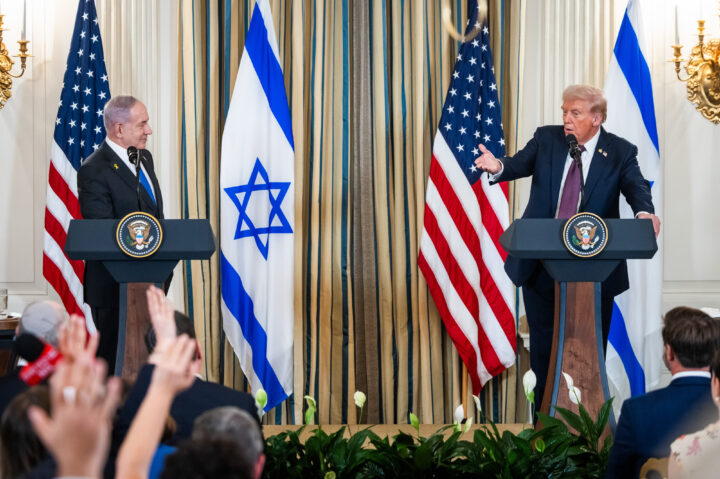
Jim Lo Scalzo/EPA/Bloomberg via Getty Images
President Donald Trump, right, and Benjamin Netanyahu, Israel's prime minister, during a news conference in the State Dining Room of the White House in Washington, DC, US, on Monday, Sept. 29, 2025.
It’s a strange moment when the leader of the free world explains to a reporter why he cursed out the prime minister of a major ally.
But we live in an increasingly strange moment, one in which President Donald Trump confirmed to the New York Post this week that he had indeed called Israeli Prime Minister Benjamin Netanyahu “f***ing crazy” during a discussion about Israel’s plans to expand operations in Lebanon, even as he stressed that he and the Israeli leader have “worked very well together.” (Trump’s confirmation came after Netanyahu’s office denied the remarks.)
The tense nature of the Trump-Netanyahu call this week underscores the increasingly divergent tactics the two are taking to ongoing conflicts in the Middle East as Trump leans into diplomacy while Netanyahu pushes for intensified military action — and as questions loom over the future of U.S. aid to Israel.
With the House’s passage of a war powers resolution yesterday (with four Republicans breaking with House GOP leadership), and a Senate vote on the issue still pending, the Trump administration’s appetite for a resumption of hostilities is even smaller than it was last month (when, as we reported, it was already quite low, owing to rising gas prices and the approaching midterms).
And it’s not just Trump distancing the U.S. from renewed all-out conflict. Speaking before the Senate Foreign Relations Committee on Wednesday, Secretary of State Marco Rubio told lawmakers that the Iran war was “over.”
The comments come even as Iran continues to scale up its attacks in the region, in some cases prompting a U.S. response. Early Wednesday morning, the Islamic Republic launched a drone attack targeting Kuwait’s main airport, killing one person and injuring at least 60.
Trump has reportedly set a red line on Iran, telling aides that he could end the ceasefire — which, while not a technical halting of all fire, has resulted in far fewer exchanges of fire and destruction than at the height of the war in March and early April — if U.S. troops are killed.
Meanwhile, Netanyahu told CNBC on Wednesday that he wants to start the process of winding down U.S. military aid to Israel over the next two years — the final years of Trump’s term — in a way that would shift the relationship, according to the prime minister, “from aid to a partnership where we both invest equal amounts and both share equally in the fruits of our innovators and technologies.” Such a move, Netanyahu added, “will also take away the myth that Israel is depleting America’s coffers” — a popular talking point among opponents of U.S. aid to Israel on Capitol Hill and beyond.
On paper, Washington and Jerusalem do appear in lockstep — alongside Beirut — on deepening relations between Israel and Lebanon and rooting out Hezbollah. To that effect, the White House announced in a joint statement with Lebanese and Israeli officials on Wednesday that the parties had agreed to a renewed ceasefire — though it is contingent on the cooperation of Hezbollah, which did not take part in the talks and continues to launch drones and missiles at northern Israel.
But even as officials in Washington reach an accord on Lebanon, the challenges on the ground remain much the same. It was, after all, the issue of Lebanon — and Netanyahu’s announcement that the IDF would attack Hezbollah strongholds in Beirut — that triggered Trump’s expletive-laden outburst on Monday, causing Netanyahu to walk back Israel’s military plans in Lebanon.
And while Netanyahu needs to stay in Trump’s good graces, it is voters in Israel — including those in the country’s north who are living under daily Hezbollah fire — whom Netanyahu will need to sway ahead of the fall elections.
They said, however, it’s unlikely the rift with Tehran will engender any goodwill towards Israel

Mahmud HAMS / AFP via Getty Images
Motorists drive past a plume of smoke rising from a reported Iranian strike in the industrial district of Doha on March 1, 2026.
Iranian attacks on Qatar could prompt Doha to reassess its regional alignment and relationship with Tehran, experts said, though they expressed skepticism that the strikes would change Qatar’s antagonistic posture toward Israel, its funding of anti-Israel media or its harboring of Muslim Brotherhood-aligned groups.
Prior to the Iran war, Doha and Tehran maintained close and pragmatic diplomatic relations centered on economic cooperation. In the leadup to hostilities, Qatar aimed to balance its ties with Iran and the U.S., however the conflict has brought to light the difficulty of this balancing act.
Qatar has suffered severe damage to its civilian, energy and military infrastructure from Iranian strikes, launched as Tehran has targeted American allies in the region amid the war with the U.S. and Israel, including over $20 billion in lost revenue caused by a strike on Qatar’s liquified natural gas facility.
“Iran’s strikes have created real fissures,” said Natalie Ecanow, a senior research analyst at the Foundation for Defense of Democracies. “For example, Qatar expelled Iran’s military and security attachés and cracked down on IRGC cells within its borders. Notably, Qatar’s prime minister called Iran’s strikes ‘a big sense of betrayal,’ which is language typically reserved for friends or partners, not foes. That tells you something about Qatar’s mindset before the war.”
Kristan Diwan, a senior resident scholar at the Arab Gulf States Institute, told Jewish Insider that the rift will likely push Doha closer to other countries in the region with aligned interests.
“I think we will see Qatar working even more closely in concert with the new ‘Sunni’ regional coalition led by Saudi Arabia with Turkey, Pakistan and perhaps Egypt and other Arab players,” Diwan said. “While not identical, their interests align,” Diwan added, on Syria, Lebanon and the Palestinian territories. “Working together will increase their impact while lessening the burden on any one state.”
But Diwan said that while Doha may distance itself from Tehran, it should not be mistaken for a more favorable posture toward Israel. She said the emerging coalition “shares a belief that the current Israeli government represents a threat to regional stability.”
“Unlike the UAE, these countries are likely to take up positions confronting both Iran and Israel,” Diwan continued. “This will allow for a more accommodating posture on Muslim Brotherhood-aligned groups and perhaps even a recalibration of hostilities toward other radical movements such as the Houthis and Hezbollah.”
Other experts warned that Qatar’s significant financial losses during the war are unlikely to alter Doha’s ideological posture toward Israel or its funding of anti-Israel antagonism.
“Frankly it’s hard to imagine Qatar ever becoming less ideological or antagonistic toward Israel,” Jonathan Ruhe, a fellow at the Jewish Institute for National Security of America, told JI. “Despite the Iran war’s economic toll, Doha still can afford to propagate anti-Israel, anti-Western extremism through Al Jazeera, the Muslim Brotherhood and other actors. And it still has every incentive to support Islamist groups and media to buttress its own credibility in the Arab and Muslim worlds.”
Additionally, Ruhe said there is little external pressure forcing Qatar to change course, pointing to the Trump administration’s favorable posture toward Doha.
“The war has not altered the Trump administration’s reliably favorable attitude toward Qatar,” Ruhe said. “Qatar’s relationship with Tehran is now severely damaged, but it can compensate through stronger ties with Turkey and Saudi Arabia, both of whom have been propagating anti-Israel rhetoric, and possibly Pakistan, too.”
But Ecanow said the prospect of a full break between Qatar and Iran remains complicated by geography and shared economic interests. Qatar’s wealth is tied to the world’s largest natural gas reservoir, which it shares with Iran.
“Qatar’s wealth flows from sitting on the world’s largest natural gas reservoir — one it shares with Iran. That ostensibly gives Doha an economic interest in the regime’s survival because a regime that’s down but not out poses little competition for Qatar’s liquefied natural gas exports. Regime change may not be an immediate U.S. objective, but this dynamic inherently puts Qatar’s interests at odds with those of the United States,” Ecanow said.
Carlson claimed Vance is ‘in a tough spot’ as the Iran war is counter to his worldview

Chip Somodevilla/Getty Images
(L-R) Tucker Carlson, Rep. Byron Donalds (R-FL), former President Donald Trump, and Sen. JD Vance (R-OH) appear on the first day of the Republican National Convention at the Fiserv Forum on July 15, 2024 in Milwaukee, Wisconsin.
In a wide-ranging New York Times interview published on Saturday, far-right podcaster Tucker Carlson offered an unusually personal defense of Vice President JD Vance, describing him as a close friend while suggesting he is being undermined by hawkish forces inside the White House amid tensions over the administration’s military actions in Iran.
Carlson, who played a key role in encouraging President Donald Trump to select Vance as his 2024 running mate, said he remains a close supporter of the vice president on a personal level.
“I couldn’t be a bigger fan of him as a man,” Carlson told New York Times podcast host Lulu Garcia-Navarro. He added that Vance is “in a tough spot” because his long-held foreign policy views clash with the administration’s decision to attack Iran in February.
Carlson went on: “I know him well and think so much of him as a person. And it is my guess that, based on his past behavior, that he’s doing everything he can to mitigate what he sees as the ill effects of [the Iran war]. But it’s kind of hard to call the shots when you’re vice president, because that’s not in the Constitution.”
Pressed by Garcia-Navarro when he last spoke to the vice president, Carlson declined to answer. “I don’t know. I mean, I would never characterize that,” he said. “I don’t want to cause him more problems. I would just say I’m not advising. No one’s seeking my counsel. I’m not trying to influence anything. I gave it my best shot. Didn’t work.”
Carlson also took a swipe at Secretary of State Marco Rubio, baselessly alleging that backers of Washington’s top diplomat have been engaging in “nonstop treachery” against Vance. “There are people in the White House who want to hurt JD Vance and have wanted that since the very first day. They were bitter. They wanted Marco Rubio to be the choice as vice president,” Carlson said.
The comments come as Carlson — once a key Trump ally — has publicly broken with the president over Iran policy, describing Trump as being possessed by demonic forces.
Trump, for his part, gave an interview to the New York Post last month calling Carlson a fool and irrelevant to his decision-making. “Tucker’s a low IQ person that has absolutely no idea what’s going on,” the president told the Post. “He calls me all the time; I don’t respond to his calls. I don’t deal with him. I like dealing with smart people, not fools.”
Former Democratic Rep. Kathy Manning: ‘There is no doubt that we are living through very difficult times for American Jews’
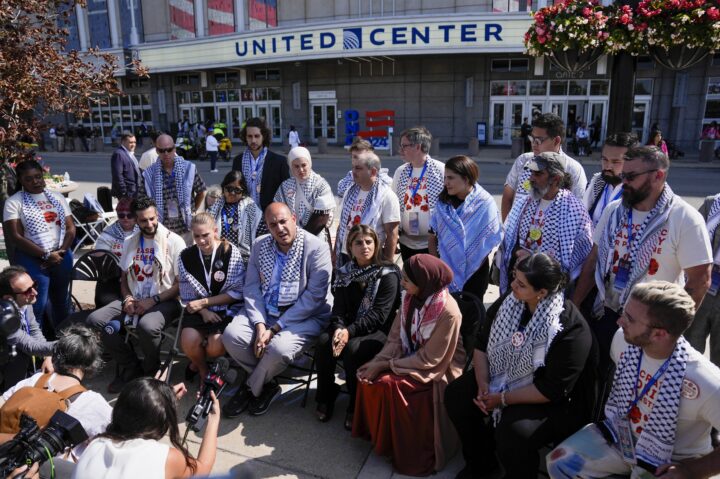
Matt Rourke/(AP
Uncommitted delegates hold a press conference outside the United Center before the Democratic National Convention Thursday, Aug. 22, 2024, in Chicago.
The debate over Israel within the Democratic Party has long been a particularly acute source of tension, in the wake of a protracted war in Gaza that deepened internal divisions over America’s increasingly contested relationship with one of its closest allies.
Recently, however, many Jewish and pro-Israel Democrats say they have observed a distinct and troubling new shift in that debate, as the range of politically acceptable opinions on Israel has strayed far outside the mainstream, with little pushback from party leaders.
Amid growing claims of Israel committing genocide as settled fact, openly pro-Hamas demonstrations, ongoing efforts to demonize pro-Israel engagement in Democratic primaries and rejections of Israel’s right to exist as a Jewish state, the political atmosphere is raising questions about whether the party is willing to collectively draw red lines around creeping extremism or if it is now accommodating anti-Israel sentiment that until not long ago had been more commonly viewed as off-limits.
While hostility toward Israel has been building for some time over its military assault in Gaza sparked by Hamas’ Oct. 7, 2023, attacks, Jewish Democrats warn that the party’s acquiescence to its anti-Israel wing risks alienating a core constituency that could have negative consequences in the midterms as well as the upcoming 2028 presidential election.
Their worries have dovetailed with a sharp rise in anti-Israel and antisemitic invective from the right that some Jewish Democrats contend is inseparable from a deeper antipathy that transcends traditional party lines.
“For those of us who care about a strong U.S-Israel relationship, there is reason to be concerned,” said Howard Wolfson, a longtime advisor to former New York City Mayor Michael Bloomberg. “The challenge is profound.”
Even as he said that challenge also extends to the right, Wolfson voiced apprehension that in his own party, “there are Democrats thinking of running for president who have said that they won’t take money from pro-Israel” political donors “and have thrown around the word genocide” while describing Israel’s conduct in Gaza. The Jewish community “has a real problem,” he lamented to Jewish Insider in a recent interview. “It is a subject of considerable angst and debate.”
Sara Forman, the former executive director of the New York Solidarity Network, an advocacy group that backs pro-Israel Democrats for state and local office, said, “The willingness to accommodate absurd assertions about Israel is a cancer that is spreading unchecked” within “the left ranks of the Democratic coalition” in addition to “factions of the Republican right wing,” a dynamic she and others attributed, in part, to the polarizing influence of online algorithms that frequently reward incendiary content.
“Right now,” she added, “I hate to say we are in an extremely frustrating situation where the identity of the Democratic Party is being redefined, and where a majority of center-left traditional liberal Jews are left somewhere in the wilderness.”
“To me,” she concluded, “it’s depressing.”
“It is very troubling for American Jews that we are even having to have this conversation,” Jon Reinish, a Democratic strategist often involved in Jewish and pro-Israel causes, told JI. “Putting aside what one thinks” about Israel, he added, “to see it become a flashpoint in politics feels pretty shitty, to be sure.”
The Jewish state, he told JI last week, “is something that transcends language in a political primary and goes back to something deep within us emotionally, in terms of our family and how we think of our own history.”
“In the last presidential election we saw Jews, especially in the suburbs, swing more toward the Republican candidate than they had since” Ronald Reagan in 1980, Reinish noted. “If I’m Democratic leadership, I would be looking very closely at that.”
Over just the past few weeks, the scope of tolerable views on Israel has slid into markedly antagonistic territory, according to interviews with more than a dozen Jewish and pro-Isrsel Democrats who voiced a growing sense of alarm over the party’s direction.
Earlier this month, for instance, Rep. Alexandria Ocasio-Cortez (D-NY) used her first appearance at the Munich Security Conference to not only repeat calls for conditioning U.S. aid to Israel but also to suggest that such support had enabled a genocide in Gaza. Though her comments were not new, that she had made them on one of the world’s most high-profile foreign policy stages underscored how her positions are continuing to gain greater currency in the party.
Some observers were also unnerved by Ocasio-Cortez’s decision to level an accusation toward Israel of genocide while in Germany, seen as insensitive to the history of the Holocaust.
Jewish Democrats say they have been unsettled by the growing ease with which anti-Israel critics have invoked charged claims of genocide without understanding its meaning or historical significance. “The genocide conversation,” according to Steve Fulop, the former mayor of Jersey City who now leads the Partnership for New York City, an influential business advocacy group, “has unfortunately monopolized the left and has become more commonplace and accepted.”
Fulop, a grandson of Holocaust survivors, said the issue was not a major focus of conversation when he ran an unsuccessful primary campaign for governor of New Jersey last year. “In the last six months,” he told JI last week, “it has become more prevalent and more of a talking point.”
This month, the subject emerged in a special election for a House seat in a wealthy northern New Jersey suburb, where a far-left candidate, Analilia Mejia, clinched the Democratic nomination — beating a former congressman, Tom Malinowski, who had faced outside spending from AIPAC due to his support for conditioning aid to Israel.
While AIPAC drew widespread backlash for its role seen as unwittingly helping to elevate a harsher critic of Israel to the House in Mejia, many pro-Israel Democratic elected officials in the state have since coalesced behind the nominee, suggesting her staunchly anti-Israel views are little impediment to winning the party’s broad support. In addition to accusing Israel of genocide, the only candidate in the primary to do so, Mejia, a progressive activist, denounced Israel after the Oct. 7, 2023, attacks without mentioning Hamas and expressed “incredible discomfort” with Israel’s existence as a Jewish state.
Even as Malinowski, for his part, disagreed with Mejia’s anti-Zionist sentiments, he echoed other Democrats who chose to endorse Mejia in the April special general election because, he wrote last week, he “strongly” believes that the “seat must remain in Democratic hands.”
Speaking broadly about anti-Israel currents now shaping the party, one Jewish Democratic member of the House said they have been unnerved by what they called an “obsession” with Israel among many far-left activists and candidates that reflects “litmus tests” not evenly applied to other key foreign policy issues.
“The line of what’s acceptable has shifted massively, especially since Oct. 7,” the House member, granted anonymity to speak candidly about the party, told JI last week.
“What I’m watching right now, in 2026, is a breakdown in respectful language toward the Jewish community,” Joel Rubin, a progressive strategist and former State Department official, explained in an interview with JI last week. “It is very troubling and implies hostility that is undeserved — considering nobody should be treated to that kind of language. But it is also really dangerous for the Democratic Party and our electoral prospects to have this internal hostility and disunity.”
In New York City, which elected a fierce critic of Israel as mayor last November, Jewish Democrats say that line has moved in a particularly troubling direction. More recently, for example, Brad Lander, a former city comptroller now challenging Rep. Dan Goldman (D-NY) in a heavily Jewish House district, drew scrutiny for hiring a campaign consultant who had boosted antisemitic conspiracy theories using a pseudonymous X account that also celebrated Iran and Hamas, among other controversial social media posts.
Even as Lander fired the consultant, Kaif Gilani, after his online activity was uncovered by JI earlier this month, the episode still fueled questions about whether he was adequately vetted, given that the consultant had established a profile as a well-known promoter of New York City Mayor Zohran Mamdani during the recent election. It also underscored just how common such extremism has now become in New York City — where protesters have in recent months openly chanted their support for Hamas outside synagogues.
Meanwhile, leading progressive lawmakers such as Ocasio-Cortez and Rep. Ro Khanna (D-CA), both of whom are seen as potential presidential contenders, have avoided publicly distancing themselves from a popular far-left streamer, Hasan Piker, who recently sided with Hamas while sharing his views on one of those protests, near a synagogue in Queens hosting an event promoting Israeli real estate investment.
Joel Rubin, a progressive strategist and former State Department official now at work on a book about Democratic foreign policy, said he interprets such rhetoric as part of a broader “political tactic by some folks in the base to try to silence Jewish voices and to intimidate them into not advocating on these issues.”
“What I’m watching right now, in 2026, is a breakdown in respectful language toward the Jewish community,” he explained in an interview with JI last week. “It is very troubling and implies hostility that is undeserved — considering nobody should be treated to that kind of language. But it is also really dangerous for the Democratic Party and our electoral prospects to have this internal hostility and disunity.”
“There has always been this struggle within the Democratic Party of the argument, on every issue, of what is acceptable and what is not,” Sam Lauter, a political consultant and pro-Israel activist in the Bay Area, told JI. “With regard to Israel, that argument is not new, but what is new is how much it’s increased and what has become acceptable and what has been just dismissed.”
The increasingly charged tenor of conversation around Israel “is not the way Democrats should be thinking about communicating to voters if we want to win elections outside of deep blue areas,” Rubin suggested. “My biggest fear is that people are afraid to stand up and speak out.”
Kenneth Baer, a former Obama administration official who now directs a communications firm, sounded a similar note of caution. “Democrats are running to outdo each other to criticize Israel to curry favor with the massively online left and the interest groups that constitute the party,” he told JI recently. “The political dynamics of 2026 may mean this doesn’t matter in November, but in 2028 and beyond, running to the extremes is not a political winner.”
“There has always been this struggle within the Democratic Party of the argument, on every issue, of what is acceptable and what is not,” Sam Lauter, a political consultant and pro-Israel activist in the Bay Area, told JI. “With regard to Israel, that argument is not new, but what is new is how much it’s increased and what has become acceptable and what has been just dismissed.”
Still, he argued, pro-Israel Democrats have also “missed out” on the opportunity to forcefully defend their positions. “It has been very clear for years that people who disagree with us have been organizing at a grassroots level while building up support and making their viewpoint a part of the party mainstream,” he said. “And our community stopped engaging at that level years ago, which is why many of us have been screaming that this is a huge problem.”
Former Rep. Steve Israel (D-NY), who previously helmed the Democratic Congressional Campaign Committee, attributed the changing landscape in large part to what he views as a demographic shift driven by younger voters “generations away from romantic images of Israel” that are now “replaced by algorithm-fueled social media portraying Israel dropping bombs on schools and hospitals in Gaza.”
“In politics, perception is reality, and the reality for younger people is that Israel is wrong,” he told JI.
But he said it would be a miscalculation to disengage from that conversation. “Pro-Israel activists who don’t understand the need to push back proceed at their own peril,” he said. “You can’t surrender the narrative, which means supporters of Israel on both sides of the aisle need to find a much more effective narrative, particularly toward young voters.”
Many pro-Israel activists are at a loss, however, for how to recapture the debate, as Middle East policy now appears likely to be a focus of the next presidential election.
“It’s easy to observe a problem and then not have specific ideas on the solution,” Israel told JI. “That is a fundamental question now.”
“I don’t have a great answer, to be honest with you,” said Wolfson, the Bloomberg advisor. “I find it is far easier to identify the breadth of the problem than to identify a solution.”
According to Lauter, “the Overton Window has shifted” for Democrats, “and what needs to also shift is our community’s understanding of how to deal with it and approach it.”
“Let’s see how the midterms go and which candidates jump in,” said Aaron Keyak, the deputy special envoy to monitor and combat antisemitism in the Biden administration who now serves on the board of Combat Antisemitism Movement. “But in the lead-up to 2028,” he told JI, “the Middle East policy discussion will certainly be more prominent.”
“Regardless of what we think or say today, the particular policy conversation leading up to 2028 is going to be driven by the candidates, so until we can fill out the answer to the ‘what’ and ‘why’ questions, we need to be able to answer the ‘who’ one,” Keyak added.
In the meantime, said former Rep. Kathy Manning (D-NC), who is now the board chair of Democratic Majority for Israel, the party still boasts a number of pro-Israel elected officials as well as candidates, including some her group recently announced it is endorsing in a range of contested House primaries.
“There is no doubt that we are living through very difficult times for American Jews,” she told JI in a recent interview, pointing to what she described as “unprecedented condemnation” of the U.S. alliance with Israel from both sides of the aisle. “What gives me hope,” she said, “is I know from my experience campaigning in a purple state in a competitive seat that the vast majority of Democrats still believe that Israel has the right to exist as a Jewish state and has the right to defend itself and its people.”
“We don’t have to love Israel,” but voters should understand the strategic benefits of working with a key Middle East ally, Hank Sheinkopf, a veteran Democratic strategist in New York City, said. “It ain’t about Jews,” he told JI. “It’s about the future of the United States of America.”
As the midterms near, Manning maintained that nominating pro-Israel Democrats will be a crucial step toward reclaiming the House. “The seats that are going to make the difference to taking back the majority are seats where candidates have to appeal not just to Democrats but also to independents and Republicans,” she said. “I think that it’s important for us to understand where voters are, regardless of what the loudest voices online or on the stage might be saying.”
Hank Sheinkopf, a veteran Democratic strategist in New York City, agreed with that sentiment, arguing that pro-Israel party members should be seeking to push the debate “back to the middle” and pressing a “straightforward geopolitical argument” to highlight the advantages of the U.S.-Israel relationship rather than relying on expenditures that have proven to be divisive in primaries.
“We don’t have to love Israel,” but voters should understand the strategic benefits of working with a key Middle East ally, Sheinkopf said. “It ain’t about Jews,” he told JI. “It’s about the future of the United States of America.”
Despite announcing sweeping security, investment and defense agreements, the fate of a Saudi-Israel normalization deal remains uncertain
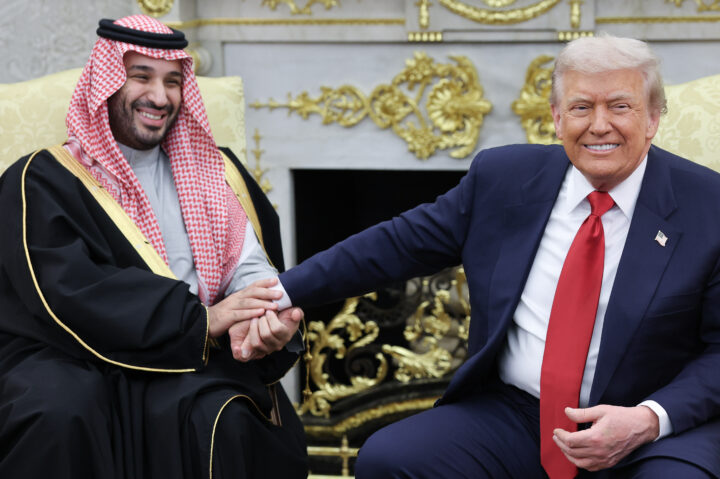
Win McNamee/Getty Images
President Donald Trump (R) meets with Crown Prince and Prime Minister Mohammed bin Salman of Saudi Arabia during a bilateral meeting in the Oval Office of the White House on November 18, 2025.
During Tuesday’s meeting between President Donald Trump and Saudi Crown Prince Mohammed bin Salman, the leaders strengthened their relationship and confirmed the completion of several deals. Any plan to utilize such transactions as part of normalization with Israel, however, was notably absent.
While taking questions from reporters in the Oval Office, Trump confirmed that the U.S. would sell Saudi Arabia F-35 fighter jets of similar caliber to Israel’s. At a dinner that evening, the president added that a strategic security agreement had crossed the finish line, while also formally naming Saudi Arabia a major non-NATO ally. On Wednesday, the two countries announced a strategic artificial intelligence partnership.
“The main takeaway of the visit was the normalization of the U.S.-Saudi relationship,” said Aaron David Miller, a senior fellow at the Carnegie Endowment for International Peace and former State Department negotiator. “[There was] very little, it seemed to me, not surprisingly, on the side of normalization to Israel. It’s almost as if Israel was sort of an afterthought this visit.”
When asked by reporters why normalization with Israel was not prioritized, Trump did not provide much of a response, instead asserting that Israel is “going to be happy.”
Observers had anticipated that Trump would roll out the red carpet for MBS on his visit to Washington. What remained unknown was whether the deepening ties between Washington and Riyadh would come with progress between Saudi Arabia and Israel, the United States’ closest ally in the region.
But the deals announced this week were made without any apparent requirement of progress toward normalization, leading some experts and leaders of pro-Israel groups to raise questions about the Trump administration’s strategy.
“By the way this was done, President Trump seems to have elevated the partnerships with Saudi Arabia and maybe, to some degree, with other Gulf states, above pretty much all other U.S. partnerships, including Israel,” said Dan Shapiro, a former U.S. ambassador to Israel under former President Barack Obama.
“So that means that other considerations, like ensuring the right incentives are still in place for Saudi Arabia to normalize relations with Israel or ensuring that military sales are done in a way that protects U.S. interests and Israel’s security interests, may be less important than they have been under previous administrations.”
Shapiro said that while it is reasonable for the U.S. to strengthen its partnerships with Gulf countries, the deals gave away major incentives for normalization “without knowing whether it can be achieved later.” He also added that it came without guarantees from the Saudi government on limiting military cooperation with China and Russia.
Anne Dreazen, the vice president for the American Jewish Committee’s Center for a New Middle East, told JI that Saudi-Israeli normalization could not have been achieved on this visit, adding that it was “not in the cards right now.”
“Now the paradigm is shifting where it’s about peace between Israel and Saudi Arabia being logical and good based on its own merits, when they can get the politics right and when they can reach agreement on the Palestinian issue,” said Anne Dreazen, the vice president for the American Jewish Committee’s Center for a New Middle East.
“Right now we’re not there. The politics in Israel and Saudi Arabia are not right for this,” said Dreazen. “I think President Trump realized that it wasn’t going to happen in this visit and wanted to move ahead with these deals because there’s a strong perception that making some deals with Saudi Arabia is in America’s interest.”
Dreazen, however, still believes normalization is “going to happen,” adding that she has confidence from conversations with Saudi officials that political differences will be resolved in the future.
Trump’s decision to make significant deals with Saudi Arabia while not pressing for normalization suggests the White House is taking a different approach than in the past, Dreazen argued.
“Now the paradigm is shifting where it’s about peace between Israel and Saudi Arabia being logical and good based on its own merits, when they can get the politics right and when they can reach agreement on the Palestinian issue,” said Dreazen, a shift from how former President Joe Biden approached negotiations.
But with MBS leaving Washington with so many deliverables, it’s unclear whether he will still prioritize normalization.
The Israelis are “going to be right to worry that the Saudis may feel like they’ve gotten everything they want and don’t have any need left for normalization,” Shapiro said.
Following his Oval Office meeting with Trump, the Saudi crown prince told reporters, “We want to be part of the Abraham Accords, but we want also to be sure that [we] secure a clear path [toward a] two-state solution.”
Leaders of pro-Israel groups said normalization between Israel and Saudi Arabia should remain a top policy priority for the U.S.
“The United States would be stronger and more secure if our major non-NATO allies worked together to promote regional peace, stability and prosperity,” said AIPAC spokesman Marshall Wittmann. “This objective would be advanced if Saudi Arabia joined the Abraham Accords, and U.S. leaders should urge it to do so.”
In a statement released on Wednesday, Democratic Majority for Israel’s president and CEO, Brian Romick, said that expanding the Abraham Accords must be “central to U.S. policy,” and urged Congress to play an active role in reviewing U.S. defense agreements with Saudi Arabia.
“Any substantial upgrade in the U.S.–Saudi relationship — including access to advanced U.S. defense systems — must be tied to meaningful, measurable progress toward Saudi-Israeli normalization,” Romick said in a statement. “It is now incumbent on the Trump Administration to use our leverage with Saudi Arabia to make real progress toward normalization.”
“There’s clearly a political dynamic going on here,” said Israel Policy Forum chief policy officer Michael Koplow. “Trump went out of his way to almost poke at the Israelis. He implied that [the U.S. is] OK with the Saudis getting F-35s but [the Israelis] want the Saudis to get a less advanced version, and he almost seemed to boast about the fact that he’s going to give the Saudis whatever he wants no matter what Israel says.”
Trump’s promise of F-35 sales to Saudi Arabia has raised questions about which model and allowances Riyadh will receive and whether Israel will maintain its qualitative military edge, which the U.S. is bound by law to uphold. To date, Israel is the only country in the Middle East to have obtained the fighter jet.
U.S. officials and experts told Reuters that the F-35 jets the U.S. plans to sell to Saudi Arabia will lack superior features that Israel’s fleet has.
Israel Policy Forum chief policy officer Michael Koplow voiced concerns about the security aspect of the deals.
“It doesn’t surprise me that all of these things are going ahead,” said Koplow. “What surprises me more is that some of the things that have been discussed over the past couple of days seem to put Israel in a more difficult security position, particularly this question of sales of F-35s.”
Israel’s government, meanwhile, has stayed largely quiet about the F-35 sales, though the Israeli Air Force has objected to the deal, warning that it could damage Israel’s air superiority in the region
“There’s clearly a political dynamic going on here,” said Koplow. “Trump went out of his way to almost poke at the Israelis. He implied that [the U.S. is] OK with the Saudis getting F-35s but [the Israelis] want the Saudis to get a less advanced version, and he almost seemed to boast about the fact that he’s going to give the Saudis whatever he wants no matter what Israel says.”
Please log in if you already have a subscription, or subscribe to access the latest updates.
 Continue with Google

 Continue with Apple